 09/05/2024
Every business has an operating model. The question is whether it was designed or inherited.
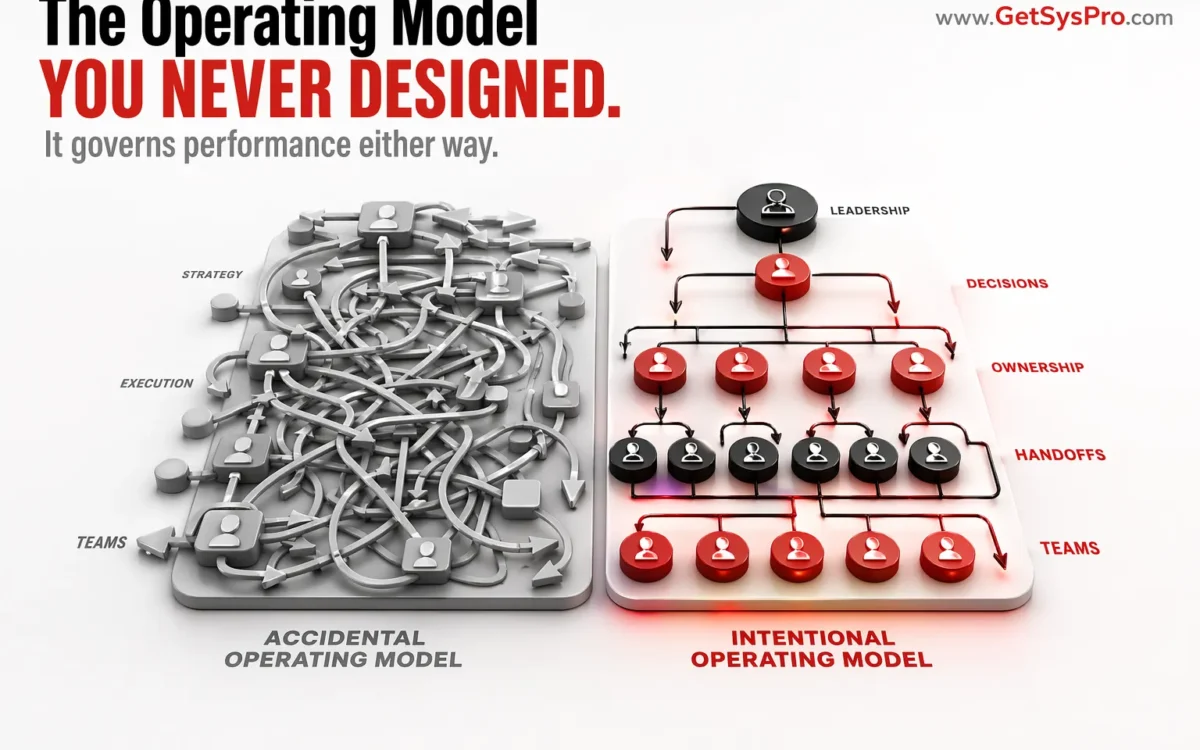
Most companies do not fail because they lack effort. They stall because the invisible architecture behind work was never defined, and growth eventually exposes it. Founders rarely sit down and formally decide how work should move through the organization. A client signs and a workflow forms. Another client signs and the workflow gets patched. A hire joins and responsibilities shift. Decisions cluster around whoever is most reliable. Communication habits harden. What started as improvisation becomes default structure, and that default becomes the operating model governing performance whether anyone designed it or not.
The operating model you never designed is still running your business. This article explains what an accidental operating model costs, how to recognize when it limits scale, and what intentional design looks like.
In This Article
- The Operating Model as Hidden Architecture
- Accidental Operating Models Create Predictable Friction
- Escalation Culture Is a Design Flaw
- Fragmented Reporting Makes Alignment Conversational
- What Intentional Operating Model Design Answers
- Tools Should Follow Design, Not Lead It
- How GetSysPro Addresses Operating Model Gaps
- Frequently Asked Questions
Key Takeaways
- Every business has an operating model. Most are accidental: assembled through improvisation rather than designed intentionally, and maintained by habit rather than by choice.
- An accidental operating model can appear to work for a long time. It works until volume exposes its structural weaknesses, and the breakdown looks like a people problem when it is actually a design problem.
- Escalation culture is a design flaw. When teams cannot determine what they are authorized to decide, they escalate upward by default, compressing leadership bandwidth and slowing execution.
- Fragmented reporting prevents cohesive organizational movement. When sales, operations, and finance track performance differently, alignment requires conversation instead of shared visibility.
- Intentional operating model design answers six structural questions explicitly. When those questions remain implicit, improvisation governs execution indefinitely.
The Operating Model as Hidden Architecture
The operating model is the hidden architecture that governs organizational outcomes. It determines how quickly decisions get made, how consistently services are delivered, and how clearly accountability gets assigned. When growth accelerates, the strength of that architecture becomes visible because volume magnifies every structural weakness that was previously small enough to work around.
Most leaders think about operating model in terms of org charts and job descriptions. Those are outputs of operating model design, not the model itself. The actual operating model is the pattern of decisions, handoffs, escalations, and accountability assignments that govern how work moves from input to output across the organization every day. That pattern exists whether it was designed or not, and its quality determines organizational capacity far more than the quality of the individuals operating within it.
Why Accidental Operating Models Feel Normal
Accidental operating models feel normal because they develop gradually. Each patch made sense at the time. Workarounds addressed real problems. Informal processes emerged from genuine needs. The accumulation of those individually reasonable responses produces a system that is collectively irrational: full of redundancies, gaps, bottlenecks, and ambiguities that nobody designed and nobody owns. Recognizing an accidental operating model requires stepping back from daily operations to examine structure from outside, which is precisely the perspective internal teams rarely develop.
“The operating model you never designed is still governing performance. It has been governing performance since the first client signed and the first workflow formed. The question is not whether you have an operating model. The question is whether the one you have was built to scale.”
Editorial, GetSysPro Team
Accidental Operating Models Create Predictable Friction
An inherited operating model produces a consistent set of structural leaks regardless of the industry or size of the business. Decision bottlenecks concentrate at the top because authority was never distributed deliberately. Overlapping responsibilities across teams produce duplicate work and unclear ownership. Informal approval pathways vary depending on who makes the request rather than on the nature of the request. Reporting inconsistencies across sales, operations, and finance produce conflicting views of the same organizational reality. Manual trackers layer over outdated workflows because nobody ever stopped to redesign the underlying process.
The Compounding Cost of Structural Friction
None of those leaks are catastrophic in isolation. Together they create friction, and friction is expensive in specific ways that compound over time. Friction consumes time: every handoff requiring clarification, every decision requiring escalation, and every reconciliation of conflicting data represents time that could have produced output instead of overhead. Margin erodes because the labor cost of managing workarounds, exceptions, and redundant processes accumulates across hundreds of daily interactions into a significant invisible cost. Leadership bandwidth compresses as leaders drawn into decisions they should not need to make have less capacity for the strategic work that determines organizational trajectory.
Escalation Culture Is a Design Flaw
Escalation culture is one of the most visible symptoms of an accidental operating model. When teams do not know what they are authorized to decide, they escalate upward as a default rather than a last resort. Leaders become the clearinghouse for issues that should resolve at lower levels. Execution slows. High performers disengage because their autonomy is effectively constrained by an authority structure that was never explicitly defined.
The misdiagnosis of escalation culture is almost universal. Organizations attribute it to employee confidence, individual risk tolerance, or leadership style. Those factors exist and matter. They are secondary to the structural cause: when authority boundaries are undefined, escalation is the rational response to ambiguity. Asking “who decides this?” is not a failure of confidence. It is a reasonable question whose answer the operating model should provide automatically but does not.
What Distributed Decision Rights Actually Produce
Defined decision rights at each organizational level eliminate the ambiguity that drives escalation. When team members know precisely what they can decide without approval, what requires notification, and what requires escalation, they act within their authority rather than defaulting upward on every judgment call. Reforge’s research on operating cadence and accountability structures identifies clear decision rights as a foundational element of high-performing operating models, noting that organizations with explicit authority boundaries consistently demonstrate faster execution than those where authority must be negotiated situationally.
Fragmented Reporting Makes Alignment Conversational
Reporting fragmentation is the operating model problem that most directly prevents organizations from moving cohesively. When sales tracks pipeline and closed revenue, operations tracks delivery capacity and quality metrics, and finance tracks margin and cash position using different definitions, timeframes, and data sources, the three functions produce three different accounts of organizational reality that do not reconcile automatically.
Alignment in that environment requires conversation rather than shared visibility. Leadership meetings become debates about which numbers are correct rather than decisions about what actions the numbers require. The organization cannot make cohesive decisions because it cannot develop a shared factual basis for those decisions. Every strategic question becomes entangled in a data reconciliation problem that consumes the meeting time available for actual decision-making.
Unified Reporting as an Operating Model Investment
Unified reporting definitions, standardized performance metrics, and shared dashboards convert alignment from a conversational achievement into a structural one. When every function tracks the same definitions on the same cadence, leadership can identify where performance is ahead of plan, where it is behind, and what operational factor drives the variance without first spending meeting time reconciling conflicting reports. That shift from conversational alignment to structural alignment is one of the highest-leverage operating model improvements available to growing organizations because it multiplies the productivity of every leadership interaction where data informs decisions.
Does your organization feel busier but not stronger?
GetSysPro audits the operating model gaps limiting your scale and builds the structural clarity that converts effort into momentum.
What Intentional Operating Model Design Answers
Designing an operating model is not an academic exercise. It is the practical work of answering six structural questions that remove the ambiguity from which every accidental operating model draws its dysfunction. When these questions have explicit answers, execution becomes predictable. When they remain implicit, improvisation governs execution indefinitely regardless of how capable or committed the people doing the work are.
The six questions are: How does work enter the organization? Who owns each stage from intake to delivery to renewal? What triggers handoffs, and what does completion look like at each stage? How is performance measured, and who reviews it on what cadence? Where does oversight occur, and where is autonomy expected? What decisions can be made at each organizational level without escalation? McKinsey’s work on operating model redesign consistently identifies these six dimensions as the foundational architecture of high-performing organizations.
From Implicit to Explicit: The Design Work
Answering those questions requires mapping the organization’s actual operating reality rather than its intended one. The actual pattern of how work moves, how decisions get made, and how accountability gets assigned often differs significantly from the official description of those things. Closing the gap between the intended operating model and the actual one is the design work that converts an accidental operating model into an intentional one. That conversion does not require organizational transformation. It requires honest documentation of current reality followed by deliberate redesign of the specific elements that generate the most friction.
Tools Should Follow Design, Not Lead It
Technology adoption decisions in growing organizations frequently precede operating model clarity rather than following it. A project management platform gets adopted to address coordination problems. CRM deployment follows to improve pipeline visibility. Financial reporting tools get implemented to reduce reconciliation time. Each selection is defensible. Each deployment into an undesigned operating model amplifies the inconsistency it was intended to reduce.
The Correct Sequence for Technology in a Growing Organization
Software cannot fix ambiguity. If the workflow governing a handoff is unclear, the platform managing that handoff will manage it inconsistently and generate data that reflects the inconsistency rather than resolving it. The correct sequence is operating model clarity first, then tool selection. Define how work moves through the organization, who owns each stage, what triggers handoffs, and what completion looks like. Then select technology that reinforces that defined structure. Organizations that follow this sequence find that their technology investments produce the efficiency gains promised. Those that reverse it discover that each platform adds overhead rather than removing it.
How GetSysPro Addresses Operating Model Gaps
If the organization feels busier but not stronger, the issue is likely operating model architecture rather than effort or capability. A structured diagnostic identifies where operating model design is misaligned with current scale, and targets the specific structural gaps generating the most friction.
Our GetSysPro Services for Operating Model Design
GetSysPro Business Operational Systems Audit provides the structured diagnostic that maps the actual operating model against the intended one, identifying workflow gaps, decision rights ambiguity, reporting inconsistencies, and accountability distribution failures that collectively constrain organizational capacity and limit scale.
GetSysPro Process and SOP Architecture converts the diagnostic findings into documented workflows and defined standards that replace the improvisation of an accidental operating model with the predictability of an intentional one.
Related GetSysPro Services
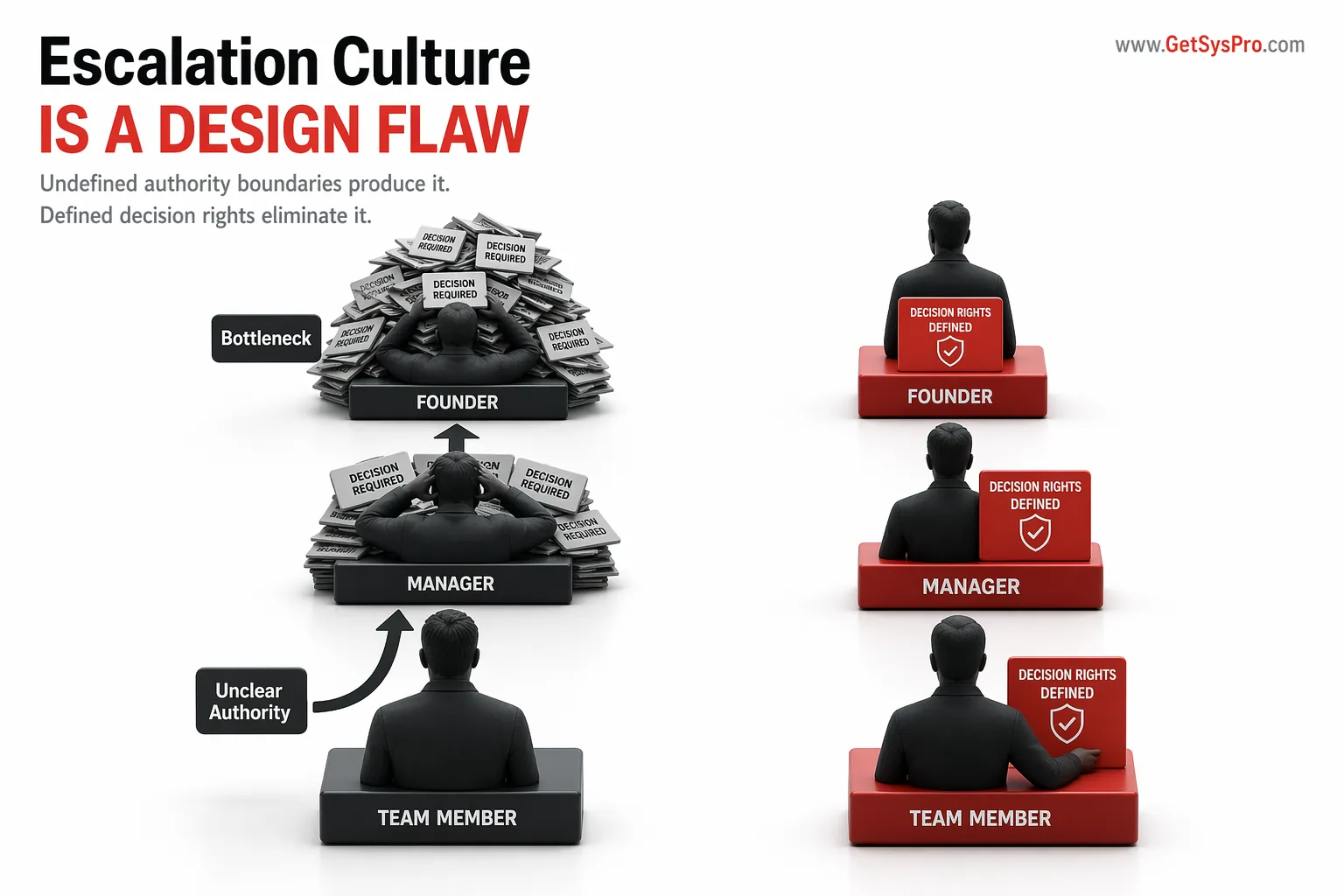
Escalation culture is not a personality problem. It is a design problem. Undefined authority boundaries produce it. Defined decision rights eliminate it. www.GetSysPro.com
Article Summary
Every business has an operating model. Most are accidental, assembled through improvisation and maintained by habit. An accidental operating model produces predictable structural leaks: decision bottlenecks, overlapping responsibilities, informal approval pathways, fragmented reporting, and manual workarounds. Escalation culture is a design flaw, not a personality flaw, caused by undefined authority boundaries. Reporting fragmentation makes alignment conversational rather than structural. Intentional operating model design answers six structural questions explicitly. Technology should follow operating model clarity, not precede it. GetSysPro audits the gaps and builds the documented workflows that replace improvisation with predictability.
Intentional Design Creates Leverage. Accidental Design Creates Friction.
GetSysPro audits your operating model gaps and builds the structural clarity that converts organizational effort into scalable performance.
Frequently Asked Questions
What is an accidental operating model and how does it form?
An accidental operating model forms through accumulated improvisation. Each workflow patch and workaround made sense at the time. The accumulation produces a system full of redundancies, gaps, and ambiguities that nobody designed and nobody owns, because organizations consistently prioritize doing work over designing how work gets done.
How do you identify whether your operating model is limiting scale?
The most reliable signals are behavioral. Recurring escalation of decisions that should resolve at lower levels signals undefined authority boundaries. Departmental misalignment on shared data signals fragmented reporting. Rework and exceptions that recur despite awareness signal undocumented workflow standards. Recurrence is the diagnostic: structural problems persist regardless of intention.
Is operating model design a one-time project or an ongoing discipline?
Both. The initial design work maps actual versus intended reality and documents workflows and decision rights that replace improvisation with defined standards. Maintenance is ongoing because growth adds complexity the existing model may not accommodate. Strong operating discipline builds review cadences that surface gaps before friction becomes undeniable.
Why do technology investments often fail to deliver efficiency gains?
Software manages whatever workflow governs its use. An unclear workflow produces inconsistent outputs that amplify existing inconsistency. Each platform addition then requires its own workarounds and reconciliations, producing more overhead rather than less. Operating model clarity must precede tool selection so technology reinforces a defined structure.
What is the difference between organizational design and operating model design?
Organizational design concerns reporting relationships: who reports to whom. Operating model design concerns how work moves through those relationships: how decisions get made, how handoffs occur, and how performance gets measured. A clean org chart and a dysfunctional operating model coexist routinely in fast-growing companies where formal structures were updated but informal daily patterns were not.