 06/02/2026
The decision is not about budget. It is about what stage your operating model is actually at.
The fractional COO versus full-time COO decision is one of the most consequential operational choices a growing business makes. Most businesses make it for the wrong reason. Budget is the most common factor. It should not be. A full-time COO hired too early produces a senior leader without a mandate. A fractional COO deployed too late produces a bandwidth gap at exactly the wrong moment. The right choice depends on where the business actually is. Budget and convention are the wrong inputs.
In This Article
Key Takeaways
- The fractional COO vs. full-time COO decision should be driven by operational complexity and bandwidth requirements, not by budget alone.
- A fractional COO is most effective when the business needs operational architecture installed and a decision framework built, not when it needs someone managing a large team daily.
- A full-time COO becomes necessary when the operational complexity is continuous, cross-functional, and requires daily presence to govern effectively.
- Hiring a full-time COO too early produces a senior leader without enough system complexity to justify their mandate. Hiring one too late produces a bandwidth collapse during a critical growth period.
- The fractional COO model works because it delivers executive operating leverage during the phase where the system is being built, not after the system requires daily stewardship.
What a COO Actually Does in a Growing Business
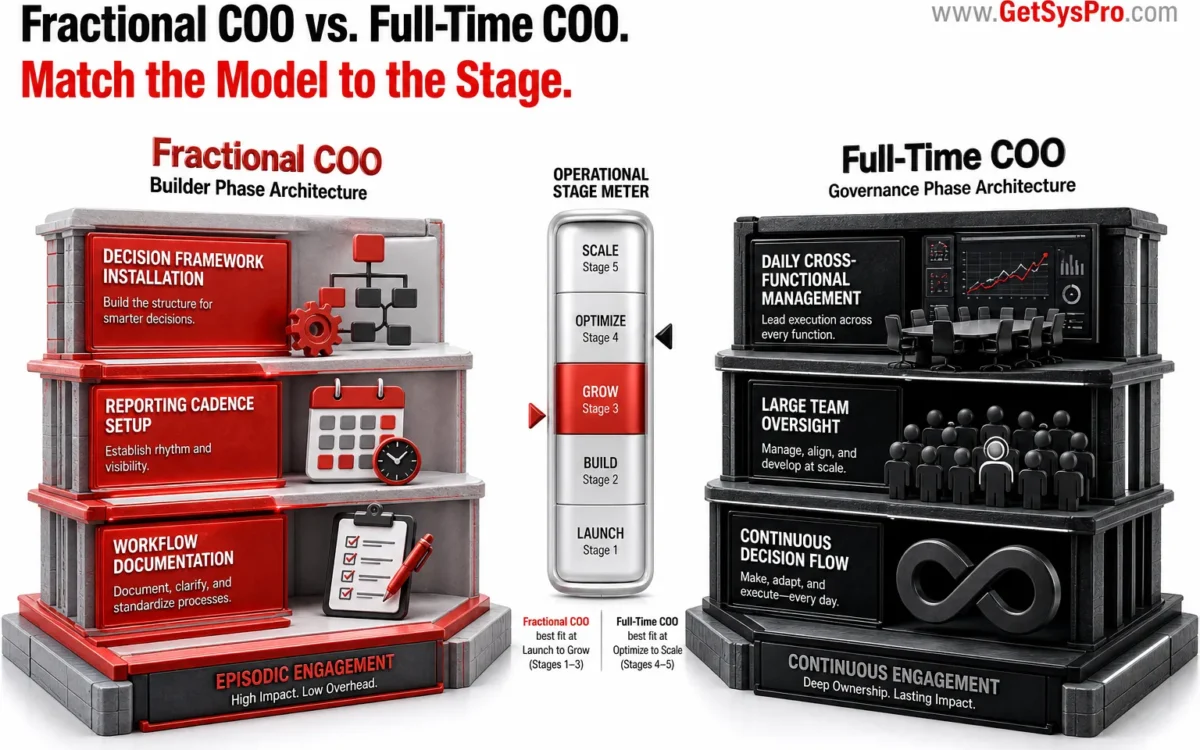
The COO role in a growing business is not a single function. It shifts depending on what the business most needs operationally at its current stage. In early-stage companies, the effective COO is a builder. They document processes, establish reporting cadences, define decision rights, and create the operating architecture that allows the founder to move from operator to strategic leader. In mid-stage companies, the effective COO is a governor. They maintain system integrity, manage cross-functional coordination, and ensure operational infrastructure keeps pace with growth.
Understanding that distinction is what makes the fractional COO versus full-time decision navigable. The builder phase and the governor phase require different levels of engagement and different cost structures. Deploying a full-time COO in the builder phase pays for daily presence. Installation work, not daily management, is what the business needs at that stage. Deploying a fractional COO in the governor phase creates a coverage gap. Continuous oversight is what the system requires at that complexity level.
The Fractional COO as Builder: Where the Model Has the Most Leverage
A fractional COO delivers the highest leverage in the builder phase because installation work is high-impact and episodic rather than continuous and daily. Building a decision rights framework, documenting core workflows, and designing accountability structure are defined projects with defined completion points. Once installed, those systems run with periodic review rather than daily management. That matches precisely the fractional COO engagement model.
What Makes the Fractional COO Model Work
The fractional COO model works when three conditions are present. Operational problems the business faces are structural rather than volume-based. Work required is installation and design rather than daily management of large teams. The founder or leadership team can execute against an installed framework without requiring continuous senior operational leadership to maintain it.
When those conditions are present, a fractional COO delivers full executive operating capability. The engagement level matches what the business actually needs. The model is not a cost compromise. It is a stage-appropriate deployment of senior operational expertise. Research on the COO role consistently finds that the most impactful operational leaders are those whose mandate matches the actual operational stage. Convention and budget are the wrong selection criteria.
Fractional COO Engagements That Produce Real Returns
Fractional COO engagements produce consistent returns in businesses between roughly $500K and $5M in annual revenue that have outgrown informal coordination but have not yet reached the operational complexity that requires full-time dedicated leadership. In that range, the business typically needs decision architecture built, reporting cadence installed, workflow documentation completed, and accountability frameworks established. Each of those is a defined installation project. A fractional COO completes the installation and leaves a system the organization runs rather than a dependency the organization maintains.
When a Full-Time COO Is the Right Answer
A full-time COO becomes the right answer when the operational complexity of the business is continuous, cross-functional, and large enough in volume to require daily senior presence to govern effectively. Specific indicators include a team of twenty or more people across multiple departments with distinct operational functions and revenue above approximately $5M to $8M. At that scale, operational decisions occur at a frequency that part-time engagement cannot absorb, and the COO must be embedded in daily operations rather than available for periodic strategic input.
At that stage, the cost of a full-time COO is not a premium over the fractional alternative. It is the cost of the operational governance the business now requires continuously. At that scale, the fractional model cannot provide daily cross-functional oversight or maintain the organizational presence a senior operating leader requires. Full-time presence is the correct structure.
The Transition Point Between Fractional and Full-Time
The transition from fractional to full-time COO is not a single event. It is a progressive condition. The business starts requiring more frequent engagement from its fractional COO. Projects that were installation-phase work become ongoing maintenance work. Decision volume at the senior operational level increases past what episodic engagement can absorb. When those signals are consistent rather than periodic, the business has reached the transition point. The fractional COO who built the system may or may not be the right full-time hire. The structural need for full-time operational leadership has arrived either way.
Not sure which model your business actually needs right now?
GetSysPro can assess where your operating model is and what level of operational leadership it requires to scale from here.
The Decision Framework: Four Questions That Settle It
Four questions cut through the noise of the fractional COO versus full-time COO debate and produce a clear directional answer for most growing businesses.
First: is the primary operational challenge installation or management? If the business needs decision architecture built, processes documented, and accountability frameworks established, that is installation work suited to a fractional COO. If the business needs daily cross-functional management of a large team with defined operational complexity, that is management work that requires full-time presence.
Second: how frequently do senior operational decisions occur? If decision volume falls within the fractional engagement schedule, the fractional COO is appropriate. If decisions require senior input daily, full-time presence is the correct structure.
Questions Three and Four in the Fractional COO Decision Framework
Third: can the leadership team execute against an installed system without daily senior operational oversight? If the answer is yes, the fractional model supports that execution. If the team requires continuous senior presence to maintain direction and accountability, the full-time model is what the structure actually needs. Fourth: what is the cost of getting this wrong in each direction? A premature full-time hire carries the cost of a senior salary without the operational complexity to justify it. A delayed full-time hire produces bandwidth collapse during a growth phase the business should have sustained. Both costs are real, and both are typically larger than the cost difference between the two models. McKinsey research on C-suite structure consistently finds that misaligned leadership roles produce measurable performance drag. The drag outlasts the decision that caused it.
What the Wrong Choice Costs You
Hiring a full-time COO before the business needs one produces predictable problems. The role lacks sufficient complexity to justify a senior leader’s engagement level. Within a year, the COO either manufactures complexity, underperforms, or departs once the mismatch becomes apparent. That cost is not just the salary. The real cost is the structural work a fractional COO would have completed for far less.
Deploying a fractional COO after the business has outgrown the model produces equally predictable problems. The operational complexity outpaces the engagement schedule. Decisions that require senior input accumulate faster than the fractional COO can process them. The leadership team fills the gap through personal bandwidth. That recreates the bottleneck the COO engagement was meant to solve. The cost is operational drag during a growth period that required more, not equivalent, leadership capacity.
Stage Determines Which Fractional COO or Full-Time Model Fits
Both failure modes share a common cause: the decision was made on the wrong basis. Budget drives toward the fractional model when what the business actually needs is a full-time hire. Convention drives toward the full-time hire when what the business needs is a fractional COO to install the foundation first. Matching the model to the actual stage is the decision that produces returns in either direction.
Where GetSysPro Fits in This Decision
GetSysPro’s Fractional COO Leadership Services is designed for the builder phase: between informal founder-driven coordination and the operational complexity that requires a full-time executive. The engagement installs decision architecture, establishes reporting cadence, documents workflows, and builds accountability frameworks so the business has a functioning operating system rather than a single-person dependency.
For businesses not yet ready to determine which model they need, a Business Operational Systems Audit surfaces where the operating model is relative to current scale. The audit answers whether the business needs installation work, daily management, or a combination, which is the factual basis the COO decision requires.
Related GetSysPro Services
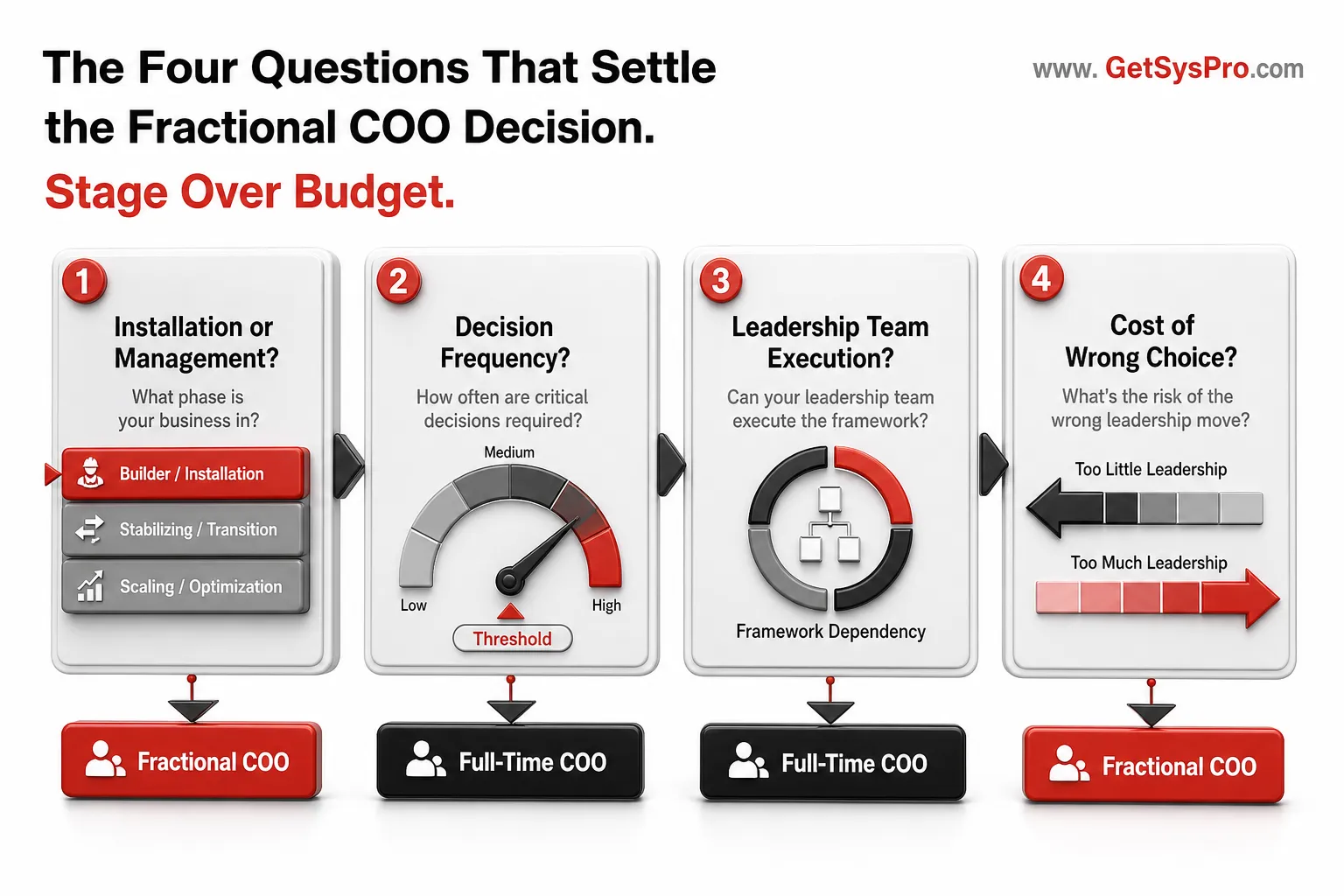
Four questions settle the fractional COO versus full-time COO decision: is the challenge installation or management, how often do senior decisions occur, can the team execute against an installed framework, and what does the wrong timing cost in each direction. GetSysPro builds the operational audit that answers them. www.GetSysPro.com
Article Summary
The fractional COO versus full-time COO decision is a stage decision, not a budget decision. The fractional model delivers the highest leverage during the builder phase: installing decision architecture, establishing reporting cadence, and documenting workflows for a business that has outgrown informal coordination but has not yet reached the operational complexity that requires daily senior executive management. The full-time model becomes appropriate when operational complexity is continuous, cross-functional, and large enough in volume to require daily senior presence. Getting the timing wrong in either direction carries real costs. The decision framework is four questions about what the business actually needs, not what it can afford or what sounds like the next step.
Match the Model to the Stage. Not to the Budget.
GetSysPro provides Fractional COO Leadership Services for businesses in the builder phase and operational audits that clarify which model is actually right for where you are now.
Frequently Asked Questions
What is the main difference between a fractional COO and a full-time COO?
A fractional COO provides senior operational leadership on a part-time or project basis, typically working with multiple clients simultaneously. A full-time COO is a dedicated internal executive whose entire professional capacity is committed to a single organization. The practical difference is not primarily cost: it is engagement model, bandwidth availability, and organizational integration depth. A fractional COO is appropriate when the work is episodic, installation-focused, and does not require daily organizational presence. A full-time COO is appropriate when operational complexity requires continuous daily management. The COO needs to be deeply embedded in the organization’s culture, team dynamics, and daily decision flow.
At what revenue level should a business consider a fractional COO?
The revenue threshold is a useful proxy but not the primary indicator. Businesses in the $500K to $5M range typically benefit most from fractional COO engagements. They have outgrown informal founder coordination but have not yet reached the complexity that requires a full-time executive. Below $500K, the operational complexity usually does not justify either model. Above $5M to $8M, depending on team size, growth rate, and operational complexity, the case for a full-time COO strengthens. Revenue is a proxy for complexity, and complexity, not revenue, is the actual decision driver.
How long does a fractional COO engagement typically last?
Fractional COO engagements vary significantly by scope and objectives, but productive engagements in the builder phase typically run between six months and eighteen months. Shorter engagements under three months rarely produce durable operational improvements because the installation work requires enough time to complete, embed, and verify before the engagement concludes. Longer engagements beyond two years often signal the business has reached the point where full-time COO support is more appropriate. At that stage, the conversation should turn to transition planning.
Can a fractional COO help with hiring a full-time COO later?
Yes, and this is one of the most underappreciated value propositions of the fractional COO model. A fractional COO who builds the operational architecture of the business creates a clear mandate profile for what the full-time COO will inherit and need to govern. That profile makes the hiring process more precise because the role is defined by actual operational requirements rather than by general expectations. The fractional COO can also evaluate candidates against the specific system they built, which produces a higher-quality hiring decision than a general executive search.
Is a fractional COO the same as a business consultant or operations consultant?
The roles overlap in some areas but are structurally different. A traditional operations consultant typically produces analysis, recommendations, and deliverables that the client team implements. A fractional COO takes operational ownership of the implementation itself, functioning as an executive rather than as an advisor. The distinction matters because it determines accountability: a consultant advises, while a fractional COO installs and owns the operational outcomes during the engagement period. GetSysPro operates as the latter. The work is installation, not recommendation, and the deliverable is a functioning operating system the business runs rather than a report the business reads.
Last Updated: [the_modified_date format=”F j, Y”]