 09/19/2024
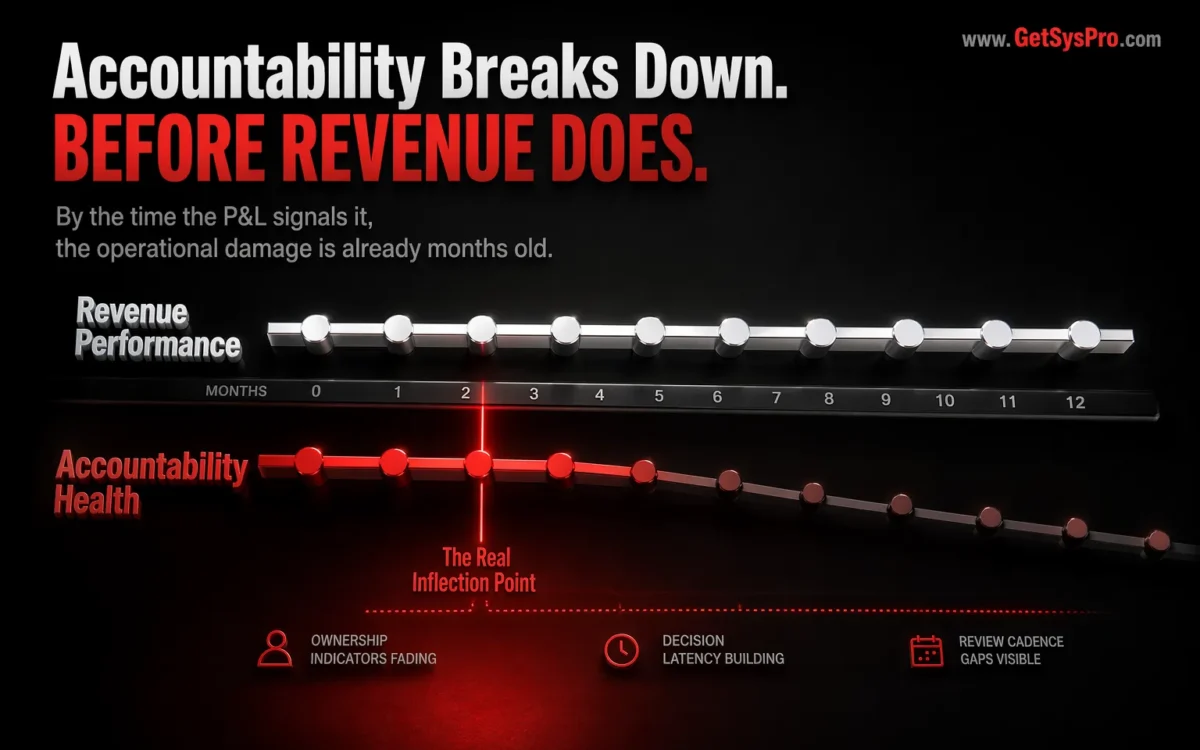
Revenue decline is obvious. Accountability decline is subtle, and it is the earlier signal.
When accountability breaks down in a growing organization, the first evidence rarely appears in financial statements. It appears in how work gets owned. Responsibility language becomes vague: “we need to improve this,” “someone should follow up,” “let’s revisit next week.” Performance becomes inconsistent. Decisions stall. The organization gets busier while moving slower, and the underlying cause stays invisible until the revenue line eventually confirms what the operational signals said months earlier.
This article explains what accountability breakdown looks like before it reaches the P&L, why it is a system problem rather than a motivation problem, and what structural design keeps accountability intact as an organization scales.
In This Article
- The Quiet Signs of Accountability Decay
- Accountability Is a System, Not a Personality Trait
- Ownership Diffusion Creates Decision Latency
- Cross-Functional Work Exposes the Cracks First
- Clarity of Expectations Is the Foundation
- The Three Structural Supports That Keep Accountability Intact
- How GetSysPro Builds Accountability Architecture
- Frequently Asked Questions
Key Takeaways
- Accountability breaks down before revenue does. By the time financial decline is visible, the operational signals that preceded it have been present for months.
- Accountability is a system problem, not a motivation problem. Even talented, committed teams produce inconsistent results when roles are unclear, outcomes are unmeasured, and review cadence is absent.
- Ownership diffusion creates decision latency. Work pauses while people wait for clarification. Leaders become the default clearinghouse. The organization grows busier while moving slower.
- Cross-functional initiatives expose accountability gaps first because they require coordination across boundaries that were never explicitly defined.
- Three structural elements keep accountability intact at scale: defined ownership tied to specific outcomes, measurable metrics reviewed consistently, and clear escalation pathways that surface issues before they linger.
The Quiet Signs of Accountability Decay
Accountability breakdown does not announce itself. It appears as drift: small operational inconsistencies that individually seem unremarkable and collectively signal that ownership has become unclear across the organization. In small businesses, informal accountability often functions because personal familiarity makes responsibility assignments obvious without documentation. As scale increases, those informal assignments fail because new hires interpret responsibilities differently, departments overlap, and decision rights blur across roles that were never explicitly defined.
The early signs are behavioral rather than financial. Owners stop getting named in meetings, so no individual feels responsible for following through. Deadlines become targets rather than commitments, which means missing them carries no consequence. Metrics exist on dashboards but go unreviewed consistently, producing data without decisions. Follow-ups require manager reminders rather than happening as natural professional rhythm. Decisions get delayed because no one is certain who has the authority to make them.
Why Small Signs Compound Into Large Problems
Each of those symptoms feels minor in isolation. Together they create an increasingly reactive organization where urgent issues consistently crowd out strategic priorities, where leaders spend time coordinating rather than directing, and where performance varies based on individual initiative rather than systemic design. Accountability breaks down gradually enough that organizations often attribute the symptoms to growth pain rather than structural failure, which delays the diagnosis and allows the compounding to continue until the revenue line eventually confirms what the operational signals communicated months earlier.
“Revenue decline is obvious. Accountability decline is quieter but more predictive. Strong companies do not rely on memory or personality to maintain accountability. They design it, document it, and review it consistently because those three practices are what make accountability durable rather than dependent on whoever happens to be paying attention.”
Editorial, GetSysPro Team
Accountability Is a System, Not a Personality Trait
The most common misdiagnosis of accountability breakdown is attributing it to individual motivation or character. The framing of “holding people accountable” implies that accountability is a function of personality: some people have it and some do not, and the solution is to hire better or manage harder. That framing misses the structural dimension that determines whether accountability is possible regardless of individual character.
Accountability breaks down before revenue does precisely because it is a system property, not a personal one. A team of committed, capable people operating within a system that has unclear roles, unmeasured outcomes, and no review cadence will produce inconsistent results not because they lack motivation but because the system makes ownership optional. Talented people fill structural gaps with extra effort when the gaps are small. When gaps accumulate and scale makes extra effort insufficient, performance becomes inconsistent in ways that feel like a people problem when the actual cause is a design problem.
What Structural Accountability Actually Requires
Structural accountability requires three elements that most growing organizations either skip or implement incompletely. Documented roles that specify not just what a person does but what outcomes they are personally responsible for producing. Measurable metrics that make performance visible and objective rather than subjective and memory-dependent. A consistent review cadence that creates the regular checkpoint at which performance against expectations gets examined, blockers get surfaced, and course corrections get made before variance compounds. Remove any of those three elements and accountability weakens even in organizations with genuinely strong culture and genuinely committed people.
Ownership Diffusion Creates Decision Latency
One of the earliest and most expensive costs of unclear accountability is decision latency. Work pauses while people wait for clarification about who has the authority to proceed. Leaders become the default clearinghouse for decisions that their role was never meant to require them to make. Cross-functional initiatives stall because the boundaries between functions were never explicitly defined, leaving every decision at the intersection of two departments requiring negotiation rather than execution.
The organization experiences this as being busy without being productive. More time gets spent coordinating, escalating, and clarifying than executing. High-performing team members, who are most sensitive to the cost of structural friction, disengage first because their effort produces less output than their capability would generate in an environment where ownership is clear and authority matches responsibility.
The Compounding Cost of Decision Latency
Decision latency compounds in ways that financial reporting does not capture until well after the damage is done. Client deliverables arrive late because no single person owned the timeline. Strategic initiatives stall because every decision requires a coordination meeting rather than an individual judgment call. Vendor relationships deteriorate because nobody owns the vendor management process comprehensively. Each of those outcomes has a financial consequence, but the consequence shows up in financial reporting months after the accountability breakdown that caused it. Addressing accountability breaks down before addressing the financial symptoms is what separates organizations that course-correct efficiently from those that manage crises reactively.
Cross-Functional Work Exposes the Cracks First
Accountability breaks fastest in initiatives that span departmental boundaries. Marketing launches campaigns with volume targets. Sales pushes deals. Operations absorbs fulfillment demands. Finance updates projections reactively. Each function performs its role adequately within its own boundaries. Without defined accountability at the cross-functional outcome level, coordination becomes friction because each function optimizes for its own scorecard rather than the shared result.
The structural fix is straightforward even when it is organizationally uncomfortable: define shared metrics for cross-functional outcomes, define explicit handoff points between functions, and assign one accountable owner for the cross-functional result. Not one owner per department’s activity. One owner for the outcome that requires all departments to coordinate. That assignment concentrates accountability in a way that distributes responsibility rather than obscuring it, because the owner can then clearly specify what each function needs to deliver and can escalate when any function’s contribution falls short.
Why Cross-Functional Accountability Fails Without Explicit Design
Cross-functional accountability fails without explicit design because the informal accountability mechanisms that function within single departments rely on shared context, shared metrics, and daily proximity that cross-functional relationships typically lack. Two departments that each believe they performed their role correctly can produce a jointly failed outcome because neither owned the integration between their contributions. Designing accountability at the cross-functional level requires treating the outcome as a distinct accountability assignment rather than assuming that accountability within each contributing function will automatically produce accountability for the combined result.
Is your organization getting busier without getting stronger?
GetSysPro builds the accountability architecture that converts organizational effort into measurable, owned performance.
Clarity of Expectations Is the Foundation
When performance expectations are unclear, accountability becomes subjective. Subjectivity weakens trust because team members cannot determine whether their performance is adequate, and managers cannot evaluate performance against an objective standard. Trust erosion reduces transparency, and transparency is what makes accountability functional rather than performative. An organization where expectations are unclear does not have a trust problem that better culture will solve. It has a design problem that clearer expectations will solve.
Gallup’s research on employee engagement identifies clarity of expectations as the most foundational employee need, noting that employees who strongly agree they know what is expected of them show significantly lower turnover and higher productivity. Gallup’s Q12 engagement framework places expectation clarity at the base of the engagement hierarchy because its absence undermines every other engagement driver above it.
Accountability Is Directional, Not Punitive
A clarification that organizational culture frequently requires: accountability is not primarily punitive. Its primary function is directional. Clear accountability tells people what winning looks like, where to focus effort, and how to prioritize when demands compete. Organizations that frame accountability as a consequence mechanism rather than a direction-setting mechanism produce cultures of compliance rather than cultures of ownership, where people meet defined minimums to avoid negative outcomes rather than pursuing defined maximums because they understand what they are accountable for producing.
The Three Structural Supports That Keep Accountability Intact
Accountability requires three structural elements that reinforce each other. Remove any one of them and the remaining two become insufficient to sustain consistent ownership at scale. Understanding what each element does and why its absence creates a specific failure mode is the prerequisite to building accountability architecture that actually holds under growth pressure.
Defined ownership tied to specific outcomes means a named individual is personally accountable for a measurable result, not for performing activities in the general direction of a goal. The distinction matters because activity-based accountability is inherently fuzzy: the person can always demonstrate that they did things, regardless of whether those things produced the outcome. Outcome-based accountability is inherently clear: either the result occurred or it did not, and the person who owns it is responsible for explaining the variance and closing it.
Measurable Metrics and Escalation Pathways
Measurable metrics reviewed on consistent cadence make performance visible and objective. Without regular review, performance variance accumulates invisibly until it reaches a threshold that forces a reaction. Regular review converts reactive management into proactive governance by surfacing problems at the size where correction is cheap rather than at the size where remediation is expensive. Harvard Business Review’s research on accountability systems in performance management consistently identifies cadence-based review as the primary mechanism separating organizations with durable accountability from those where accountability depends on individual initiative. Clear escalation pathways define what triggers escalation, who receives it, and what response is expected. Without explicit escalation design, issues linger at the individual level longer than they should because nobody wants to escalate something that turns out to be minor. Explicit criteria remove that ambiguity and make surfacing problems a defined professional responsibility rather than a judgment call with social risk.
How GetSysPro Builds Accountability Architecture
Accountability architecture is the structural foundation that makes performance consistent, ownership clear, and organizational scale possible without leadership becoming the default resolution mechanism for every gap that emerges.
GetSysPro Services That Strengthen Accountability
Internal EOS Integration and Management builds the accountability framework that converts verbal agreement into measurable performance through scorecards that align expectations, meeting cadence that reinforces priorities, and role clarity that reduces the ambiguity in which accountability breaks down before revenue does.
Organizational Chart Development defines the reporting relationships, ownership boundaries, and decision rights that eliminate the structural ambiguity driving ownership diffusion, decision latency, and cross-functional accountability failure.
Related GetSysPro Services
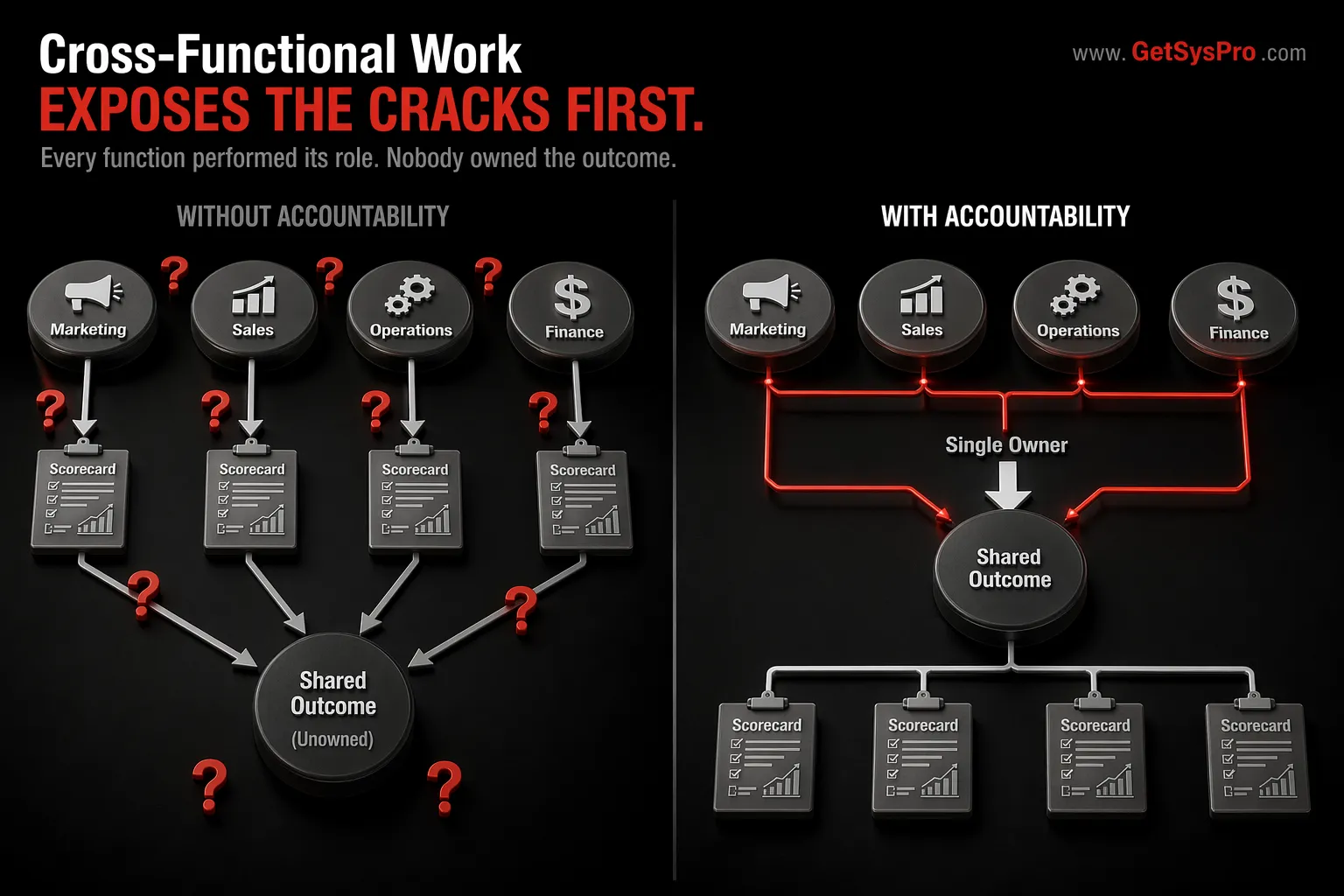
Every function performed its role. Nobody owned the outcome. Cross-functional accountability breaks at the boundary that was never explicitly defined. www.GetSysPro.com
Article Summary
Accountability breaks down before revenue does, and the early signals are behavioral rather than financial. Accountability is a system property requiring three structural elements: defined ownership tied to specific outcomes, measurable metrics reviewed consistently, and clear escalation pathways. Ownership diffusion creates decision latency that compounds invisibly until it surfaces in financial reporting. Cross-functional initiatives expose accountability gaps first because they require explicit boundary definition that informal mechanisms cannot provide. Clarity of expectations is the foundational driver of performance and retention. GetSysPro builds the accountability architecture that makes ownership clear, performance measurable, and organizational scale possible without leadership becoming the default resolution mechanism for every ownership gap.
Design Accountability Before Revenue Forces the Conversation.
GetSysPro builds the ownership structures, measurable metrics, and review cadence that keep accountability intact as your organization scales.
Frequently Asked Questions
What are the earliest signs that accountability is breaking down?
Behavioral signals precede financial ones. Owners stop getting named in meetings, so no individual feels personally responsible for outcomes. Deadlines shift from commitments to targets, removing consequence from missing them. Metrics go unreviewed, producing data without decisions. Follow-ups require manager prompting rather than professional initiative. Decisions get delayed because authority is unclear. Together these indicate that ownership has become structurally optional.
Why does accountability break down at scale even when individual commitment is high?
Breakdown at scale is almost always structural rather than motivational. Informal mechanisms work in small organizations because personal familiarity makes responsibility obvious without documentation. As headcount grows, new team members interpret responsibilities differently, departments overlap, and authority boundaries blur. Structural accountability mechanisms replace informal ones as scale increases because informal mechanisms depend on shared context that larger organizations no longer have.
How do you design accountability for cross-functional initiatives?
Three explicit design decisions are required. Define the cross-functional outcome as a distinct accountability assignment. Name one accountable owner for the integrated result, not each department’s contribution individually. Define handoff points explicitly: what each function delivers, to whom, and on what timeline. Without those decisions, each department optimizes locally and the combined outcome becomes nobody’s responsibility.
What is the difference between accountability and micromanagement?
Accountability defines what outcome a person owns and creates visibility into whether it is achieved. Micromanagement dictates how each step gets performed. Properly designed accountability increases autonomy by clarifying what winning looks like. Organizations that avoid accountability design out of concern about appearing controlling produce the opposite effect: unclear ownership forces managers into more intervention, not less.
How often should accountability metrics be reviewed?
Review frequency should match the consequence of delay. Weekly review of leading indicators surfaces blockers before they compound. Monthly review of financial and operational metrics identifies variance requiring correction. Quarterly review of strategic priorities ensures accountability architecture remains aligned with organizational direction. Missing any interval creates a gap during which problems accumulate without triggering a response.