06/17/2026
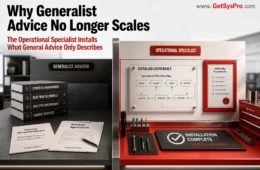
Broad advice is everywhere. What growing businesses actually need is a specialist who installs the system.
For most of the history of business consulting, generalist advice was the best available option. A smart, experienced advisor who had seen many businesses could identify patterns, recommend frameworks, and point a founder toward better decisions. That was valuable when operational knowledge was scarce and access to experienced operators was limited. Neither of those conditions applies today. The market has shifted, and the businesses that are scaling in 2026 are not doing so by consuming more general advice. They are doing so by working with operational specialists who install specific solutions rather than describe general ones.
Industry analysis published in 2026 confirms the shift. Demand for generalist consulting is declining while specialized advisory services are rising. Fractional executive roles including part-time COOs are projected to become standard for small and mid-sized firms. The businesses driving that demand have a specific problem with a specific operational cause. They need a specialist who can solve it, not an advisor who can frame it.
In This Article
In This Article
- Why Generalist Advice Worked Before and Stopped Working Now
- What an Operational Specialist Actually Does Differently
- The Problem With Broad Frameworks Applied to Specific Businesses
- Why Specialization Produces Faster Returns Than General Consulting
- What to Look for When Evaluating an Operational Specialist
- Where GetSysPro Fits as an Operational Specialist
- Frequently Asked Questions
Key Takeaways
- Demand for generalist consulting is declining. Specialized operational expertise is what growing businesses in the $500K to $5M range are seeking in 2026.
- An operational specialist diagnoses the specific structural problem, builds the specific solution, and installs it inside the business. A generalist advisor describes the category of problem and recommends a direction.
- Broad frameworks applied to specific businesses produce generic outputs. The more specific the problem, the more valuable the specialist who has solved that exact problem before.
- Specialization produces faster returns because the specialist does not spend engagement time learning the landscape. They arrive already knowing what breaks at each stage and why.
- The signal that a practice is genuinely specialized is a defined service menu tied to specific operational outcomes, not a capabilities list that describes everything the practice has ever done.
Why Generalist Advice Worked Before and Stopped Working Now
Generalist business advice worked when operational knowledge was scarce. A founder with no operational network could gain genuine value from someone who had seen more businesses. The advisor’s breadth was the asset.
That scarcity no longer exists. Operational content is abundant. Frameworks are published and freely available. The foundational knowledge that once justified a generalist engagement is now a Google search. What remains scarce is not the knowledge of what good looks like. It is the operational specialist who can take a specific business with a specific structural problem and install the specific solution that resolves it. That scarcity is what the market is now paying for.
The Operational Specialist Fills the Gap Generalist Advice Left Open
The gap generalist advice consistently leaves open is implementation. A generalist advisor produces a diagnosis and a recommendation. The business still has to implement. When the business lacks the operational expertise to implement effectively, the recommendation produces no result and the engagement produces no return. The operational specialist closes that gap not by giving better advice but by doing the installation work rather than describing it.
What an Operational Specialist Actually Does Differently
An operational specialist arrives at the engagement already knowing the specific failure modes that appear at the client’s stage of growth. They do not need to spend the first quarter of the engagement learning the landscape. Decision congestion, undocumented workflows, authority ambiguity, and inconsistent reporting are the patterns that appear at the $500K to $5M stage. An operational specialist has seen those patterns enough times to recognize them quickly, diagnose accurately, and fix them with tools already refined for exactly that context.
A generalist advisor arrives and learns the landscape. They ask the same discovery questions they ask every client because every engagement starts from the same foundational position. The learning happens on the client’s time and budget. The output is shaped by the advisor’s general frameworks rather than by deep familiarity with the specific problem the client actually has.
Operational Specialist Engagements Are Defined by Output, Not Time
The other structural difference is how the engagement is scoped. Generalist advisory engagements are typically scoped by time: a retainer, a number of sessions, a months-long relationship. The output is undefined because the advisor’s value is their ongoing presence, not a specific deliverable. Operational specialist engagements are scoped by output: a documented workflow library, an authority framework, a reporting cadence, an org chart redesign. The engagement ends when the output is complete and installed, not when the retainer expires.
The Problem With Broad Frameworks Applied to Specific Businesses
Every major business framework, from EOS to OKRs to various scaling methodologies, was designed as a general tool applicable across business types and stages. That generality is the framework’s strength and its limitation. The strength is broad applicability. The limitation is that broad applicability produces generic outputs when applied to a specific business with a specific structural problem.
A business with a decision congestion problem does not need a complete EOS implementation. It needs its authority boundaries documented and its approval thresholds defined. Applying a full EOS framework to that problem is like replacing the entire plumbing system to fix one leaking pipe. The framework resolves the problem eventually, but the overhead of applying it far exceeds the overhead of solving the actual problem precisely. An operational specialist knows the difference and brings the right tool rather than their preferred tool.
Why the Operational Specialist Chooses Precision Over Comprehensiveness
Precision is what separates an operational specialist from a framework practitioner. A framework practitioner applies the same methodology to every engagement because the methodology is what they know. An operational specialist applies the methodology that fits the problem because the problem is what they know. That precision is what produces faster implementation, lower disruption, and higher adoption rates in the team that has to live with the installed system after the engagement closes.
You do not need more general advice. You need the specific system built.
GetSysPro is an operational specialist practice. We identify the specific structural problem and install the specific solution.
Why Specialization Produces Faster Returns Than General Consulting
Operational specialist engagements produce faster returns for two structural reasons. First, the specialist does not spend time learning the landscape. They arrive knowing what they are looking for and find it faster. A generalist advisor running a discovery process with a scaling business in the $1M to $3M range will spend weeks understanding the operational context before they can produce useful output. An operational specialist who has worked with dozens of businesses at that stage arrives already knowing the context. Discovery confirms rather than creates the diagnosis.
Second, the specialist’s output is immediately actionable because it is specific. A generalist recommendation to “improve decision-making processes” requires the business to translate it into a concrete action. An operational specialist delivers documented authority thresholds, a decision rights matrix by role, and a defined escalation protocol. The business does not have to translate the output into action. The action is the output.
How Operational Specialists Close the Implementation Gap
Implementation gap is the distance between a recommendation and a functioning change. Generalist advice maximizes this gap because the recommendation is abstract and the implementation is left to the client. Operational specialists minimize it because the installation is part of the engagement scope. The gap closes not because the client figures out how to implement the advice but because the specialist installs the solution and trains the team to operate it. That is what makes the return on an operational specialist engagement faster and more durable than the return on a general advisory engagement.
What to Look for When Evaluating an Operational Specialist
The signal that a practice is genuinely specialized rather than rebranded generalist is a defined service menu tied to specific operational outcomes. A specialist practice can tell you exactly what they build, how long it takes, and what the business will do differently once the deliverable is installed. A generalist practice describes what they know, what industries they have worked in, and what frameworks they use. The outputs are different in kind, not just in degree.
Three questions separate an operational specialist from a generalist advisor with specialized language. What specific deliverable will this engagement produce? How will the team operate the system after the engagement closes? What happens if the installed system does not hold? A specialist answers all three directly and specifically. A generalist advisor redirects to process, relationship, and ongoing engagement. Harvard Business Review research on consulting disruption consistently finds that practices most vulnerable to replacement are those whose value is ongoing presence rather than a specific installed capability.
Operational Specialist Engagements Have a Defined Completion Point
A reliable indicator of genuine specialization is a defined completion point. The engagement ends when a specific output is installed and verified to be functioning. Not when the retainer expires, not when the advisor decides the client is ready, and not when the client runs out of budget. Operational specialists build toward a specific end state. The completion of that end state is the measure of success, and both parties know what it looks like before the engagement begins.
Where GetSysPro Fits as an Operational Specialist
GetSysPro is a specialized operational practice. Every service in the menu targets a specific structural problem with a specific deliverable. Business Operational Systems Audit produces a specific map of where the operating model has design gaps and what those gaps are costing in escalation volume, decision latency, and forecast variance. Process and SOP Architecture produces documented workflow standards the team can reference and follow without depending on any single person’s institutional knowledge.
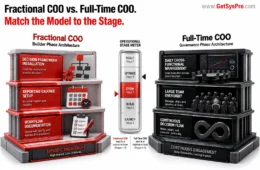
Fractional COO Leadership Services installs the decision architecture, reporting cadence, and accountability framework that the business needs at its current stage. Every engagement is personally led by Tomo Oblak, who has over 21 years of experience in real estate, construction, and COO-level business operations. The engagements are scoped by output, completed when the system is installed and verified, and structured so the business owns the system and does not need GetSysPro to maintain it.
Related GetSysPro Services

Generalist engagements end when the retainer expires. Operational specialist engagements end when the deliverable is installed and the system holds. GetSysPro scopes every engagement by output, not by time. www.GetSysPro.com
Article Summary
Demand for generalist consulting is declining because operational knowledge is no longer scarce. What growing businesses need in 2026 is an operational specialist who arrives already knowing the failure modes at their stage. They diagnose precisely rather than broadly and install a specific solution rather than describing a general one. Key differences: specialists scope by output rather than time, apply the right tool rather than their preferred framework, and close the implementation gap generalist advice leaves open. The signal that a practice is genuinely specialized is a defined service menu tied to specific deliverables with a defined completion point.
Stop Describing the Problem. Start Installing the Solution.
GetSysPro is a specialized operational practice. Every engagement produces a specific deliverable, closes at a defined completion point, and leaves a system the business owns.
Frequently Asked Questions
What is the difference between a generalist business advisor and an operational specialist?
A generalist business advisor brings broad experience across business types and stages and applies general frameworks and pattern recognition to help clients identify what needs to change. An operational specialist brings deep expertise in a specific operational domain and installs specific solutions rather than recommending general ones. The practical difference is what the engagement produces: a generalist engagement produces recommendations and direction, while an operational specialist engagement produces installed systems the business operates after the engagement closes.
Why is demand for generalist consulting declining in 2026?
Demand for generalist consulting is declining because the core value proposition of generalist advice, access to operational pattern recognition and strategic frameworks, is no longer scarce. Business content, frameworks, and operational knowledge are widely available. What growing businesses cannot find freely is a specialist who has solved their specific problem at their specific stage enough times to do it precisely, quickly, and with a defined output. That precision is what the market is paying for in 2026, and it is what generalist practices structurally cannot provide regardless of how experienced their advisors are.
How does an operational specialist scope an engagement differently than a generalist advisor?
A generalist advisor scopes by time: a retainer, a series of sessions, an ongoing relationship with an open-ended output. An operational specialist scopes by output: a documented workflow library, an authority framework, a reporting cadence, an org chart redesign. The engagement ends when the specific deliverable is installed and functioning. Both parties know what the completion state looks like before the engagement begins. That output-based scoping is what produces a defined return on investment and a defined end to the dependency on the external practitioner.
What makes a framework practitioner different from an operational specialist?
A framework practitioner applies the same methodology to every engagement because the methodology is what they know. An EOS practitioner implements EOS regardless of whether EOS is the right tool for the specific problem. OKR practitioners implement OKRs regardless of whether the business has the infrastructure to make them function. Operational specialists apply the methodology that fits the problem. They might use EOS components, OKR structures, or custom-built frameworks depending on what the specific problem requires. The problem determines the tool, not the other way around.
How do I know if a consulting practice is genuinely specialized or just using specialized language?
Three questions separate genuine specialization from rebranded generalism. First: what specific deliverable will this engagement produce? A specialist answers with a named output. A generalist describes a process. Second: what will the team be able to do differently once the engagement closes? A specialist describes a specific operational capability the business will have. A generalist describes an improved understanding or strategic clarity. Third: what happens if the installed system does not hold? A specialist has a defined protocol for that scenario. A generalist advisor redirects to more engagement. The specificity and accountability of the answers reveal which type of practice you are evaluating.
Last Updated: [the_modified_date format=”F j, Y”]