 08/22/2024
Scaling real estate without losing control requires more than capital and deal flow. Every property added multiplies operational complexity, and complexity without structure produces the slow, invisible performance erosion that acquisition metrics never capture.
Real estate investors measure progress in doors, capital deployed, and portfolio value. Those numbers tell a compelling story. They do not tell the operational story running underneath. A portfolio can grow aggressively while its operating system quietly falls behind the complexity it manages, and the gap between portfolio growth and operational infrastructure is where control disappears.
Scaling real estate without losing control requires understanding the inflection points where growth converts from an asset into a liability, what systemization looks like at each stage, and how to build governance that makes performance predictable as complexity rises.
In This Article
- The Operational Inflection Points in Portfolio Growth
- How Control Erosion Starts and Why It Is Hard to See
- Portfolio Performance Depends on Operations, Not Acquisitions
- What Systemization Actually Looks Like at Scale
- Reporting Cadence as a Control Mechanism
- Why Hiring and Software Do Not Create Control Alone
- How GetSysPro Supports Scaling Real Estate
- Frequently Asked Questions
Key Takeaways
- Buying one property is transactional. Managing ten is operational. Managing fifty is organizational. Each stage requires a fundamentally different operating model.
- Control erosion starts as drift, not collapse. Stretched collections, inconsistent maintenance intake, unreconciled vendor invoices, and delayed financial close are the early signals.
- Portfolio performance depends on operational consistency as much as acquisition quality. Comparative analysis across properties requires structured reporting infrastructure.
- Hiring and software do not create control independently. People without defined workflows increase coordination overhead. Software without process clarity amplifies inconsistency.
- Scaling real estate without losing control requires governance, documentation, reporting cadence, and clear escalation thresholds that make performance predictable as complexity rises.
The Operational Inflection Points in Portfolio Growth
Portfolio growth creates operational stress at specific inflection points where the operating model that worked previously stops working now. Understanding those points is the first step toward scaling real estate without losing control, because structural investment at each inflection costs far less than remediation after gaps compound.
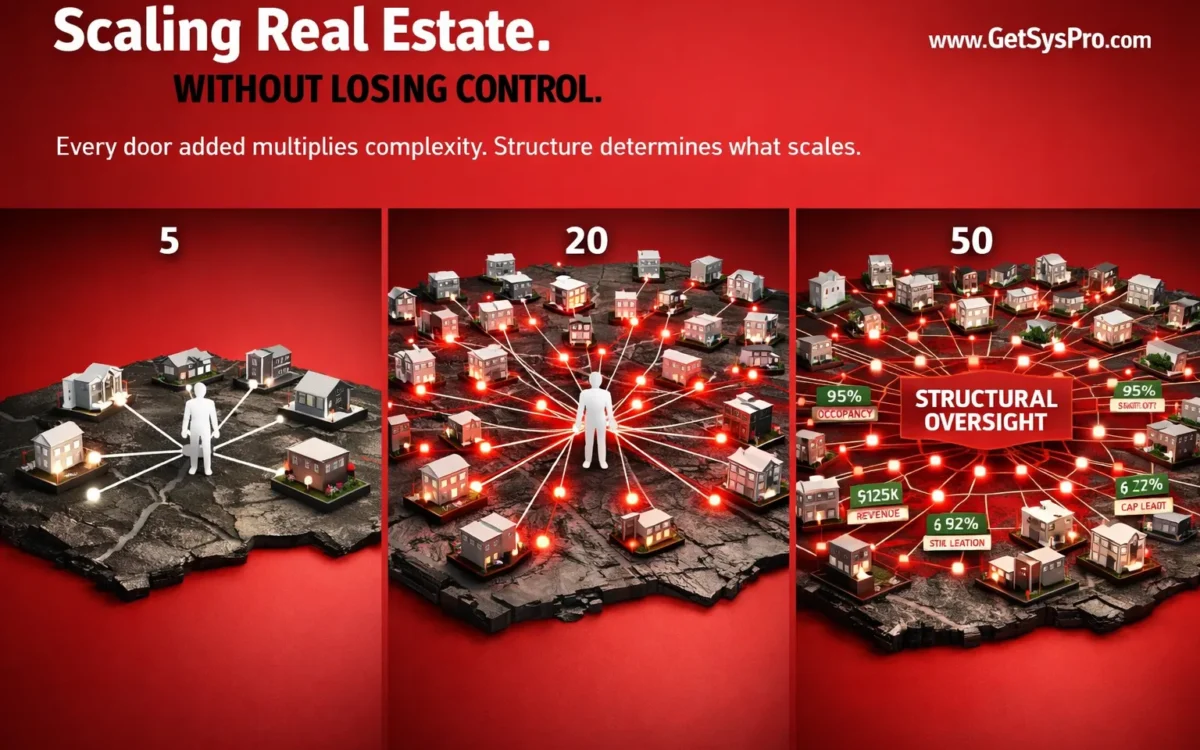
Around five properties, personal oversight still works. The investor maintains visibility into every unit, vendor relationship, and maintenance issue. That informality is efficient because the investor’s attention is the operating model. It is insufficient at ten.
From Five to Twenty and Beyond
Between ten and twenty properties, personal visibility becomes structurally impossible. The operating model must shift to systemized oversight: defined maintenance intake, standardized vendor contracts, structured rent tracking, and a reporting framework that surfaces problems without requiring active search. Around thirty to fifty properties, organizational infrastructure becomes essential. Comparative performance analysis, escalation thresholds, and governance frameworks make portfolio performance visible without direct investor involvement in every routine decision. Scaling real estate without losing control at this stage means treating portfolio management as an organizational discipline, not a personal one.
“Scaling real estate without losing control is not primarily a capital challenge. It is an operational architecture challenge. Investors who scale confidently built the operating system before complexity outpaced their personal management capacity.”
Editorial, GetSysPro Team
How Control Erosion Starts and Why It Is Hard to See
Control erosion in a growing real estate portfolio rarely announces itself. It starts as drift: small operational inconsistencies that each seem manageable but compound into structural fragility. By the time drift becomes visible in financial performance, it has typically been accumulating for months and has already produced material NOI impact.
Rent collection timelines stretch because follow-up is not standardized. Some tenants receive consistent reminders while others receive inconsistent ones, creating cash flow unpredictability even in a portfolio with low vacancy. Maintenance requests stall because intake is inconsistent across properties, driving tenant dissatisfaction and deferred costs that compound over time.
The Drift Pattern in Detail
Vendor invoices arrive in different formats and on different timelines, making it difficult to verify whether contracted rates are honored. Financial close gets delayed when data consolidation requires manual effort across inconsistent reporting formats, so decisions rely on information that is weeks out of date. None of those signals indicate collapse. Each indicates that the portfolio has outgrown its operating system and that structural intervention is needed before drift becomes damage.
Portfolio Performance Depends on Operations, Not Acquisitions
A portfolio can underperform even when every acquisition was well-underwritten if operations are inconsistent. Deferred maintenance compounds into capital expenditure. Vendor cost creep erodes NOI. Delayed collections create cash flow gaps. Each operational failure reduces portfolio performance independently of acquisition quality.
The Urban Land Institute describes portfolio management as requiring comparative analysis of investments to understand operational effectiveness, not just top-line results. ULI’s portfolio management framework makes clear that identifying underperforming assets requires visibility into operational drivers at the asset level.
What Comparative Analysis Actually Requires
Comparative performance analysis requires standardized reporting infrastructure that most growing portfolios lack. Identifying which properties underperform on maintenance cost per unit or collection timing requires all properties to report those metrics in the same format on the same cadence. Without that infrastructure, the investor can see that overall performance is below expectation but cannot quickly identify which assets drive the gap or what operational factor produces it.
What Systemization Actually Looks Like at Scale
Systemization in a real estate portfolio replaces personal oversight with structural oversight, allowing consistent operation without direct investor involvement in every decision. Four frameworks account for the majority of operational control in a growing portfolio.
Defined maintenance intake procedures ensure every issue enters the system through the same process regardless of property, tenant, or property manager. Standardized vendor contracts with documented expectations for pricing, scope, response time, and invoicing make vendor performance measurable and accountable rather than relationship-dependent.
Rent Tracking and CapEx Thresholds
Structured rent tracking connects collection activity to deposit records in a way that surfaces discrepancies quickly rather than allowing month-end reconciliation problems to accumulate. Clear capital expenditure approval thresholds define what each property manager can authorize independently versus what requires investor review, keeping spending discipline consistent as the portfolio grows and more people gain access to vendor relationships and maintenance budgets.
Reporting Cadence as a Control Mechanism
Reporting cadence is one of the most overlooked control mechanisms in real estate portfolio management. Quarterly reviews feel sufficient from a distance, but monthly variance review is what actually exposes inefficiency before it compounds into material performance impact.
The interval between when an operational problem begins and when it appears in financial reporting is the window during which correction is cheapest. Monthly reporting compresses that window. Quarterly reporting expands it by three months while the problem continues producing cost without triggering a correction response.
Oversight as Executive Rhythm
Effective portfolio reporting tracks leading indicators alongside financial totals: days to collect rent versus lease terms, maintenance completion time versus standard, vendor invoice accuracy versus contracted rates. Those metrics surface operational problems at the source rather than the financial statement. Oversight is not micromanagement. It is an executive rhythm that forces three questions at a consistent interval: what changed, why it changed, and what decision that change requires now.
Is your portfolio growing faster than your operating system?
GetSysPro builds the oversight structure, reporting cadence, and operational frameworks that keep control intact as your real estate portfolio scales.
Why Hiring and Software Do Not Create Control Alone
The most common response to scale stress is hiring more people or deploying more technology. Both interventions help when preceded by structural clarity. Neither works without it. Adding a property manager to an environment without defined workflows adds a person to an inconsistent system. Coordination overhead increases as more people navigate the same ambiguities that caused problems before the hire.
The Correct Sequence: Structure First
Technology platforms for property management and maintenance tracking are valuable tools whose value depends entirely on the process clarity governing their use. Deploying software into an operation without defined procedures automates inconsistency rather than resolving it. Research on technology adoption in property management consistently finds that process clarity is the primary determinant of whether technology investments produce expected returns. Define the workflows first, hire into that structure, then deploy technology to accelerate defined processes.
How GetSysPro Supports Scaling Real Estate
GetSysPro builds the operational infrastructure that makes portfolio growth produce confidence rather than anxiety. The work is executive-level oversight of the systems, workflows, and accountability structures that property managers and vendors operate within.
GetSysPro Services for Real Estate Portfolio Operators
GetSysPro Manage Oversight of REI Properties provides executive-level monitoring of workflows, reporting consistency, and operational accountability so portfolio systems evolve as the portfolio expands rather than lagging behind growth and generating control erosion that compounds until it becomes structurally expensive to reverse.
GetSysPro Process and SOP Architecture documents the maintenance intake, vendor management, rent tracking, and capex approval workflows that convert personal oversight into structural oversight across the portfolio.
Related GetSysPro Services

Same portfolio size. Two operating models. One compounds NOI drag invisibly. The other surfaces problems before they compound. Operations determine performance. www.GetSysPro.com
Article Summary
Scaling real estate without losing control requires treating portfolio management as an operational architecture challenge at every growth inflection point. Control erosion starts as drift and compounds invisibly while acquisition metrics look healthy. Portfolio performance depends on operational consistency as much as acquisition quality, and comparative analysis requires standardized reporting infrastructure. Four frameworks build structural oversight: defined maintenance intake, standardized vendor contracts, structured rent tracking, and clear capex thresholds. Monthly reporting cadence compresses the correction window. People and technology require structural clarity to produce returns. GetSysPro builds the oversight infrastructure that makes portfolio growth produce confidence rather than operational anxiety.
Growth Should Increase Confidence, Not Anxiety. Build the System.
GetSysPro builds the governance structure, reporting cadence, and operational documentation that make scaling real estate without losing control a structural outcome rather than a personal one.
Frequently Asked Questions
At what portfolio size does operational structure become essential?
Before ten properties. The cost of building the system at five is a fraction of the remediation cost at twenty after control erodes. Informal operations become insufficient between ten and twenty properties when personal visibility becomes impossible, and investors who reach that point without infrastructure experience the drift pattern: stretched collections, inconsistent maintenance, and vendor invoice discrepancies compounding into material NOI drag.
What operational failures most commonly erode NOI?
Four failures account for most NOI erosion: inconsistent maintenance intake allowing deferred cost accumulation, vendor cost creep from undocumented contracts, collection timing inconsistency creating cash flow unpredictability, and delayed financial reporting that forces decisions on outdated information.
How does reporting cadence affect the cost of corrections?
Monthly variance review surfaces problems within thirty days of when they begin. Quarterly review surfaces them ninety days later while cost continues accumulating. Monthly cadence is the practical standard for portfolios above ten properties because it compresses the detection-to-correction window to its minimum.
Can property management software replace operational structure?
Software amplifies whatever operational model exists beneath it. In a structured operation it accelerates manual effort. In an unstructured one it automates inconsistency at higher speed. Structural clarity is a prerequisite for software to produce claimed value. Technology selection belongs after process documentation, not before.
What does executive-level real estate portfolio oversight involve?
Monitoring the systems, workflows, and accountability structures that property managers and vendors operate within, rather than managing individual properties directly. The investor reviews whether procedures are followed consistently, whether metrics stay within expected ranges, and whether reporting provides comparative visibility to identify underperforming assets and diagnose their operational drivers.