 07/11/2024
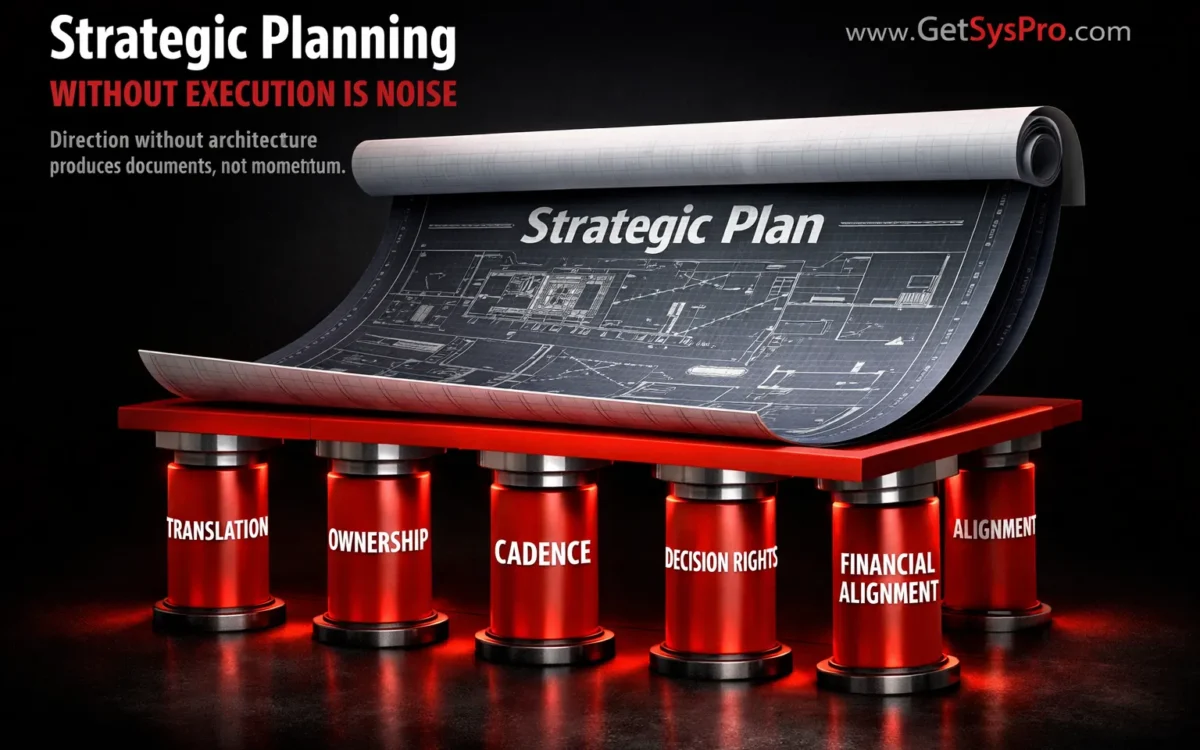
Strategic planning without execution is not a strategy problem. It is a structure problem. Direction without architecture produces noise, not momentum, and the gap between a compelling vision and operational reality compounds with every quarter that passes without closing it.
Every growing company eventually reaches the same inflection point. Leadership schedules the strategic planning session. Vision decks get built. Three-year revenue targets land on the page. Expansion opportunities get mapped. The energy in the room is high. Six months later, daily operations look almost identical to before. Strategic planning without execution architecture does not produce strategy failure. It produces structural fatigue: teams stop believing new initiatives will stick because the evidence consistently shows they do not.
This article examines why strategic planning without execution fails at a structural level, what execution architecture actually requires, and how to build the operating system that converts strategic intent into organizational momentum.
In This Article
Key Takeaways
- Strategic planning without execution fails at the structural level, not the vision level. Most strategy failures are execution architecture failures in disguise.
- Translation is the missing layer. Strategy must move from concept to workflow, from ambition to accountability, and from ideas to measurable commitments before it produces organizational change.
- A planning event generates ideas. A planning system converts ideas into accountable priorities with named owners, leading indicators, and a review cadence that sustains execution over time.
- Ownership is the single most powerful execution variable. When the answer to “who owns this?” is “we all do,” the initiative will not move.
- Execution discipline requires cadence, decision rights, and financial alignment. Without all three, strategic priorities compete with operational noise and consistently lose.
Translation Is the Missing Layer
Leadership often believes strategy is clear because it was clearly stated. The gap between stated strategy and organizational behavior is not a communication failure in most cases. It is a translation failure. Strategy must move from concept to workflow before it changes what people do on Monday. A revenue growth target stated in a planning session does not translate itself into changed hiring decisions, adjusted pricing behavior, or reallocated sales effort. Translation is the architectural work that connects strategic direction to operational reality, and most organizations skip it entirely.
The translation layer answers the execution questions that strategic statements leave open. If growing revenue is the priority, the execution questions are who owns which revenue lever, by what date, measured against what metric, with what authority to make resource decisions. If improving margin is the priority, the execution questions are who owns operational efficiency, who owns pricing discipline, what the review cadence looks like, and what leading indicators signal whether margin is improving before the financial statements confirm it. Strategic planning without execution architecture produces direction without answers to those questions, which means teams interpret the strategy individually and execute inconsistently.
Strategy Is Direction. Execution Architecture Is the Road.
The distinction between strategic direction and execution architecture is not semantic. A strategy defines where the organization is going. Execution architecture defines how the organization will get there by building the structural elements that align daily behavior with strategic intent. Those elements include defined ownership, measurable commitments, documented workflows, a review cadence, and decision rights that allow the people closest to the work to move without waiting for executive approval on every step. Strategic planning without those elements produces a destination without a road, and organizations that navigate roadless terrain default to the path of least resistance, which is usually the work already in front of them.
The Project Management Institute has consistently found in its research on strategy implementation that a significant share of strategic initiatives fail not because the strategy was wrong but because organizations lack the execution capability to implement it. PMI’s research on strategic planning and implementation identifies execution architecture gaps as among the primary drivers of strategy failure across industries.
“Strategic planning without execution architecture is not a strategy problem. It is a structure problem. Most organizations that fail to execute on strategy are not failing because their vision is wrong. They are failing because no structural system exists to translate that vision into the daily decisions and behaviors that accumulate into organizational progress.”
Editorial, GetSysPro Team
Planning Events Are Not Planning Systems
A quarterly offsite generates ideas. A planning system converts ideas into accountable commitments. The distinction is consequential: organizations that mistake planning events for planning systems consistently discover that the energy generated in the room dissipates within weeks as teams return to the operational demands that were present before the session and will be present after it.
A planning system has four structural components that a planning event does not. First, a small set of quarterly priorities defined specifically enough that completion is objectively verifiable rather than subjectively interpreted. Not “improve client experience” but “reduce average response time to client inquiries from 48 hours to 24 hours by September 30.” Second, one accountable owner per priority, not a department and not a committee, because shared ownership is functionally no ownership. Third, a scorecard with leading indicators tied directly to each priority so the organization tracks whether it is on trajectory to achieve the goal before the deadline reveals whether it did. Fourth, a meeting cadence that reviews those metrics, surfaces and clears constraints, and drives decisions rather than generating updates that require no action.
Why Strategic Planning Without Execution Cadence Produces Shelfware
Without those four components, urgency replaces alignment as the primary organizational force. Teams return to the work they are measured on today because today’s measurement system was not updated to reflect the new strategy. Strategic intent fades into background noise not because people lack commitment but because the operating system that governs their daily behavior was never updated to reflect the new direction. Strategic planning without execution cadence produces plans that organizations revisit in the next planning session as evidence of what did not get done, and the cycle repeats until leadership stops believing that planning changes anything.
Ownership Makes Strategy Executable
Strategy dilutes as it moves through an organization without explicit accountability assignment. Shared ambition feels collaborative in the planning session and produces ambiguity in execution because nobody has the clear authority and responsibility that individual ownership creates. The diagnostic for this failure is direct: ask who owns the initiative. If the answer names a department, a team, or the collective leadership group, the initiative does not have an owner. Departments do not make decisions. Teams do not feel personal accountability. Collective leadership diffuses responsibility until nothing moves.
Single-point ownership requires an individual whose name appears on the initiative, who has the authority to make the decisions the initiative requires, who has clear boundaries defining what they can decide without escalation, and who is personally accountable for the measurable outcome the initiative is designed to produce. That structure does not eliminate collaboration. It preserves it while adding the accountability layer that makes collaboration productive rather than a substitute for individual responsibility.
The Test That Reveals Strategic Planning Without Execution Accountability
A simple diagnostic separates organizations with execution architecture from those operating on strategic planning without execution accountability. Ask the leadership team to name, for each strategic priority, the single individual who owns it and describe exactly what that person is accountable for producing and by when. In organizations with genuine execution architecture, that question produces specific names, specific outcomes, and specific dates without hesitation. In organizations where strategic planning without execution accountability is the pattern, the question produces committee names, general descriptions of activity rather than outcomes, and timelines attached to phases rather than deliverables. The diagnostic takes ten minutes and reveals more about execution capability than any strategy document.
Cadence Sustains Execution
Execution discipline requires rhythm. Without a structured cadence, strategic priorities compete directly with operational urgency and lose consistently, because operational urgency is immediate and visible while strategic progress is gradual and requires deliberate tracking to perceive. Organizations that rely on commitment and intention without building a cadence to sustain them discover that good intentions do not survive contact with the volume of daily operational demands that characterize growing companies.
A functional execution cadence operates at three intervals. Weekly performance review focuses on metrics, blockers, and decisions rather than status updates and activity reports. The purpose of the weekly review is to identify what is off track and what needs to happen this week to return it to track, not to confirm that people are working. Monthly financial tracking connects the execution metrics to forecast variance and margin drivers so the financial picture reflects strategic progress rather than trailing operational activity. Quarterly priority assessment examines whether the current priorities remain the right priorities, whether capacity exists to execute them, and what tradeoffs the organization must make when demands exceed available execution bandwidth.
Cadence Converts Strategic Planning Into a Living Operating System
With cadence, strategy becomes a living operating system rather than an annual event that produces a document. Without it, strategic initiatives compete with operational noise and lose. The difference between organizations that execute strategy consistently and those that experience strategic planning without execution is almost always cadence: the former have built rhythm into the operating model, while the latter rely on initiative and energy that dissipate under operational pressure. Rhythm does not require complexity. It requires consistency and a clear purpose for each meeting that prevents agenda drift back toward operational updates that belong in a different forum.
Is your strategy producing momentum or generating documents?
GetSysPro builds the execution architecture that converts strategic planning into measurable organizational progress.
Decision Rights Prevent Stall-Out
Strategic priorities almost always require resource shifts. Budget must move. Capacity must be reallocated. Legacy work must stop to free the bandwidth that new initiatives require. When decision rights are unclear, those shifts do not happen. Teams hesitate at the boundary of their authority. Decisions escalate upward to leadership that is already operating at capacity. Momentum dies in the delay between when a decision is needed and when it gets made, and the delay is not caused by insufficient commitment but by insufficient structural clarity about who can decide what.
Decision rights clarity is not bureaucracy. It is speed. Organizations with defined decision thresholds move faster than those without them because the people closest to the work can make the decisions the work requires without waiting for access to leaders whose attention is already consumed by other demands. The absence of decision rights forces every non-routine decision upward, which creates the leadership bottlenecks that strategic planning without execution structure consistently produces.
Defining Decision Thresholds as an Execution Infrastructure Investment
Defining decision thresholds requires specifying, for each role in the execution structure, what categories of decision that role can make autonomously, what requires notification, and what requires approval. The specification does not need to cover every possible scenario. It needs to cover the categories of decision that most frequently create delay in the specific organization’s execution environment. For most growing companies, those categories are budget allocation within approved parameters, vendor selection below a defined threshold, hiring decisions within headcount plan, and scope adjustments within defined boundaries. Documenting those thresholds reduces escalation volume, accelerates execution, and removes one of the most consistent sources of strategic planning without execution follow-through.
Aligning Strategy With Finance and Operations
Strategic planning without execution remains incomplete until the strategy connects to both the financial model and the operational infrastructure. Revenue projections require capacity forecasts that verify the organization can actually produce the revenue at the margin the financial model assumes. Cost structures require realistic modeling against the actual workflows that will generate them. New initiatives require documented workflow changes so the operational infrastructure supporting them exists before execution demands it.
The most common financial failure mode in strategic execution is ambition that outpaces infrastructure. An organization plans to grow revenue by forty percent but does not model whether its current team, systems, and operational capacity can support that growth at acceptable quality and margin. The revenue arrives, the infrastructure cannot support it, delivery quality deteriorates, margin compresses as emergency capacity gets added reactively, and what looked like strategic success produces operational crisis. Aligning the financial projections to the operational capacity model before execution begins converts this failure mode from a likely outcome to a manageable planning constraint.
Financial and Operational Alignment as Strategic Planning Completion
Strategic planning is not complete when the direction is defined. It is complete when the direction connects to a financial model with realistic capacity assumptions, an operational infrastructure that can support it, and workflow documentation that ensures the team executes the new direction consistently rather than reverting to the processes designed for the previous strategy. Harvard Business Review’s research on the execution trap reinforces that strategy and execution are not sequential but interdependent: the strategic plan must account for execution constraints or it will be defeated by them regardless of the quality of the vision it contains.
How GetSysPro Closes the Execution Gap
Strategic planning without execution architecture produces organizational fatigue and leadership skepticism because the evidence consistently demonstrates that new initiatives do not stick. Restoring execution credibility requires building the structural elements that strategic planning events consistently omit: ownership, cadence, decision rights, financial alignment, and documented workflows that connect strategic intent to daily operational behavior.
Our – GetSysPro Services That Build Execution Architecture
GetSysPro Internal EOS Integration and Management aligns long-term vision with measurable short-term execution through scorecards, ownership assignment, and an outcome-driven cadence that converts strategic planning from an annual event into a continuous operating discipline.
GetSysPro Process and SOP Architecture documents the workflows that new strategic initiatives require so execution quality is consistent and not dependent on individual interpretation of undocumented standards.
When strategic goals dilute as they cascade through the organization because reporting relationships and accountability boundaries are unclear, GetSysPro Organizational Chart Development defines the accountability and reporting structure that gives strategic planning without execution architecture its most critical missing component: clarity about who owns what and who decides what at every level of the organization.
Related GetSysPro Services
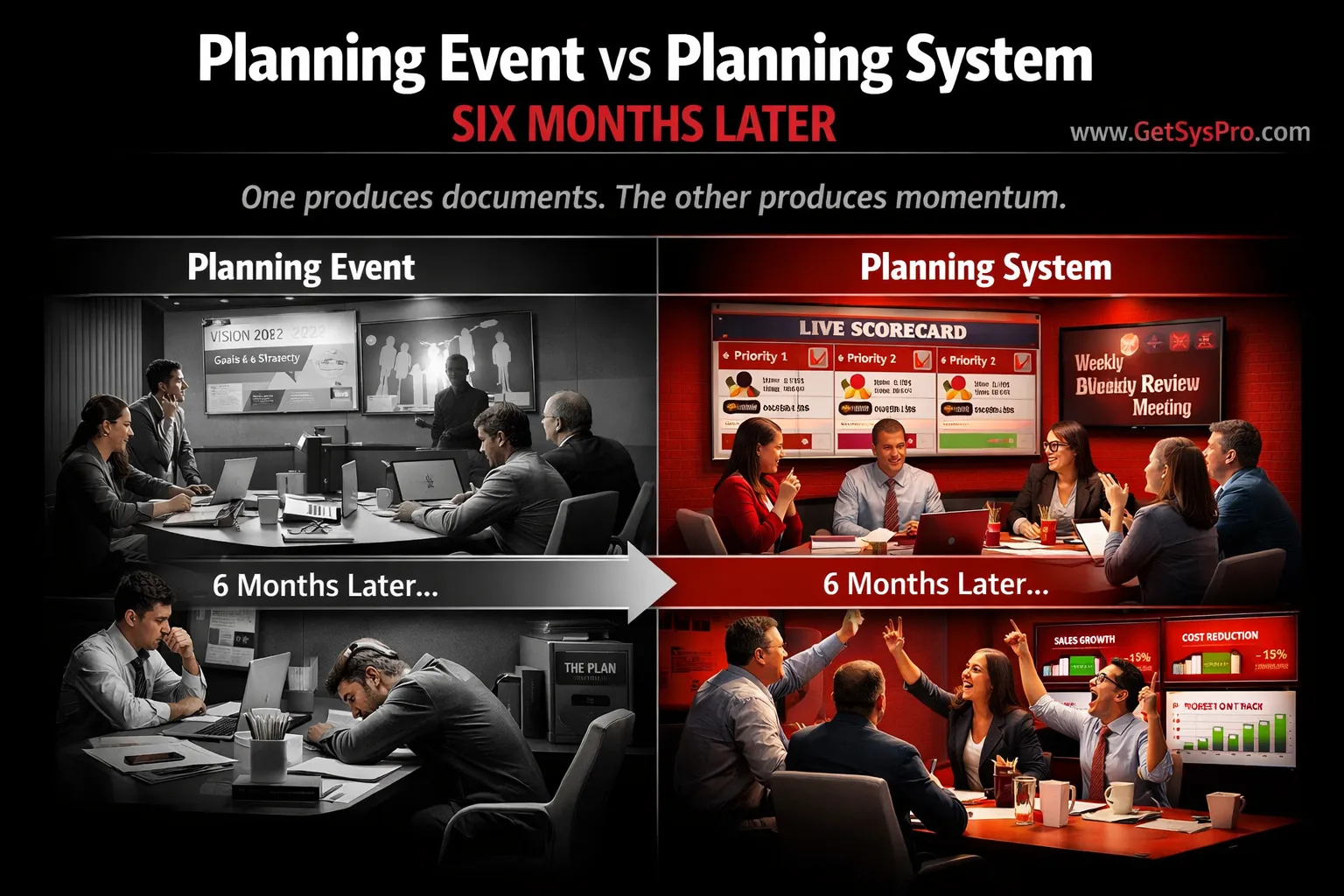
A planning event produces a document. A planning system produces momentum. Six months later the difference is visible in every metric. www.GetSysPro.com
Article Summary
Strategic planning without execution fails at the structural level, not the vision level. Translation is the missing layer that moves strategy from concept to workflow. Planning events generate ideas; planning systems convert ideas into accountable priorities with owners, scorecards, and review cadence. Single-point ownership is the most powerful execution variable. Cadence converts strategy from an annual event into a continuous operating discipline. Decision rights clarity enables speed. Financial and operational alignment completes the strategic plan. GetSysPro builds the execution architecture that makes strategic planning produce organizational momentum rather than organizational fatigue.
Strategy Without Execution Is Noise. Build the Architecture That Makes It Signal.
GetSysPro builds the ownership structures, cadence, decision rights, and workflow documentation that convert strategic planning into measurable organizational progress.
Frequently Asked Questions
What is the most common reason strategic planning without execution produces no organizational change?
The most common reason is the absence of a translation layer between strategic direction and operational behavior. Strategy is stated clearly in the planning session and then cascaded as the same high-level direction rather than translated into specific ownership assignments, measurable commitments, and documented workflow changes. Teams receive the strategic direction and continue executing against the measurement system that was in place before the planning session because nobody updated that system to reflect the new priorities. Strategic planning without execution architecture changes what leadership talks about without changing what the organization does.
How do you distinguish a planning event from a planning system?
A planning event produces a document or a deck. A planning system produces a set of specific, accountable commitments with named owners, measurable outcomes, defined timelines, a scorecard tracking leading indicators, and a cadence that reviews progress and drives decisions. The test is simple: after the session, does each strategic priority have a single named owner, a specific measurable outcome, and a defined date? Does a review cadence exist to track whether execution is on trajectory? If the answer to either question is no, the organization ran a planning event rather than building a planning system.
Why do decision rights matter so much in strategic execution?
Strategic priorities almost always require resource shifts that fall outside normal operational boundaries. Without defined decision thresholds, every non-routine decision escalates to leadership. Leadership is already operating at capacity with operational demands. Decisions sit in queue waiting for attention that has not arrived, momentum dies in the delay, and the initiative that required a timely resource decision falls behind schedule before it properly begins. Decision rights clarity eliminates that bottleneck by empowering the people closest to the work to make the decisions the work requires. Speed in execution depends more on decision rights clarity than on the quality of the people executing.
How often should strategic priorities be reviewed for a growing company?
Growing companies benefit from a three-interval cadence. Weekly reviews focus narrowly on execution metrics, constraints that need clearing, and decisions that need making this week. Monthly reviews connect execution progress to the financial model, examining variance from forecast and adjusting tactical approaches when the data indicates the current approach is not producing the expected outcome. Quarterly reviews assess whether the current priorities remain the right priorities given what the organization has learned, what capacity actually exists, and what tradeoffs are necessary when demands exceed available execution bandwidth. Annual planning sets direction. The three-interval cadence converts that direction into continuous organizational momentum.
How do you know when strategic planning without execution architecture has become a cultural problem?
The clearest signal is cynicism: when experienced team members hear new strategic initiatives announced and privately predict they will not materialize into sustained organizational change. That cynicism is rational. It reflects a pattern the team has observed repeatedly where strategic planning without execution architecture produces energy and documents but not behavioral change. Restoring execution credibility requires not just building the execution architecture but demonstrating through consistent cadence and visible follow-through that this iteration of strategic planning will produce different outcomes. Credibility is rebuilt through evidence, not through communication, and the evidence requires sustained execution over multiple quarters before the organizational skepticism that repeated failure creates begins to diminish.