06/20/2024
Why high performers leave growing companies has nothing to do with the work being hard. They leave because the environment makes excellence difficult, and difficulty without reward eventually becomes a decision.
Why high performers leave growing companies is one of the most misdiagnosed problems in scaling organizations. Leaders assume compensation. HR assumes culture. Nobody looks at the operating model. But the pattern is consistent and structural: unclear priorities, stalled decisions, inconsistent accountability, and constant rework turn high output into high friction. The company grows. The best people leave. Revenue rises and talent declines simultaneously, which looks like a contradiction until you understand that growth without structure is a retention crisis in slow motion.
This article names the specific structural conditions that drive high performers out of growing companies and what to build to stop it.
In This Article
Key Takeaways
- Why high performers leave growing companies is almost always structural, not motivational. Blurred ownership, leadership bottlenecks, inconsistent standards, and operational noise are the actual drivers.
- High performers want defined responsibility, measurable ownership, and authority aligned with accountability. When the organization cannot tell them what winning looks like, they eventually stop trying to win there.
- Leadership bottlenecks teach capable people to wait. High performers do not stay in environments where autonomy is constrained but accountability remains high.
- Inconsistent performance standards are more damaging than high standards. Strong employees can tolerate difficulty. Arbitrary expectations produce disengagement.
- Structure is a retention strategy. If your best people are leaving while revenue rises, growth has outpaced structure and the operating model needs redesign before the talent problem compounds further.
High Performers Leave When Ownership Is Blurred
High performers do not need easy. They need clear. Defined responsibility, measurable ownership, and authority that aligns with accountability are the conditions under which strong operators thrive. Strip those conditions away and the same person who produced exceptional results becomes frustrated, disengaged, and eventually gone.
In loosely structured growing companies, ownership blurs predictably. Projects overlap because role boundaries were never drawn. Handoffs multiply because accountability was never assigned explicitly. Decision-making slows because nobody is certain who has the authority to act. Effort rises while outcomes stay uncertain, and high performers make a rational calculation: the return on their effort here is declining.
This Is a System Design Problem, Not a Motivation Problem
Leaders often misread the signal. A high performer who disengages or exits looks like someone who stopped caring. In most cases, they stopped because the organization stopped giving them anything concrete to care about. When the system cannot define what winning looks like, high performers cannot keep winning. They do not leave because the work got hard. They leave because the work got pointless, and pointless is something no level of compensation fully compensates for.
Gallup’s research on employee engagement establishes that knowing what is expected at work is the foundational condition for performance and retention. Gallup’s Q12 framework places expectation clarity at the base of engagement, ahead of recognition, development, and every other driver organizations typically focus on when retention becomes a problem.
“Why high performers leave growing companies is almost never about compensation or culture in isolation. It is about structure. When ownership is unclear, autonomy is constrained, and standards shift informally, the operating environment itself becomes the reason they leave.”
Editorial, GetSysPro Team
Leadership Bottlenecks Drain Autonomy
Permission-based execution is a talent exit strategy. When every meaningful decision requires top-level approval, pace collapses and capable team members feel underutilized. Initiative declines not because people lose ambition but because the system repeatedly demonstrates that initiative does not produce outcomes. Waiting does. And waiting is not something high performers accept indefinitely.
This pattern is especially damaging in growing companies because the bottleneck worsens as volume increases. More decisions route upward, leadership bandwidth compresses further, and execution slows precisely when the market demands speed. The company teaches its best people that capability is not what determines pace. Access to the founder’s calendar does.
Autonomy and Accountability Cannot Be Decoupled
High performers accept high accountability because they believe their effort will produce outcomes. Remove autonomy while keeping accountability high and that belief collapses. The person remains responsible for results they no longer control, which is the specific condition that converts high performers into departure candidates. Distributed decision rights, explicit thresholds, and defined authority boundaries are the structural fixes. They do not require trusting people blindly. They require defining clearly what each role can decide without escalation and enforcing that definition consistently.
Inconsistent Performance Management Breaks Trust
Strong employees can tolerate difficult standards. What they cannot tolerate is arbitrary ones. When performance expectations shift informally, feedback arrives reactively, and recognition feels uneven, the operating environment communicates something specific: the rules change based on circumstances rather than on documented standards. High performers are particularly sensitive to this because they invested effort based on a set of expectations that apparently no longer apply.
Without a structured review cadence and documented performance criteria, managers default to subjective evaluation. Subjective evaluation rewards presence over output, personality over performance, and relationships over results. High performers who consistently deliver exceptional results under objective criteria lose ground to average performers who manage relationships more effectively under subjective ones. That inversion produces a fast exit.
What Clarity of Expectations Actually Produces
Documented performance expectations do more than reduce ambiguity. They change how employees experience their roles. When team members understand precisely what success looks like, they direct effort toward producing it rather than decoding what leadership actually wants this week. That shift from interpretation to execution is where high performer output compounds. Gallup’s engagement research is direct on this point: managers must define and discuss expectations explicitly rather than assuming they are shared, because ambiguous expectations drain the discretionary effort that separates high performers from everyone else.
Rework and Operational Noise Push Them Out
Workflow chaos is a retention problem that most organizations misclassify as an operational inefficiency. It is both, but the retention dimension is the more expensive one.
Over time, that pattern produces a specific and quiet conclusion: output here is capped by the system, not by capability. A high performer who reaches that conclusion does not immediately quit. They stop investing discretionary effort. Then they start looking. Then they leave, often to a competitor whose operating model lets them produce at a level the previous organization structurally prevented.
When processes are undefined, high performers compensate for the system. Preventable errors get fixed manually. Deliverables that missed unstated standards get rewritten. Priorities get translated across teams that received different instructions, and standards get rebuilt informally on each project because no documented version exists to reference.
Documentation Removes Noise. Noise Removes High Performers.
The argument against documentation in growing companies is speed. “We move too fast to document everything.” That argument is precisely backwards. Undocumented processes require every team member to reconstruct the standard from scratch on every execution, which consumes more cumulative time than documentation would have required. The real cost of undocumented operations is not the time it takes to write them down. It is the rework, inconsistency, and talent attrition that undocumented operations produce continuously until someone addresses them.
Are your best people leaving while revenue keeps rising?
GetSysPro builds the organizational structure, decision rights, and process documentation that let high performers operate at their ceiling rather than someone else’s.
The Real Cost of Losing a High Performer
Organizations consistently underestimate the cost of high performer departure because they calculate replacement cost rather than total cost. Replacement cost includes recruiting time, hiring fees, and onboarding overhead. Total cost includes the output that did not happen during the vacancy, the institutional knowledge that left with the person, the morale impact on the team that remains, and the competitive advantage transferred to whoever hired them next.
SHRM-based estimates frequently place replacement costs at six to nine months of the departing employee’s salary for professional roles. Research on the cost of replacing an employee reinforces that retention is an economic decision, not just a cultural one. For high performers specifically, the multiplier is higher because their output contribution per role typically exceeds that of the average employee in the same position by a significant margin.
Why Growing Companies Undercount the Attrition Cost
Growing companies undercount attrition cost for a structural reason: revenue growth masks talent deterioration. When revenue rises, it absorbs the cost of turnover temporarily. The financial statements look healthy while the talent base quietly degrades. By the time the talent deterioration becomes visible in financial performance, the organization has been losing high performers for months or years and the structural gaps that drove them out have compounded. Fixing the talent problem at that stage requires significantly more structural work and significantly more time than fixing it before revenue growth stopped concealing it.
Structure Is a Retention Strategy
If your best people are leaving while revenue rises, that is not a contradiction. It is a diagnostic signal that growth has outpaced structure. The operating model that worked at smaller scale has not evolved to match the organization’s current complexity, and high performers feel that gap more acutely than anyone else because they operate closest to the ceiling the structure imposes.
The most resilient growing companies treat structure as a retention strategy rather than an administrative overhead. Defined goals and measurable metrics give high performers something concrete to optimize against. Transparent reporting and role ownership answer the “who owns what” question that structural ambiguity leaves permanently open. Documented workflows reduce the operational noise that converts high output into high frustration. Distributed decision rights restore the autonomy that permission-based execution eliminates.
GetSysPro Services That Address the Structural Retention Gap
GetSysPro Organizational Chart Development clarifies reporting relationships, ownership, and authority boundaries so high performers stop operating in constant clarification mode and start executing against defined responsibility.
GetSysPro Process and SOP Architecture reduces operational noise by documenting workflows and standardizing delivery so high performers stop compensating for the system and start producing at the level they are actually capable of.
High performers stay where they can win. Winning requires defined systems, clear ownership, and an operating environment that amplifies capability rather than constraining it. Build that environment and the retention problem largely resolves itself, because the structural conditions that drive high performers out no longer exist.
Related GetSysPro Services
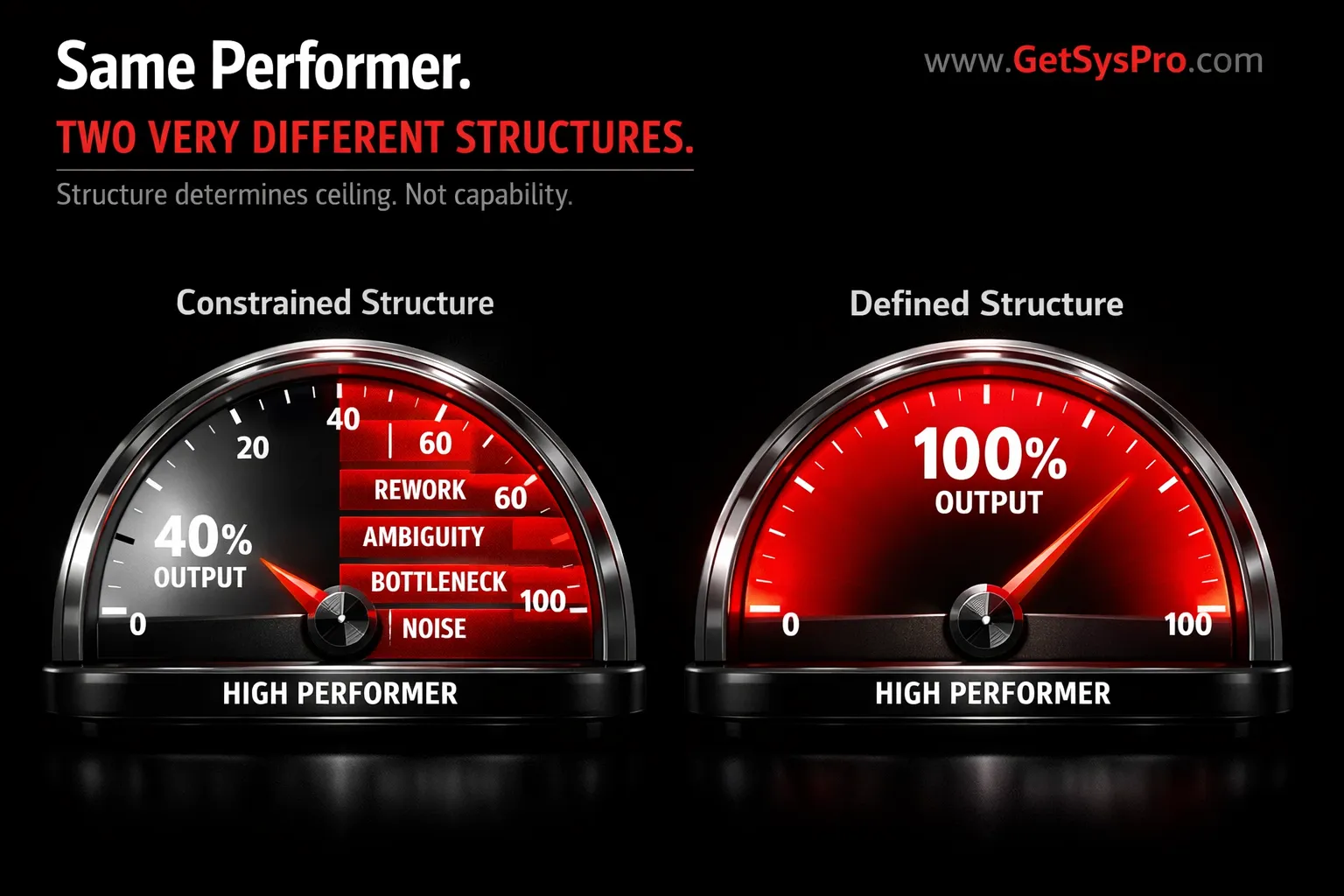
Same performer. Two structures. One produces 40 percent. The other produces 100. GetSysPro builds the one that produces 100. www.GetSysPro.com
Article Summary
Why high performers leave growing companies is a structural problem, not a motivational one. Blurred ownership, leadership bottlenecks, inconsistent performance standards, and operational noise are the four structural conditions that convert excellent operators into departure candidates. Replacement costs run six to nine months of salary for professional roles, and total attrition cost significantly exceeds that when output loss and institutional knowledge transfer are factored in. Structure is a retention strategy. Defined goals, transparent ownership, documented workflows, and distributed decision rights create the operating environment where high performers stay and produce rather than leave and compete.
High Performers Stay Where They Can Win. Build That Environment.
GetSysPro builds the organizational structure, decision rights, and process documentation that retain your best people by removing the structural conditions that drive them out.
Frequently Asked Questions
What specifically makes growing companies more likely to lose high performers than stable ones?
Growth adds complexity faster than most organizations add structure. Role boundaries blur as headcount increases and new functions emerge without defined ownership. Decision rights that worked informally at smaller scale create bottlenecks at larger scale. Performance standards that the founding team shared implicitly never get documented, so new team members and growing teams operate on different interpretations of what excellence looks like. Each of those structural gaps is more damaging to high performers than to average performers because high performers operate closest to the edges of what the structure allows.
Can compensation fix the retention problem if the structural issues exist?
Compensation can delay the exit but cannot prevent it. A high performer who stays for a raise while the structural conditions remain unchanged will reach the same conclusion in six to twelve months: the operating environment caps their output and the compensation no longer compensates for that constraint. Gallup’s research consistently shows that expectation clarity and defined ownership rank above compensation as drivers of sustained engagement. Addressing structural gaps produces retention that compounds. Compensation produces a temporary reprieve that requires repeating.
Our company has strong culture. Why would high performers still leave?
Culture and structure are not substitutes for each other. Strong culture produces belonging, shared values, and a positive experience of the work environment. It does not produce clear ownership, distributed decision authority, or documented performance standards. A high performer can genuinely value the culture while simultaneously finding the structural conditions intolerable. They will often try to articulate the problem as a cultural issue because the structural gaps do not have obvious names in most organizations. The diagnosis requires looking past the culture narrative to the operating model beneath it.
How do you identify which structural gaps are driving the attrition before it becomes a crisis?
The most reliable signals appear before exit interviews. Escalation frequency is one: when decisions that should resolve within teams consistently route to leadership, decision rights are unclear and the bottleneck is already forming. Rework rate is another: when the same types of errors recur across projects, process documentation is absent and high performers are compensating manually. Declining initiative is the third: when capable team members stop proposing solutions and start waiting for direction, autonomy has been constrained long enough to change their behavior. Any one of those signals warrants a structural audit before the talent the organization most needs to retain makes its exit decision.
Is structural redesign disruptive to a company that is actively growing?
Structural redesign targeted at specific gaps is far less disruptive than the attrition it prevents. A focused intervention that defines decision thresholds, documents core workflows, and clarifies role ownership does not require pausing growth or reorganizing the entire company. It addresses the specific structural conditions generating the most friction and does so sequentially by impact priority. The disruption risk is in comprehensive overhauls attempted all at once. Targeted structural improvement applied to the highest-leverage gaps consistently reduces friction rather than creating it, which is why the organizations that invest in it during growth periods scale more smoothly than those that defer the work.