 11/28/2023
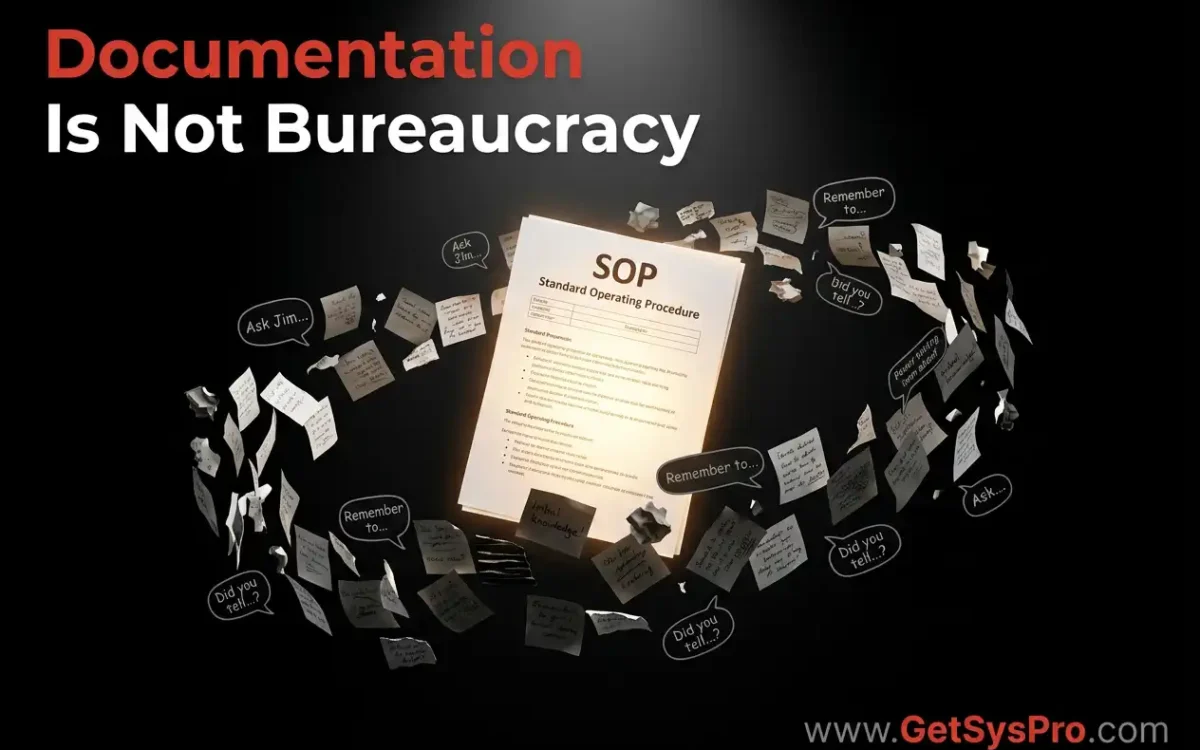
Documentation is not bureaucracy. It is the infrastructure that makes a business run without its founder in every room.
Documentation is not bureaucracy, and the businesses that understand this distinction scale differently from the ones that do not. Most growing businesses avoid documenting workflows because it feels slow, corporate, or unnecessary when things seem to be working. The problem is that things stop working the moment complexity rises beyond what any one person can oversee, and undocumented businesses discover this at the worst possible time.
This article explains what documentation actually does for a growing business, where it has the most impact, and how to think about it as operational infrastructure rather than administrative overhead.
In This Article
- The Difference Between a Policy Manual and an Operational System
- How Written Processes Create Compounding Operational Leverage
- How Documentation Fixes Onboarding and Reduces Drift
- Documentation Protects the Business When Key People Leave
- Fewer Meetings, Clearer Handoffs, Less Repeated Work
- How Documentation Makes Delegation Safe
- How GetSysPro Builds Documentation That Actually Gets Used
- Frequently Asked Questions
Key Takeaways
► Documentation is not bureaucracy. It is leverage that converts tribal knowledge into repeatable execution across the entire organization.
► Undocumented businesses create dependency on specific people, which makes them fragile, slow to scale, and hard to delegate within.
► Documentation reduces rework, shortens onboarding, protects against key person risk, and eliminates the meetings that exist only to answer questions the process should already answer.
► Effective documentation answers four questions: what triggers the process, who owns it, what done looks like, and what gets escalated.
► GetSysPro builds living, operational documentation tied to ownership so businesses can grow without adding chaos at every stage.
The Difference Between a Policy Manual and an Operational System
The reason most founders resist documentation is that they associate it with large companies producing thick policy manuals that nobody reads. That association describes bad documentation accurately. What it misses entirely is what documentation actually needs to do for a growing business.
Effective documentation does not produce binders of rules. Clarity about how work moves is the actual output. A documented process answers practical questions: what triggers this workflow, who owns each step, what the output looks like, and what requires escalation. Any business can write that down for its ten most common processes in a week. The result is not a corporate handbook. A functioning operational system is what gets built instead.
Founders can usually explain every workflow verbally. They know how onboarding works, how billing moves, how approvals flow, and how vendor decisions get made. That knowledge exists. The problem is that it lives in memory, which means it lives in one place and travels nowhere without the person who holds it. Documentation moves that knowledge out of memory and into the organization, where it becomes accessible, consistent, and scalable.
“Documentation is not what big companies do after they scale. It is what scalable companies do to scale. The difference in timing is the difference between building a business and managing a bottleneck.”
Editorial, GetSysPro Team
How Written Processes Create Compounding Operational Leverage
Leverage in business means getting more output from the same input. Documentation creates leverage by making knowledge reusable. A founder who explains a process once to a team member creates a one-time transfer. A founder who documents that process creates a permanent asset the entire organization can draw from without anyone asking again.
The compounding effect of this matters most as volume grows. Every small efficiency that documentation creates multiplies across more transactions, more clients, and more employees. A process that takes ten minutes less per execution saves one hour when repeated six times, one full day when repeated forty-eight times, and weeks per year as the business scales. That is leverage.
Documentation also returns time to leadership by reducing the number of decisions founders handle. Teams stop interrupting for routine questions because the process answers them. Leaders recover bandwidth for higher-impact work, and what emerges is a more strategic leadership layer that can finally operate above the operational noise.
The Compounding Return on Every Process Written Down
What Makes Process Documentation Feel Slow and How to Fix It
The feeling that documentation slows things down comes from doing it wrong. Long policy paragraphs written from a legal perspective slow teams down. Answering the four practical questions above speeds them up. The distinction is not in the act of documenting but in what the documentation is designed to do.
Operational documentation answers: what starts this process, who owns each step, what the output looks like, and what requires escalation. If those four questions have clear answers in writing, the documentation works. If the documentation cannot be read and followed by a new team member in under an hour, it is too complex and needs simplification.
How Documentation Fixes Onboarding and Reduces Drift
Onboarding is where operational drift begins in most scaling businesses. Without documented standards, every new hire learns the process slightly differently depending on who trains them, which day they start, and which questions they think to ask. That inconsistency becomes part of the delivery model and creates variation the business did not choose and cannot easily control.
Documented onboarding steps and role expectations fix this by making the standard independent of the trainer. A new hire following documented processes learns the same version of how work gets done as every person before and after them. Ramp time drops. Error rates follow. Senior people stop carrying the informal training burden that documentation should handle.
The downstream effect on retention is real. Employees who join clear organizations with defined roles and documented processes understand what good looks like from day one. That clarity reduces the frustration and uncertainty that contribute to early turnover. It also reduces the informal burden on existing team members who otherwise spend their first weeks explaining things that should already have a written answer.
The Connection Between Documentation and Consistent Client Experience
Client experience is a direct output of delivery consistency. When documentation standardizes how work moves, clients receive a more predictable experience regardless of which team member handles their work. That consistency builds trust faster, generates better reviews, and reduces the service recovery situations that consume leadership time and margin.
Businesses that rely on informal knowledge to deliver consistently are betting that personnel stays stable and memory stays reliable. Both bets lose over time. Documentation removes the bet.
Documentation Protects the Business When Key People Leave
Every undocumented business carries an invisible risk that only becomes visible when a key person leaves. Consider the operations manager who understood the billing process, the project lead who owned every client relationship, or the founder who handled vendor negotiations personally. When any of those people leave, the knowledge they carried leaves with them.
This risk scales with the business. Five people where the founder holds all knowledge is fragile but recoverable. Thirty people with five undocumented knowledge holders across departments face a much more serious exposure. Any one departure creates operational confusion that takes weeks or months to absorb.
Documentation converts personality-based execution into system-based execution. Processes run because they are written down and understood, not because one specific person is present. Business continuity at the operational level means exactly this. A design principle built into daily work replaces the contingency plan that only gets considered after something breaks.
Spreading Knowledge Across the Organization Instead of Concentrating It in People
Key person risk is a concept widely understood in finance and insurance but underappreciated in operations. A business that would struggle to function without a specific individual has concentrated operational risk in the same way a portfolio concentrates financial risk. Documentation distributes that risk by spreading knowledge across the organization rather than concentrating it in individuals.
The investment in documentation before someone leaves is always smaller than the cost of rebuilding knowledge after they do. Businesses that wait until a departure forces the issue pay that cost at the worst possible time, when the person is no longer available to fill the gaps they left.
Is your business running on tribal knowledge?
GetSysPro documents your workflows, standardizes execution, and builds the operational infrastructure that makes your business run without depending on any single person.
Fewer Meetings, Clearer Handoffs, Less Repeated Work
Many cross-functional problems in growing businesses do not come from poor communication. They come from undefined boundaries. Marketing assumes operations can deliver faster than capacity allows. Sales commits to timelines without knowing the delivery standard. Finance does not know the operational triggers for billing. Each of these misalignments generates a meeting or an escalation that should not have been necessary.
Clear documentation eliminates this class of problem by making handoffs, inputs, outputs, and decision thresholds visible to everyone who needs them. A cross-functional meeting that exists only to clarify what one department expects from another is a symptom of undocumented boundaries. Write the boundaries down once and the meeting stops recurring.
Using Documentation to Define Ownership and Reduce Confusion
One of the most practical frameworks for documenting cross-functional ownership is a responsibility assignment matrix, which maps tasks to the roles that own, approve, consult on, and need visibility into each one. Defining these relationships in writing reduces the ambiguity that generates unnecessary coordination overhead and makes accountability clear without requiring a meeting to establish it each time.
Documentation does not eliminate collaboration. It makes collaboration more productive by ensuring that when people do meet, they spend time on decisions rather than on clarifying what should already be known. The quality of meetings improves when the groundwork is documented. The number of unnecessary meetings drops.
How Documentation Makes Delegation Safe
Delegation fails most often not because the person receiving the task lacks capability but because the expectation lacks definition. Without documented standards, founders hesitate to release control because outcomes feel unpredictable. Stepping back in when something goes wrong trains the team that the founder will always re-enter, which reduces the team’s ownership of the outcome.
How a Written Standard Breaks the Re-Entry Cycle
Documentation breaks that cycle. A process with a written standard gives the person taking ownership a clear picture of what good looks like, what triggers escalation, and what the boundaries of their authority are. The founder can release the work with confidence because the system carries the expectation rather than the relationship. Delegation becomes structural rather than interpersonal.
This is how documentation creates real operational freedom for founders. Every process that moves from memory into a written standard stops requiring the founder’s direct involvement to run correctly.
What Good Documentation Looks Like in Practice
Effective process documentation is short, specific, and action-oriented. It names the trigger that starts the process, lists the steps in order, assigns an owner to each step, defines what the completed output looks like, and specifies what requires escalation and to whom. A well-written SOP fits on one page for most operational processes. If it takes more than that, the process itself may need simplification before the documentation does.
Documentation should also live somewhere the team actually uses. A shared drive folder that nobody visits is not a documentation system. A process embedded in the tools the team uses every day is. The medium matters as much as the content.
How GetSysPro Builds Documentation That Actually Gets Used
Most documentation efforts fail not because the idea is wrong but because the execution disconnects from how the business actually operates. Documents get written once, stored somewhere, and never updated. Teams route around them rather than through them, and the documentation becomes a liability rather than an asset.
GetSysPro builds documentation differently. Every process document connects to a role owner, a trigger, a standard, and a review cadence. It lives inside the operational system rather than alongside it. Teams use it because it answers the questions they actually have, not the questions someone anticipated they might have six months ago.
Which GetSysPro Services Address Documentation Gaps
When role clarity is the bottleneck and processes float between people without clear ownership, GetSysPro Organizational Chart Development defines who owns what so documentation has a home and an accountable person to maintain it.
When tribal knowledge drives rework and inconsistency across delivery, GetSysPro Process and SOP Architecture converts that knowledge into written standards that teams can follow, train from, and build on as the business grows.
Documentation is not bureaucracy. It is the operational infrastructure that makes a business scalable, resilient, and safe to grow.
Related GetSysPro Services
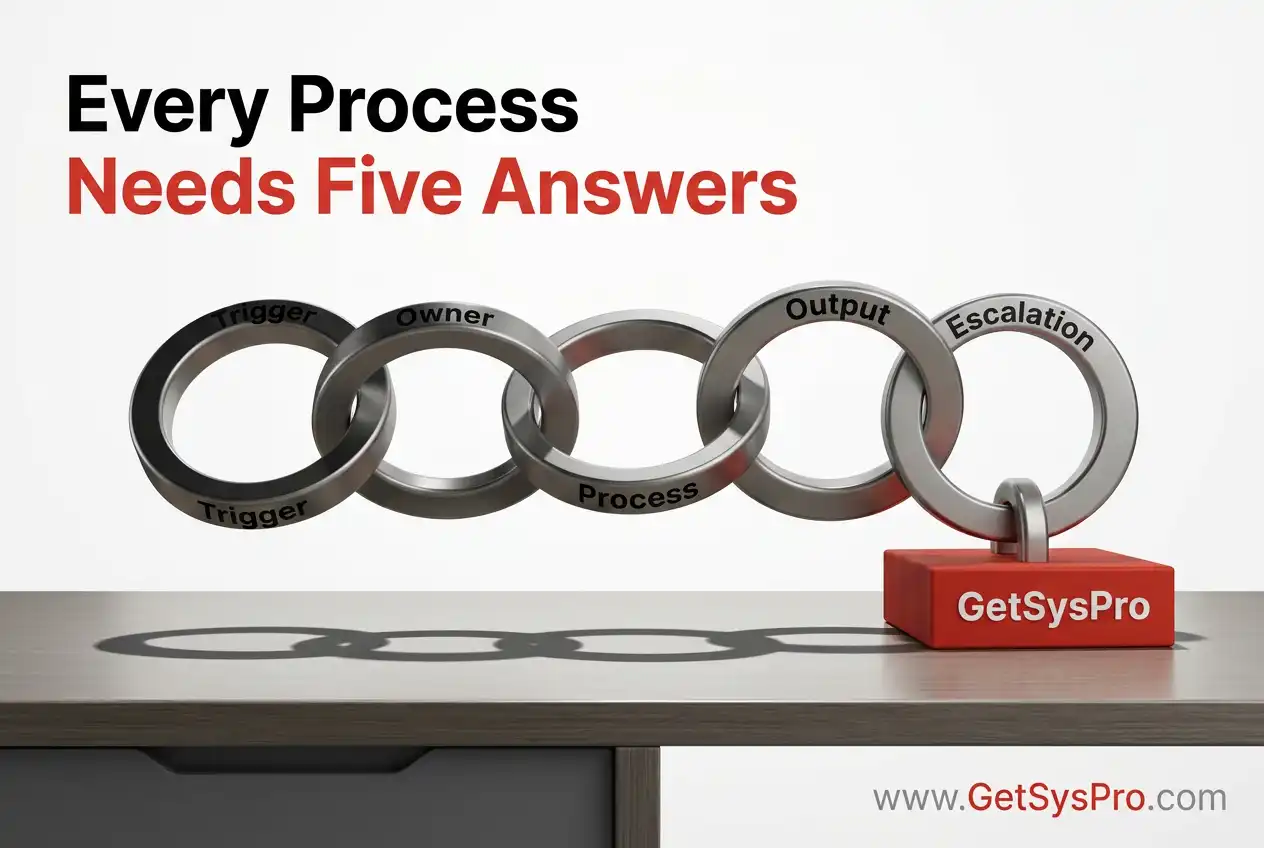
Five questions. One documented process. Scalable execution. www.GetSysPro.com
Article Summary
Documentation is not bureaucracy. It is the operational infrastructure that converts tribal knowledge into repeatable execution, makes delegation safe, protects the business when key people leave, and eliminates the meetings that exist only to answer questions the process should already handle. Effective documentation is short, specific, action-oriented, and tied to a role owner. GetSysPro builds documentation that teams actually use by connecting every process to a trigger, an owner, a standard, and a review cadence rather than filing it in a folder nobody opens.
Documentation Is Not Bureaucracy. It Is How You Scale Without Chaos.
GetSysPro builds the process documentation and SOP architecture that makes your business run predictably at any size.
Frequently Asked Questions
Why is documentation not bureaucracy in a growing business?
Because bureaucracy creates rules for the sake of control while documentation creates clarity for the sake of execution. Effective operational documentation answers four practical questions: what triggers the process, who owns each step, what done looks like, and what requires escalation. A team that has those answers in writing moves faster and more consistently than one that has to ask a manager or wait for the founder every time a question arises.
What does good operational documentation include?
Good operational documentation names the trigger that starts a process, lists the steps in order with a clear owner for each, defines what the completed output looks like, and specifies what requires escalation and to whom. Most operational processes fit on one page when written this way. Documentation that runs longer than that usually signals a process that needs simplification before the writing does.
How does documentation reduce key person risk in a business?
By moving knowledge out of individual memory and into the organization. An undocumented business concentrates operational knowledge in specific people. When those people leave, the knowledge leaves with them. Documentation distributes that knowledge across the organization so processes continue running based on what the system contains rather than who is present on any given day.
How does documentation make delegation safer for founders?
Delegation fails when the expectation lacks definition. A founder who delegates a task without a written standard has transferred the work but kept the anxiety. A documented process gives the person receiving the task a clear standard, an escalation path, and defined boundaries. The founder can release the work with confidence because the system carries the expectation rather than the personal relationship.
How does GetSysPro approach process documentation differently?
GetSysPro connects every process document to a role owner, a trigger, a standard, and a review cadence so documentation lives inside the operational system rather than alongside it. Most documentation efforts produce files that teams work around rather than through. GetSysPro builds documentation that teams actually use by designing it around the questions they actually have during real execution.
Last Updated: [the_modified_date format=”F j, Y”]