 11/14/2023
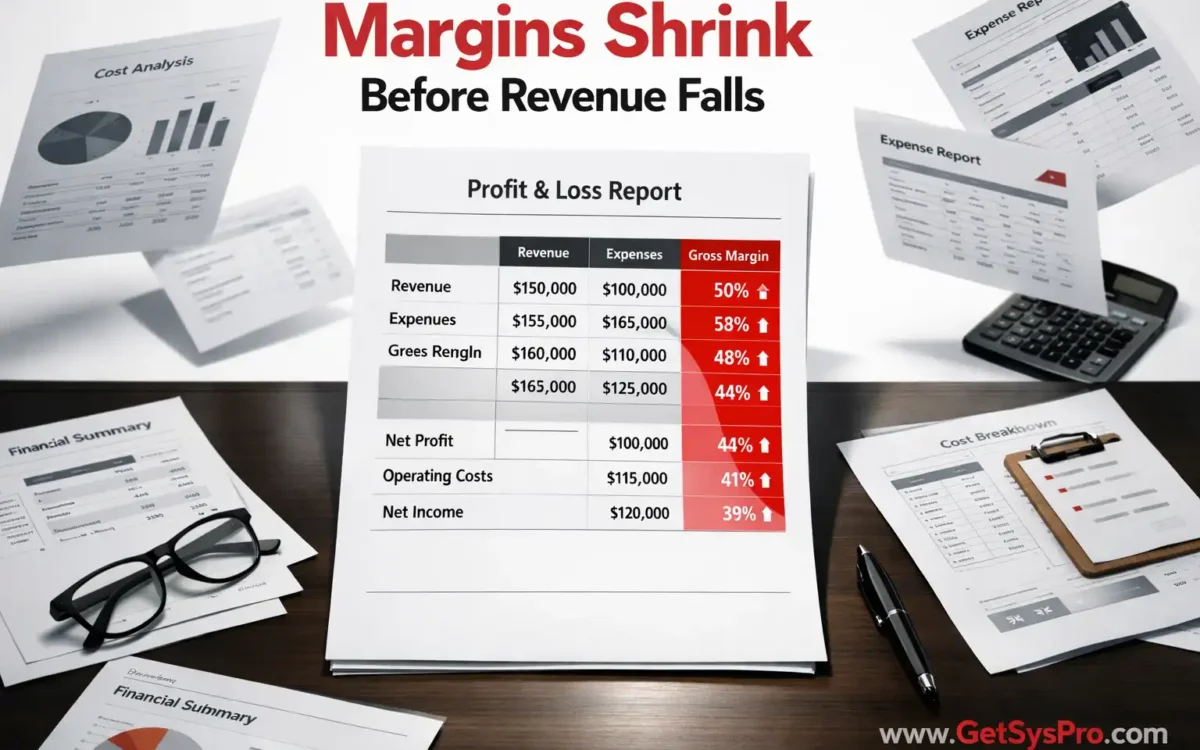
Margins shrink before revenue falls. By the time the numbers show up on a report, the damage is already done.
Margins shrink before revenue falls, and that timing gap is exactly why so many growing businesses miss the warning signs until it is too late to respond cheaply. Revenue can keep climbing for months while profitability erodes underneath, driven by inefficiency, rework, scope drift, and unmanaged costs that never show up as a single line item but accumulate steadily across every department.
Understanding where margin compression starts, how it builds, and what operational disciplines prevent it is one of the most practical financial education investments a business owner can make. This article walks through each stage clearly.
In This Article
- Why Margins Shrink Before Revenue Falls: Understanding the Pattern
- How Labor Inefficiency Causes Margins to Shrink Before Revenue Falls
- How Rework and Inconsistency Silently Erode Profitability
- Scope Drift: Another Reason Margins Shrink Before Revenue Falls
- Vendor Creep: How Costs Cause Margins to Shrink Before Revenue Falls
- Margin Visibility Stops Margins Shrinking Before Revenue Falls
- How GetSysPro Builds the Operational Structure That Protects Profitability
- Frequently Asked Questions
Key Takeaways
► Margin compression almost always starts operationally before it shows up financially. Revenue growth can mask it for months.
► Labor cost, rework, scope drift, and vendor creep are the four most common operational drivers of shrinking margins in growing businesses.
► Margin protection requires operational design, not just financial monitoring. The fix happens upstream in workflows and accountability structures.
► Treating margin as an operational metric rather than a finance output changes how quickly problems are identified and corrected.
► GetSysPro builds the process structure, role clarity, and oversight systems that protect margins before compression becomes a crisis.
Why Margins Shrink Before Revenue Falls: Understanding the Pattern
Margin compression is the gradual narrowing of the gap between what a business earns and what it costs to deliver. Gross margin, operating margin, and net margin all measure different layers of this gap, but compression in any one of them is a signal that costs are rising faster than revenue or that revenue is not covering delivery costs as efficiently as it once did.
The reason margin compression hides so effectively is that it rarely announces itself. It builds through dozens of small inefficiencies that each look minor in isolation. A project that runs two days over. A vendor invoice that increased five percent without a formal renegotiation. A client who asked for one extra revision that became three. A handoff that required a clarifying meeting that should not have been necessary. None of these feel like a margin problem in the moment. Over time, they compound into one.
By the time quarterly reporting shows reduced net income, leadership often responds by revisiting pricing or marketing. Both can be legitimate levers, but both treat the symptom. The cause is almost always operational, and the fix requires going upstream to where the margin actually disappeared.
“Margin compression is not a pricing problem and it is not a sales problem. It is an operational problem. It shows up on the income statement, but it starts in the workflow.”
Editorial, GetSysPro Team
How Labor Inefficiency Causes Margins to Shrink Before Revenue Falls
Labor is typically the largest cost component in a service business, and it is also the one most vulnerable to margin erosion through inefficiency. When workflows are unclear, people spend time figuring out what to do next, who owns which piece of a task, and what the standard looks like. That time is not billed. It is absorbed as overhead and it narrows margin quietly with every hour spent.
Growth compounds the problem in a predictable way. A larger client base demands more coordination. A bigger team generates more communication overhead. Greater complexity forces more on-the-fly decisions because the documented process does not exist. Each dynamic increases labor cost per unit of output, which means the revenue from delivering a service buys less profit than before even if the price has not changed.
Understanding labor cost per project or per service line is one of the clearest tools for identifying where margin is leaking. When a business can see that a specific service type consistently runs over its estimated labor hours, it can diagnose whether the issue is scoping, workflow design, team skill, or some combination. Without that visibility, margins shrink before revenue falls and no one connects the two until the damage is embedded.
How Rework and Inconsistency Silently Erode Profitability
Rework is one of the most expensive and underreported costs in a growing business. Doing something twice doubles the labor cost without generating any additional revenue. An incomplete handoff turns into a clarifying conversation that nobody budgeted for. A quality issue that surfaces after delivery requires a correction the business absorbs entirely to protect the client relationship.
None of these show up as a distinct line item called “rework” on most income statements. They hide inside labor hours, overtime, and reduced team capacity for new work. They also show up as client relationship strain, delayed payments, and discount pressure from clients who feel they did not receive what was promised.
Inconsistency in execution is almost always the root cause of rework. Different team members following different processes produce different quality levels. Incomplete handoffs between functions force the receiving party to fill gaps through unplanned effort. Absent quality standards make approval processes subjective, slow, and unpredictable.
Standardizing workflows through documented SOPs is not bureaucracy. It is margin protection. When the right way to do something is written down, followed, and enforced, variation drops, rework drops, and margin improves without changing the price charged to a single client.
Scope Drift: Another Reason Margins Shrink Before Revenue Falls
Scope drift is the quiet expansion of what a business delivers beyond what the original agreement covered and priced. It is extremely common in service businesses and it converts profitable work into marginal or loss-generating work faster than almost any other operational failure.
It typically starts with good intentions. A client asks for one small addition. The team accommodates because the relationship matters and the request seems minor. That sets a precedent. The next request is slightly larger. The one after that is larger still. By the time the project closes, the business has delivered significantly more than it priced, and the gross margin on that engagement has collapsed.
How to Stop Scope Drift Before It Destroys the Margin
The operational discipline that prevents scope drift is contract clarity combined with a defined change process. Specific and documented original scope makes it easy to identify when a request falls outside it. A defined change process names who evaluates the change, what triggers a pricing or timeline adjustment, and how the client receives notification. That structure turns scope changes into manageable decisions rather than margin-destroying accommodations.
Sales teams and delivery teams also need alignment on what the contract commits to. Sales closing on promises that delivery cannot fulfill within the priced scope means delivery absorbs the difference. Most businesses treat that alignment as optional until the cost becomes impossible to ignore.
Are your margins shrinking without a clear explanation?
GetSysPro audits the operational structure behind your costs and builds the systems that protect margin before it becomes a crisis.
Vendor Creep: How Costs Cause Margins to Shrink Before Revenue Falls
Vendor cost creep is the slow accumulation of small cost increases that individually seem insignificant but collectively represent meaningful margin compression. A vendor increases their rate by four percent. A subscription renews at a slightly higher tier. A service contract auto-renews without a renegotiation review. Each one is a minor increase. Across all vendors and over twelve months, the combined impact can be substantial.
The discipline that prevents vendor cost creep is a structured vendor review process. This means knowing when each major contract renews, reviewing actual versus contracted costs on a regular cadence, and approaching renewals proactively rather than reactively. Businesses that do this consistently find that they have more negotiating leverage than they expected and that small adjustments made regularly prevent the need for large, disruptive renegotiations later.
Subscription and software costs deserve special attention for growing businesses. Tools that made sense at ten employees may have pricing tiers designed for much larger organizations. As the business grows into higher usage tiers, costs increase automatically. Without regular audits of technology spend, these costs silently expand the overhead structure. This is precisely how margins shrink before revenue falls, one small unreviewed cost at a time.
Margin Visibility Stops Margins Shrinking Before Revenue Falls
The most important shift a business can make in margin management is treating margin as an operational metric rather than a finance output. This means measuring and reviewing margin at the project level, the service line level, and the department level on a regular cadence. Waiting until quarterly reporting means the damage is already done.
What Operational Margin Visibility Looks Like in Practice
Leaders who review margin at the project level can investigate why specific service types consistently underperform. A department whose labor costs trend up relative to output surfaces as a problem early enough to correct. A project showing significantly higher rework hours than comparable work allows the root cause to surface before it repeats.
Practical visibility practices that protect margin include standardized cost tracking by project or service line, defined approval processes for scope changes, consistent vendor contract review cadences, monthly gross margin analysis by department, and formal alignment between sales commitments and delivery capacity before contracts close.
None of these require sophisticated software. They require documented processes, defined ownership, and a review cadence that someone is accountable for maintaining. That is operational design, and it is exactly what margin protection requires.
How GetSysPro Builds the Operational Structure That Protects Profitability
GetSysPro approaches margin protection as an operational design problem. The question is not what the margin numbers say. The question is what in the operating model is producing those numbers and what structural changes will produce different ones.
When role clarity and accountability are weak and margin drivers fall between functions without clear ownership, GetSysPro Organizational Chart Development aligns ownership to outcomes so every cost driver has an accountable owner and margin protection becomes a role responsibility, not an afterthought.
When rework, inconsistency, and undocumented execution drive labor hours beyond what scoping and pricing assumed, GetSysPro Process and SOP Architecture standardizes how work moves so variation drops, rework drops, and margin improves without a single price increase.
Businesses that need a comprehensive view of where their operating model creates cost before committing to specific interventions can start with the GetSysPro Business Operational Systems Audit, which maps the full picture and sequences fixes in order of impact.
Margins shrink before revenue falls. The businesses that catch it early enough to redesign the system rather than react to the damage are the ones that protect profitability through every phase of growth.
Related GetSysPro Services
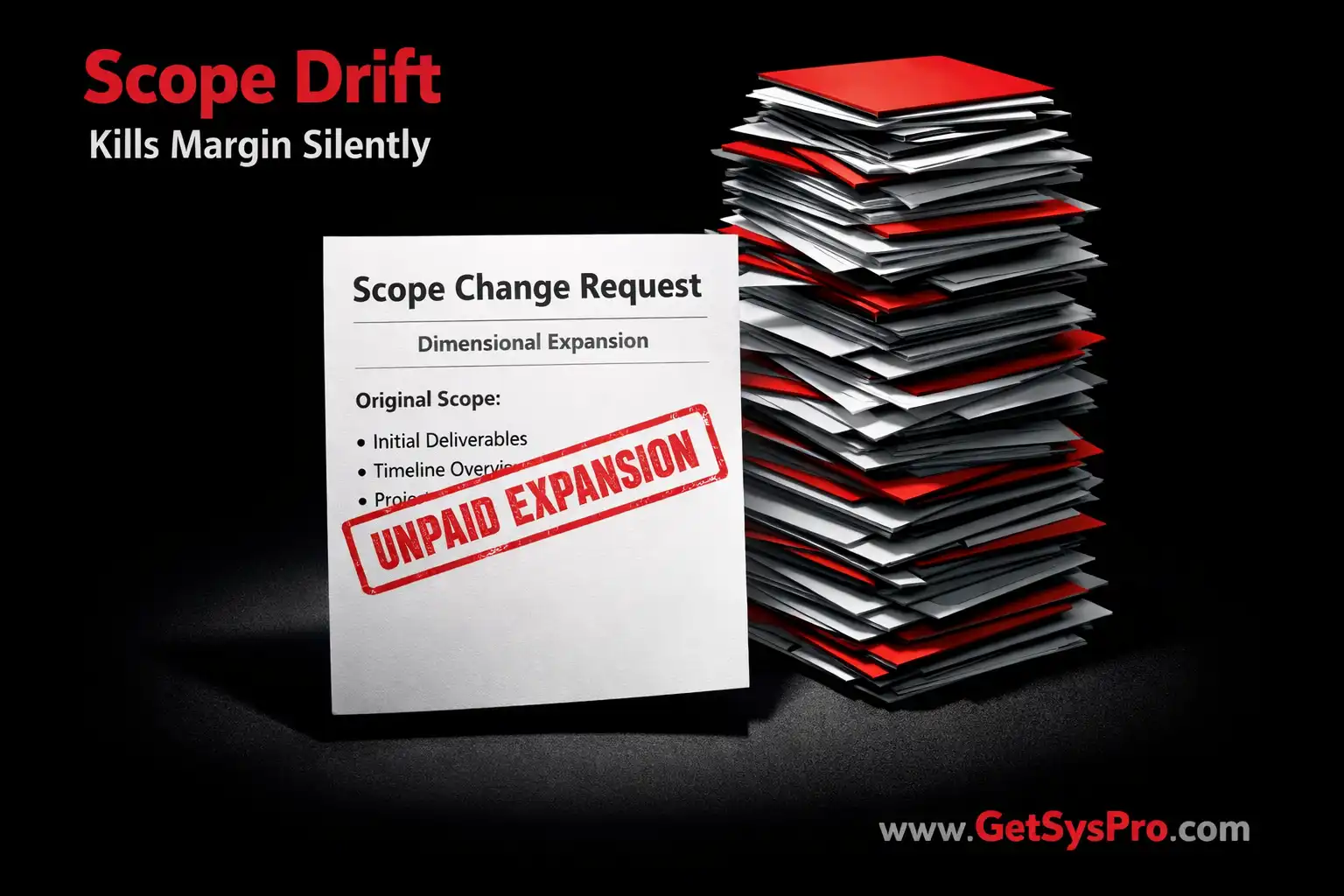
Scope drift converts profitable work into marginal work one small request at a time. www.GetSysPro.com
Article Summary
Margin compression starts operationally and shows up financially, which is why it is so easy to miss until it has already done significant damage. Labor inefficiency, rework, scope drift, and vendor cost creep are the four most common drivers in growing service businesses. Protecting margins requires operational design: documented workflows that reduce variation, scope controls that prevent unpaid expansion, vendor review processes that catch cost creep early, and margin visibility at the operational level rather than only in quarterly reports. GetSysPro builds that infrastructure and stays through implementation until it runs consistently.
Margin Problems Are Operational Problems. GetSysPro Fixes Both.
We build the process structure, role clarity, and oversight systems that protect your margins before compression becomes a crisis.
Frequently Asked Questions
Why do margins shrink before revenue falls?
Because cost increases and inefficiency accumulate operationally before they become visible in top-line revenue numbers. A business can continue growing its revenue while simultaneously absorbing higher labor costs per unit of output, uncompensated scope expansions, and vendor rate increases. Revenue looks healthy while the gap between revenue and the cost of generating it quietly narrows. By the time the income statement shows the problem, the operational causes have often been building for months.
What operational patterns cause margins to shrink before revenue falls?
The four most common are labor inefficiency from unclear workflows, rework from inconsistent execution and incomplete handoffs, scope drift where delivered work expands beyond what the price covered, and vendor cost creep from contracts that renew without active review. Each has an operational fix. Raising prices or increasing sales volume alone solves none of them.
How is margin different from revenue and why does it matter more for business health?
Revenue is the total amount the business brings in. Margin is what remains after subtracting the cost of delivering the product or service. A business with growing revenue and shrinking margins is becoming less profitable per dollar earned, which means it has to work harder and grow faster just to stay in the same financial position. Margin health is a more accurate indicator of operational sustainability than revenue growth alone.
How does scope drift cause margins to shrink before revenue reflects the problem?
Scope drift converts profitable work into marginal or loss-generating work by expanding what the business delivers without adjusting what it charges. Businesses stop it through specific contract language that defines what the engagement includes, a formal change process that specifies how the team evaluates and prices scope changes, and sales-to-delivery alignment so the promises sales makes match what delivery can fulfill within the priced scope.
How does GetSysPro stop margins from shrinking before revenue falls?
GetSysPro identifies the specific operational drivers of margin compression in a business, then builds the process structure, accountability framework, and oversight systems that address those drivers directly. This includes documenting workflows that reduce labor inefficiency and rework, establishing scope control processes, clarifying role ownership so margin drivers have accountable owners, and installing the review cadences that surface compression early enough to correct before it becomes significant.
Last Updated: [the_modified_date format=”F j, Y”]