 12/12/2023
You cannot time the market. You can build a business that performs regardless of what the market does.
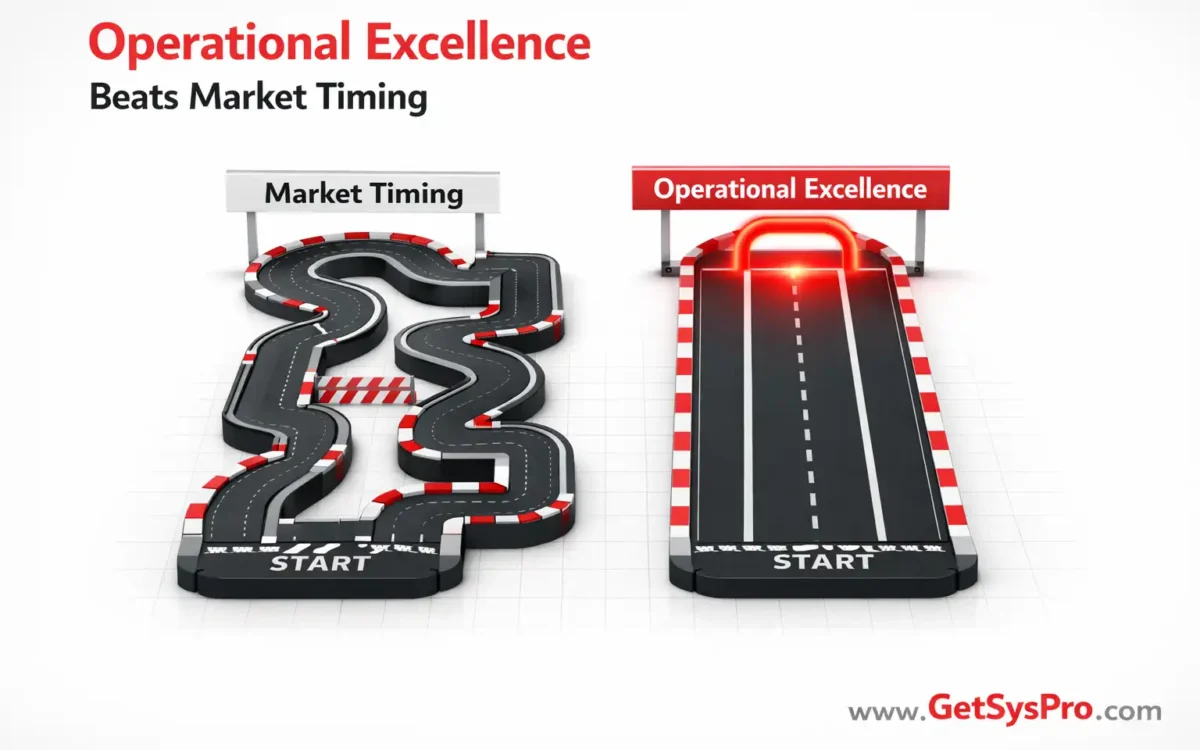
Operational excellence beats market timing, and once you see why, it changes how you think about building a business entirely. Most founders spend a lot of energy watching external conditions. Interest rates. Consumer sentiment. Competitor moves. Economic headlines. All of that matters to some degree, but here is the honest truth: the businesses that perform consistently across good years and bad ones are almost never the ones that read the market correctly. They are the ones that built something internally that could hold up under pressure.
This article talks through what operational excellence actually looks like in practice, why market timing is a much weaker lever than most people think, and how to build the kind of internal discipline that keeps a business performing when conditions get difficult.
In This Article
- Why Operational Excellence Beats Market Timing Every Cycle
- Growth Hides Inefficiency Until the Market Stops Hiding It for You
- Visibility Is What Lets You Act Instead of React
- Structured Operations Make You More Adaptable, Not Less
- Forecasting Reduces Surprise and Shortens Response Time
- Consistency Is the Competitive Advantage That Compounds
- How GetSysPro Helps You Build Operational Excellence
- Frequently Asked Questions
Key Takeaways
- Operational excellence beats market timing because internal discipline compounds across every market cycle while timing depends on getting lucky repeatedly.
- Market downturns do not create operational problems. They expose ones that were already there, just hidden by revenue growth.
- Operational visibility gives leadership the information needed to make targeted decisions under pressure instead of reactive, indiscriminate ones.
- Consistency in execution is what allows a business to adapt quickly when conditions shift, because the team already knows how to follow a system.
- GetSysPro builds the operational structure that protects performance when markets tighten and accelerates it when they open up.
Why Operational Excellence Beats Market Timing Every Cycle
Here is the thing about market timing: even when it works, it only works once. Getting out before a downturn or entering before a run-up is a single event. Operational excellence, on the other hand, delivers an advantage in every quarter, in every condition, compounding quietly over years.
Think about the businesses you have watched perform through tough stretches. They almost never credited their success to reading the market correctly. What they consistently pointed to was internal clarity. They knew their numbers. Their teams knew what to do. Decisions moved quickly because ownership was defined. Problems surfaced early because reporting was real. That kind of operational foundation does not care whether rates are up or down. It just keeps working.
Market conditions will always fluctuate. Rates move, consumer confidence shifts, competitors adapt, and headlines amplify uncertainty in every direction. The businesses that endure across those cycles are the ones that built something internally strong enough to withstand disruption regardless of its source.
“Market timing is a short-term bet. Operational excellence is a long-term compounding advantage. The businesses that last are not the ones that got lucky. They are the ones that built something that does not need luck.”
Editorial, GetSysPro Team
Growth Hides Inefficiency Until the Market Stops Hiding It for You
This is something most founders understand intellectually but still get caught by in practice. During expansion, revenue compensates for almost everything. Margins stay acceptable despite rework. Timelines slip but clients stay happy because everyone is busy. Coordination is messy but deals keep closing. The business runs on momentum and the inefficiencies just kind of get absorbed.
Then conditions tighten. Revenue slows and the momentum stops carrying the weight it used to. Suddenly all those masked inefficiencies become visible as liabilities. Decision-making slows exactly when speed matters most, leadership cannot see what to cut versus what to protect, and accountability gaps mean problems escalate instead of getting solved at the team level.
Market stress does not create these problems. It exposes them. The founder who blames an economic cycle for declining margins is often looking past the real cause, which is usually operational. The external conditions just removed the cushion that had been covering it up.
What Operational Discipline Looks Like When Markets Tighten
Businesses with strong operational foundations behave differently when conditions get difficult. Cost centers get reduced without damaging delivery capacity. Key relationships hold because client-facing processes are consistent and not dependent on one person. Faster decisions follow naturally because accountability is clear and information is available. That kind of response is not possible without the underlying operational structure already in place.
Visibility Is What Lets You Act Instead of React
Operational excellence starts with visibility. That means clear financial reporting, clear ownership of results, defined escalation paths, and performance metrics everyone can see. These fundamentals create resilience because they surface the information leadership needs before situations become emergencies.
Without that visibility, decisions become reactive. Leadership responds to crises rather than preventing them. Cost cuts go too deep in some areas and not deep enough in others. Client issues escalate before the right person knows about them. The business lurches from problem to problem rather than running steadily through them.
With visibility, decisions become targeted. A leader who can see that one service line is running at thin margin while another is healthy can make a specific adjustment rather than across-the-board cuts. A leader who knows exactly what each team member owns can delegate with confidence rather than hovering to manage risk. Visibility is what converts a reactive organization into a proactive one.
The Reporting Structure That Makes Visibility Real
Real visibility comes from consistent, timely reporting tied to clear ownership. Financial data needs reviewing on a regular cadence rather than only at quarter-end. Performance metrics should belong to specific roles rather than floating as general company awareness. Escalation criteria defined in advance ensure issues surface to the right person rather than getting stuck in informal channels. Building that reporting structure is an operational investment that pays dividends in every market condition.
Structured Operations Make You More Adaptable, Not Less
There is a common misconception that structure and agility are opposites. The more documented and defined your operations, the slower and more bureaucratic you become. The opposite is actually true, and it is one of the more important things to understand about operational excellence.
Adjusting Under Pressure Is Faster When the Map Already Exists
Without defined workflows, adaptation under pressure becomes chaotic. Leadership cannot isolate which levers to pull because the operating model is not clearly mapped. Cost reduction becomes indiscriminate rather than strategic. Teams make inconsistent decisions because the standard is not written down. The business adapts, but messily and slowly, and the adaptation often creates second-order damage that takes longer to unwind than the original disruption.
Structured operations give leadership a map. When conditions shift, the team knows where things are, what each function does, and how the pieces connect. Adjustment becomes surgical rather than blunt. A documented process can be modified deliberately. A tribal knowledge process just changes randomly depending on who happens to be in the room. Structure is not what makes organizations slow. Poor structure is what makes organizations slow.
Is your business built to perform in any market condition?
GetSysPro builds the operational foundation that keeps you executing when markets tighten and accelerating when they open up.
Forecasting Reduces Surprise and Shortens Response Time
One of the most practical things a business can do to strengthen its operational foundation is to stop relying exclusively on historical reporting and start building forward-looking visibility: rolling projections, scenario planning, and cash flow forecasts that extend ninety days rather than looking only at last month’s actuals.
Forecasting does not mean predicting the future accurately. Most forecasts will be wrong in their specifics. What forecasting actually does is reduce surprise and shorten response time. A business that knows its cash position ninety days out can make decisions today that a business relying only on yesterday’s bank balance cannot. A team that has already scenario-planned a revenue slowdown can activate a response within days rather than weeks when one actually arrives.
Scenario Planning as an Operational Tool
Scenario planning gets treated as a strategic exercise when it is really an operational one. Asking what happens if revenue drops fifteen percent, if a key client pauses, or if costs rise ten percent is not a strategy session. It is operational preparation. The answers define which expenses are protected, which are flexible, and what the trigger is for each adjustment. A business that has done this work in advance moves faster and more confidently when the scenario actually arrives.
Consistency Is the Competitive Advantage That Compounds
Operational excellence does not require complexity. It requires consistency. Defined workflows that run the same way regardless of who is doing them. Documented procedures that protect institutional knowledge when people leave or roles change. Structured review cadences that keep departments aligned without requiring constant management attention.
Compounding Returns on Every Quarter You Execute Well
Consistency compounds in a way that most people do not fully appreciate. A team that executes a process the same right way every time builds speed through repetition. A client experience that stays consistent regardless of which team member handles the work builds trust faster than any marketing message. A leadership layer receiving accurate reporting on a consistent cadence makes better decisions than one getting sporadic, inconsistent information.
Over multiple market cycles, that consistency becomes a durable advantage. Competitors scramble to adjust when conditions change. Consistently operated businesses adjust too, but from a position of clarity and control rather than confusion. The operational foundation they built during good times is exactly what protects them during difficult ones.
How GetSysPro Helps You Build Operational Excellence
The argument that operational excellence beats market timing is compelling in theory. Putting it into practice requires addressing some specific gaps that most growing businesses carry into difficult conditions.
Unclear accountability and reporting lines mean decisions keep routing to leadership by default, creating a bottleneck exactly when speed matters most. GetSysPro Organizational Chart Development builds the role clarity and ownership structure that distributes decision-making authority so leadership can focus on the things only they can do.
Closing the Gaps Before Market Conditions Force the Issue
Execution that varies by person and workflows living in tribal knowledge rather than documented standards means consistency breaks down under pressure and rework costs spike at the worst possible time. GetSysPro Process and SOP Architecture documents and standardizes the core processes that drive delivery so the team executes consistently regardless of market conditions.
For a comprehensive view of where the operational foundation is strong and where it is exposed before market conditions force the question, the GetSysPro Business Operational Systems Audit maps the full picture and sequences improvements in order of impact.
Operational excellence beats market timing because it compounds quietly while you focus on growing. Build it now and it protects you when conditions get hard. Ignore it and the next market shift will make that cost visible in ways that are difficult to recover from quickly.
Related GetSysPro Services
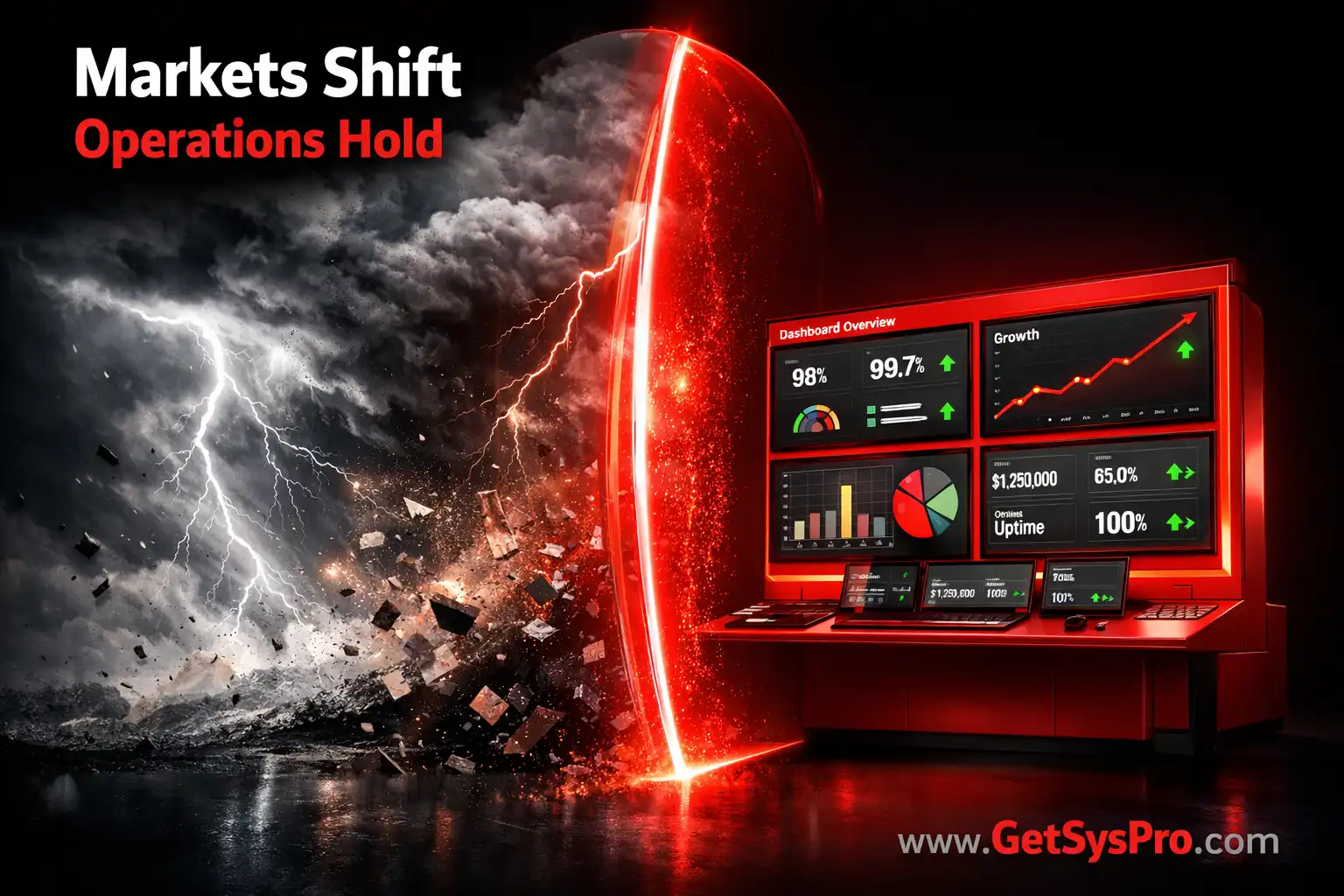
Markets shift. Operationally excellent businesses hold steady. www.GetSysPro.com
Article Summary
Operational excellence beats market timing because internal discipline compounds across every market cycle while timing depends on getting lucky repeatedly. Market downturns expose operational weaknesses that were already present, not create new ones. Visibility, consistency, structured adaptability, and forward-looking forecasting are the four operational foundations that protect performance when markets tighten and accelerate it when they open up. GetSysPro builds those foundations through organizational clarity, process documentation, and systems audits that surface gaps before market conditions force the question.
Stop Betting on Market Timing. Build Something That Performs Regardless.
GetSysPro builds the operational excellence that protects your business in any market condition.
Frequently Asked Questions
Is operational excellence actually a stronger long-term advantage than reading the market correctly?
Market timing works occasionally but requires getting it right repeatedly to sustain an advantage. Operational excellence compounds continuously. A business with clear ownership, consistent execution, real-time visibility, and documented processes performs better in every quarter regardless of external conditions. Over multiple cycles, that internal discipline creates a durable advantage that no amount of market reading can replicate consistently.
Market downturns hit some businesses harder than others. What separates them operationally?
During expansion, revenue growth absorbs operational inefficiency. Rework gets covered by margin. Coordination problems get papered over by momentum. When conditions tighten and revenue slows, those same inefficiencies become visible as liabilities. Unclear workflows slow decision-making. Inconsistent reporting leaves leadership blind. Undefined accountability means problems escalate rather than getting solved. The market did not create those problems. It just removed the cushion that was hiding them.
Operational visibility sounds important. Can you define it and explain the real-world difference it makes?
Operational visibility means having accurate, timely information about financial performance, process health, and team accountability available to leadership on a consistent basis. During difficult conditions it matters because it converts reactive decisions into targeted ones. A leader with real visibility can make specific adjustments that protect what matters. A leader without it makes blunt cuts that often damage delivery capacity or client relationships in ways that take longer to recover from than the market disruption itself.
Structured businesses seem rigid. Can they actually move fast when conditions shift quickly?
Structured operations actually increase agility because they give leadership a clear map of the business to adjust when conditions shift. Without defined workflows, adaptation under pressure is chaotic and inconsistent. With documented processes and clear ownership, adjustments become deliberate and surgical. The team knows the system, so modifying it is faster and more predictable than modifying a tribal knowledge operation where every change ripples unpredictably.
Our operations have gaps we know about. Where does GetSysPro typically start when fixing them?
GetSysPro audits the operational foundation of a business, identifies where accountability, visibility, and execution consistency are weakest, and installs the organizational structure, documented processes, and reporting systems that address those gaps. The goal is to build the operational foundation before a market shift forces the issue, because addressing it proactively is always faster, cheaper, and less disruptive than rebuilding under pressure.
Last Updated: [the_modified_date format=”F j, Y”]