 08/08/2024
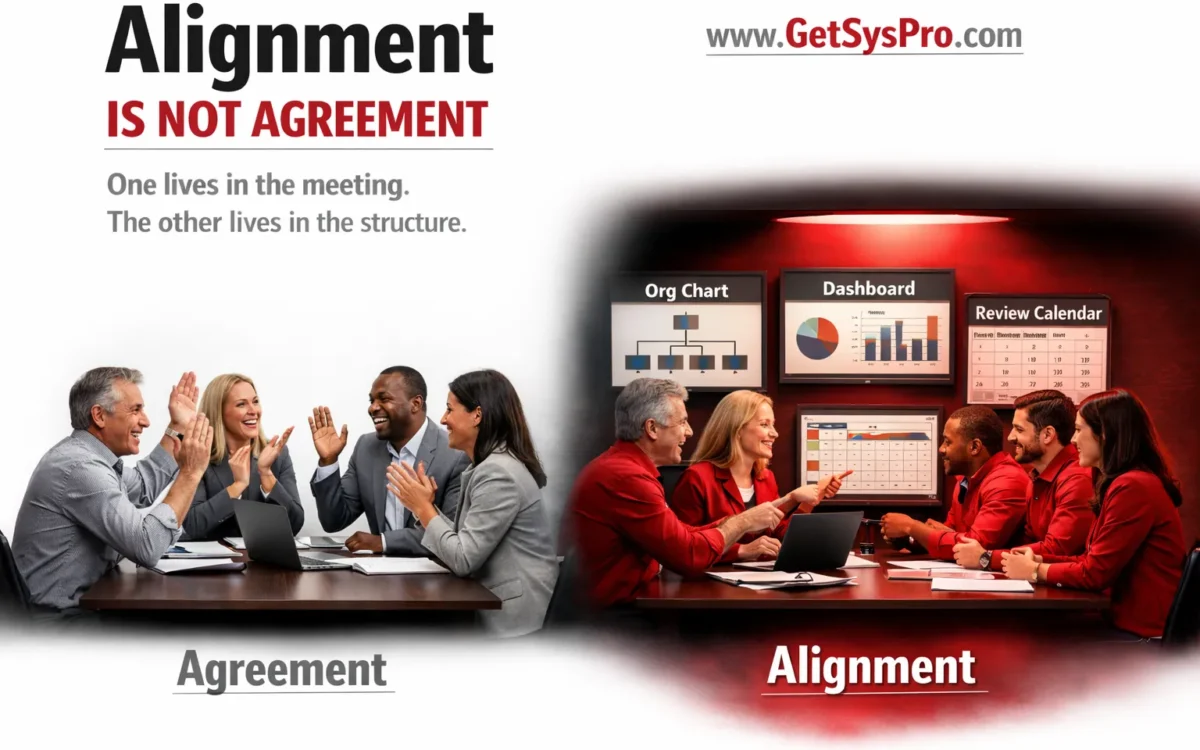
Alignment is not agreement. Agreement happens in a conversation. Alignment happens in a structure, and without that structure, the best strategy session in the world produces temporary consensus rather than operational consistency.
Leadership teams walk out of strategy sessions feeling good. Everyone nodded. Everyone agreed. The discussion felt productive and the energy in the room was real. Then a few weeks pass, and execution starts to diverge. Departments move in slightly different directions. Priorities drift in subtle ways. Friction returns. And the leadership team is left wondering why a meeting that felt so aligned produced results that clearly were not.
Here is the thing: alignment is not agreement. That distinction sounds simple, but it changes everything about how you build an organization that actually moves together. Agreement is a moment. Alignment is a system. This article breaks down what alignment actually requires, where it most commonly breaks, and what it looks like when it is working.
In This Article
- Agreement Is a Moment. Alignment Is a System.
- The Strategy Clarity Gap That Creates Divergence
- Ownership Is the Foundation of Alignment
- Cross-Functional Alignment Breaks Without Shared Metrics
- Cadence Prevents Drift
- Documentation Makes Alignment Repeatable
- Building Alignment With GetSysPro
- Frequently Asked Questions
Key Takeaways
- Alignment is not agreement. Agreement is easy to create in a room. Alignment is harder because it must survive time, pressure, and competing priorities.
- Strategy comprehension gaps are common even in strong companies. Research shows that only 29% of employees at high-performing companies can correctly identify their organization’s strategy. That is not a communication problem. It is an integration problem.
- Operational alignment requires clear ownership per function, shared metrics across teams, a consistent review cadence, and documented workflows that give everyone the same definition of how work gets done.
- Cross-functional misalignment between sales, operations, and finance is a system problem, not a people problem. Each function optimizes for its own scorecard when shared dashboards and reporting do not exist.
- Agreement feels productive. Alignment produces results. The difference is structure.
Agreement Is a Moment. Alignment Is a System.
Think about the last time your leadership team walked out of a session feeling genuinely on the same page. Everyone was engaged. The vision felt shared. Decisions felt clear. And then, gradually, execution started to look different from what was discussed in that room. Not dramatically different, but different enough that you started wondering whether everyone was actually working from the same playbook.
That gap is the difference between agreement and alignment. Agreement is what you have at the end of a good meeting. Alignment is what you need to execute consistently after the meeting ends. Agreement requires nodding. Alignment requires structure: measurable goals that translate the conversation into specific outcomes, defined ownership so everyone knows who is responsible for what, and a review cadence that keeps the organization pointed in the same direction as time and pressure accumulate.
Why “We Had a Good Meeting” Is Not Evidence of Alignment
One of the most common alignment is not agreement moments in growing organizations comes when leadership assumes that shared understanding at the top automatically produces consistent execution throughout. It does not. Strategy must be converted from high-level direction into the daily operating reality of every team member who needs to execute it. Without that conversion, interpretation fills the gap. Each team interprets the shared direction slightly differently based on their own function, their own pressures, and their own priorities. Those slight interpretive differences compound across dozens of daily decisions into meaningful execution divergence that looks, from the outside, like a people problem or a culture problem when it is actually a structure problem.
“Alignment is not agreement, and the organizations that confuse the two end up investing in better meetings when they need to invest in better structure. The meeting can be excellent. Without the structural follow-through that converts agreement into operational consistency, the excellence of the meeting is the ceiling of the alignment it produces.”
Editorial, GetSysPro Team
The Strategy Clarity Gap That Creates Divergence
Here is a number that tends to surprise people: research published in Harvard Business Review found that only 29% of employees at high-performing companies could correctly identify their organization’s strategy when given six choices. The HBR research on strategy comprehension makes it clear that this is not a communication problem. Leadership communicated the strategy. Employees heard it. They just could not connect what they heard to the daily operating decisions they were making.
That is an integration problem. Strategy stays abstract when it is not tied to workflows, metrics, and decision-making authority. “Grow revenue” does not tell a sales manager which deals to prioritize this week. “Improve customer experience” does not tell an operations team which bottleneck to address first. The translation layer that connects strategic intent to daily operational behavior is what most organizations are missing, and its absence is where alignment breaks down in practice regardless of how well the strategy was communicated.
How Interpretation Fills the Gap When Structure Does Not
Without the translation layer, interpretation fills the space. Each department interprets strategic direction through the lens of its own priorities, its own metrics, and its own understanding of what success looks like. Sales interprets “grow profitably” as closing more deals. Finance interprets it as improving margins on existing revenue. Operations interprets it as reducing delivery costs. All three interpretations are reasonable. All three produce different decisions. And those different decisions, made daily across every function, accumulate into the execution divergence that leadership notices weeks later and struggles to diagnose because nobody was wrong, they were just operating from different interpretations of the same direction.
Ownership Is the Foundation of Alignment
Alignment begins with clarity about who owns what. Not who is involved in what, not who is responsible to a team for what, but who is the single named person accountable for a specific outcome. When ownership is shared loosely, accountability weakens in a predictable way: everyone feels generally responsible and nobody feels specifically accountable, which means that when a decision needs to be made or a problem needs to be solved, there is a moment of hesitation about whose call it actually is.
That hesitation is where alignment breaks down at the execution level. Departments compensate by making local decisions that prioritize their own function’s performance over the integrated outcome the organization needs. Each local decision is defensible from within the function that made it. The aggregate of those local decisions produces the divergence that leadership is trying to solve by having better meetings rather than building clearer ownership structures.
The Four Ownership Questions That Most Organizations Leave Unanswered
Four ownership questions determine whether alignment is possible in a growing organization. Revenue growth needs a single named owner with the specific authority to make pricing, capacity, and resource decisions that affect it. Operational efficiency needs a defined accountable person with clear metrics to measure against. Customer retention requires someone with cross-functional authority to address the service, delivery, and relationship factors that drive it. Margin protection needs an owner with visibility into cost structure and the authority to act on what that visibility reveals. Most growing organizations have clear answers for some of these and genuine ambiguity about others, and that ambiguity is precisely where alignment is not agreement plays out in operational reality.
Cross-Functional Alignment Breaks Without Shared Metrics
Some of the most common and most frustrating alignment gaps appear not within a single function but across functions. The classic version shows up between sales, operations, and finance. Sales pushes volume and closes what the market wants. Operations absorbs the delivery strain that sales volume creates. Finance watches cost pressure and cash timing risks mount. Each function is doing exactly what it is supposed to do. None of them are doing anything wrong. And yet the company experiences internal tension that feels like a people problem but is actually a metrics problem.
Without structured cross-functional reporting and shared dashboards, each function optimizes for its own scorecard. Sales measures pipeline and closed revenue. Operations measures delivery capacity and quality. Finance measures margin and cash position. When those scorecards point in different directions, which they frequently do at growth inflection points, the functions experience each other as obstacles rather than as collaborators. Sales feels blocked by operations. Operations feels overwhelmed by sales. Finance feels ignored by both. Nobody is behaving badly. The system is just designed to produce that friction.
What Shared Metrics Actually Solve
Shared metrics do not eliminate the genuine tension between sales growth and operational capacity or between revenue expansion and margin protection. Those tensions are real and healthy. Shared metrics change how that tension gets resolved. Instead of each function advocating for its own scorecard in meetings that produce alignment is not agreement moments, shared dashboards create a common factual basis for decisions that require cross-functional tradeoffs. The conversation moves from “sales is asking too much” to “here is where we are on capacity versus pipeline, and here is what the data says about where the constraint is.” That is a different conversation with a different quality of outcome.
Cadence Prevents Drift
Even organizations that have built clear ownership and shared metrics experience alignment drift without a consistent review cadence. Priorities shift as urgent issues demand attention. Long-term objectives fade as the day-to-day volume of operational demand crowds them out. Teams that were aligned in a planning session gradually diverge as each function responds to its own immediate pressures without a regular structured moment to recalibrate against the shared direction.
A functional cadence operates at three intervals and each interval serves a different alignment purpose. Weekly accountability review tracks commitments made and blockers encountered, keeping the team connected to the specific actions that were agreed upon rather than allowing those commitments to drift as the week fills with reactive demands. Monthly financial variance analysis connects current performance to the financial model, surfacing where execution is delivering on plan and where course correction is needed before variance compounds. Quarterly strategic recalibration assesses whether the current priorities still reflect the right direction given what has been learned, what capacity actually exists, and what the market is telling the business.
Without Cadence, Urgency Replaces Alignment
The practical test for whether cadence is working is whether the organization consistently addresses strategic priorities or consistently gets pulled toward the most urgent operational issues regardless of their strategic importance. Organizations without cadence consistently fail that test. Urgency wins because it is immediate and visible while strategic priorities are gradual and require deliberate tracking to remain in focus. Cadence creates the deliberate tracking structure that keeps strategic priorities visible alongside operational urgency rather than constantly losing to it.
Does your team agree in meetings but diverge in execution?
GetSysPro builds the ownership structures, shared metrics, and review cadence that convert agreement into operational alignment.
Documentation Makes Alignment Repeatable
There is one more alignment element that organizations consistently underestimate: documentation. Informal workflows produce interpretation variation that agreement cannot prevent because the agreement is about direction, not about the specific steps through which direction gets executed. One department believes a handoff process works one way. Another department believes it works differently. Both are acting in good faith based on their own experience and understanding. The company still gets inconsistent results because there was never one written definition of how the process works.
Written standards do something that conversation cannot: they create a single shared operating definition that persists after the conversation ends and does not depend on individual memory, interpretation, or presence. Alignment at the workflow level means that a new team member in one department executes a process in a way compatible with how another department expects to receive it, without requiring a calibration conversation every time the handoff occurs. McKinsey’s research on organizational alignment and operational consistency reinforces that documented standards are among the highest-leverage tools for converting strategic intent into repeatable execution. That is alignment is not agreement made concrete: the agreement happened when the standard was written, and the alignment persists because the standard exists.
Why Documentation Is an Alignment Investment, Not an Administrative Burden
The resistance to documentation in growing organizations usually comes from perceiving it as overhead: time spent writing things down that could be spent doing things. That perception reverses when you account for the time spent on calibration conversations, on fixing misaligned handoffs, on resolving the confusion that informal workflows consistently generate. Documentation does not add overhead to an aligned organization. It removes the overhead that misalignment creates continuously in an undocumented one. The investment is a one-time cost. The return compounds every time the documented standard prevents a misalignment that would otherwise require human intervention to resolve.
Building Alignment With GetSysPro
Alignment is not agreement, and building it requires more than better communication or more frequent meetings. It requires the structural elements that convert a shared direction into operational consistency: owned outcomes, shared visibility, consistent cadence, and documented standards that give every team member the same definition of how work gets done here.
GetSysPro Services That Build Operational Alignment
GetSysPro Internal EOS Integration and Management builds the accountability framework that converts strategic intent into measurable owned execution. Scorecards make objectives tangible and trackable. Meeting cadence reinforces priorities and prevents drift.
GetSysPro Organizational Chart Development addresses the ownership foundation that alignment requires by defining reporting relationships, accountability boundaries, and decision authority so the four ownership questions that most organizations leave unanswered have clear, documented answers.
For organizations where workflow-level misalignment is the primary source of execution inconsistency, GetSysPro Process and SOP Architecture creates the documented standards that give every team member the same operating definition of how work moves through the business.
Related GetSysPro Services
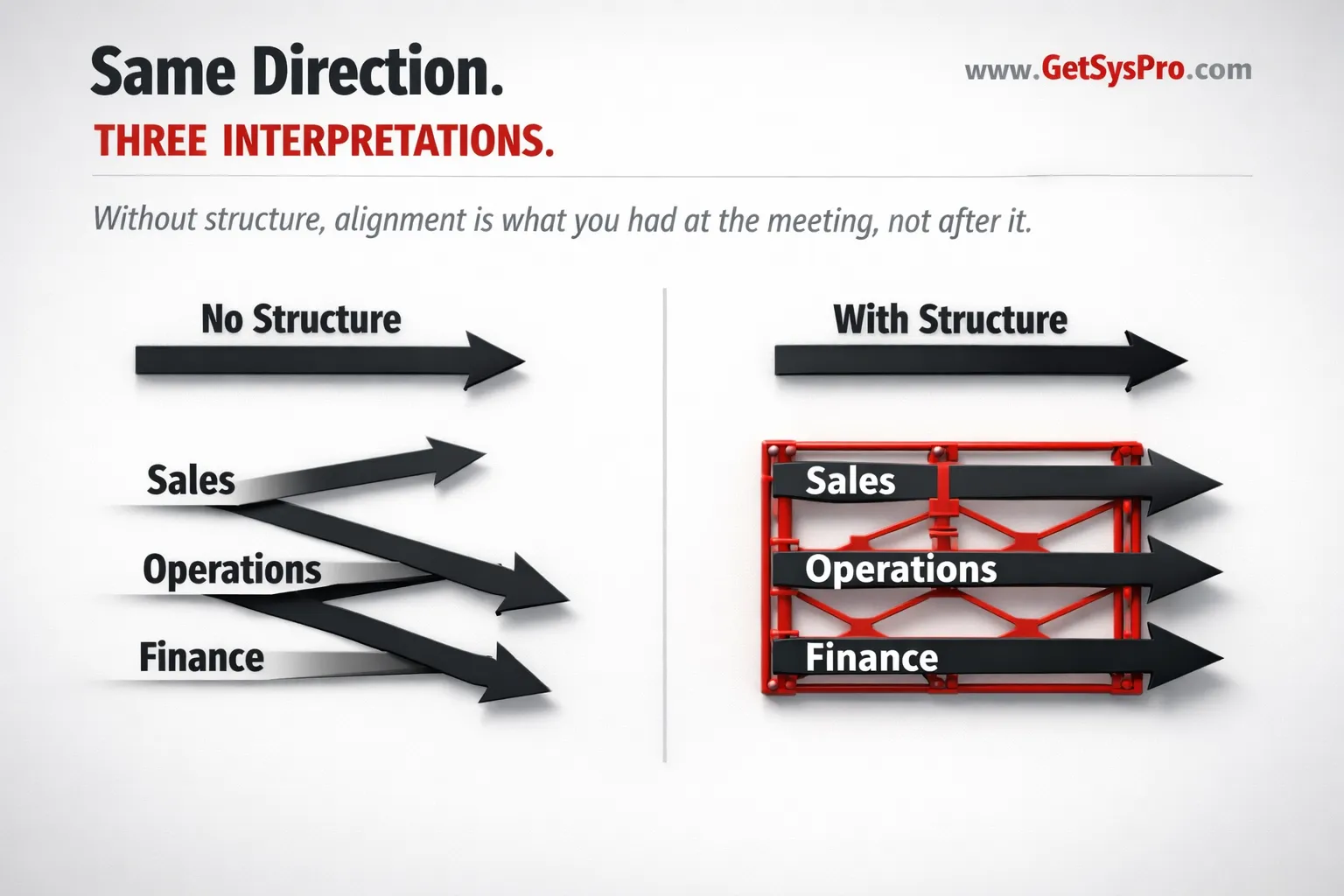
Same direction. Three interpretations. Without structural alignment, execution diverges before the meeting ends. www.GetSysPro.com
Article Summary
Alignment is not agreement. Agreement is easy to create in a meeting. Alignment is harder because it must survive time, pressure, and competing priorities. The strategy clarity gap means even high-performing organizations have teams that interpret direction differently. Ownership clarity, shared metrics, consistent cadence, and documented standards are the four structural elements that convert agreement into operational alignment. Cross-functional misalignment between sales, operations, and finance is a system problem that shared dashboards solve. Documentation creates the single operating definition that makes alignment repeatable without constant conversation. GetSysPro builds the structural elements that make alignment is not agreement a distinction your organization can close for good.
Agreement Feels Productive. Alignment Produces Results. Build the Difference.
GetSysPro builds the ownership structures, shared metrics, review cadence, and process documentation that convert agreement into operational consistency.
Frequently Asked Questions
What is the practical difference between alignment and agreement in a business context?
Agreement means that everyone in the room shared the same high-level direction at the end of a meeting. Alignment means that everyone in the organization makes compatible decisions based on that direction without requiring constant clarification. Agreement is a moment. Alignment is an ongoing operational state that requires structural support to sustain. The most common sign that a business has agreement without alignment is when execution consistently diverges weeks after leadership sessions that felt productive, because the agreement was reached but the structure needed to sustain it was never built.
Why do leadership teams that feel aligned still experience execution divergence?
Because strategy stays abstract when it is not translated into owned outcomes, specific metrics, and documented workflows. Leadership alignment at the top does not automatically produce operational alignment throughout the organization. Each team interprets strategic direction through its own functional lens, priorities, and pressure points. Those interpretive differences compound across hundreds of daily decisions into meaningful execution divergence that feels like a people problem but is actually a structural problem. The solution is translation: converting high-level direction into the specific ownership assignments, measurable commitments, and documented standards that give every team member the same operational definition of what the direction requires.
How do shared metrics help with cross-functional alignment?
Shared metrics create a common factual basis for decisions that require cross-functional tradeoffs. Without them, sales, operations, and finance each optimize for their own scorecard and experience each other as obstacles. With them, the conversation shifts from functional advocacy to joint problem-solving grounded in shared data. The genuine tensions between growth and capacity, between revenue expansion and margin protection, do not disappear. Shared metrics change how those tensions get resolved: through data-driven tradeoff analysis rather than through functional politics, which produces better decisions and preserves the cross-functional relationships that execution quality depends on.
How often should alignment be reinforced through cadence to prevent drift?
Three intervals serve different alignment purposes and together prevent the drift that any single cadence interval cannot prevent alone. Weekly accountability review keeps short-term commitments visible and blockers surfaced before they compound. Monthly financial variance analysis connects current operational performance to the financial model and surfaces course correction needs before variance becomes structural. Quarterly strategic recalibration assesses whether current priorities still reflect the right direction given what has been learned. Organizations that maintain all three intervals consistently find that alignment requires less intervention to sustain than organizations that rely on periodic realignment sessions to correct the drift that accumulated between them.
Is documentation really necessary for alignment or can a strong team culture substitute for it?
Strong team culture and shared values are genuinely valuable and genuinely insufficient as substitutes for documentation. Culture provides commitment to the shared direction. Documentation provides the specific operating definition of how that direction gets executed. A team with strong culture but no documented workflows still produces interpretation variation because each team member executes based on their own understanding of an undocumented process. The variation is not a culture failure. It is a documentation absence. Documentation and culture are complementary rather than substitutes: culture creates the commitment to execute consistently, and documentation creates the shared definition of what consistent execution looks like at the workflow level.