 08/07/2023
Revenue Is Not the Problem
Revenue is not the problem when growth starts to feel unstable. From the outside, the symptoms look like sales dips, margin compression, or tighter cash flow. From the GetSysPro Team perspective, revenue is the visible outcome, while the underlying issue is usually structural.
When a company feels pressure, leadership often defaults to revenue moves. Increase marketing spend. Push sales harder. Adjust pricing. Expand offerings. Those actions can create a short-term lift, but if the operational foundation is weak, more revenue often amplifies the instability.
Tomo Oblak frequently observes that founders misdiagnose operational strain as a demand problem. A business doing $1.2 million that suddenly feels chaotic might not need more leads. It might need clearer workflows, stronger reporting, better decision architecture, and defined ownership across departments.
Revenue growth increases complexity. More clients mean more communication. More transactions require more coordination. More vendors require more oversight. If roles are unclear and processes are informal, complexity compounds quickly and leaders respond by stepping in more often, which increases dependency instead of scalability.
Many businesses cycle through revenue spikes followed by internal correction. A strong quarter creates momentum, operational strain rises, leadership works overtime to stabilize delivery, then growth slows while the team regains control. From the outside the business looks fine, but internally fatigue accumulates and strategic planning gets postponed.
In service based industries and real estate investment operations, this pattern is common because volume can jump quickly. Without standardized onboarding, consistent reporting, and clear accountability paths, quality fluctuates and deadlines slip. Margins shrink because inefficiencies require more labor hours to resolve, and the cost is often hidden until the end of the month.
Structural weakness also creates financial risk that looks like a revenue issue. Forecasting becomes reactive. Expense visibility declines. Billing inconsistencies appear. Leadership may see strong top line revenue while cash tightens and true margins erode under inefficiency.
Revenue Symptoms Point to Structure
Revenue problems often present as symptoms, not causes. When a company feels unstable, the first step is to identify where structure is failing to support current volume. The goal is not to slow growth, it is to make delivery reliable at the volume you already have.
A practical way to think about this is to separate what you sell from how you deliver. If delivery is inconsistent, revenue will feel inconsistent because the organization cannot produce predictable outcomes repeatedly.
Decision Rights Reduce Growth Dependency
One of the fastest ways to reduce chaos is to clarify decision rights. When decision authority is vague, everything escalates. Leaders get pulled into approvals that should happen inside the team, and the organization becomes slower as it grows.
MIT CISR describes governance as the allocation of decision rights and accountabilities, and emphasizes that clearly specifying them supports coherent decision making as organizations move faster and distribute decisions:
https://cisr.mit.edu/content/classic-topics-decision-rights
Process Standardization Protects Margins
Margins often compress during growth because work takes longer than it should. Rework increases. Hand offs get missed. Teams duplicate effort because there is no single standard way to execute. Standardizing key workflows does not remove flexibility, it removes preventable variation.
If you need to reduce variability in execution, GetSysPro Process and SOP Architecture helps document workflows, standardize delivery steps, and build repeatable handoffs:
https://www.getsyspro.com/service/process-and-sop-architecture/
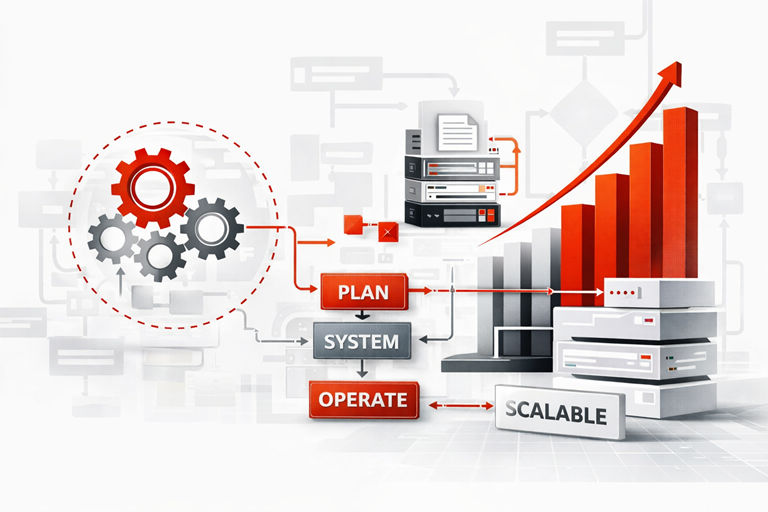
Structured systems and documented processes transform operational chaos into scalable growth. Discover how operational infrastructure supports business performance at www.GetSysPro.com
Reporting Discipline Improves Forecasting
Structural weakness frequently shows up as forecasting problems that leadership interprets as a revenue issue. If reporting is inconsistent, the business is always explaining last month instead of managing next month. The fix is a reporting cadence tied to operational drivers, not just accounting categories.
Rolling forecasts are one example of a planning approach that stays current by updating the forecast on a regular schedule rather than relying on a static annual plan:
https://corporatefinanceinstitute.com/resources/accounting/rolling-forecast/
Management Layers Without Clarity Add Drag
Hiring managers can help, but it is not a structural solution by itself. If authority boundaries are unclear, new layers become additional approval steps and communication slows. Accountability gets diluted because ownership is still vague, it is just spread across more people.
A scalable structure makes it clear who owns outcomes and who can decide within boundaries, so management adds leverage instead of friction.
Build Structure Before You Add More Revenue
When margins compress or cash tightens, the first question should not be how to generate more sales. The first question should be whether the current operating model can deliver consistently at current volume. If the answer is unclear, adding volume increases risk.
If you need clearer ownership, accountability, and reporting lines that match how the business actually runs, GetSysPro Organizational Chart Development supports role clarity and decision alignment:
https://www.getsyspro.com/service/organizational-chart-development/
Revenue is an outcome. Structure is a driver. Before chasing more revenue, evaluate the system producing it, because opportunity rarely breaks companies, but opportunity that outpaces architecture often does.