 08/15/2023
Scaling Without Structure Fails
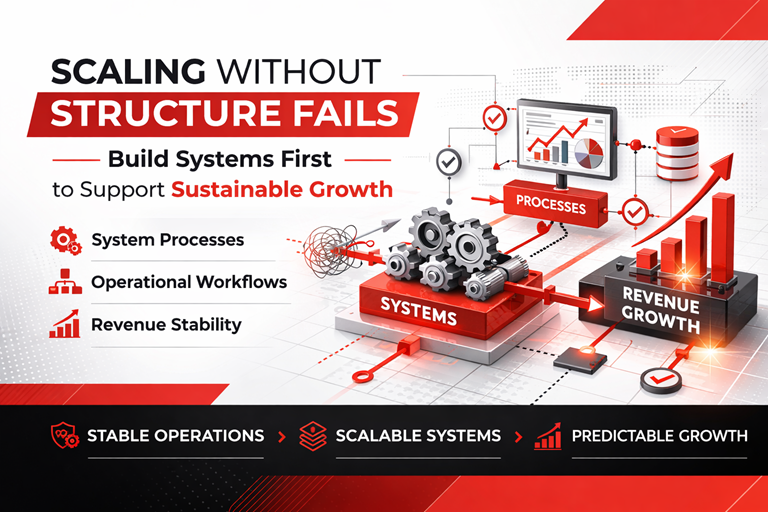
Scaling without structure fails because growth does not fix weaknesses, it exposes them. Revenue can rise, deal volume can increase, and hiring can accelerate, while internal stability quietly declines. From the GetSysPro Team perspective, growth without structure is not success, it is exposure.
Expansion magnifies what already exists inside the organization. If clarity, accountability, and operational discipline are strong, growth compounds those strengths. If they are weak, growth accelerates instability. The difference between sustainable scale and operational breakdown rarely lies in market demand, it lies in design.
Tomo Oblak frequently observes that founders underestimate the operational weight of growth. Going from $750,000 in annual revenue to $2 million is not simply more money, it is more transactions, more coordination, more communication, and more points of failure. If processes are informal, the added volume does not distribute evenly, it accumulates around leadership.
At first, centralized decision making can feel like control. Leaders read more threads, attend more meetings, approve more exceptions, and stay closer to execution. Over time, that approach creates dependency. Teams hesitate because ownership boundaries are unclear, and the organization slows down even while demand increases.
Growth Without Structure Creates Decision Bottlenecks
As volume rises, the number of daily decisions rises with it. Pricing approvals, client exceptions, hiring choices, vendor negotiations, workflow adjustments, and resource allocations all require attention. Without clear decision rights, leadership becomes the bottleneck and execution queues up behind them.
This is where decision fatigue becomes costly. When everything requires an executive decision, judgment quality drops, time disappears, and the business starts paying a hidden tax in delays and rework. MIT Sloan Management Review describes how decision rights can be reshaped through “choice architectures” that improve decision making and productivity:
https://sloanreview.mit.edu/article/intelligent-choices-reshape-decision-making-and-productivity/
Scaling Without Structure Causes Operational Drift
Operational drift happens when processes are not documented and each person interprets responsibilities slightly differently. Small deviations compound over time until departments operate on assumptions that conflict with each other. Client experience becomes inconsistent, internal reporting varies, and quality depends more on who is involved than on an agreed standard.
Standardization reduces that variation and makes performance less dependent on individual style. MGMA describes process standardization as a driver of operational performance, quality, and cost reduction through error reduction, communication, and routine training:
https://www.mgma.com/articles/enhancing-practice-operations-through-process-standardization
Scaling Without Structure Hides Margin Leakage
Revenue growth can conceal inefficiency until the organization is under stress. When workflows are unclear, labor hours increase. When communication paths are undefined, mistakes require rework. When vendor relationships are unmanaged, costs drift upward. Leadership may celebrate top line growth while operational leakage compresses margins in the background.
Margin leakage is often gradual and easy to miss until it shows up as “mysterious” margin compression. DealHub defines margin leakage as the gradual erosion of profit margins due to issues that can go unnoticed until they significantly impact results:
https://dealhub.io/glossary/margin-leakage/
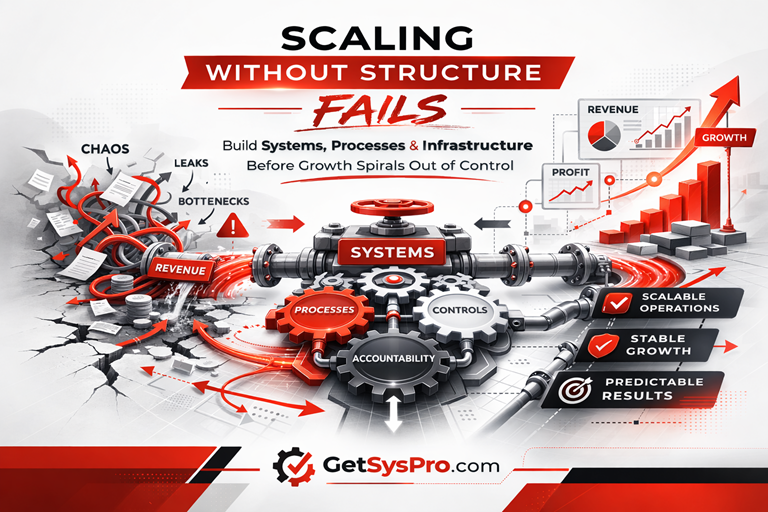
Growth without systems creates bottlenecks and inefficiencies, but structured processes and operational frameworks turn revenue into predictable, scalable results. Learn more at www.GetSysPro.com
Scaling Structure Requires Clear Roles and Accountability
Scalable businesses are not perfect, they are clear. Roles are defined. Decision thresholds are documented. Core processes are standardized and reviewed periodically. Reporting provides visibility without overwhelming leadership. Accountability is measurable rather than implied.
If you need clearer ownership and reporting lines that match how the business actually operates, GetSysPro Organizational Chart Development supports accountability at scale:
https://www.getsyspro.com/service/organizational-chart-development/
Scaling Structure Needs SOPs and Repeatable Workflows
Structure becomes real when work can move without constant verbal instruction. Documented workflows create repeatability, accelerate onboarding, and reduce dependence on tribal knowledge. They also create a baseline for improvement because you cannot improve what is not defined.
If execution depends on memory and heroics, GetSysPro Process and SOP Architecture helps document workflows, standardize handoffs, and reduce variability:
https://www.getsyspro.com/service/process-and-sop-architecture/
Scaling Without Structure Damages Culture
Unstructured growth creates a reactive environment. Expectations feel fluid, priorities change rapidly, and accountability becomes ambiguous. Over time, high performers disengage because effort does not consistently translate into results. Structure provides psychological safety because people understand their role, authority boundaries, and what success requires.
Scaling Without Structure Fails, Structure Scales Strength
Sustainable growth is not about limiting ambition. It is about aligning ambition with capacity. Infrastructure must evolve in proportion to revenue, and that evolution includes documentation, workflow refinement, reporting discipline, and ownership clarity.
From the GetSysPro Team perspective, the healthiest organizations treat growth as a systems challenge first and a revenue challenge second. Expansion without architecture creates fragility. Expansion supported by structure creates resilience. Businesses that invest in design scale strength, and businesses that ignore it scale chaos.