08/21/2025
Revenue climbs, initiatives multiply, and coordination replaces vision. Clarity is the antidote.
Growth becomes noise when activity increases faster than clarity. Revenue rises, new initiatives launch, headcount expands, and partnerships multiply, yet internally coordination consumes the space that vision used to occupy. That is the stage where growth stops feeling like momentum and starts feeling like distraction. When growth becomes noise, it is not a culture problem. It is a prioritization architecture problem.
A useful external frame for understanding why this happens is the Eisenhower Matrix, which separates urgent from important so teams stop treating every new initiative as a strategic priority. Without a similar filter applied to organizational decision-making, growth produces activity rather than progress.
In This Article
Key Takeaways
- Growth becomes noise when activity increases faster than clarity. It is a prioritization architecture problem, not a culture problem.
- Noise shows up first in initiative overload, meeting density, and financial volatility. Each is a structural symptom rather than a character or effort issue.
- When priorities multiply without documented filters, expansion becomes reactive and teams move fast but not in the same direction.
- Operating rhythm is the system that prevents urgency from displacing strategy. Without cadence, every week becomes triage rather than execution.
- Subtraction is a growth strategy. Defining what the business will not pursue this quarter is as important as defining what it will.
What Growth Becomes Noise Actually Means
Growth becomes noise at the point where organizational activity volume exceeds the structural capacity to direct it toward outcomes. Every individual decision, a new hire, a new product line, a new market, a new vendor relationship, looks defensible in isolation. Collectively those decisions strain an operating model that was designed for a smaller, simpler business. The strain is not visible in the revenue numbers, which keep rising. It is visible in the energy required to produce those numbers, which keeps rising faster.
The noise manifests as coordination overhead. Additional meetings maintain alignment that documented priorities would maintain automatically. Status check-ins track progress that a review cadence would surface systematically. More escalations resolve conflicts that authority boundaries would resolve structurally. When growth becomes noise, the business is spending organizational energy on friction that should not exist at its current scale.
Growth Becomes Noise Because It Feels Like Momentum
The reason growth noise persists is that it is easy to confuse with healthy activity. Teams are busy. Meetings are full. New things are launching. The feeling is momentum. The reality is that strategic execution has been displaced by operational coordination. That distinction is hard to see from the inside of a busy organization, which is why growth noise compounds before it gets addressed and why the intervention it requires is architectural rather than motivational.
Where Growth Becomes Noise First
Growth noise becomes measurable in three places before it appears in financial results. Initiative overload is the first: new products, new markets, new tools, and new hires accumulating without a governance filter that determines which initiatives the current operating model can actually absorb and execute well. Each choice is individually defensible. Together they create competing demands on the same limited organizational capacity.
Meeting density is the second. When priorities have not been structurally defined, alignment requires constant recalibration through conversation rather than reference to a documented standard. Strategy time converts into operational triage. Leaders spend their time resolving the conflicts that an operating rhythm would prevent rather than executing the plan that operating rhythm would protect.
Financial Volatility Is a Late-Stage Growth Becomes Noise Signal
Financial volatility is the third signal. Spend expands while tracking lags. Hiring accelerates without role architecture that defines what each hire is accountable for producing. Vendor costs accumulate without renegotiation cadence. Margin fluctuates even when revenue rises because the cost structure is scaling reactively rather than by design. When growth becomes noise, the financial signals arrive after the organizational signals have already been present for months.
Why Priorities Multiply Without Filters
Priorities multiply when the organizational filter for what qualifies as a priority is absent or unclear. What distinguishes a strategic priority from a nice-to-have? Who has the authority to greenlight a new initiative, and what conditions must be met before that authority can be exercised? What must be true about capacity, margin, and timing before expansion into a new area is approved? How do proposed initiatives map to documented quarterly objectives before they receive resources?
When those questions do not have documented answers, expansion decisions become reactive rather than strategic. Each initiative that gets approved without passing through a defined filter adds to the noise. Teams move fast but not in the same direction because the direction was never formally defined at a level specific enough to govern daily decisions.
A Priority Filter Stops Growth From Becoming Noise by Design
Documenting what qualifies as a priority is not a bureaucratic constraint on growth. It is the design decision that makes growth sustainable. Without a filter, organizational capacity distributes across whatever is loudest rather than whatever matters most. With a filter, the business concentrates capacity on the initiatives most likely to produce the outcomes it has committed to. That concentration is what converts growth from noise into compounding progress.
If everything feels important, nothing is prioritized.
GetSysPro installs the prioritization architecture and operating rhythm that converts growth noise into focused execution.
The Missing System Is Operating Rhythm
When cadence is weak, urgency wins. Weekly conversations become reviews of what is currently on fire rather than reviews of whether execution is on plan. Monthly reviews become explanations of why margin moved rather than assessments of whether targets were met. Quarterly planning sessions become discussions of what the business is even trying to accomplish rather than strategic recalibrations of a plan already in progress.
Operating rhythm is the structural solution to that pattern. Research on organizational rhythm consistently finds that consistent operational cadences reduce reactive decision-making and protect strategic execution time in growing organizations. A consistent cadence of weekly execution reviews, monthly variance analysis, and quarterly strategic recalibration creates protected space for the work that growth requires rather than allowing urgency to displace it. When growth becomes noise, restoring operating rhythm is the most direct intervention available.
How Internal EOS Integration Stabilizes a Noise Environment
Internal EOS Integration & Management becomes a stabilizer in noise environments because it translates priorities into measurable objectives with accountable owners and a review cadence that keeps organizational focus from drifting between sessions. The EOS framework’s core function in a growing business is exactly what noise environments need: a documented system that makes priorities visible, accountability explicit, and rhythm consistent regardless of what urgency is competing for attention that week.
Why Expansion Causes Growth to Become Noise Without Guardrails
Growth noise also compounds when new initiatives bypass workflow standards. Every exception to the existing process becomes a custom process for that initiative. Every custom process creates future rework when the exception scales or intersects with another part of the operating model. The accumulation of exceptions is one of the most common sources of operational complexity in fast-growing businesses because each one felt justified at the time it was created.
Process and SOP Architecture prevents initiative sprawl from converting into operational chaos by documenting standards and ensuring expansion follows architecture rather than improvisation. When new initiatives are required to operate within documented workflow standards from the beginning, the cost of adding them to the operating model is lower and the risk of creating future rework is contained. Growth becomes structurally absorbable rather than structurally disruptive.
Standards Are the Infrastructure of Scale
Every organization that scales successfully reaches a point where documented standards replace individual judgment as the primary mechanism of consistent execution. That transition is not a loss of flexibility. It is the acquisition of the infrastructure that makes flexibility sustainable. Without documented workflow standards, each new initiative requires the organization to invent its operating model from scratch rather than extending an existing one. That reinvention is the source of the noise, and documented standards are what eliminates it.
Subtraction as a Strategy When Growth Becomes Noise
Sustainable growth requires subtraction as much as addition. Defining what the business will not pursue this quarter is as strategically significant as defining what it will. An initiative list that never loses items consumes capacity through maintenance rather than expansion.
The practical mechanics are straightforward. Set authority thresholds so initiative approvals do not default to meetings. Tie every active initiative to a measurable outcome, a defined owner, and a review date so progress is visible and accountability is structural. Kill projects that do not move the scoreboard rather than parking them in a holding pattern that consumes attention without returns.
“Growth becomes noise when activity outpaces architecture. The fix is not slowing down. It is building the structure that directs velocity toward outcomes rather than across everything that feels urgent.”
Editorial, GetSysPro Team
Related GetSysPro Services
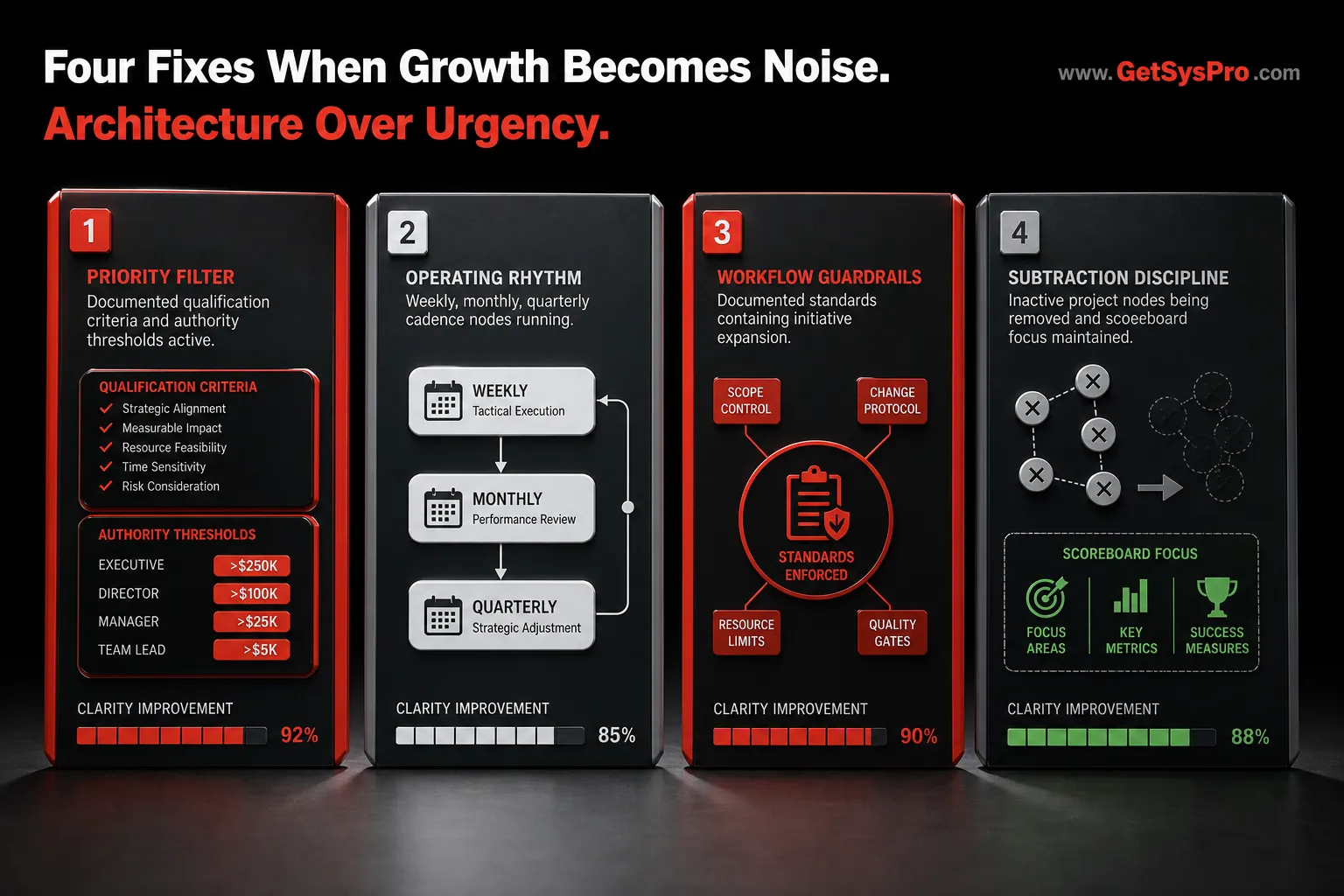
Four structural fixes convert growth noise into focused execution: a documented priority filter, an operating rhythm cadence, workflow guardrails that contain expansion, and subtraction discipline that removes initiatives not producing returns. GetSysPro installs all four. www.GetSysPro.com
Article Summary
Growth becomes noise when activity increases faster than the organizational architecture can direct it toward outcomes. The signals appear first as initiative overload, meeting density, and financial volatility. The structural causes are absent prioritization filters, weak operating rhythm, and expansion that bypasses workflow standards. Structural solutions include documented priority filters that govern what gets approved, a consistent cadence that protects strategic execution from urgency, workflow guardrails that make new initiatives architecturally absorbable, and subtraction discipline that keeps organizational capacity concentrated on what matters most. Growth is valuable. Focus makes it durable.
Growth Is Valuable. Focus Makes It Durable. Build the Architecture.
GetSysPro installs the prioritization frameworks, operating rhythm, and workflow standards that convert growth noise into compounding progress.
Frequently Asked Questions
How do you know when growth becomes noise rather than healthy momentum?
The clearest signal is when coordination effort increases faster than output. A business experiencing healthy momentum produces more as it grows larger. A business where growth becomes noise adds coordination overhead faster than it adds capacity, which means a growing percentage of organizational energy goes into maintaining alignment rather than advancing objectives. Specific behavioral signals include leadership teams that spend most of their meeting time on status updates rather than decisions, initiative lists that grow without pruning, and financial results that fluctuate unpredictably even as revenue trends upward.
What is a prioritization filter and how does a business implement one?
A prioritization filter is a documented set of criteria that every proposed initiative must meet before receiving organizational resources. The specific criteria vary by business, but the essential components address strategic alignment, capacity availability, financial threshold, ownership assignment, and measurable outcome definition. Implementing a filter requires defining those criteria explicitly, assigning the authority to apply them consistently, and requiring every initiative approval to pass through the filter before resources are committed. Once the filter exists and gets applied consistently, initiative overload decreases because proposals that do not meet the criteria do not enter the execution pipeline.
Why does operating rhythm prevent growth from becoming noise?
Operating rhythm prevents growth noise by creating a structural alternative to urgency-driven decision making. When a consistent cadence of weekly execution reviews, monthly variance analysis, and quarterly recalibration exists, the organizational default for addressing problems is the next scheduled review rather than an emergency meeting. Strategic priorities receive protected time on a known schedule rather than competing for leadership attention against whatever happens to feel urgent that day. Urgency still exists, but it has a defined escalation pathway rather than displacing everything else. That structural protection is what prevents the priority drift that produces noise.
How does Process and SOP Architecture reduce growth noise specifically?
Process and SOP Architecture reduces growth noise by requiring new initiatives to operate within documented workflow standards rather than creating custom processes for each one. When a new product line, market, or operational function launches without documented workflow standards, it requires the organization to coordinate its execution through conversation and exception management rather than through reference to a written standard. That coordination overhead is a primary source of meeting density and initiative overload. When the new initiative is required to follow documented workflow standards from launch, the coordination overhead is lower because the standards answer most of the operational questions the team would otherwise need to resolve through meetings.
Is subtraction really a growth strategy or just a way of limiting ambition?
Subtraction is a concentration strategy rather than a limitation strategy. Organizational capacity is finite, and every initiative that receives resources reduces the capacity available for every other initiative. Pruning the initiative list does not reduce the ambition of the business. It concentrates the capacity of the business on the initiatives most likely to produce the outcomes it has committed to. Organizations that subtract strategically, that kill projects that are not producing returns and decline opportunities that do not align with current-quarter priorities, consistently outperform organizations that pursue everything because concentration produces execution quality that diffusion cannot. Growth becomes noise when everything is pursued. Growth becomes compounding when priorities are chosen and defended.
Last Updated: [the_modified_date format=”F j, Y”]