08/07/2025
Most businesses review employees rigorously and their operating system by feel. That inversion creates drift.
Most companies conduct performance reviews for employees. Very few conduct a performance review for the business itself. Individual reviews are structured, metrics are discussed, and expectations are clarified, yet the operating system underneath is evaluated by feel. That inversion creates drift: people are reviewed more rigorously than the system they are forced to work inside. The performance review your business actually needs is not about effort or attitude. It is about architecture.
A useful external frame for what system-level review looks like is the COSO internal control framework, which defines organizational control through repeatable components: risk assessment, control activities, information and communication, and monitoring. Translated to a business performance review, those components describe an organization that evaluates its operating model as rigorously as it evaluates its people.
In This Article
- What Gets Reviewed and What Gets Assumed
- The Signals That Look Like Growth But Are Structural Drift
- The Business Performance Review Questions That Actually Matter
- How to Turn Business Feelings Into a Measurable Audit
- Documentation Is Part of Performance, Not Paperwork
- The Overlooked Payoff: Better Employee Reviews
- Frequently Asked Questions
Key Takeaways
- Most businesses review their people more rigorously than the operating system those people work inside. That inversion produces drift that compounds over time.
- The signals that precede a system performance crisis, slower approvals, escalating KPI explanations, late reporting, increasing escalations, are often mistaken for growth pressure rather than structural drift.
- A business performance review evaluates architecture: decision latency, reporting cadence, KPI ownership, workflow documentation, and governance activation patterns.
- Documentation integrity is a performance metric. Contracts, internal policies, and vendor agreements that no longer reflect current operations are governance liabilities, not paperwork problems.
- When the operating system is reviewed and measured, employee performance reviews become more objective. Clear accountability frameworks produce clearer scorecards.
What Gets Reviewed and What Gets Assumed
Employee performance reviews have structure. There is a cadence, a format, metrics, and a feedback mechanism. The review produces a documented record and often an action plan. Most businesses apply that level of rigor to their people every quarter or every year.
The operating system those same people work inside rarely receives equivalent scrutiny. Workflows are assumed to be functioning because work is getting done. Reporting is assumed to be accurate because numbers are arriving. Authority is assumed to be clear because decisions are being made. The system gets a performance review only when something breaks visibly enough to force attention, which means the review is almost always reactive rather than proactive.
Why the Performance Review Gap Produces Drift
When the operating system is not reviewed, it drifts. Processes that were documented two years ago reflect a company that no longer exists at its current scale. Authority thresholds that were appropriate at twenty employees are unclear at fifty. Reporting cadences that worked when the founder reviewed everything manually have not been redesigned around a leadership team. That drift is invisible until it produces a symptom, at which point the business is already managing consequences rather than preventing them.
The Signals That Look Like Growth But Are Structural Drift
Most leadership teams do not schedule a system performance review. They encounter the need for one reactively when operational friction reaches a threshold that demands attention. The signals are consistent and often misread as the natural pressure of a growing business.
Approvals start taking longer, so leaders add meetings to resolve the backlog. KPI conversations shift from discussing numbers to explaining them. Hiring requests accelerate because work feels heavier even though revenue has not grown proportionally. Reporting starts arriving late, so decisions get made on outdated information. Escalations increase because decision rights were never updated as the organizational structure grew.
Structural Drift and Growth Pressure Look Identical From the Inside
The problem with misreading structural drift as growth pressure is that the responses are different. Growth pressure calls for resources. Structural drift calls for redesign. Adding headcount to a system that has drifted architecturally produces more people working inside the same broken structure, which increases cost without resolving the friction. A performance review of the business distinguishes between the two by measuring the system rather than feeling it. Research on organizational measurement consistently finds that teams operating with poor system visibility misattribute structural problems to individual performance, which leads to personnel decisions that do not resolve the underlying operational issue.
The Business Performance Review Questions That Actually Matter
A genuine performance review of the business evaluates architecture rather than attitude. The questions that surface systemic health are different from the questions that surface individual performance, and they require different data to answer.
Is decision latency increasing or decreasing over the past two quarters? Is reporting cadence timely and consistent across departments, or does it vary by person and circumstance? Are KPIs tied to accountable owners with documented follow-through, or are they reviewed and forgotten? Are workflows documented, trained on, and actually followed, or do they exist in documents nobody references? Is governance activated proactively, or only when a problem surfaces?
When the Performance Review Questions Are Hard to Answer Quickly
If those questions are difficult to answer quickly and confidently, that difficulty is the finding. A business whose leaders cannot quickly answer whether decision latency is trending up or down does not have a measurement problem. It has a system design problem. The review makes the invisible visible by forcing specific answers rather than general impressions, and the gaps in the answers reveal exactly where the architectural work needs to happen.
When was the last time your business got a performance review?
GetSysPro audits the operating system with the same rigor most businesses apply only to their people.
How to Turn Business Feelings Into a Measurable Audit
The practical version of a business performance review is a structured operational audit that evaluates the system against measurable criteria rather than leadership impressions. A Business Operational Systems Audit evaluates workflow health, authority architecture, reporting integrity, and accountability design by treating the operating model as something that can be measured rather than assumed.
The audit surfaces where workflows have drifted from their documented state, where authority thresholds no longer match the current organizational structure, where reporting depends on manual effort rather than consistent cadence, and where accountability frameworks exist on paper but not in practice. Those findings convert the general sense that something is wrong into a prioritized list of architectural corrections with defined scope and sequence.
From Anecdotes to Architecture: The Performance Review Shift
When the system is measured, the conversation in the leadership team changes. Leaders stop debating whether a process feels slow or a report feels late and start working from data about where the bottleneck sits and what structural change addresses it. The performance review of the business produces the same shift that employee performance reviews produce: from impressions to evidence, from subjective to measurable, from difficult conversations to documented action plans.
Documentation Is Part of Performance, Not Paperwork
A system performance review always surfaces documentation integrity as a performance metric in its own right. Contracts that no longer reflect current operational reality create friction every time they are invoked. Internal policies that are outdated create ambiguity that defaults to the person with the most institutional memory. Vendor agreements that vary by relationship rather than by written standard create inconsistent enforcement that produces inconsistent outcomes.
Specialized Documents Creation addresses this layer by ensuring governance documents, contracts, and vendor terms reflect how the company actually operates rather than how it operated when the documents were written. Documentation that is current and internally consistent is not an administrative achievement. It is a governance performance indicator.
Outdated Documentation Is a Performance Problem
The performance review frame clarifies why documentation integrity matters beyond compliance. When a vendor dispute arises and the governing agreement no longer reflects the current relationship, the documentation has failed its governance function. When a new hire cannot find a written standard for the job they were hired to do, the workflow documentation has failed its training function. Reviewing documentation as a performance dimension of the business applies the same rigor to governance artifacts that the business applies to its people.
The Overlooked Payoff: Better Employee Reviews
There is a compound benefit to conducting a performance review of the operating system that most businesses do not anticipate: employee performance reviews become more objective when they follow it.
When accountability frameworks are documented and applied consistently, individual performance expectations map to measurable outcomes rather than to general impressions. Feedback becomes less emotional because the scoreboard is clear. High performers can be recognized against defined criteria rather than against subjective assessments. Underperformance can be addressed with reference to documented standards rather than perceived expectations.
“Review the system with the same rigor you apply to your people. The operating model is the environment every individual review is measured inside. If it is drifting, the individual reviews are measuring noise.”
Editorial, GetSysPro Team
Related GetSysPro Services
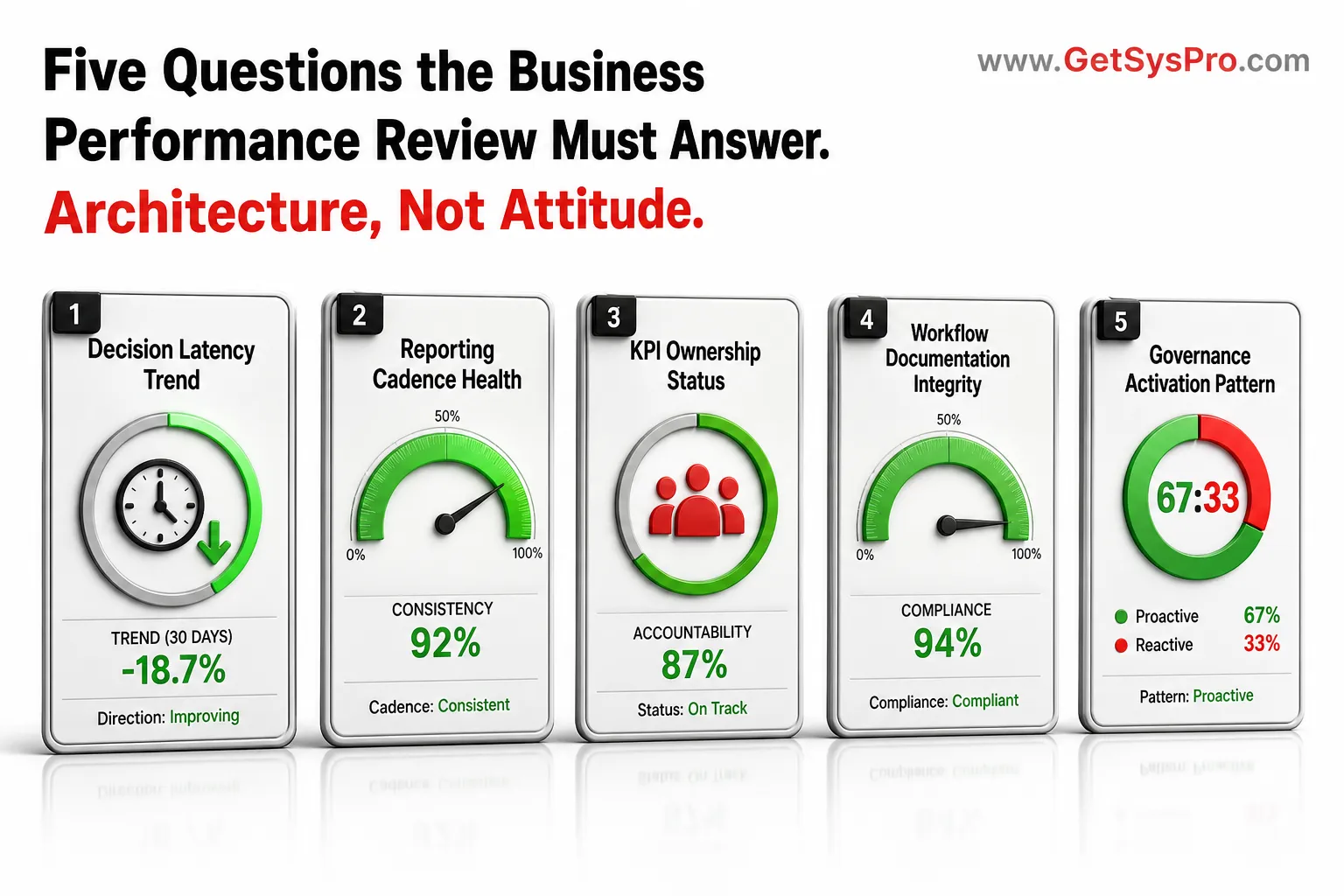
A business performance review asks five questions that evaluate architecture rather than attitude: decision latency trend, reporting cadence health, KPI ownership status, workflow documentation integrity, and governance activation pattern. When those are hard to answer quickly, that difficulty is the finding. GetSysPro produces the answers. www.GetSysPro.com
Article Summary
The performance review your business actually needs is a structured evaluation of the operating system, not just the people working inside it. Most businesses review their employees with rigor and their architecture by feel. That inversion creates drift that compounds until operational symptoms force reactive attention. The questions that matter evaluate decision latency, reporting cadence, KPI ownership, workflow documentation, and governance activation patterns. When those are measured rather than assumed, the leadership conversation shifts from anecdotes to architecture, and employee reviews that follow become more objective because the scoreboard they reference is accurate.
Review the System. Then Review the Staff. In That Order.
GetSysPro conducts the business performance review that surfaces architectural drift before it produces consequences.
Frequently Asked Questions
What is a business performance review and how is it different from an employee performance review?
An employee performance review evaluates individual contribution: whether a person met their goals, how they performed against expectations, and what development is needed going forward. A business performance review evaluates the operating system itself: whether workflows are documented and followed, whether authority boundaries are clear and applied consistently, whether reporting cadence produces timely and accurate information, and whether accountability frameworks are functioning as designed. The two reviews are complements. The business performance review creates the conditions under which employee reviews can be conducted fairly and accurately.
How often should a business conduct a performance review of its operating system?
The minimum viable frequency is annual, but the most useful cadence is aligned with significant organizational changes: a meaningful headcount increase, a new service line or market, a leadership transition, or a revenue milestone that places new demands on the operating model. Businesses that grow quickly benefit from a system performance review every six to twelve months because the operating model drifts faster under growth pressure. Annual reviews catch drift before it compounds into crisis. Less frequent reviews convert structural drift into operational emergencies that require significantly more intervention to correct.
What are the most common findings in a business performance review?
The findings that appear most consistently are authority boundaries that have not been updated since the organization grew, reporting cadences that depend on manual assembly rather than structured processes, workflow documentation that describes how the business operated at a smaller scale rather than how it operates now, and accountability frameworks where ownership is assigned in titles but not enforced in practice. Documentation integrity gaps are also common: contracts and vendor agreements that no longer reflect current terms, and internal policies that have drifted from documented standards through informal workarounds.
Can a business conduct its own performance review without external help?
A self-conducted review is possible but faces two consistent limitations. First, the team reviewing the system is also operating inside it, which makes it difficult to identify drift that has become normalized. Informal workarounds that developed over two years feel like standard practice to the people who created them. Second, a self-conducted review rarely produces the prioritization clarity that an external audit provides. Internal teams can identify problems but struggle to sequence corrections by impact and feasibility without an external frame of reference. External operational reviews produce a more complete picture and a more actionable output than internal assessments.
How does documentation quality affect the business performance review outcome?
Documentation quality determines how much of the review can be conducted against written standards versus how much depends on interviewing individuals to reconstruct how things actually work. When documentation is current and accurate, the review is faster and more precise: the auditor compares actual process behavior against the documented standard and measures the variance. When documentation is outdated or absent, the review requires more time to map current reality before it can evaluate whether that reality is healthy. Businesses with strong documentation integrity produce faster, more actionable review findings and require less corrective work to close the gaps the review surfaces.
Last Updated: [the_modified_date format=”F j, Y”]