 09/04/2025
Premium fuel cannot fix a poorly tuned engine. In business, structure is the engine. Build it first.
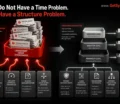
Marketing spend, growth capital, and aggressive hiring are fuel. Structure is the engine. When you design the machine before adding fuel, growth produces speed. When you add fuel to an undesigned machine, growth produces heat, friction, and strain that compound with every dollar and every hire. Most leaders are not wrong about what to do. They are wrong about when to do it.
Bain research on organizational complexity consistently finds that complexity creeps in as companies grow and slows decisions and execution when not managed intentionally. Adding more investment into an operationally unprepared business produces less output, not more, because the inputs amplify whatever friction already exists in the system.
In This Article
- Why Fuel Amplifies Whatever the Machine Already Has
- Hiring Is Fuel That Multiplies Coordination Paths
- Marketing Spend Is Fuel That Stresses the Handoff Points
- Capital Is Fuel That Magnifies Governance Gaps
- How to Design the Machine Before You Accelerate
- Where GetSysPro Fits Before You Add Fuel
- Frequently Asked Questions
Key Takeaways
- Fuel amplifies whatever is already inside the machine. If the machine has friction, more fuel produces more friction, not more speed.
- Hiring adds coordination paths before it adds output. Without clear reporting lines and authority boundaries, headcount increases complexity faster than capacity.
- Marketing spend stresses handoff points. Consistent lead volume reveals whether intake, fulfillment, and billing can absorb it without the delivery standard varying by person.
- Capital magnifies governance gaps. Speed punishes ambiguity, and capital brings speed.
- Design the machine before you add fuel. Workflow clarity, authority architecture, and role definition are what make growth accelerate rather than strain.
Why Fuel Amplifies Whatever the Machine Already Has
More demand is valuable. More hires can help. More tools can add leverage. When the operating design is unclear, however, every new input increases friction rather than output. More leads without a consistent intake process creates confusion between sales and delivery. Additional headcount without clear roles increases handoffs and misalignment. Capital without governance increases risk and variance.
The sequence mistake is adding resources before solving the structural problems those resources will encounter. A business that struggles to deliver consistently for ten clients will struggle more visibly for twenty. A team that operates through informal coordination at fifteen people will operate through chaotic coordination at thirty. Growth does not fix structural gaps. It exposes and amplifies them.
Design the Machine First: The Sequence That Changes the Outcome
When you design the machine before adding fuel, the inputs compound. Each new hire fills a defined role. New clients follow a consistent delivery process. Capital deployments follow documented governance. The result is not just faster growth. It is growth that builds capacity rather than consuming it. The business that accelerates into a designed operating system scales. The business that accelerates into an informal one strains.
Hiring Is Fuel That Multiplies Coordination Paths
Adding ten employees to a loosely structured company does not add ten units of output. It adds ten more nodes in the communication network. If reporting relationships are unclear, people over-communicate or escalate to stay safe. If authority thresholds are undefined, managers hesitate and decisions drift upward. Payroll rises immediately. Productivity rises later, and sometimes never catches up because the system was not redesigned before the headcount was added.
The coordination overhead that comes with growth is not inevitable. It is the product of hiring into ambiguity rather than into definition. When reporting lines are clear and each role has a documented scope of authority and accountability, a new hire reduces friction rather than adding to it. The organization gains capacity rather than complexity.
Before You Hire: Design the Machine Around the Role
Organizational Chart Development clarifies reporting lines and measurable ownership so new hires fill defined gaps rather than ambiguous space. A hire into a well-defined role with clear authority boundaries, documented expectations, and an established reporting relationship produces returns faster and with less coordination overhead than a hire into a loosely defined function that the business expects the person to shape through experience.
Marketing Spend Is Fuel That Stresses the Handoff Points
Marketing does not just generate leads. It generates workload and timing pressure. When lead volume increases, the real test is whether onboarding, fulfillment, and billing can absorb it consistently. If the intake process is informal, conversion consistency weakens. When the handoff between sales and operations is unclear, delivery standards vary by person and circumstance. Billing disconnected from milestones makes cash timing unpredictable.
This is why more leads can make a company feel less stable rather than more. The marketing investment is working. The operating model is not ready for what the marketing produces. When you design the machine before increasing marketing spend, the leads flow into a consistent intake process, the handoffs follow documented standards, and delivery quality holds regardless of volume.
Design the Machine to Handle What Consistent Lead Volume Tests
A business discovers its operational weak points most clearly when volume is high and timing is compressed. A prospect who experiences a smooth intake process, a consistent delivery standard, and accurate billing becomes a repeat client and a referral source. A prospect who experiences an inconsistent intake, a variable delivery, and billing confusion becomes a churn event and a reputational risk. Marketing spend accelerates whichever of those two experiences the operating model currently produces.
Ready to add fuel? Design the machine first.
GetSysPro identifies the mechanical friction in your operating system before acceleration compounds it.
Capital Is Fuel That Magnifies Governance Gaps
Capital increases expectations and brings speed. Speed punishes ambiguity. When approvals are inconsistent, spend becomes noisy and tracking becomes reactive. Unstandardized contracts multiply vendor risk with each new agreement. Internal policies assumed rather than documented produce selective enforcement and inconsistent outcomes. The business can appear to be scaling while risk silently accumulates underneath the revenue numbers.
Specialized Documents Creation tightens the legal and operational boundaries that keep growth from becoming exposure. Standardized vendor agreements, documented approval thresholds, and current internal policies are the governance infrastructure that capital deployment requires. Without them, capital does not just accelerate growth. It accelerates the risk that informal governance was already accumulating.
Design the Machine Around Governance Before Capital Arrives
The businesses that deploy capital most effectively are those that completed the governance work before the capital arrived. Approval thresholds are written down. Vendor standards are consistent. Internal policies match current operational reality. When capital is deployed into that environment, it flows toward productive use. When capital is deployed into an informal governance environment, it flows toward wherever individual judgment directs it in the moment, which produces inconsistent outcomes and difficult-to-trace variance.
How to Design the Machine Before You Accelerate
Machine design is not a motivational exercise. It is mapping. The questions that design the machine are operational and specific. How does work enter the organization? Where does it transition between teams? Who owns each stage of delivery? What triggers a handoff from one function to the next? What is the standard of completion at each point?
When those questions do not have explicit answers, expansion is blind acceleration. HBR research on scaling operations consistently finds that businesses that define processes before expanding them produce more consistent outputs at higher volumes than those that allow informal processes to scale. People compensate through extra meetings, manual tracking, and founder approvals. That compensation is not scale. It is strain wearing the appearance of activity. Every dollar of marketing spend and every new hire encounters that strain, which is why growth feels harder rather than easier as the business gets bigger without getting more structured.
Process and SOP Architecture: The Machine Design That Scales
Process and SOP Architecture converts tribal knowledge into repeatable execution so growth initiatives integrate into systems rather than bypass them. When the workflow is mapped and documented, new hires learn the job from the standard rather than from whoever is available. New clients experience the delivery process rather than whichever version the delivery team happened to improvise. Marketing spend lands in a system that can absorb it rather than a process that bends under volume.
Where GetSysPro Fits Before You Add Fuel
If growth feels pressured rather than strengthening, the instinct to add more fuel is understandable but often counterproductive. More investment into a system with mechanical friction produces more friction. The intervention that changes the trajectory is evaluating the engine before accelerating.
A Business Operational Systems Audit identifies the friction in the operating model before acceleration compounds it: workflow consistency, authority architecture, documentation integrity, and performance visibility. The audit answers where the machine has design gaps so those gaps can be closed before the next round of fuel makes them more expensive to fix.
Ambition drives opportunity. Architecture sustains it. Design the machine first. Then accelerate.
Related GetSysPro Services
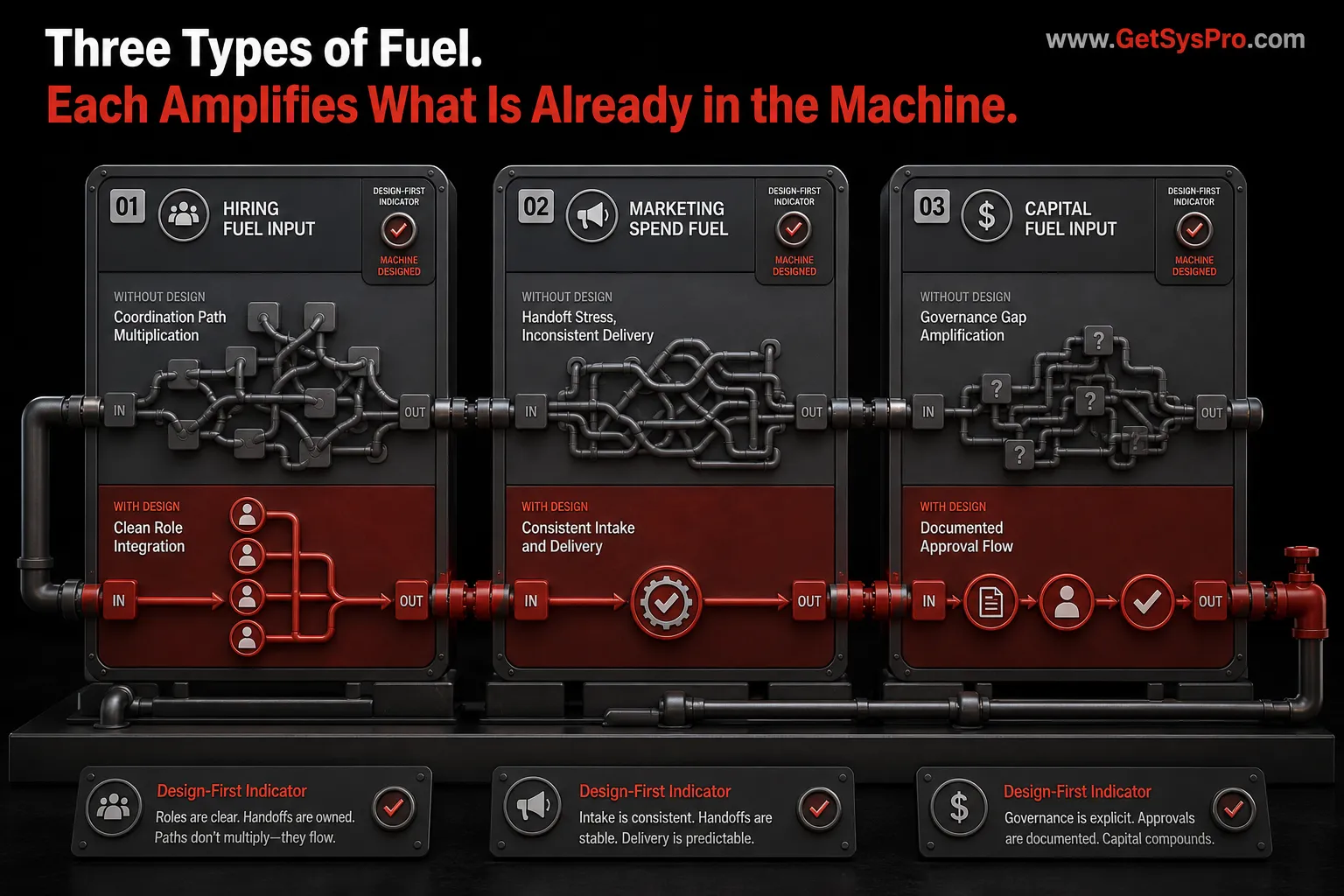
Hiring, marketing spend, and capital each test a different structural element of the operating model. Without machine design, each one amplifies friction. With machine design in place first, each one amplifies output. The machine determines the outcome, not the fuel. www.GetSysPro.com
Article Summary
Fuel amplifies whatever is already inside the machine. Marketing spend, hiring, and capital are fuel. When the operating model underneath is informal, undocumented, and full of friction, each type of fuel accelerates the friction rather than the growth. The sequence that produces returns is designing the machine first: mapping workflows, defining roles, establishing authority boundaries, and standardizing documentation before the next round of investment arrives. Ambition drives opportunity. Architecture sustains it.
Ambition Drives Opportunity. Architecture Sustains It.
GetSysPro designs the machine so the fuel you add produces speed, not strain.
Frequently Asked Questions
What does it mean to design the machine before adding fuel?
Designing the machine means building the operational architecture of the business before investing in the resources that will stress it. Fuel, meaning marketing spend, headcount, and capital, amplifies whatever is already inside the system. If the system has unclear workflows, undefined authority boundaries, and informal documentation, fuel amplifies those problems. Designing the machine means mapping workflows, defining reporting lines and authority thresholds, documenting delivery standards, and standardizing governance before the next round of investment arrives. When the machine is designed first, fuel produces acceleration. When it is not, fuel produces escalating friction.
Why does hiring increase complexity before it increases output?
Every person added to an organization creates new communication paths, new coordination requirements, and new potential points of ambiguity. In a well-designed operating system with clear reporting lines, defined authority, and documented processes, a new hire slots into a structure that guides their work from day one. In a loosely structured organization, a new hire joins a system that requires them to invent their own processes, navigate unclear authority, and depend on whoever has institutional knowledge to understand how things actually work. The coordination overhead of the second scenario is significant and does not decrease automatically as the person gains experience.
How does marketing spend reveal operational weak points?
Marketing spend increases lead volume, and consistent lead volume is the most reliable stress test for the intake, handoff, and delivery processes of the business. When a business operates at low volume with informal processes, the founder or a small team compensates through personal attention and direct communication. When volume increases, that compensation cannot scale. The inconsistency that was manageable at ten clients per month becomes visible and damaging at thirty. Marketing spend does not create operational weak points. It reveals the ones that already exist by raising the volume at which the informal process must operate.
What governance work needs to happen before a capital deployment?
Before capital is deployed at any significant scale, four governance elements need to be in place in documented form: approval thresholds that define who can authorize spending at each level and in each category, vendor agreement standards that apply consistent terms and risk controls across all supplier relationships, internal policy documentation that governs exception handling and escalation, and performance visibility systems that allow leadership to track whether capital is producing the intended returns. Without those elements, capital deployment depends on individual judgment at every decision point, which produces inconsistent outcomes and difficult-to-trace variance that grows more complex to unwind as the capital base increases.
When is the right time to do an operational systems audit relative to a growth initiative?
The right time is before the initiative launches, not after the initiative reveals problems. Conducting the audit before a marketing campaign identifies whether intake and delivery processes can handle the volume the campaign will generate. Before a hiring push, the audit clarifies whether reporting lines, role definitions, and authority thresholds are clear enough to make new hires productive. Before a capital deployment, it confirms whether governance is strong enough to deploy capital without accumulating risk. Audits conducted after the initiative has begun are still valuable, but they are corrective rather than preventive, which means the friction they identify has already been compounding during the growth period.
Last Updated: [the_modified_date format=”F j, Y”]