 11/06/2024
The mindset that built the business is now the friction slowing it down.
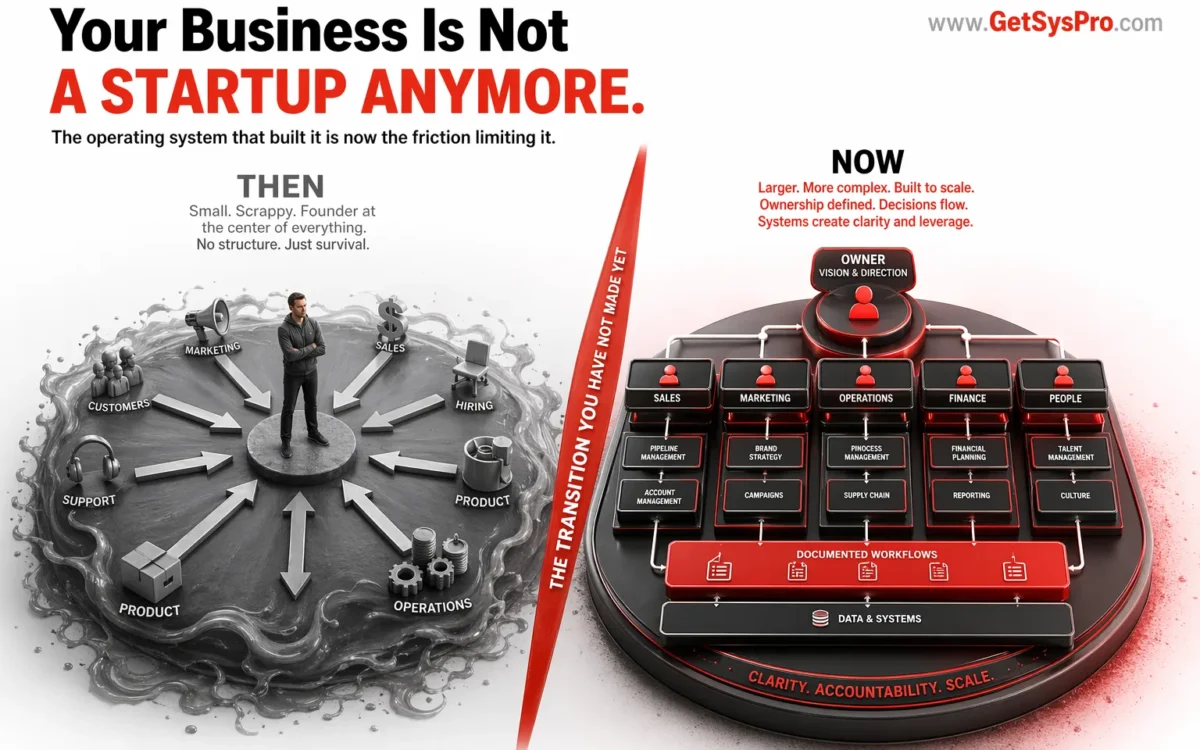
Revenue is consistent. The team has grown. Customers expect predictability. And the company is still running on the improvised operating system that got it here. That is the startup hangover, and it is not a culture problem or a people problem. It is an architectural problem: the business outgrew its operating design while the founder was busy growing the business.
Your business is not a startup anymore. This article names what that transition demands, where the old patterns break, and what mature operating design actually looks like when it replaces founder-led improvisation with structural execution.
In This Article
- The Friction Is Architectural, Not Cultural
- Growth Stages Demand Different Systems
- The Startup Behaviors That Break at Scale
- Adding Managers Does Not Create Structure
- Mature Companies Run on Operating Models
- What the Transition Actually Requires
- How GetSysPro Supports the Transition
- Frequently Asked Questions
Key Takeaways
- The startup hangover is an architectural problem, not a culture problem. The operating design that created early speed produces friction at scale because it was never built to manage complexity, coordination, or predictable delegation.
- Startup improvisation creates speed in early stages and creates friction at scale. The same fluidity that supported experimentation produces decision latency, accountability diffusion, and inconsistent execution when the team and complexity grow.
- Adding management layers without redefining underlying structure increases coordination overhead rather than reducing friction. Clarity must precede hierarchy.
- Maturity is not the loss of entrepreneurial spirit. It is the refinement of it: moving from founder-led heroics to a company that executes predictably without constant founder intervention.
- Your business is not a startup anymore. Structure must match ambition, and that structure requires intentional design rather than accumulated improvisation.
The Friction Is Architectural, Not Cultural
The most visible sign that your business is not a startup anymore is recurring operational friction that no amount of effort or attitude adjustment resolves. Projects require repeated clarification before anyone can execute them. Reporting produces inconsistent numbers that create debates rather than decisions. Leadership spends more time filling execution gaps than thinking about strategy. Teams stay busy while outcomes feel less predictable than they did when the team was smaller.
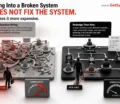
That pattern is not a sign that the team has degraded. It is a sign that the operating design has not matured with the business. In a startup, the founder’s personal attention fills every structural gap. That works when the founder can touch every decision, know every context, and personally course-correct every deviation. At scale, the founder cannot touch everything anymore, and the structural gaps that founder attention previously covered become visible as friction, inconsistency, and accumulated confusion.
Why It Gets Misdiagnosed
Startup hangover almost always gets misdiagnosed as a people problem. The team is not executing. Communication is breaking down. Nobody is taking ownership. Those observations are accurate. The causes behind them are structural, not motivational. Roles defined by personality rather than outcome produce unclear ownership. Decisions routed through the founder by default produce decision latency. Approvals happening informally produce inconsistent spending and delivery standards. Diagnosing those structural failures as people failures produces the wrong interventions and leaves the actual architectural problem accumulating more friction.
“Startup improvisation once created speed. At scale, it creates friction. Your business is not a startup anymore, and the operating system that built it must be replaced by one designed to run it. That replacement is not the end of ambition. It is the structural condition that makes ambition executable.”
Editorial, GetSysPro Team
Growth Stages Demand Different Systems
Every growth stage places different demands on an organization’s operating design. The systems that produce results at one stage actively produce friction at the next if they are not updated. Early-stage companies survive on flexibility, founder attention, and speed. The lack of formal structure is not a weakness at this stage. It is an efficiency, because the founder’s direct involvement substitutes for structural overhead that would slow down the experimentation the business needs to find its model.
As revenue stabilizes and the team grows, those same characteristics become liabilities. HBR’s foundational research on the five stages of small business growth identifies how management style, structure, and systems must evolve as company size and complexity increase, noting that what made the startup work can become what makes the grown-up company stall. The transition is not optional. It is a structural requirement of the growth itself, and avoiding it does not prevent the demands from arriving. It ensures the business meets those demands without the systems to handle them.
The Specific Demands That Scale Places on Operating Design
At scale, the operating design must support delegation without founder involvement in every decision, coordination across multiple functions without constant realignment meetings, and consistent execution across a team where not everyone shares the founder’s context or judgment. None of those capabilities emerge automatically from growth. Each requires intentional structural investment that produces the systems through which a larger team can execute predictably rather than depending on the founder to convert every ambiguity into a direction.
The Startup Behaviors That Break at Scale
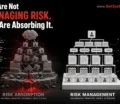
The startup behaviors that break at scale are predictable because they all share the same structural characteristic: they work through personal involvement rather than through documented systems. Roles defined by personality rather than outcome mean that when the person who “owns” something leaves, moves to a new role, or gets stretched too thin, ownership disappears with them. Decisions routed through the founder by default mean that every significant judgment call requires founder bandwidth, which becomes the organizational bottleneck as scale increases.
Approvals happening informally create inconsistent spending and delivery standards that vary depending on who asked and who was available to respond. Reporting that is inconsistent forces leaders to manage from anecdotes and memory rather than from shared data, producing the strategic misalignment that surfaces as competing priorities across functions. Workflows living in people’s heads mean that quality depends entirely on which individual touches the work, making performance inconsistent and making onboarding new team members into those workflows expensive and slow.
None of This Is Immoral. All of It Is Outdated.
The startup behaviors that break at scale were not failures when they were adopted. They were appropriate responses to the constraints and priorities of an earlier stage. Recognizing that your business is not a startup anymore does not require condemning the practices that built it. It requires acknowledging that those practices were designed for a different organizational context and that applying them to a more complex organization produces the friction that growth-stage founders universally recognize but frequently misattribute to the wrong causes.
Adding Managers Does Not Create Structure
One of the most common responses to startup hangover is adding management layers. The reasoning is sound: more complexity requires more management capacity. The execution fails when the management layer gets added without redefining the underlying structure those managers are supposed to operate within. Adding a manager into a role without documented authority boundaries, defined decision rights, measurable performance expectations, and a review cadence does not reduce founder involvement. It creates an additional relay through which founder-dependent decisions travel more slowly.
Clarity must precede hierarchy. Before adding a management layer, the organization must answer the structural questions that layer will need to operate within: what decisions does this role make independently, what outcomes is it accountable for producing, what authority boundary separates it from adjacent roles, and how will performance be reviewed and against what standard. Without those answers, the management layer becomes part of the startup hangover rather than the solution to it.
What Organizational Structure Requires Before Headcount
The prerequisite for effective organizational structure is documented role architecture: outcome-based role definitions, explicit decision rights, defined reporting relationships, and performance metrics that make accountability objective rather than subjective. Organizations that build that architecture before adding headcount find that new managers reach full effectiveness faster, require less founder involvement to operate, and produce less coordination overhead than organizations that add people into structural ambiguity and expect role clarity to emerge from the presence of capable individuals. It does not emerge. It must be designed.
Mature Companies Run on Operating Models
Mature companies run on operating models, not heroics. The distinction is specific: a company running on heroics depends on particular individuals’ judgment, energy, and institutional knowledge to produce consistent results. Remove those individuals and performance degrades because the systems that should sustain performance independent of any individual do not exist. A company running on an operating model produces consistent results through documented processes, defined accountability, and structural oversight that functions regardless of which specific individuals occupy which roles.
McKinsey’s research on operating models notes that even the best strategy will not automatically produce performance, and that an effective operating model must be intentionally designed to deliver clarity and speed across the organization. The transition from founder-dependent execution to operating-model execution is the core maturity challenge for growth-stage businesses, and most founder-led companies defer it longer than they should because designing the operating model requires stepping back from executing within it.
Maturity Is Refinement, Not Loss
Maturity is not the loss of entrepreneurial spirit. It is the refinement of it. The ambition, speed, and direct accountability that characterized the startup do not disappear in a mature operating model. They get encoded into systems that make them accessible throughout the organization rather than dependent on the founder’s direct presence. Founders who once personally ensured quality on every deliverable do not become less entrepreneurial by building the quality standards that ensure consistent output across a larger team. Ambition scales. Heroics become unnecessary.
Still running a grown business on startup habits?
GetSysPro builds the operating model that matches your current scale, not the one you started with.
What the Transition Actually Requires
The transition from startup operating design to mature operating design requires four structural investments made in the right sequence. Documented role architecture replaces personality-defined roles with outcome-based definitions that make ownership clear and transferable rather than dependent on specific individuals. Defined decision rights distribute authority deliberately so that decisions reach the right level without requiring founder involvement as the default escalation path.
Consistent reporting cadence creates the shared visibility that replaces anecdote-based management with data-based governance, giving every function a common factual basis for decisions that currently require alignment conversations because the data foundation does not exist. Documented workflow standards replace institutional knowledge held by specific individuals with organizational standards that make execution quality consistent regardless of who touches the work, which is what enables effective onboarding, delegation, and scale.
The Right Sequence Matters
The sequence matters because each element creates the prerequisite for the next. Role architecture creates the ownership clarity that makes decision rights meaningful. Decision rights create the authority distribution that makes reporting cadence purposeful. Reporting cadence creates the visibility that makes workflow standards enforceable. Organizations that attempt to install these elements out of sequence or in isolation consistently find that the element they installed without its prerequisite does not hold under the operational pressure of a growing business, which is why piecemeal structural improvement rarely produces the compounding operational results that comprehensive operating model design delivers.
How GetSysPro Supports the Transition
GetSysPro Services for the Startup-to-Scale Transition
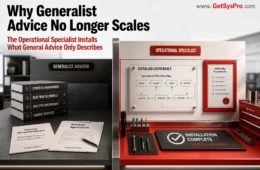
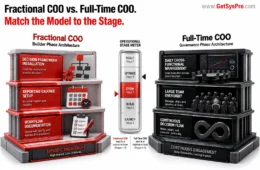
Fractional COO Leadership Services bridge startup agility and mature governance: installing accountability frameworks, defining decision clarity, establishing reporting cadence, and building workflow discipline without disrupting the momentum or replacing the entrepreneurial energy that drives it.
Business Operational Systems Audit maps the gap between the current operating design and where mature design needs to be, identifying the specific structural gaps producing the most friction so investment targets the highest-leverage improvements first.
Related GetSysPro Services
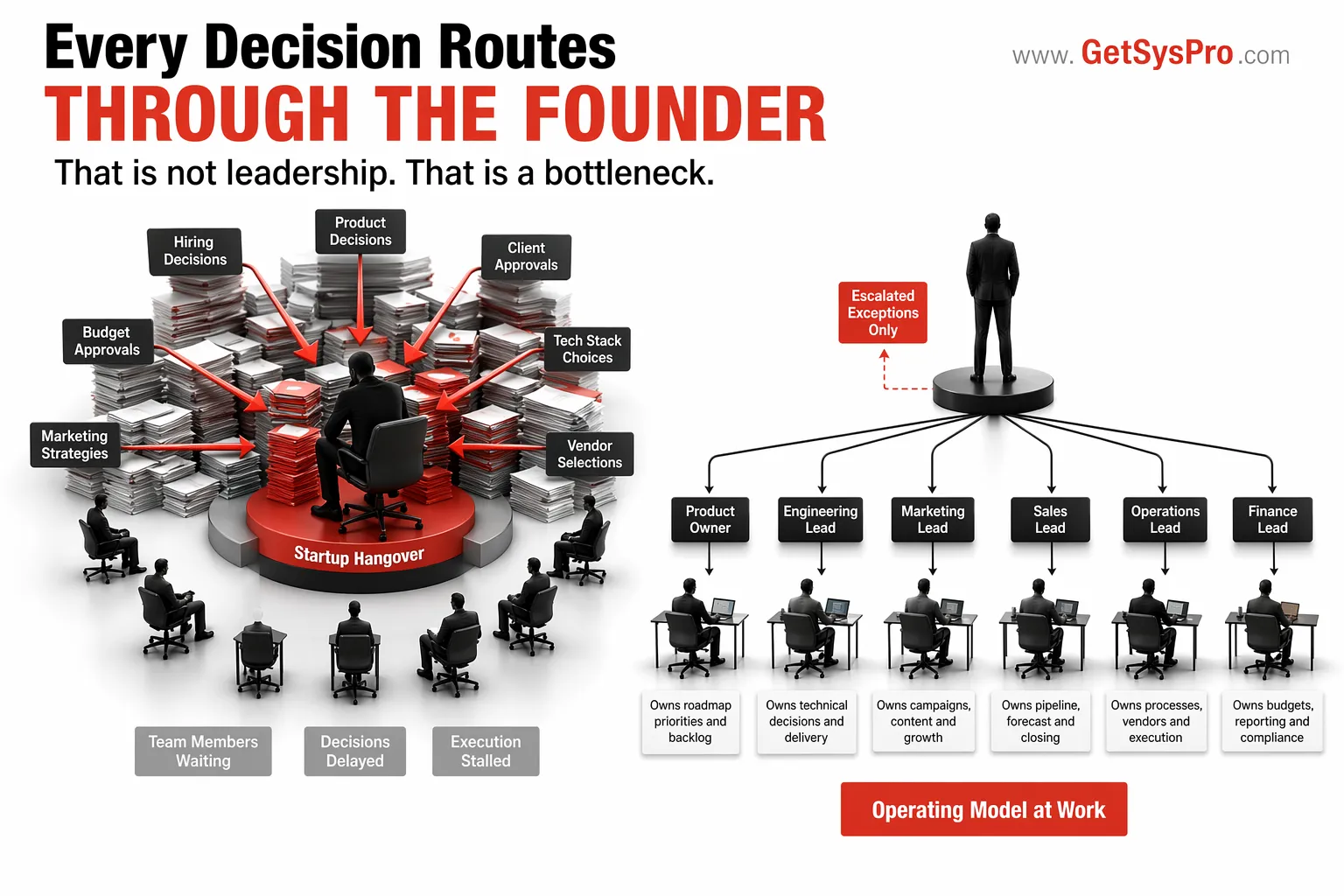
Every decision routing through the founder is not leadership. It is a bottleneck. Your business is not a startup anymore, and the operating model must reflect that. www.GetSysPro.com
Article Summary
Your business is not a startup anymore, and the operating design that built it is now creating the friction limiting it. Startup improvisation works through personal founder involvement and breaks when scale makes that involvement structurally impossible. The resulting friction is architectural, not cultural, and it gets worse when management layers are added without redefining the underlying structure those layers need to operate within. Mature companies run on operating models that make execution consistent without requiring constant founder intervention. The transition requires four structural investments in sequence: documented role architecture, defined decision rights, consistent reporting cadence, and documented workflow standards. GetSysPro builds the operating model that matches your current scale.
Your Business Is Not a Startup Anymore. Run It Like What It Has Become.
GetSysPro builds the operating model, decision clarity, reporting cadence, and workflow discipline that replace founder-led heroics with structural execution at scale.
Frequently Asked Questions
How do you know when a business has outgrown its startup operating design?
The signal is recurring friction that effort does not resolve. Projects require repeated clarification. Reporting produces inconsistent numbers that generate debates rather than decisions. Leadership fills execution gaps rather than thinking strategically. Teams stay busy while outcomes feel less predictable than at smaller scale. Those symptoms indicate operating design has not matured with the business.
Why does adding managers sometimes make the startup hangover worse?
Adding managers into an undefined structure adds coordination without clarity. New managers route the same ambiguities back to the founder, and additional handoffs slow decisions further. Before adding management layers, define what decisions each role makes independently, what outcomes it owns, and how performance gets measured. Without those answers, the management layer becomes part of the problem rather than the solution.
What is the difference between running on heroics and running on an operating model?
A business running on heroics depends on specific individuals’ judgment to produce consistent results. Remove those individuals and performance degrades because the sustaining systems do not exist. An operating model produces consistent results through documented processes and defined accountability regardless of which individuals occupy which roles. That transition is the core maturity challenge for growth-stage businesses.
Does building operational structure reduce entrepreneurial speed?
Initially it requires investment. Over time it multiplies speed. Founders who resolve every operational ambiguity personally are the bottleneck of their own organization. Building the structure that distributes decision-making frees founder attention for the strategic work only they can do. Ambition does not shrink. Heroics become unnecessary because the operating model handles what founder intervention previously handled, more consistently and at scale.
What is the correct sequence for building a mature operating design?
Four structural elements installed in sequence. Documented role architecture replaces personality-defined roles with outcome-based definitions. Defined decision rights distribute authority to the right level. Consistent reporting cadence replaces anecdote-based management with shared visibility. Documented workflow standards make execution quality consistent regardless of who touches the work. Each element creates the prerequisite for the next, which is why installing them out of sequence rarely holds.