03/27/2025
Revenue is real, the team is built, and growth still feels heavier than it should. That is the mid-stage plateau.
The mid-stage plateau is rarely market-driven. It is structural: coordination costs rise, decision speed slows, and the operating model that fueled early wins starts working against the business rather than for it. Growth stalls structurally, and adding more intensity to a structurally misaligned system amplifies the friction rather than clearing it.
In This Article
- It Does Not Feel Like a Plateau at First
- The Real Cause: Coordination Costs and Decision Latency
- Leadership Saturation Is the Plateau’s Signature
- Margin Compression Follows Complexity
- The Plateau Is a Redesign Stage, Not a Failure Stage
- How Complexity Accumulates Without Anyone Deciding to Add It
- How GetSysPro Breaks the Mid-Stage Plateau
- Frequently Asked Questions
Key Takeaways
- The mid-stage plateau is a structural problem, not a market problem. It appears when the operating model that produced early growth accumulates coordination overhead, decision latency, and reporting inconsistency as scale increases. The system does not break visibly. It becomes expensive.
- The plateau hides behind activity. Leaders are busier, meetings multiply, everyone is working. Strategic initiatives still take longer to ship. The same problems return in different forms. The business spends more energy coordinating than producing.
- Leadership saturation is the plateau’s signature. Founders remain central to too many decisions. Escalation continues upward even with managers in place. Teams hesitate to act without confirmation because delegation never came with clear authority.
- The plateau shows up in the P&L. Fixed costs rise as headcount and vendors expand. Rework and duplication become normal when workflows are unrefined. Profitability stalls even when revenue continues to move.
- The solution is operating model redesign. Role definitions that match actual workflows. Decision rights that reduce escalation. Reporting cadence that forces visibility. Documented workflows that reduce memory dependence. Accountability tied to measurable outcomes.
It Does Not Feel Like a Plateau at First
The mid-stage plateau hides behind activity. Leaders feel busier than ever. Meetings multiply. Everyone is doing the work and appears engaged with it. Strategic initiatives still take longer to ship than they did when the team was smaller. Execution becomes more fragile. The same problems keep returning in different forms despite repeated attempts to resolve them.
This is the point where mid-stage companies spend more energy coordinating than producing. The coordination overhead is invisible on any individual task. Across the entire organization it accumulates into a meaningful drag on output. The operating model has not broken visibly. It has become expensive to run at the current scale. The cost manifests as reduced momentum rather than as a clear failure that would prompt immediate investigation.
Why the Plateau Resists Easy Diagnosis
The mid-stage plateau resists easy diagnosis because its symptoms look like execution problems rather than structural ones. Delayed strategic initiatives look like project management failures. Recurring operational issues look like personnel problems. Escalation loops look like communication breakdowns. Each symptom points to an individual fix: a better project manager, a stronger hire, a clearer communication protocol. The structural cause stays hidden because no single symptom points directly to it. The operating model has accumulated coordination overhead without removing the old layers that generated it.
“The mid-stage plateau is common. It is predictable. It is correctable. Growth does not stall randomly. It stalls structurally. The operating model that fueled early wins starts working against the business, not because the market changed but because the system accumulated complexity without removing the overhead that complexity generates.”
Editorial, GetSysPro Team
The Real Cause: Coordination Costs and Decision Latency
Mid-stage businesses stall for structural reasons that follow a consistent pattern. Communication channels multiply as headcount rises. Each additional channel increases the coordination cost of getting aligned before any decision can be made. Approval pathways lengthen because decision rights were never formalized and each ambiguous decision defaults to the highest available authority. Reporting becomes inconsistent. Leadership time goes toward debating which version of reality is accurate rather than toward making decisions from shared data.
Bain’s research on organizational complexity identifies exactly this pattern: complexity creeps in as companies expand and decisions stall because they pass through too many nodes. Uncertainty about decision rights causes issues to escalate upward, slowing responsiveness at every level. Departments optimize locally because shared metrics and consistent cadence are missing. The organizational energy that should compound toward shared outcomes fragments into functional optimization instead.
Why Working Harder Fails at the Plateau
The natural response to a growth plateau is to apply more effort: more meetings, more accountability pressure, more hours. At the mid-stage plateau, more effort applied to a structurally misaligned system produces more coordination overhead, not more output. Every additional meeting to align on a decision that defined decision rights would have resolved automatically generates more overhead. Every additional accountability conversation about a recurring problem that a documented workflow would have prevented restates the structural gap without fixing it. The intensity increase is genuine. The structural cause remains unchanged.
Leadership Saturation Is the Plateau’s Signature
The most visible feature of the mid-stage plateau is leadership saturation. Founders and senior executives remain central to too many decisions even with managers in place. Escalation continues upward because teams hesitate to act without confirmation. That hesitation is rational. When delegation did not come with clear authority and defined controls, acting without confirmation carries real accountability risk. The manager hired to own a function cannot actually own it because the authority that ownership requires was never explicitly transferred.
Research on small business growth stages identifies delegation as a key challenge during the transition to rapid growth: inability to delegate effectively limits progress at this stage. The organization adds headcount and keeps the bottleneck. Delegation without clear authority and documented controls is not actually delegation. It is title assignment with the same escalation dependency underneath.
What Effective Delegation at Mid-Stage Actually Requires
Effective delegation at the mid-stage requires three specific structural elements that title assignment alone cannot provide. Decision rights documentation specifies what each role can decide without escalation and what conditions trigger it, eliminating the ambiguity that generates hesitation. Performance scorecards tied to measurable outcomes make accountability objective rather than dependent on subjective management perception. Managers can operate with genuine confidence that their contribution is visible. Reporting cadence provides the shared visibility that allows the founder or executive to monitor outcomes without personally managing every decision that produces them.
Margin Compression Follows Complexity
The mid-stage plateau is not only a speed problem. It shows up in the P&L. As headcount and vendors expand, fixed costs rise faster than the operational efficiency gains that justify them. The workflows governing that headcount and those vendor relationships were never refined to match the increased scale. Rework and duplication become normal operating conditions rather than exceptions. Operational noise increases. Profitability stalls even when revenue continues to move because the cost of running the increasingly complex system is consuming margin that growth was expected to expand.
Mid-stage leaders frequently respond to this pattern by attempting to market their way out of the plateau. More leads do not fix a delivery system operating under structural strain. More revenue does not remove operational drag. It amplifies it, because the same coordination overhead and rework that affected every unit of current revenue also affects every additional unit of new revenue. The drag compounds with scale rather than diminishing.
Why Marketing Cannot Fix an Operational Problem
The intuition behind marketing out of the plateau is that revenue growth will eventually outpace operational inefficiency. That arithmetic works only when operational cost is fixed or declining. At the mid-stage plateau, operational cost is variable and rising because complexity scales with volume. Adding revenue to a system with rising operational cost per unit does not improve the ratio. It accelerates the compression. It accelerates the margin compression that the plateau was already producing. Structural redesign, not demand generation, is what changes the underlying cost ratio and restores the leverage that growth requires to produce sustainable profitability.
Is your business feeling heavier despite real traction?
GetSysPro identifies the structural friction points contributing to the plateau and builds the operating model that restores execution leverage.
The Plateau Is a Redesign Stage, Not a Failure Stage
The mid-stage plateau is a signal that the company has outgrown its current operating design. It is not a signal of organizational failure. It is a predictable transition point that most growth-stage companies encounter. The operating model that worked at smaller scale accumulates overhead without removing old layers. More intensity applied to the current system is not the answer. The solution is operating model redesign.
Role definitions that match actual workflow rather than historical job descriptions reduce the coordination overhead that mismatched roles generate at every handoff. Decision rights that reduce escalation move decision-making authority to the level with the most relevant context rather than defaulting every ambiguous situation upward. Reporting cadence that forces visibility converts performance data from a backward-looking record into a forward-looking management tool. Documented workflows reduce dependence on institutional memory held by specific individuals and replace it with organizational standards that survive personnel change. Accountability tied to measurable outcomes makes performance objective rather than dependent on subjective assessment.
What Redesign Produces That Intensity Cannot
Operating model redesign produces structural leverage. It is the ability to achieve more output with the same or fewer inputs because friction has been removed from the system rather than overcome through effort. Intensity produces temporary output increases that revert when the effort is redirected. Structural leverage produces permanent efficiency improvements that compound as volume increases. The mid-stage plateau specifically requires structural leverage because intensity is what most companies apply first and what consistently fails to break the plateau.
How Complexity Accumulates Without Anyone Deciding to Add It
One of the most disorienting features of the mid-stage plateau is that no individual decision created the problem. Every hire was a rational response to a real need. Every approval layer was added to manage a specific risk. Each meeting was created to address a real coordination gap. Each reporting variation was the local response of a team that needed information in a format that served its own function. Individually, each of those decisions was defensible. Collectively, they produced an operating model with coordination overhead that now works against the business.
This is the pattern Bain identifies as complexity creep. It enters the organization through individually rational decisions. Over time it compounds into a system that slows response time, elevates decisions upward, and fragments organizational energy across functions that optimize locally rather than toward shared outcomes. The mid-stage plateau is what complexity creep produces when it accumulates without a structural reset.
The Structural Reset That Breaks the Plateau
Breaking the mid-stage plateau requires seeing the system clearly before adding more pressure to it. A structural reset examines what each layer of coordination, approval, reporting, and workflow actually contributes versus what overhead it generates. Overhead that exceeds the contribution gets eliminated. That examination is not a cost-cutting exercise. It is an operating model audit. The audit identifies where the system has accumulated layers without removing the old ones that no longer serve the business at its current scale.
How GetSysPro Breaks the Mid-Stage Plateau
GetSysPro Services for Mid-Stage Operating Model Redesign
A Business Operational Systems Audit identifies the friction points contributing to the plateau: workflow redundancy, reporting integrity gaps, decision architecture issues, and accountability diffusion. The audit produces the structural baseline from which redesign restores leverage rather than adding more noise to the system.
Organizational Chart Development clarifies accountability and reporting relationships so execution stops defaulting to escalation, directly addressing the leadership saturation that defines the mid-stage plateau experience.
Process and SOP Architecture documents workflows and replaces institutional memory dependence with organizational standards that make execution consistent regardless of which individuals perform the work.
Related GetSysPro Services
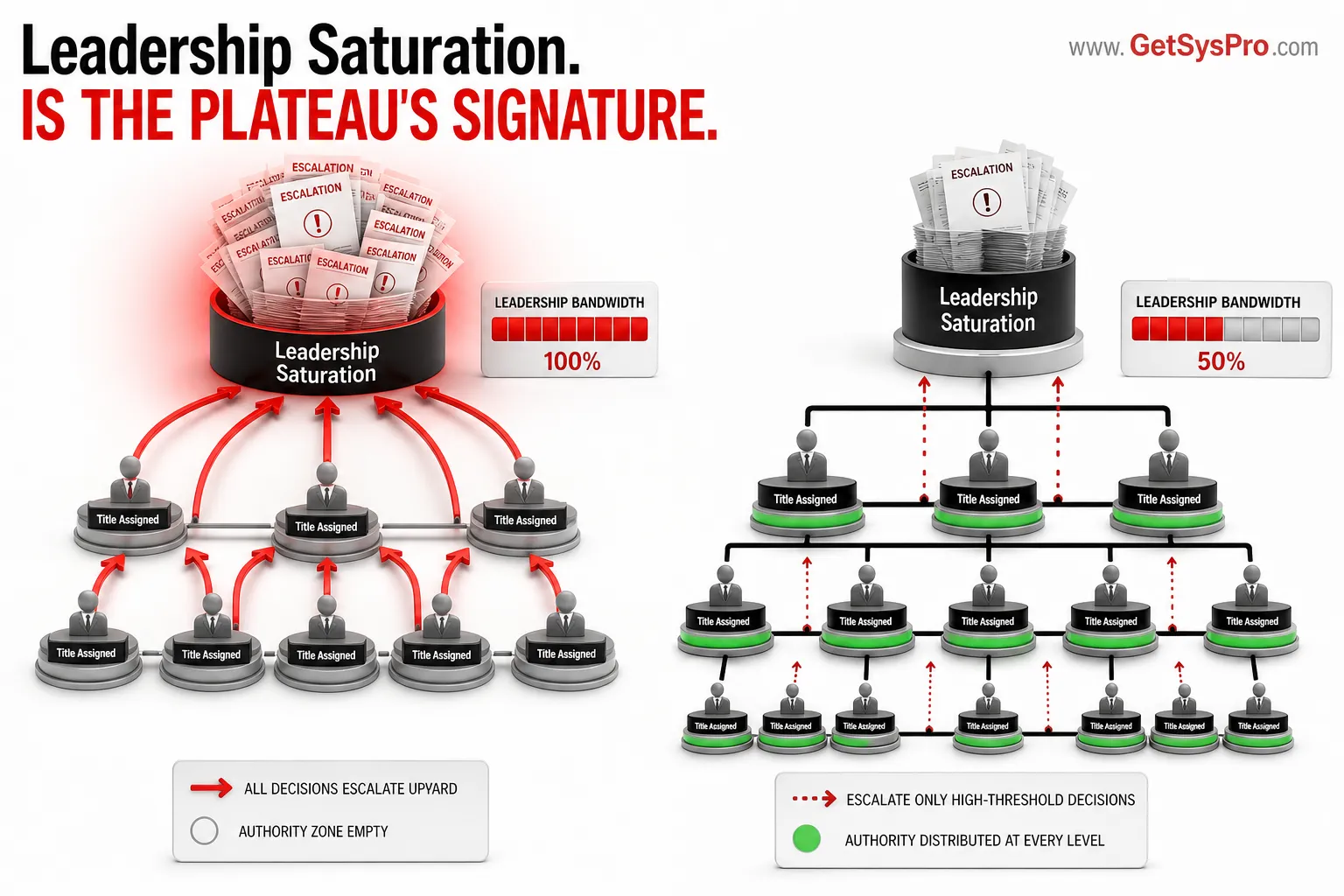
Leadership saturation is the plateau’s signature. When delegation does not come with clear authority and documented controls, the organization adds headcount and keeps the bottleneck. www.GetSysPro.com
Article Summary
The mid-stage plateau is a structural problem, not a market problem. It appears when the operating model that produced early growth accumulates coordination overhead, decision latency, and reporting inconsistency that compound against the business as scale increases. It hides behind activity but shows up in delayed strategic initiatives, recurring operational problems, leadership saturation, and margin compression. The solution is not more intensity. It is operating model redesign: role definitions that match actual workflows, decision rights that reduce escalation, reporting cadence that forces visibility, documented workflows that replace memory dependence, and accountability tied to measurable outcomes. The mid-stage plateau is common, predictable, and correctable. Growth does not stall randomly. It stalls structurally.
Growth Does Not Stall Randomly. It Stalls Structurally.
GetSysPro identifies the structural friction points contributing to the mid-stage plateau and builds the operating model redesign that restores execution leverage.
Frequently Asked Questions
What exactly is the mid-stage plateau and what causes it?
The mid-stage plateau is the point in a business’s growth trajectory where traction exists but growth feels heavier than it should. Revenue is respectable, the team is real, and the brand is known, but execution is slower and more fragile than it was at smaller scale. The cause is structural: the operating model that produced early wins accumulates coordination overhead, decision latency, and reporting inconsistency as scale increases. The system has not broken visibly. It has become expensive to run and is compounding friction against the growth it once enabled.
Why does the mid-stage plateau hide behind activity?
The plateau hides behind activity because its symptoms look like execution problems rather than structural ones. Delayed strategic initiatives look like project management failures. Recurring issues look like personnel problems. Escalation loops look like communication breakdowns. Each symptom points toward an individual fix rather than toward the structural cause. The operating model has accumulated coordination overhead without removing old layers. No single symptom points directly to that cause and the organization stays busy responding to symptoms rather than addressing the underlying structure.
What is leadership saturation and how does it signal the plateau?
Leadership saturation is the condition where founders and senior executives remain central to too many decisions even after managers have been put in place. Escalation continues upward because delegation without clear authority and documented controls is not actually delegation. Teams hesitate to act without confirmation because acting without confirmation carries real accountability risk when authority boundaries are undefined. Leadership saturation is the plateau’s signature because it confirms that the organization has added headcount without transferring the decision-making authority that headcount was hired to exercise.
How does the mid-stage plateau affect profitability rather than just speed?
As headcount and vendors expand, fixed costs rise faster than operational efficiency gains. The workflows governing that headcount and those vendor relationships were never refined to match increased scale. Rework and duplication become normal operating conditions. Profitability stalls even when revenue continues to move. The cost of running the increasingly complex system consumes the margin that growth was expected to expand. Adding more revenue to a system with rising operational cost per unit accelerates margin compression rather than improving the ratio.
What does operating model redesign at the mid-stage actually involve?
Operating model redesign at the mid-stage involves five specific structural elements. Role definitions get updated to match actual workflow rather than historical job descriptions. Decision rights documentation specifies what each role can decide without escalation. Reporting cadence converts financial and operational performance from backward-looking records into forward-looking management tools. Workflow documentation replaces institutional memory dependence with organizational standards that survive personnel change. Accountability frameworks tie performance measurement to measurable outcomes rather than to subjective management assessment.