10/16/2025
Motion is easy to produce. Predictability is earned. Here is what control actually looks like.
A busy business can still be unstable. Motion is easy to produce while predictability is earned. The real maturity signal is not how much is happening. It is how consistently the organization converts effort into outcomes. If the week feels loud but the month closes with surprises, the business is almost certainly measuring activity. Measuring control looks quieter: fewer escalations, faster decisions, stable margins, and performance visibility that does not require a meeting to interpret.
McKinsey research on leading and lagging indicators recommends keeping KPI sets limited at each organizational level and avoiding redundant metrics that count activity without predicting outcomes. The distinction between activity metrics and control metrics is the difference between a scorecard that proves the team was busy and a scorecard that reveals whether the operating system is functioning.
In This Article
Key Takeaways
- Activity metrics count what happened. Control metrics reveal whether governance is functioning and whether outcomes are predictable.
- Activity can rise precisely when the system is weak. People compensate for structural uncertainty with visible effort.
- Measuring control requires a different set of metrics: decision cycle time, forecast accuracy, spend compliance, on-time delivery, and escalation volume.
- Sales teams and leadership teams are the two places busy organizations most often confuse activity for control.
- Control requires architecture. Measuring control without building the control mechanisms first produces metrics that describe dysfunction rather than prevent it.
Why Activity Metrics Feel Comforting but Mislead
Activity is measurable, immediate, and emotionally reassuring. More meetings feels like alignment. More calls feels like revenue pipeline. Additional hires feel like capacity building. New initiatives feel like strategic momentum. Each of those signals produces a genuine psychological sense of progress, which is exactly why activity metrics remain dominant in most growing businesses regardless of how reliably they predict outcomes.
The problem is that activity can rise precisely when the system is weak. When authority is unclear, people compensate with more check-ins. Unreliable reporting causes leadership to schedule more review meetings. Vague accountability produces more status updates as teams demonstrate effort through visibility. The volume of activity increases while the predictability of outcomes stays flat or declines. Measuring control means recognizing that effort and output are different variables and that more of the first does not automatically produce more of the second.
Measuring Control Begins With Recognizing the Substitution
The substitution of activity for control is not deliberate. It is the natural output of a system that has not been designed to produce control metrics. When a business has no decision cycle time tracking, it cannot know whether governance is fast or slow. When forecast accuracy is never reviewed, it cannot know whether planning is reliable. Measuring control requires intentionally building the measurement infrastructure that makes control visible, which is a design project rather than a reporting project.
What Measuring Control Actually Looks Like
Measuring control looks different from measuring activity in both the metrics chosen and the questions those metrics answer. Activity metrics ask: how much happened? Control metrics ask: how reliably did the system convert effort into intended outcomes? A control-oriented scorecard contains metrics that predict whether growth will feel stable or fragile as volume increases.
Control metrics do not replace activity metrics entirely. They sit above them in the measurement hierarchy. Activity metrics tell you what the team did. Control metrics tell you whether what the team did produced the outcomes the governance structure expected. When those two layers are both visible, the leadership team can distinguish between a volume problem and a governance problem, which produces faster and more accurate corrective action.
Measuring Control Means Measuring Governance, Not Just Output
The governance layer of any growing business contains specific mechanisms: approval thresholds, reporting cadences, escalation triggers, and accountability frameworks. Measuring control means measuring whether those mechanisms are functioning. Decision cycle time measures whether approval architecture is producing timely outcomes. Forecast accuracy measures whether planning processes are reliable. Spend compliance measures whether authority boundaries are being respected. Each metric in a control-oriented scorecard is directly tied to a specific governance mechanism, which is what makes it actionable rather than merely descriptive.
Where Busy Organizations Get Tricked First
Sales teams are the first place most growing businesses confuse activity for control. Call volume, demo count, and proposal quantity are easy to count and visually impressive in a dashboard. Control appears when the business can tie sales activity to profitable conversion with low variance: conversion rate by source, cost per acquisition relative to margin, and sales cycle stability. A sales team running 200 calls per week with declining conversion and increasing sales cycle length is a team with activity metrics that look strong and control metrics that are failing. Harvard Business Review research on sales measurement consistently finds that volume metrics without outcome correlation are the most common source of misdirected sales investment in growing companies.
Leadership teams are the second place. Five performance meetings per week is activity. Measuring control looks different: KPIs visible on a consistent cadence, decisions documented with named owners, and follow-up accountability that does not depend on memory or private conversations. When performance visibility requires a meeting to produce it, the reporting architecture has not been built. The meeting is compensating for the absence of a system.
The Pattern: Activity Compensates for Absent Control Architecture
Both examples share the same pattern. Activity accumulates in the spaces where control architecture has not been built. The sales team runs more calls because no conversion standard defines what a productive call cadence looks like relative to pipeline quality. The leadership team schedules more meetings because no dashboard makes performance visible between sessions. Measuring control reveals the absence of the architecture. Building the architecture makes measuring control automatic rather than effortful.
Your scoreboard may be measuring the wrong things.
GetSysPro identifies where your organization is measuring activity instead of control and builds the governance architecture that makes control visible.
The Five Control Metrics Worth Building
Five metrics consistently reveal whether an organization is measuring control rather than activity. Decision cycle time measures the elapsed time from proposal to approval by decision type. Short cycle times indicate that authority boundaries are clear and governance is functioning. Long or variable cycle times indicate bottlenecks, unclear thresholds, or decision avoidance.
Forecast accuracy measures the variance between forecast and actuals tracked consistently over time. Businesses that do not track forecast accuracy cannot distinguish between a planning problem and an execution problem, which means every miss generates an inconclusive post-mortem. Spend compliance tracks threshold exceptions and whether they were pre-authorized rather than approved retroactively. On-time delivery rate measures whether projects are meeting their documented timeline commitments rather than the informal expectations that accumulate around them.
Escalation Volume as a Measuring Control Indicator
Escalation volume is the fifth and most diagnostic of the five. Escalations per department per quarter, coded by reason, reveal whether decision rights are functioning as designed. Rising escalation volume in a specific department almost always indicates an authority gap, a documentation gap, or an accountability gap in that department’s operating model. When escalation volume declines over time, measuring control shows that the governance architecture is working. When it rises, measuring control provides the specific location and reason code for the architectural failure.
How GetSysPro Strengthens Organizational Control
Control requires architecture: clear mechanisms that reduce interpretation, prevent default escalation, and make governance visible without requiring manual assembly. When a business relies on constant intervention, meeting-based reporting, and ad hoc accountability to produce its performance data, it is measuring activity by a different name.
A Business Operational Systems Audit surfaces whether control mechanisms exist or whether the organization is running on manual override: approval-by-exception rather than approval-by-threshold, reporting-by-meeting rather than reporting-by-dashboard, and accountability-by-escalation rather than accountability-by-design. The audit produces a specific map of which control mechanisms are absent and what their absence is costing in escalation volume, decision latency, and forecast variance.
Authority Clarity Is the Foundation of Measuring Control
Organizational Chart Development aligns roles with measurable accountability so decision-making stops traveling upward by default and governance becomes scalable. When authority is unclear, measuring control is impossible because every metric reflects individual judgment rather than system performance. When authority is explicit and consistently applied, measuring control becomes a straightforward comparison of expected outcomes to actual outcomes at each organizational level.
The Test for Your KPI List
Every metric on the scorecard should pass a single test: does it help predict outcomes and correct early, or does it prove the team was busy? Metrics that fail are not removed. They are repositioned as operational inputs rather than governance outputs. Call volume belongs on the sales team dashboard. The leadership scorecard shows conversion rate, pipeline quality, and sales cycle variance.
Measuring Control Requires Shifting the Ratio, Not Adding Metrics
Applying the test reveals how much measurement infrastructure is oriented toward activity versus measuring control. Most growing businesses find the ratio heavily weighted toward activity. Shifting it requires replacing activity metrics at the governance level with control metrics that reveal whether the system is functioning.
Related GetSysPro Services
“Stop measuring activity. Start measuring control. Knowing whether governance is functioning tells you more than knowing how busy the team is.”
Editorial, GetSysPro Team
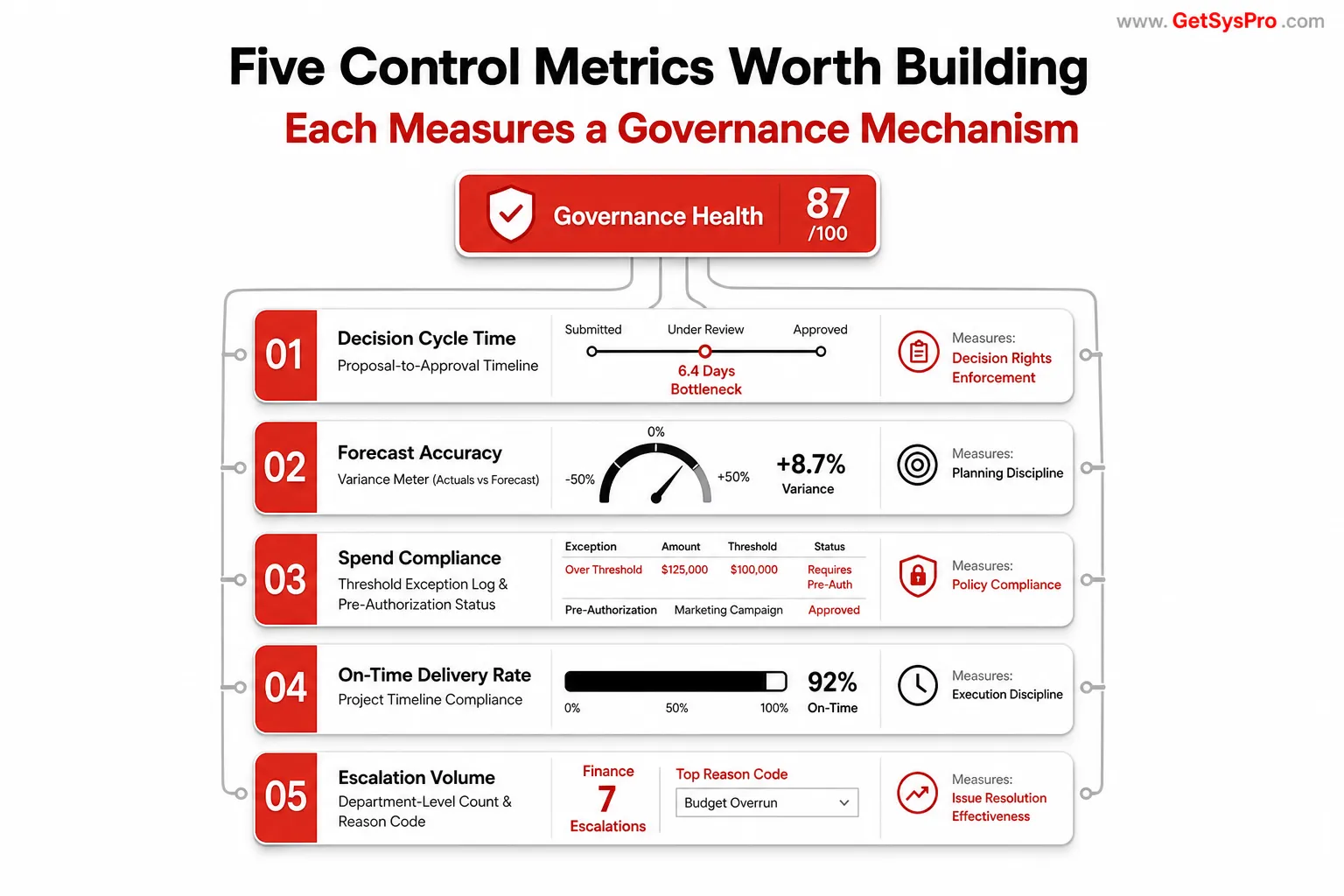
Five metrics reveal whether governance is functioning: decision cycle time, forecast accuracy, spend compliance, on-time delivery, and escalation volume. Each measures a specific governance mechanism rather than a volume output. Build the architecture and the metrics become actionable. GetSysPro installs both. www.GetSysPro.com
Article Summary
Activity metrics count what happened. Control metrics reveal whether governance is functioning. Activity can rise precisely when the system is weak. The five control metrics worth building are decision cycle time, forecast accuracy, spend compliance, on-time delivery rate, and escalation volume. Each one measures a specific governance mechanism rather than a volume output. The test for every metric on the current scorecard is simple: does it predict outcomes and enable early correction, or does it prove the team was busy? Measuring control requires building the architecture that makes control visible first. The metrics follow the architecture, not the other way around.
Article Summary
Activity metrics count what happened. Control metrics reveal whether governance is functioning. Activity can rise precisely when the system is weak. The five control metrics worth building are decision cycle time, forecast accuracy, spend compliance, on-time delivery rate, and escalation volume. Each one measures a specific governance mechanism rather than a volume output. The test for every metric on the current scorecard is simple: does it predict outcomes and enable early correction, or does it prove the team was busy? Measuring control requires building the architecture that makes control visible first. The metrics follow the architecture, not the other way around.
Stop Measuring Activity. Start Measuring Control. Build the Architecture First.
GetSysPro builds the governance architecture that makes control visible, measurable, and consistent as the business grows.
Frequently Asked Questions
What is the difference between activity metrics and control metrics?
Activity metrics count what happened during a period: calls made, meetings held, hires added, initiatives launched. They answer the question of how much occurred. Control metrics measure whether the operating system converted effort into intended outcomes reliably: decision cycle time, forecast accuracy, spend compliance, delivery rate, and escalation volume. They answer the question of whether governance is functioning. A business can have excellent activity metrics and failing control metrics simultaneously, which is the condition that produces the feeling of being busy while outcomes remain unpredictable.
Why do control metrics predict stability better than activity metrics?
Control metrics are directly tied to governance mechanisms. Decision cycle time reflects whether authority architecture is functioning. Forecast accuracy reflects whether planning processes are reliable. Escalation volume reflects whether decision rights are clear enough to prevent default escalation. Each of those mechanisms either holds or breaks under growth pressure, and the metric makes the failure visible before it produces a consequential outcome. Activity metrics do not carry the same predictive signal. High call volume does not predict whether conversion will hold as the sales team doubles. High escalation volume does predict that the organization will slow down as it grows.
How should measuring control be introduced to a leadership team already using activity metrics?
The transition is most effective when framed as addition rather than replacement at the leadership level. The activity metrics the team currently uses are not wrong. They are positioned at the wrong level of the measurement hierarchy. Call volume belongs on the sales team dashboard. Conversion rate and sales cycle variance belong on the leadership scorecard. The practical sequence is to introduce control metrics alongside existing activity metrics for one to two quarters, allowing the leadership team to observe the correlation between the two and understand what the control metrics are revealing. Once the correlation is established, the activity metrics can migrate down the hierarchy to their appropriate level without the team feeling that information is being removed.
What is escalation volume and why does it belong on a control scorecard?
Escalation volume is the count of decisions or issues that required resolution at a level above where they should have been resolvable, tracked per department per period with a reason code indicating why the escalation occurred. It belongs on a control scorecard because it is the most direct measurement of whether decision authority is functioning. When authority boundaries are clear and process standards are documented, most decisions resolve at the level where they belong. When authority is ambiguous or process standards are absent, decisions escalate because the person closest to the issue lacks either the authority or the information to resolve it independently. Rising escalation volume is one of the earliest signals of governance deterioration in a growing business.
How does measuring control relate to a Business Operational Systems Audit?
The audit evaluates whether the control mechanisms that control metrics would measure actually exist in the operating model. A business cannot measure decision cycle time if it has no documented decision approval process. It cannot measure forecast accuracy if it has no consistent forecasting cadence. It cannot measure spend compliance if it has no documented spending thresholds. The audit identifies which control mechanisms are absent and produces a prioritized sequence for building them. Once the mechanisms are in place, the corresponding metrics become meaningful rather than merely aspirational, and measuring control becomes a genuine governance activity rather than a measurement exercise without underlying architecture.
Last Updated: [the_modified_date format=”F j, Y”]