12/04/2024
Structural clarity decays unless it is actively maintained. Most companies wait until the decay is expensive.
In physics, entropy describes the natural tendency of systems to move from order to disorder unless energy is applied. Companies behave exactly the same way. Every growing business begins with focus: fewer clients, fewer processes, clearer communication, and decisions that happen quickly because everyone is close to the work. As scale increases, operational entropy creeps in because complexity grows faster than structure evolves.
This article names what operational entropy looks like in practice, where it shows up in financial performance, and what governance discipline keeps structural clarity from decaying faster than the business can afford.
In This Article
- What Operational Entropy Looks Like in Real Organizations
- Complexity Requires Coordination Mechanisms
- Decision Latency Is a Measurable Entropy Signal
- Variability Is Expensive and It Shows Up in Margin
- Leadership Bandwidth Gets Consumed by Entropy
- Maintaining Order Requires Governance Input
- How GetSysPro Addresses Operational Entropy
- Frequently Asked Questions
Key Takeaways
- Operational entropy is the slow slide into disorder that happens when a business grows but its structure does not. It is not a people problem or a leadership failure. It is the natural outcome of complexity increasing faster than governance evolves.
- Operational entropy rarely announces itself. It appears as small deviations: inconsistent reporting, undocumented approval chains, variable vendor agreements, and role interpretations that drift depending on who trained whom.
- Decision latency is one of the most measurable operational entropy signals. When clarity weakens, decisions require more input, more stakeholders, and more escalation, consuming the leadership bandwidth that strategic work requires.
- Entropy shows up in margin. When processes vary by person, rework increases, manual intervention becomes normal, and labor hours burn on internal disorder rather than customer-facing output.
- Maintaining structural clarity requires governance input: document review, workflow mapping, role definition refinement, and reporting cadence enforcement. These are not administrative tasks. They are performance stabilizers.
What Operational Entropy Looks Like in Real Organizations
Operational entropy rarely announces itself. It does not arrive as a crisis or a single failure. It accumulates as small deviations that each feel manageable until they compound into structural drag. Reporting becomes inconsistent across departments because different teams adopted different formats and nobody reconciled them. Approval chains grow longer without documentation because new sign-off requirements get added reactively and never reviewed. Vendor agreements vary in format, scope, and enforcement because each relationship was handled by whoever managed it at the time.
Employees interpret roles differently depending on who trained them, because the documented standard was never updated to reflect actual operations. Meetings increase in frequency while decreasing in outcome clarity, because coordination is happening through conversation rather than through defined processes. Each of those deviations seems minor in isolation. Collectively they create a business burning more energy for less output than it did at smaller scale.
Why Entropy Compounds Instead of Staying Stable
Operational entropy compounds because small deviations create new defaults. An inconsistent report becomes the standard for that team. An undocumented approval chain becomes the expected process. Variable vendor agreements become the template others follow. Each accepted deviation lowers the threshold for the next, and accumulated deviations produce a structural baseline increasingly distant from the intended operating design. Research on organizational information entropy ties this pattern to the accumulation of disorder and uncertainty in organizational information systems, noting that unmanaged informational disorder compounds over time in ways that reduce decision quality and organizational performance.
“Operational entropy cannot be eliminated. It is the natural consequence of complexity without corresponding governance investment. The question is not whether entropy is accumulating in your organization. Whether you are applying enough structural energy to keep the rate of decay below the rate of growth is the only question that matters.”
Editorial, GetSysPro Team
Complexity Requires Coordination Mechanisms
As organizations scale, they require increasingly deliberate coordination to maintain predictability and accountability. The informal coordination that works when a team is small enough for everyone to share context stops working when scale means that not everyone shares context, history, or a common understanding of how things are supposed to work. At that point, coordination must be designed into the operating system rather than improvised through extra conversations.
Research published in the Academy of Management Review identifies coordination mechanisms including routines, meetings, plans, and schedules as tools that create conditions like accountability, predictability, and common understanding in organizations. The implication is direct: coordination does not emerge from goodwill or effort at scale. It requires structural mechanisms that define how work moves, how decisions get made, and how performance gets measured and reviewed.
Why More Communication Is Not the Answer
The most common response to operational entropy is to communicate more: more meetings, more check-ins, more alignment sessions. That response treats a structural problem as a communication problem, which produces a predictable outcome: the volume of communication increases while the actual clarity declines, because the conversations are compensating for missing structural design rather than replacing it. Communication at scale requires structural support. Without defined processes, documented standards, and clear accountability, more communication generates more coordination overhead without producing more organizational clarity.
Decision Latency Is a Measurable Entropy Signal
Decision latency is one of the most practical and measurable signals of operational entropy accumulation. When organizational clarity is high, decisions reach the right level quickly because authority is defined, context is shared, and the decision-maker has what they need to act. When operational entropy has been accumulating, decisions require more input, more stakeholders, and more escalation before they can move because the structural clarity that would have made the path obvious has degraded.
McKinsey’s research on organizational decision-making argues that better decision processes improve both speed and quality, and emphasizes that clarifying who should decide and how decisions should be made is among the highest-leverage organizational improvements available. When decision rights are unclear, speed disappears. Leaders become the default clearinghouse for issues that should resolve closer to the work, and the escalation volume consumes the leadership bandwidth that strategic design requires.
Tracking Decision Latency as an Operational Health Metric
Organizations that track decision latency as an operational health metric gain early warning of operational entropy accumulation before it reaches financial statements. A gradual increase in the time between when a decision is needed and when it is made, or an increase in the number of people involved in decisions that previously required fewer stakeholders, is a measurable signal that authority clarity has degraded and that structural recalibration is required. Most organizations do not track this metric. By the time operational entropy reaches financial performance, it has typically been accumulating for months.
Variability Is Expensive and It Shows Up in Margin
Operational entropy shows up in financial performance as margin drift. When processes vary by person, rework increases because work that should transfer cleanly from one stage to the next requires correction at each point where the standard differs. Manual intervention becomes normal because the process has not been updated to handle the variations that have accumulated. Error correction consumes labor hours that should be producing output for customers rather than fixing internal inconsistency.
The financial symptom is a company that feels like it is working harder for the same results. Revenue may stay flat or grow while margin compresses, because the incremental effort required to produce output in a high-entropy environment costs more than the same output would cost in a well-maintained structural environment. That cost does not appear as a budget line labeled operational entropy. It appears as unexplained variance in labor efficiency, service delivery time, and error rates that leadership manages reactively rather than addressing structurally.
Why Process Variability Compounds Cost
Process variability compounds cost because each variation from the standard requires a judgment call that the standard would have eliminated. Each judgment call consumes attention that a defined process would have freed. Each correction consumes time that consistent execution would not have required. Multiply those micro-costs across every process, every handoff, and every role in the organization and the aggregate cost of operational entropy becomes material, even though no individual instance appears significant enough to address on its own.
Does your company feel busier but less efficient than a year ago?
GetSysPro audits where operational entropy has accumulated and builds the structural clarity that stops the decay before it becomes expensive to reverse.
Leadership Bandwidth Gets Consumed by Entropy
As operational entropy rises, leaders spend more time resolving issues and less time designing the system. The founder becomes the escalation path for decisions that should resolve at lower levels. Executives function as problem solvers rather than architects. Cognitive load increases as the volume of issues requiring senior judgment grows, and strategic focus declines because the bandwidth required for strategic work is being consumed by the operational noise that structural clarity would have prevented.
This is not a character flaw or a leadership failure. It is the structural outcome of unclear roles, unclear workflows, and unclear escalation thresholds. When the organization does not define what decisions each level can make independently, every uncertain decision travels up the hierarchy by default. Undocumented workflows mean exceptions require individual judgment calls rather than defined responses. Without specified escalation thresholds, every ambiguous situation becomes a leadership problem regardless of its actual complexity or strategic significance.
What Leadership Time Actually Costs
Leadership time is the most expensive operational resource in any organization, and operational entropy taxes it systematically. Every hour a senior leader spends resolving an issue that structural clarity would have prevented is an hour not spent on the organizational design, strategic positioning, and relationship development that only senior leaders can perform. The accumulation of those redirected hours across weeks and months represents a material opportunity cost that compounds alongside the direct costs of operational entropy in margin and efficiency.
Maintaining Order Requires Governance Input
In thermodynamics, maintaining order requires ongoing energy input because systems naturally move toward disorder without it. In business, maintaining structural clarity requires ongoing governance input for precisely the same reason: the natural tendency of growing organizations is toward increasing disorder, and that tendency accelerates as complexity grows unless deliberate structural investment counteracts it.
The governance inputs that maintain structural clarity are specific. Document review keeps standards current and prevents the drift between documented procedure and actual practice that operational entropy produces. Workflow mapping removes redundant steps that accumulate as processes evolve without systematic review. Role definition refinement reduces the overlap and gap accumulation that occurs as organizational structure evolves faster than documentation. Reporting cadence enforcement catches variance early, before it compounds into structural drag that requires significantly more effort to reverse.
Governance as a Performance Investment, Not Administrative Overhead
Organizations that treat these governance inputs as administrative overhead rather than performance investments consistently find that the cost of deferred structural maintenance is higher than the cost of ongoing structural discipline. The quarterly workflow review that feels like overhead prevents the semi-annual operational crisis that requires weeks to address. The role definition refinement that feels bureaucratic prevents the accountability diffusion that costs months of performance variance to diagnose and correct. Operational entropy cannot be eliminated, but it can be managed at a cost that is significantly lower than the cost of allowing it to accumulate unchecked.
How GetSysPro Addresses Operational Entropy
GetSysPro Services That Counter Operational Entropy
A Business Operational Systems Audit identifies where operational entropy has accumulated: workflow redundancy, reporting fragmentation, decision bottlenecks, and accountability diffusion. The objective is controlled order rather than bureaucracy, and the audit produces the structural baseline from which governance investment can address the specific entropy accumulation points that are costing the most.
Process and SOP Architecture builds the documented standards that make structural clarity persistent rather than dependent on individual memory or consistent personnel, directly addressing the process variability and role interpretation drift that operational entropy produces as organizations scale.
Related GetSysPro Services
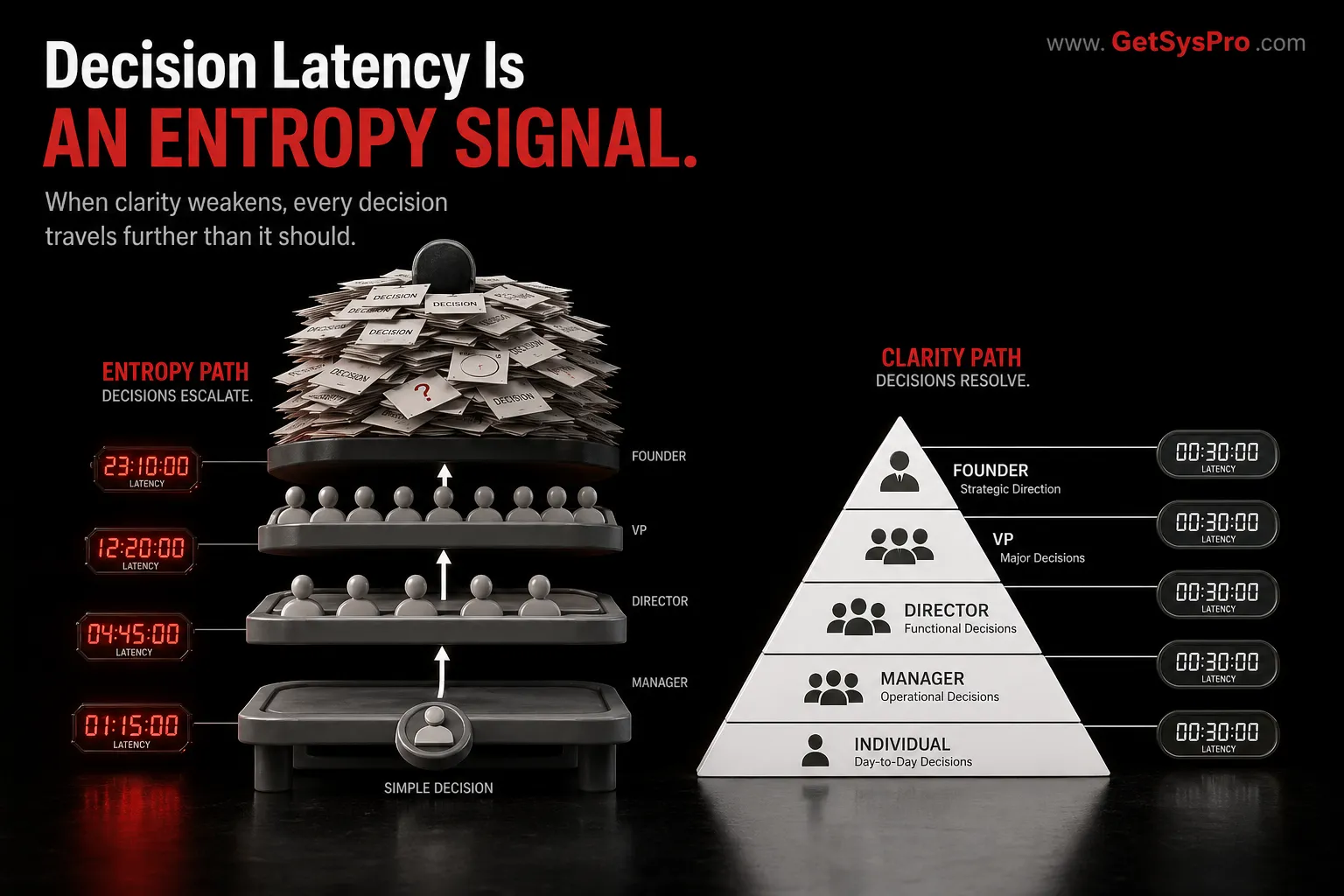
When operational entropy accumulates, every decision travels further than it should. Decision latency is not a people problem. It is a structural signal. www.GetSysPro.com
Article Summary
Operational entropy is the natural slide from structural order to organizational disorder that occurs as complexity grows faster than governance evolves. It accumulates invisibly through small deviations that compound: inconsistent reporting, undocumented approval chains, process variability, and role interpretation drift. Decision latency is a measurable signal of operational entropy. Variability shows up as margin compression. Leadership bandwidth gets consumed by the escalation volume that structural clarity would have prevented. Maintaining order requires ongoing governance input: document review, workflow mapping, role definition refinement, and reporting cadence enforcement. GetSysPro audits where operational entropy has accumulated and builds the structural clarity that keeps decay from outpacing growth.
Order Requires Design. Performance Requires Order.
GetSysPro identifies where operational entropy is accumulating and builds the governance structure that keeps structural clarity intact as your organization scales.
Frequently Asked Questions
What is operational entropy and how does it differ from general organizational dysfunction?
Operational entropy is the structural decay that occurs as organizational complexity increases without corresponding governance investment. Unlike general dysfunction with identifiable causes like poor leadership, operational entropy is the natural outcome of complexity outpacing structure. It accumulates because systems move toward disorder and growing organizations add complexity faster than structural clarity to manage it.
What are the earliest measurable signals of operational entropy?
Decision latency is the most measurable early signal: decisions that previously required one person now require three, and timelines that were days are now weeks. Process variance shows the same task producing inconsistent outputs depending on who performs it. Reporting fragmentation surfaces as different teams presenting different numbers for the same metric. Together they indicate operational entropy accumulation.
How does operational entropy show up in financial performance?
Operational entropy appears as margin compression rather than revenue decline. Labor efficiency drops because rework and error correction consume hours that should produce customer-facing output. Service delivery time increases as process variability creates friction at every handoff. Error rates rise because inconsistent execution produces inconsistent results. The company works harder for the same output because the internal cost of operational disorder rises while revenue stays flat or grows.
What is the difference between governance and bureaucracy in this context?
Governance maintains structural clarity through targeted investments: document review to keep standards current, workflow mapping to remove redundant steps, role definition to reduce overlap, and reporting cadence to surface variance early. Bureaucracy adds process overhead without improving clarity. The distinction is whether the structural investment produces measurable operational improvement or simply adds compliance requirements that consume time without reducing entropy.
How often should organizations conduct operational entropy audits?
Fast-growing organizations adding headcount, markets, or service lines should audit at least annually because each growth event adds structural complexity that governance must address. Stable organizations should audit every eighteen to twenty-four months to catch normal operational drift. Any significant change, including a new market, major hire, or restructuring, should trigger an audit because change events accelerate entropy accumulation in the areas they affect.