 07/10/2025
Chaos in growing companies is rarely emotional. It is architectural. Here is how one team fixed it.
To fix company chaos, this team did not hire faster or push harder. They stopped, mapped the work, and rebuilt the operating system so execution became predictable again. They were not failing. Demand was strong, the brand was solid, and revenue was climbing. They were functioning, which is what made the chaos easy to tolerate and hard to confront. That distinction matters because it describes most growing companies that need to fix company chaos: not broken enough to force action, but inefficient enough to cap everything.
A useful external reference for how organizations reduce chaos is the COSO internal control framework, which establishes that stability comes from embedded control activities, clear information flow, and consistent monitoring, not from constant individual heroics.
In This Article
- What Chaos Actually Looks Like Inside a Growing Company
- How Mapping Workflows Revealed the Real Problem
- How Defined Decision Rights Stopped the Escalation Loop
- How Cadence and Dashboards Replaced Reactive Management
- How Documentation Removed the Last Layer of Ambiguity
- What Changed After the Redesign
- Frequently Asked Questions
Key Takeaways
- Company chaos is an architectural problem, not an effort problem. Adding people or pressure without fixing the system makes it worse.
- Workflow mapping exposes duplication, delay, and unnecessary approval layers that are invisible until the work is diagrammed end to end.
- Documented decision rights remove the escalation default. When authority boundaries are written down, decisions resolve at the right level without confirmation loops.
- Weekly dashboards replace reactive management. Consistent visibility into a small set of key indicators prevents the surprises that create urgency and consume leadership bandwidth.
- Documentation precision eliminates assumption-based execution. When contracts, vendor terms, and governance guidelines are aligned with current operations, enforcement stops depending on memory.
What Company Chaos Actually Looks Like in a Growing Business
This was a services company doing just over $4.8 million in annual revenue with 26 employees. The symptoms of company chaos were not dramatic. Deadlines slipped often enough to feel normal. Invoices occasionally went out late. Department heads requested more hires every quarter. Meetings filled the calendar. The founder worked long weeks and still felt behind.
Revenue was growing, but confidence was not. The company was not broken. It was busy in a way that felt productive but was actually consuming bandwidth without building capacity. That pattern, functioning but fragile, is the environment where company chaos compounds quietly until something external forces the confrontation.
Why Functioning Does Not Mean You Have Fixed Company Chaos
The hardest part of addressing company chaos in a growing business is that the business still produces results. Clients get served. Revenue lands. The team shows up. The cost of the chaos is invisible on the income statement and visible only in the energy required to maintain the output. That energy, the heroics, the manual coordination, the constant context-switching, is the tax a business pays for operating without a documented system underneath it.
How Mapping Workflows Revealed the Real Problem
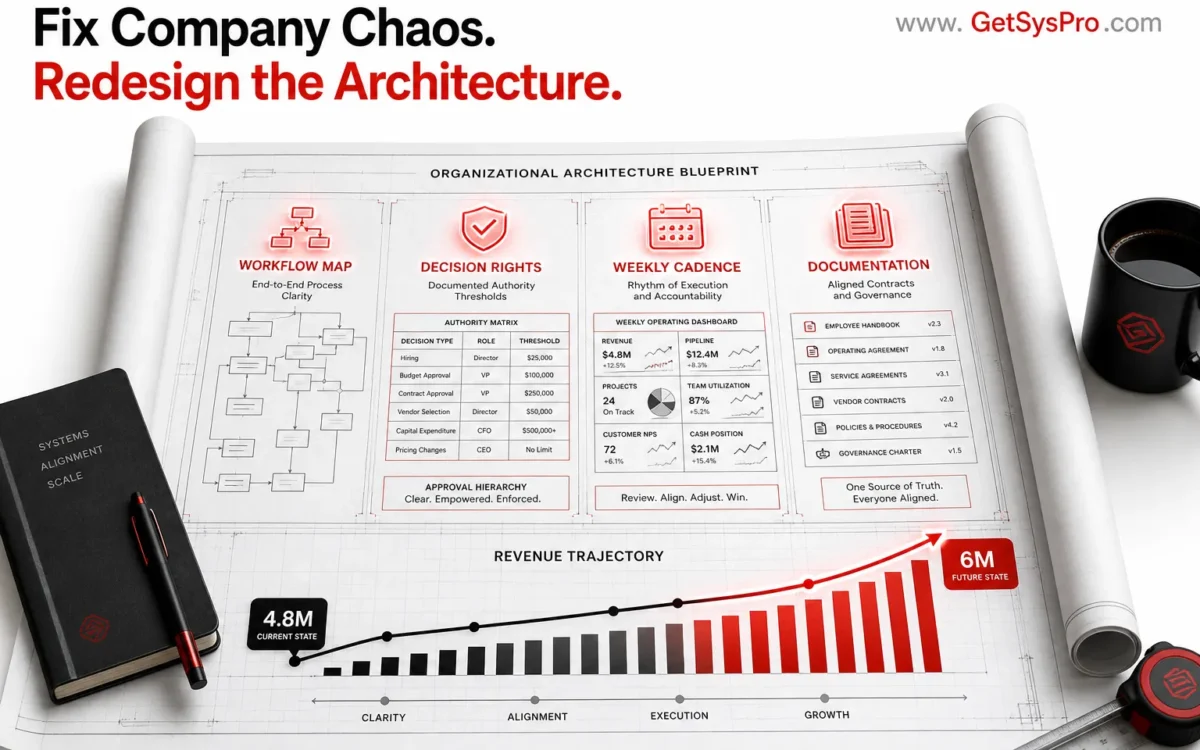
The first move to fix company chaos was to stop using the word busy and start diagramming work. Sales handoff, client onboarding, service delivery, billing, and vendor management were mapped end to end. Duplication appeared quickly. Delays did too.
Tasks were passing through too many hands. Approvals existed only because that was how things had always been done, not because the approval added governance value. Reporting required manual compilation, which meant visibility arrived late and triggered reactive conversations rather than proactive decisions. The map did not reveal incompetence. It revealed a system that had grown without being designed.
What a Fix Company Chaos Workflow Audit Uncovers
A Business Operational Systems Audit is designed to surface these friction points objectively: where work stalls, where authority is assumed rather than defined, and where reporting depends on manual assembly rather than structured cadence. The audit produces a prioritized picture of where the architecture is behind the scale of the business, without requiring the team to self-diagnose under pressure.
How Defined Decision Rights Stopped the Escalation Loop
After mapping, authority boundaries stopped being implied. They became documented. Expense thresholds were defined in writing. Department heads were given measurable autonomy within clear limits. Escalation criteria were written down so decisions stopped defaulting upward by habit.
The result was immediate. Pauses dropped. Confirmation requests declined. Meetings that had existed only to reduce uncertainty about whether a decision was within someone’s authority became unnecessary. When you fix company chaos through documented decision rights, the escalation loop breaks not because people become more confident but because the system removes the ambiguity that made escalation feel necessary.
How to Fix Company Chaos: Authority Boundaries Convert Hesitation Into Action
The pattern in most growing businesses is that authority exists in practice but not in writing. Leaders make decisions up to a certain threshold, but that threshold was never formalized. When the threshold is informal, the team treats every situation above a certain perceived risk level as requiring confirmation. Formalizing the threshold, writing it down and applying it consistently, converts hesitation into action at every level below the documented escalation point.
Busy is not the same as built. Is your operating system keeping up with your revenue?
GetSysPro maps the architecture behind the chaos and rebuilds it so execution becomes predictable.
How to Fix Company Chaos Through Cadence and Dashboards
Instead of waiting for monthly summaries to understand business performance, the team introduced weekly dashboards and reviewed a small set of indicators consistently: pipeline movement, margin variance, outstanding receivables, and operational backlog. The indicators were chosen because each one, when it moved unexpectedly, predicted a downstream problem worth addressing before it arrived.
Visibility increased. Surprises decreased. Fewer surprises reduced urgency, and less urgency reduced the meetings that urgency generates. To fix company chaos through cadence is to replace reactive management with a rhythm the organization can anticipate and plan around rather than respond to after the fact.
Cadence Is the Mechanism That Converts Data Into Decisions
Many growing businesses have access to operational and financial data. Research on meeting-heavy organizations consistently finds that most meetings exist to resolve information gaps rather than to make decisions. Few growing businesses have a structured cadence for reviewing data. Without a review rhythm, data is a record rather than a tool. The weekly review converts data into decisions by assigning ownership of variance, requiring corrective action when performance departs from plan, and creating accountability for follow-through between sessions. That rhythm is what prevents small problems from becoming the large surprises that disrupt operations and consume leadership attention.
How Documentation Removed the Last Layer of Ambiguity
The final layer addressed was documentation. Relationship-based contracts and inconsistent vendor terms were replaced. Agreements were reviewed and aligned with current operations. Internal governance guidelines were formalized so enforcement stopped depending on individual memory or the presence of a specific person.
Specialized Documents Creation supported this layer by replacing assumption with enforceable precision in vendor terms, partnership agreements, and governance language. When documentation is current and internally consistent, the organization executes against written standards rather than against recalled preferences. That shift eliminates a category of company chaos that no amount of effort or culture work resolves.
Fix Company Chaos: Written Standards Replace Recalled Preferences
Informal documentation is one of the most persistent sources of company chaos in growing businesses because it is invisible until it produces a problem. A vendor dispute surfaces an outdated agreement. Three different leaders produce three different answers to the same governance question. New hires learn the job by asking rather than reading. Each instance is manageable in isolation. Their cumulative effect is an organization that runs on recalled preferences rather than on written standards, which makes every personnel change a knowledge loss event.
What Changed After They Chose to Fix Company Chaos
There was no dramatic moment. The results were operational and arrived in sequence.
Within three months, decisions moved faster, meeting time declined, and hiring requests slowed because redundancy had been removed from the workflow. Margin stabilized because approvals and vendor terms were applied consistently rather than situationally. Leadership bandwidth expanded because the escalation rate declined.
Within nine months, the company crossed $6 million with lower operational stress than at $4.8 million. That outcome follows when a business addresses the architectural causes of company chaos rather than compensating through effort.
“You do not fix company chaos by working harder inside it. You fix it by redesigning the architecture it runs on. The result is not just less chaos. It is a business that scales without requiring heroics to hold it together.”
Editorial, GetSysPro Team
Related GetSysPro Services

The before state: duplication, bottlenecks, late reporting, informal documents. The after state: mapped workflows, documented authority, weekly cadence, aligned governance. Same team. Same market. Different architecture. GetSysPro installs the after state. www.GetSysPro.com
Article Summary
A $4.8 million services company fixed its company chaos not by hiring more people or pushing harder but by mapping workflows, documenting decision rights, installing a weekly review cadence, and formalizing documentation. Each intervention addressed an architectural gap rather than a personnel problem. Within nine months the company crossed $6 million with lower operational stress than it experienced at the earlier revenue level. That outcome follows from a consistent principle: you do not fix company chaos by working harder inside it. You fix it by redesigning the architecture it runs on.
Fix Company Chaos by Redesigning the Architecture, Not Increasing the Effort.
GetSysPro maps, documents, and installs the operating system that makes growth predictable rather than chaotic.
Frequently Asked Questions
What does it actually mean to fix company chaos architecturally?
Fixing company chaos architecturally means addressing the structural causes of dysfunction rather than the symptoms. The symptoms of company chaos include missed deadlines, constant meetings, reactive decision-making, and leadership bandwidth compression. Those symptoms have structural causes: workflows that were never mapped and documented, authority boundaries that exist informally but not in writing, reporting that depends on manual assembly rather than cadence, and documentation that no longer reflects current operations. Architectural fixes address each of those causes directly. The result is a business that produces consistent outputs not because the team is working harder but because the system is designed to produce them.
How do workflow maps reveal company chaos that is not visible day to day?
Daily operations feel normal even when the system is inefficient because teams adapt to the inefficiency. Manual steps become routine. Unnecessary approvals feel like governance. Duplicate work gets absorbed into job descriptions. When the workflow is diagrammed end to end, the inefficiency becomes visible as structure rather than as noise. Duplication appears as redundant steps. Delay appears as handoffs that stall without a documented owner. Unnecessary approvals appear as checkpoints that add latency without adding control. The map does not create the problems. It makes them visible for the first time in a form that allows them to be addressed systematically.
How quickly can documented decision rights reduce meeting load?
The reduction is often immediate because most meetings in chaotic organizations exist to resolve uncertainty about authority rather than to exchange information or make collaborative decisions. When expense thresholds are defined, approval pathways are documented, and escalation criteria are written down, the decisions that were previously resolved in meetings resolve at the appropriate level without a meeting. Teams report measurable reductions in meeting frequency within the first few weeks of implementing documented decision rights, with more significant reductions following as the team builds confidence that the documented authority is real and consistently applied.
Why does a weekly dashboard cadence reduce urgency better than monthly reporting?
Monthly reporting creates urgency because problems that develop over weeks arrive as surprises at the end of the cycle. By the time the monthly report surfaces a margin variance or a receivables problem, the issue has been compounding for three to four weeks. Weekly dashboard review catches variance early, when corrective action is proportionate and the problem has not yet affected downstream operations. Urgency is almost always the product of late visibility. Consistent weekly review converts late visibility into early detection, which converts urgency into routine management.
What does it cost a business to run on informal documentation rather than written standards?
The cost compounds in four ways. First, inconsistent enforcement: without written standards, enforcement varies by person and situation, which produces inconsistent outcomes and unresolved disputes. Second, knowledge fragility: institutional knowledge that lives in individuals rather than in documentation is lost when those individuals leave, creating operational disruption that requires significant time to recover from. Third, scaling drag: every new hire learns the informal version of the job from whoever is available rather than from documented standards, which means onboarding takes longer and quality varies by trainer. Fourth, governance gaps: informal documentation leaves the business exposed in vendor disputes, partnership conflicts, and compliance reviews where written standards are the only enforceable record of agreed terms.
Last Updated: [the_modified_date format=”F j, Y”]