 01/23/2025
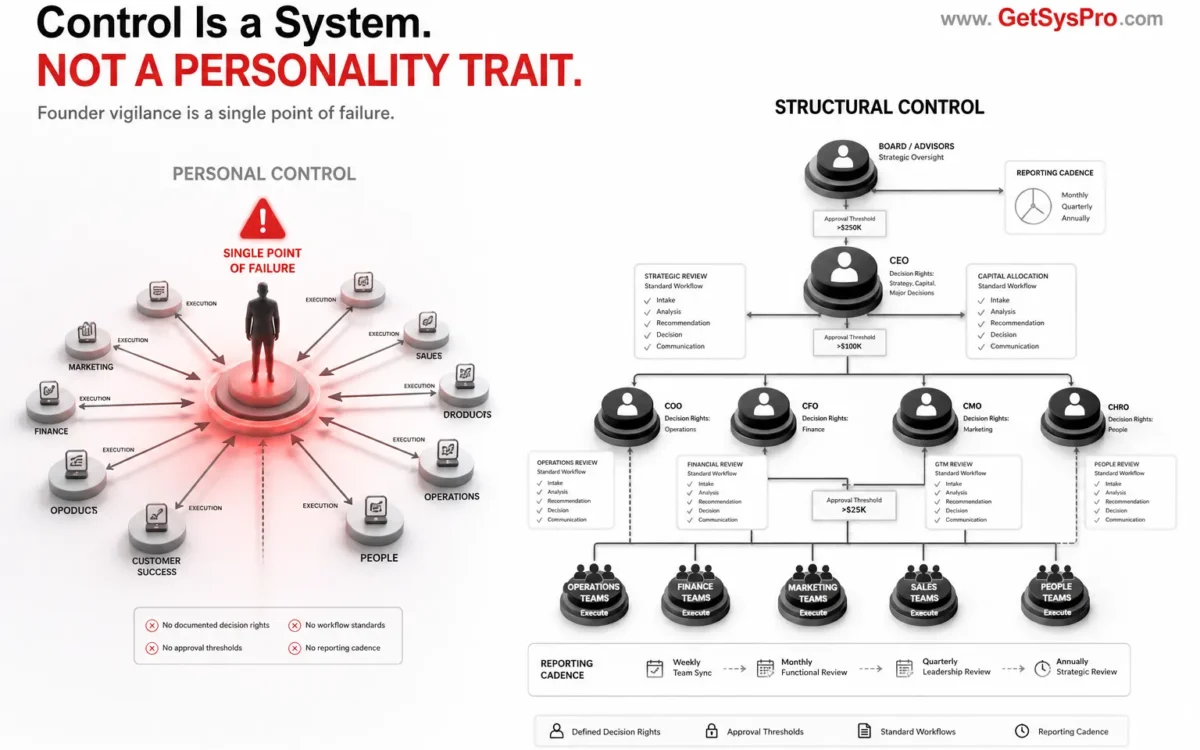
Founder vigilance creates temporary stability. It is not a control system. It is a single point of failure.
If you want real control, you must design it. Founder attention can hold an organization together at small scale, but attention is not architecture. Control that scales is embedded in structure: defined approval thresholds, documented decision rights, consistent reporting cadence, and workflow standards that make execution predictable regardless of who performs the work. Without those structural elements, what founders call control is centralized vigilance that fails the moment the person at the center cannot be everywhere simultaneously.
In This Article
- The Hands-On Founder Trap
- A Quick Test: Would the Company Hold for Two Weeks?
- Strictness Is Not Control
- Control Is Built From Four Visible Mechanisms
- Financial Discipline Is Where Control Is Easiest to See
- What a Structured Control Framework Actually Looks Like
- How GetSysPro Installs Structural Control
- Frequently Asked Questions
Key Takeaways
- Control is a system, not a personality trait. Founder vigilance creates temporary stability at small scale and creates a single point of failure at larger scale. Real control is embedded in architecture, not in a person’s memory, attention, or willpower.
- The two-week test reveals the difference between personal control and structural control. If execution would degrade without the founder’s presence for two weeks, control is personal rather than structural and will fail at scale.
- Strictness is not control. Tight approval processes without defined thresholds create bottlenecks. More meetings without defined decision rights create noise. True control is measured by predictability: consistent execution without constant correction.
- Scalable control comes from four visible mechanisms: defined approval thresholds, clear decision rights, consistent reporting cadence, and documented workflow standards. When those exist, autonomy becomes safe rather than risky.
- Financial discipline is where control is most measurable. If every expense requires founder sign-off, oversight is centralized but not scalable. Defined spending thresholds tracked consistently produce scalable financial discipline without requiring personal involvement in every transaction.
The Hands-On Founder Trap
Some founders describe themselves as hands-on, detail-oriented, or the final review on everything that leaves the organization. That framing sounds disciplined. It sounds responsible. It describes a single point of failure. If nothing moves without the founder’s personal involvement, control is not strong. It is centralized and fragile, dependent on the continued availability and unlimited bandwidth of one person.
Early-stage companies can operate this way and succeed because the volume of decisions, contracts, and delivery events is small enough that one person can reasonably touch most of them. Founders review invoices, approve contracts, spot-check delivery, and personally resolve exceptions. That model works until volume rises. When it does, the business hits a ceiling that has nothing to do with market opportunity and everything to do with the structural absence of control systems that would allow execution to happen without requiring the founder at every decision point.
Why Centralized Control Breaks at Scale
Centralized control breaks at scale for a mathematical reason: the number of decisions, exceptions, and execution events requiring oversight grows faster than any individual’s capacity to provide it. Every hour the founder spends reviewing a deliverable, approving a transaction, or resolving an ambiguity that a documented system would have handled is an hour not spent on the strategic and organizational design work that only the founder can do. At scale, centralized control does not just limit organizational capacity. It consumes the leadership bandwidth that the organization’s next stage requires.
“Control is a system, not a personality trait. The founder who reviews everything has not built control. They have built dependency. Real control is what remains when the founder is unavailable. That kind of control can only be built into architecture, not into attention.”
Editorial, GetSysPro Team
A Quick Test: Would the Company Hold for Two Weeks?
One question reveals the difference between personal control and structural control: if you were unavailable for two weeks, would execution remain consistent? Not would things go perfectly. Would the organization execute at a predictable, acceptable standard without requiring your personal judgment on every exception and ambiguity that arose?
If the answer is no, the control that exists in the organization is personal rather than structural. Personal control feels powerful in the moment because the person exercising it can see everything, correct everything, and maintain a sense of organizational coherence through their own attention. Personal control does not survive growth, extended travel, illness, key personnel turnover, or any other condition that reduces the founder’s ability to maintain the personal involvement the organization depends on. Structural control survives all of those conditions because it is embedded in systems rather than in a person.
What the Two-Week Test Is Actually Measuring
The two-week test measures whether the organization’s execution is documented, defined, and distributed rather than concentrated in the founder’s institutional knowledge. An organization that holds for two weeks has documented workflows that allow anyone in the relevant role to execute the work correctly. It has defined decision rights that allow decisions to reach the right level without escalating to the founder by default. It has reporting cadence that surfaces performance variance without requiring the founder to personally track every metric. Those structural elements are what the two-week test is detecting, and their absence is what it reveals.
Strictness Is Not Control
A common misunderstanding in founder-led organizations is the equation of strictness with control. Tight approval processes feel like control because they force decisions through a review step. Without clearly defined thresholds that specify who can approve what at which dollar amount or risk level, tight approval processes do not create control. They create bottlenecks where everything routes through the same review point regardless of its actual significance, consuming review capacity on low-stakes decisions while creating delay on high-stakes ones.
More meetings without defined decision rights do not create control. They create alignment theater where people gather to discuss decisions that nobody has the documented authority to make, and the meeting ends with a follow-up scheduled rather than a decision recorded. True control is measured by predictability: can the organization execute consistently without constant correction? An organization under genuine control produces consistent outcomes because the systems that govern execution are defined and enforced. An organization under the illusion of strictness produces consistent oversight without consistent outcomes.
The Predictability Standard for Real Control
Predictability is the operational definition of real control. If the organization produces consistent outputs when the founder is present and inconsistent outputs when the founder is absent, the consistency was never structural. It was personal. Predictability that depends on the presence of a specific individual is not organizational control. It is individual performance, and individual performance does not scale. Structural control produces predictable outcomes regardless of which specific individuals are performing the work on any given day, which is the only standard of control that survives organizational growth.
Control Is Built From Four Visible Mechanisms
Scalable control comes from visibility combined with defined boundaries rather than from supervision. Four specific mechanisms, when documented and enforced, produce an organizational control system that functions without requiring personal oversight at every step. Defined approval thresholds specify who can approve what, at what dollar amount, and with what documentation requirements, removing the ambiguity that routes every decision to the founder by default. Clear decision rights define what must escalate, what should not, and who owns the final call at each level, eliminating the consensus theater that substitutes for documented authority.
Consistent reporting cadence creates the shared visibility that makes organizational performance measurable without requiring the founder to personally track every metric. Weekly operational KPIs, monthly financial variance review, and quarterly trend analysis make control visible rather than dependent on founder intuition about how things are going. Documented workflow standards specify how delivery should run, how exceptions get handled, and what done means at each handoff, replacing the institutional knowledge held in specific individuals’ heads with organizational standards that survive personnel change and scale with volume.
Why Autonomy Becomes Safe When Control Is Structural
Founders who lack structural control often resist delegation because autonomy without boundaries feels risky. The resistance is rational: in an organization without defined approval thresholds and decision rights, giving people autonomy does produce inconsistent and sometimes costly outcomes. When those structural elements exist, autonomy becomes safe because the boundaries within which people operate are clear, escalation requirements are specified, and performance standards are documented. Structural control enables delegation by making the boundaries of safe action explicit.
Is your organization dependent on constant oversight to run smoothly?
GetSysPro replaces personality-driven oversight with operating infrastructure that makes control durable, scalable, and independent of any single person.
Financial Discipline Is Where Control Is Easiest to See
Financial controls are the most concrete and measurable expression of organizational control, which makes them the clearest diagnostic for whether control is structural or personal. If every expense requires founder sign-off, the organization has centralized oversight but low scalability. Every transaction that requires founder involvement is a transaction that slows down when founder availability is limited and stops entirely when the founder is unreachable. The founder has not built financial control. They have built financial dependency.
Defined spending thresholds tracked consistently produce scalable financial discipline without requiring personal involvement in every transaction. Department managers operate within documented authority limits. Exceptions above threshold automatically route to the next approval level. Variance gets reviewed on a consistent cadence against budget rather than only when something has already gone wrong. The U.S. Bureau of Labor Statistics data on total employer compensation costs reinforces why financial control matters at scale: payroll and benefits represent the largest and most fixed category of organizational cost, and decisions about hiring, compensation, and headcount require a control framework that provides visibility and approval structure proportional to the financial exposure each decision carries.
Financial Control as the Template for Organizational Control
The architecture of financial control, defined thresholds, documented authority, consistent review cadence, and exception escalation, is the same architecture that organizational control requires in every domain. The same structural logic that makes spending thresholds more effective than founder sign-off on every invoice makes workflow standards more effective than founder spot-checks on every deliverable. The same logic that makes monthly financial variance review more effective than reactive financial management makes weekly operational KPIs more effective than founder intuition about team performance.
What a Structured Control Framework Actually Looks Like
The COSO internal control framework provides a structured model for what organizational control requires beyond personal oversight. COSO defines internal control across five integrated components: control environment, risk assessment, control activities, information and communication, and monitoring. Each component addresses a dimension of organizational control that personal oversight cannot provide at scale.
The control environment establishes the organizational tone for accountability and ethical conduct. Risk assessment identifies and analyzes the conditions under which the organization’s objectives are at risk. Control activities are the specific policies, procedures, and approval structures that prevent or detect control failures before they become expensive. Information and communication ensure that relevant performance data reaches the right people at the right time to support decision-making. Monitoring evaluates whether the control system itself continues to function as intended and identifies where it requires updating as the organization changes.
Control Is a System, Not an Event
The COSO framework makes explicit what experienced operators understand: control is not a state that an organization achieves and then maintains passively. It is an ongoing system that requires intentional design, consistent enforcement, and regular evaluation to remain effective as the organization’s complexity increases. Control is a system that must be built, documented, and actively maintained. Personal vigilance, regardless of how intense or consistent, cannot substitute for the five components that a structured control framework requires because personal vigilance addresses none of them systematically.
How GetSysPro Installs Structural Control
GetSysPro Services That Replace Oversight With Architecture
Fractional COO Leadership Services replace personality-driven oversight with repeatable systems: accountability frameworks, defined workflows, reporting cadence, and decision architecture that make organizational control durable rather than dependent on any specific individual.
Organizational Chart Development defines authority boundaries and reporting relationships so decisions do not default to the founder by default, and control structure is documented rather than assumed.
Process and SOP Architecture documents workflow standards that make execution quality consistent regardless of which individuals perform the work, replacing institutional knowledge dependency with documented standards that survive personnel change and scale with volume.
Related GetSysPro Services
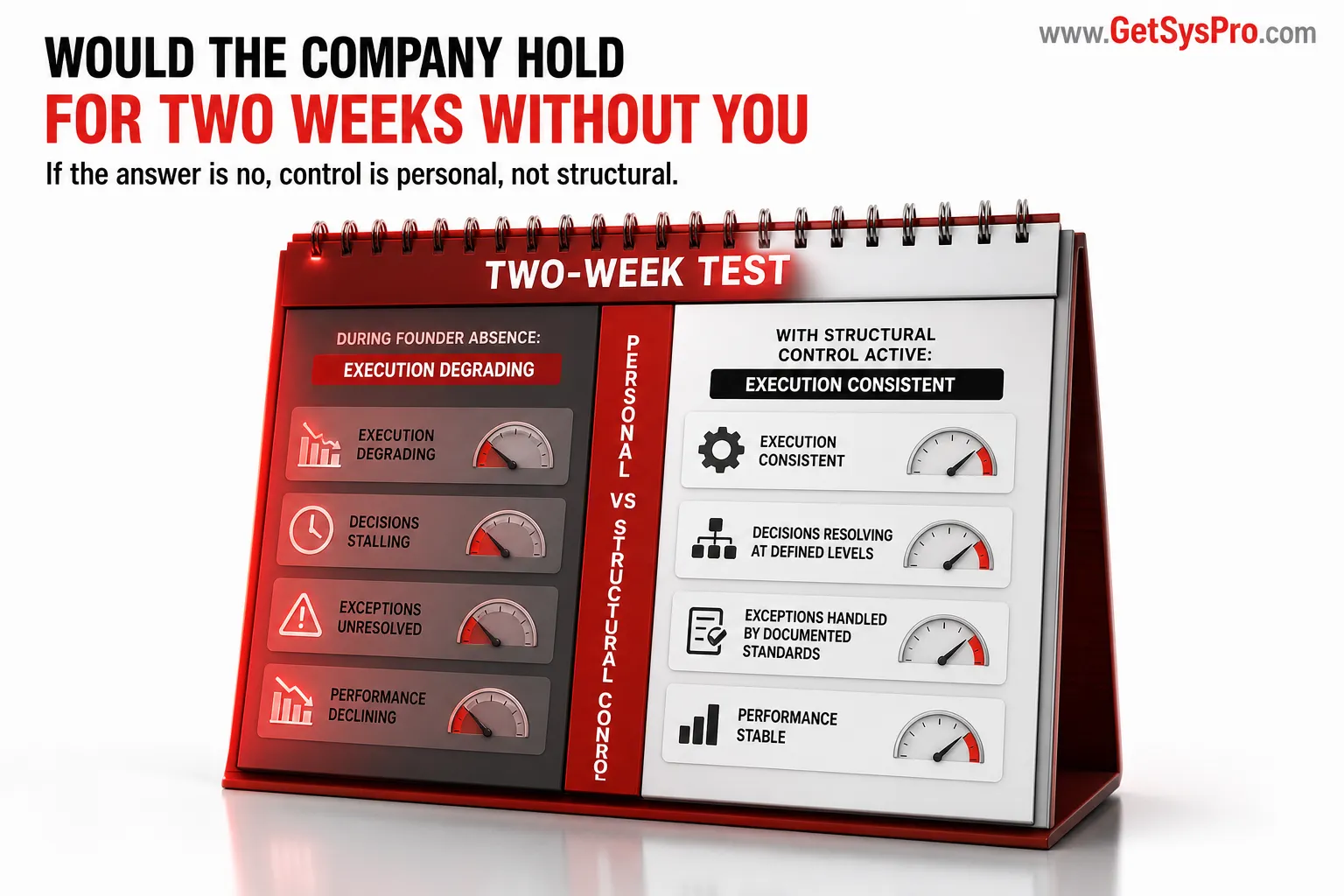
If execution would degrade without the founder for two weeks, control is personal rather than structural. Personal control does not survive growth. Structural control is embedded in systems that continue operating regardless of who is present. www.GetSysPro.com
Article Summary
Control is a system, not a personality trait. Founder vigilance creates temporary stability and creates a single point of failure at scale. The two-week test reveals whether control is personal or structural: if execution degrades without the founder’s presence, control is personal. Strictness is not control. Predictability is. Scalable control comes from four visible mechanisms: defined approval thresholds, clear decision rights, consistent reporting cadence, and documented workflow standards. Financial controls are the most concrete expression of organizational control and the clearest diagnostic of whether control is structural or personal. The COSO framework defines what organizational control requires across five components that personal oversight cannot provide at scale. Control that scales is invisible because it is embedded. Systems outlast individuals. Governance outlasts effort. Documentation outlasts memory.
Systems Outlast Individuals. Governance Outlasts Effort. Documentation Outlasts Memory.
GetSysPro installs the operating infrastructure that makes control durable, scalable, and independent of founder involvement at every step.
Frequently Asked Questions
What is the difference between personal control and structural control?
Personal control depends on one individual’s ongoing attention. Structural control is embedded in documented systems: defined approval thresholds, decision rights, workflow standards, and reporting cadence that function regardless of which individuals are present. Personal control fails when the person at the center is unavailable. Structural control continues because it is embedded in the organization rather than in a person.
How do you know if your organization has structural control or just personal oversight?
The two-week test is the most direct diagnostic. If execution remains consistent without the founder for two weeks, structural control exists. If execution degrades, decisions stall, or exceptions go unresolved, control is personal. A secondary diagnostic: if approval thresholds and decision rights exist only in the founder’s memory rather than in documented standards, the same conclusion applies.
Why does strictness fail as a substitute for structural control?
Strictness without defined thresholds creates bottlenecks rather than control. Every decision routes through the same review point regardless of significance, consuming capacity on low-stakes decisions while creating delay on high-stakes ones. Real control is predictable: the organization executes consistently because execution systems are documented and enforced. Strictness produces oversight. Structural control produces consistent outcomes. They are not the same thing.
What are the four mechanisms that produce scalable organizational control?
Defined approval thresholds specify who can approve what at what dollar amount, removing ambiguity that routes decisions upward by default. Clear decision rights define what must escalate and who owns the call. Consistent reporting cadence creates shared visibility through weekly KPIs, monthly variance, and quarterly trend review. Documented workflow standards specify how delivery runs and what done means at each handoff. Together those four produce control without personal oversight at every step.
How does the COSO internal control framework apply to growing businesses?
COSO defines control across five components: control environment, risk assessment, control activities, information and communication, and monitoring. Growing businesses benefit from COSO because it makes explicit that control is an ongoing system requiring intentional design and regular evaluation rather than a state that founder vigilance can maintain indefinitely. Each component addresses a dimension of control that only structural investment can produce at scale.