 01/09/2025
Growth multiplies everything inside your business. Make sure it is multiplying strength, not weakness.
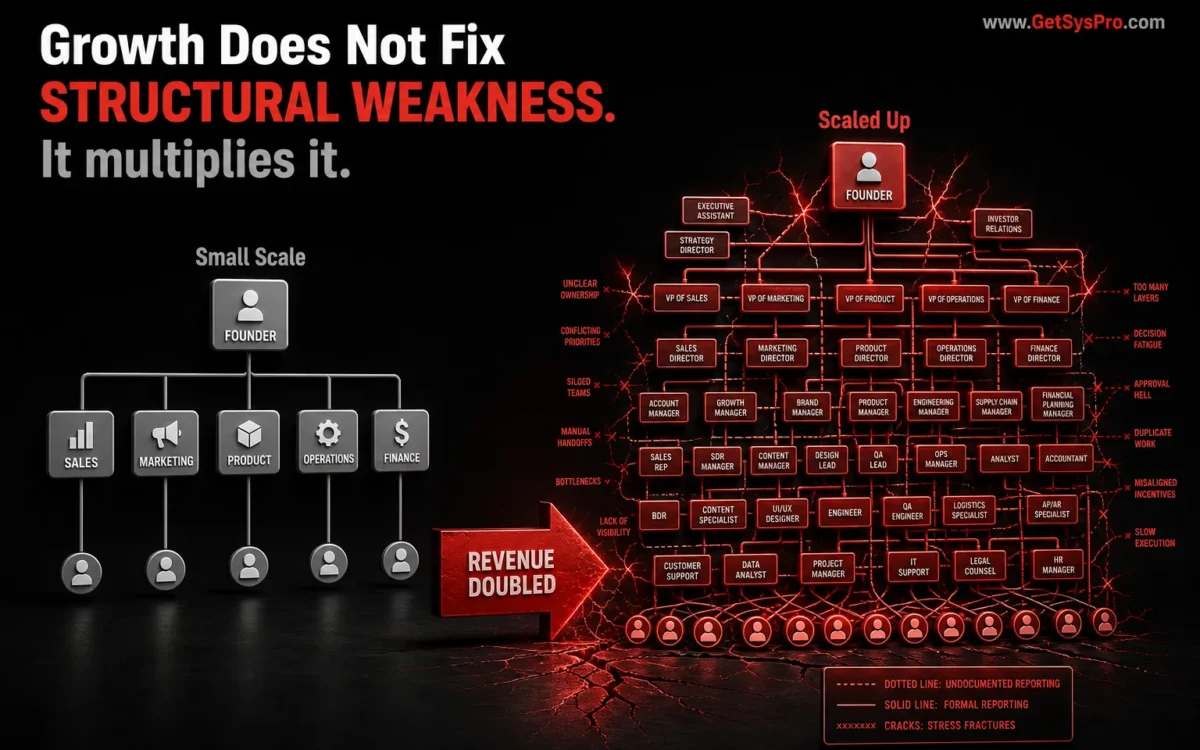
There is a persistent myth in business that growth will solve internal problems. Revenue growth will ease cash pressure. New clients will justify inefficiencies. Increased visibility will smooth over operational strain. Growth does not fix structural weakness. It exposes it. When revenue increases, inefficiencies do not disappear. They compound: manual processes consume more time, reporting gaps distort larger numbers, approval delays hit bigger contracts. The system that once functioned under lighter load fractures under scale.
In This Article
- Growth Is a Stress Test, Not a Cure
- Scale Multiplies Variability Unless Governance Evolves
- The Common Inflection Point: Fast Growth, Rising Strain
- What Structural Weakness Looks Like Under Growth
- Culture Fatigue Is a Structural Problem
- What to Reinforce at Each Growth Milestone
- How GetSysPro Addresses Structural Weakness
- Frequently Asked Questions
Key Takeaways
- Growth does not fix structural weakness. It exposes it. The inefficiencies that seemed manageable at smaller scale compound at larger scale, consuming more time, producing more distortion, and creating more friction precisely when organizational capacity is stretched furthest.
- Growth is a stress test. Early-stage founders compensate for structural gaps through personal oversight, but that approach fails mathematically as volume rises because the gaps that founder attention covered become undeniably expensive without formal systems to replace them.
- Scale multiplies variability unless governance evolves with it. The workflow that is mostly clear at one million dollars becomes expensive at five million because the same confusion repeats more times per week and the cost of each repetition is proportionally larger.
- Structural weakness shows up in predictable forms: reporting lags, blurred role definitions, inconsistent vendor standards, undefined decision thresholds, and accountability frameworks that vary by individual rather than by documented standard.
- Culture cannot compensate indefinitely for unclear architecture. High performers disengage when they cannot identify what they own, how performance is measured, or how decisions get made.
Growth Is a Stress Test, Not a Cure
Early-stage companies can compensate for structural gaps with intensity. Founders review every invoice, approve every contract, and personally resolve client issues. That personal involvement creates operational control because the founder’s judgment substitutes for the formal systems that do not yet exist. The substitution works until volume rises enough that founder oversight becomes mathematically impossible. At that point, the structural gaps that personal attention previously covered become visible as failures rather than as manageable informalities.
The myth that growth will correct these gaps persists because growth feels corrective in the early stages. Revenue increases, new clients arrive, the organization gains momentum, and the structural problems seem smaller relative to the expanding top line. That relative perception is the risk. The structural problems are not shrinking. They are accumulating underneath revenue growth, and the gap between the organization’s structural capacity and its operational complexity is widening with every dollar of additional scale.
Why Intensity Cannot Scale
Founder intensity is a finite resource applied to an infinitely scalable set of demands. Every system that depends on founder attention to function correctly is a system that will fail when founder attention is divided among more decisions, more clients, and more operational variables than any single person can manage. The organizations that scale successfully are not the ones with the most intense founders. They are the ones that replace intensity-dependent systems with structure-dependent systems before intensity runs out.
“Growth does not fix structural weakness. It is the test that reveals it. The inefficiencies that felt manageable under lighter load become expensive under scale, and the structural gaps that intensity once covered become the operational failures that growth-stage organizations misattribute to personnel, communication, or external conditions.”
Editorial, GetSysPro Team
Scale Multiplies Variability Unless Governance Evolves
As organizational complexity rises, variability rises with it unless governance mechanisms evolve to contain it. That pattern is consistent across industries and company sizes: structural gaps that produce small, tolerable inconsistencies at lower volume produce large, expensive inconsistencies at higher volume because every instance of the gap repeats more frequently and the cost of each repetition scales with the value of the work it affects. The workflow that is mostly clear at one million dollars becomes expensive at five million because the same confusion repeats more times per week and the cost of each repetition is proportionally larger.
A reporting lag that felt tolerable when decisions moved slowly becomes dangerous when the organization requires faster feedback to manage larger commitments. A vague approval process becomes margin leakage when spend volume increases because each vague approval decision represents a larger dollar amount exercised within an unclear authority boundary. HBR’s foundational research on the five stages of small business growth identifies the consistent pattern: as companies grow, management style, structure, and systems must evolve because the approaches that produced early success actively produce failure at the next stage if they are not updated.
The Compounding Cost of Tolerated Inconsistency
Structural inconsistencies that organizations tolerate at early stages are not stable. They are compounding. Each quarter that passes without governance investment allows the gap between structural capacity and operational complexity to widen further, which means the cost of the eventual recalibration grows rather than staying constant. Organizations that invest in structural recalibration during growth spend significantly less on that investment than organizations that defer it until structural weakness produces a crisis that forces immediate correction at maximum cost.
The Common Inflection Point: Fast Growth, Rising Strain
One of the most recognizable inflection points in growth-stage businesses appears when a company doubles revenue in a short window. The initial experience is energizing: new clients, increased visibility, expanded capacity, and momentum that feels like the organization is finally operating at its potential. Shortly after, leadership feels strained. Communication volume increases while clarity decreases. Teams work harder while feeling progressively less aligned. Decisions that used to happen quickly now require multiple conversations and rarely produce clean resolution.
At this inflection point, leaders frequently misdiagnose the problem. The most common misdiagnoses are that the organization needs more people or better tools. Both solutions can be correct, but neither addresses the underlying structural problem if one exists. Hiring into a structurally weak organization amplifies the weakness because new people inherit and operate within the same broken systems. Deploying better tools into an organization without documented workflows, defined ownership, and consistent reporting cadence produces expensive software that runs on top of structural disorder rather than replacing it.
Why New People and New Tools Cannot Fix Structural Problems
New people require clear ownership and documented workflows to produce their projected contribution. Without those structural elements, new hires absorb onboarding cost, operate within the same ambiguity as everyone else, and produce incremental output rather than the step-change improvement the hire was designed to create. New tools require defined processes to automate or support. Without process clarity, new software creates new coordination requirements rather than reducing existing ones. Both investments produce their projected return only inside a structurally sound operating environment.
What Structural Weakness Looks Like Under Growth
Structural weakness under growth shows up in predictable operational forms that individually seem manageable and collectively signal a system that is not keeping pace with the organization’s complexity. Financial reporting lags behind decision cycles, forcing leadership to manage by instinct and memory rather than by current data. Role definitions blur as departments expand, creating ownership overlap where two people believe they are responsible for the same outcome and coverage gaps where neither person is responsible for outcomes that fall between established roles.
Vendor management lacks consistent standards, so quality and cost vary depending on which relationship manager handled the onboarding and what their individual standard was. Strategic priorities shift without measurable alignment to operational execution, creating organizational churn as teams interpret shifting priorities differently. Decision bottlenecks accumulate because authority thresholds are undefined and every ambiguous situation defaults to leadership escalation. Accountability becomes subjective because KPIs and review cadence differ across teams rather than following a consistent organizational standard.
Why Structural Weakness Produces Sudden Breaks
Structural weakness in a growing business rarely creates an immediate crisis when these forms first appear. They create gradual instability that looks like normal organizational friction until conditions tighten and the accumulated structural weakness produces a sudden break: a major client escalation, a significant financial discrepancy, a key personnel departure, or an operational failure that reveals how much of the organization’s performance was dependent on informal systems and individual heroics rather than on structural foundations that would have held under pressure.
Is your business expanding but feeling increasingly fragile?
GetSysPro audits where structural weakness has accumulated and builds the governance that makes growth strengthen the company rather than stress it.
Culture Fatigue Is a Structural Problem
Growth without structural reinforcement creates cultural fatigue that organizations consistently misattribute to cultural causes. People inside ambiguous systems experience stress not because culture is failing but because structural clarity is absent. Expectations feel inconsistent because they are not documented. Success criteria feel fluid because performance standards are not defined. High performers disengage when they cannot identify what they own, how their performance will be measured, or how decisions that affect their work get made.
Culture matters, and culture cannot compensate indefinitely for unclear architecture. The organizations that attribute cultural fatigue to cultural causes and invest in culture interventions without addressing the underlying structural conditions will find that cultural investment produces temporary improvement followed by return to the same disengagement pattern. Structural clarity is the prerequisite for cultural performance because a team cannot maintain accountability, alignment, or high performance standards inside a system that does not define what those things mean in operational terms.
What High Performers Actually Require
High performers require three structural conditions to sustain their performance: clear ownership of defined outcomes, authority to make the decisions that affect those outcomes, and a performance measurement system that makes their contribution objective rather than dependent on subjective management perception. When those three structural conditions are present, high performers sustain high performance. When those conditions are absent, even the most capable people operate below their potential inside a system that makes their capability irrelevant to their measured output.
What to Reinforce at Each Growth Milestone
Sustainable expansion requires structural recalibration at each growth milestone. Growth does not fix structural weakness automatically. It requires intentional governance investment at the right moments rather than only at the point of failure. That recalibration is not more process for its own sake. It is the right structure for the organization’s current complexity level. Clear role ownership tied to outcomes replaces personality-defined roles that create ownership ambiguity when personnel change. Defined decision thresholds and escalation paths replace the informal authority system that produces consistent bottlenecks at the founder or executive level as scale increases.
Standardized and documented workflows replace the institutional knowledge held by specific individuals that makes execution quality dependent on which person touches the work. Consistent reporting cadence covering weekly execution performance, monthly financial variance, and quarterly strategic priorities replaces the reactive reporting that produces information only when something has already gone wrong. Forecasting discipline oriented toward future state rather than current bank balance replaces the reactive financial management that leaves organizations unprepared for the volatility that scale introduces.
Vendor Standards and Contract Consistency at Scale
Vendor management standards and contract consistency deserve specific attention as growth milestones approach because they represent a category of structural weakness that scales with spend volume in direct proportion. An organization with inconsistent vendor standards at low spend volume carries an acceptable risk. The same inconsistency at three times the spend volume carries three times the risk of quality variance, three times the cost of procurement inefficiency, and three times the potential exposure to contractual ambiguity. Standardizing vendor management and contract documentation before spend volume increases is structural recalibration at its most financially direct.
How GetSysPro Addresses Structural Weakness
GetSysPro Services for Growth-Stage Structural Investment
Growth does not fix structural weakness, but structural investment does. A Business Operational Systems Audit examines workflow integrity, reporting cadence, authority boundaries, and accountability frameworks to identify where structural weakness has accumulated and what specific governance investment will address it before growth amplifies the cost of each gap rather than after.
Process and SOP Architecture builds the documented workflow standards that make execution quality consistent regardless of which individual performs the work, directly addressing the execution variability and institutional knowledge dependency that structural weakness produces as organizations scale.
Related GetSysPro Services
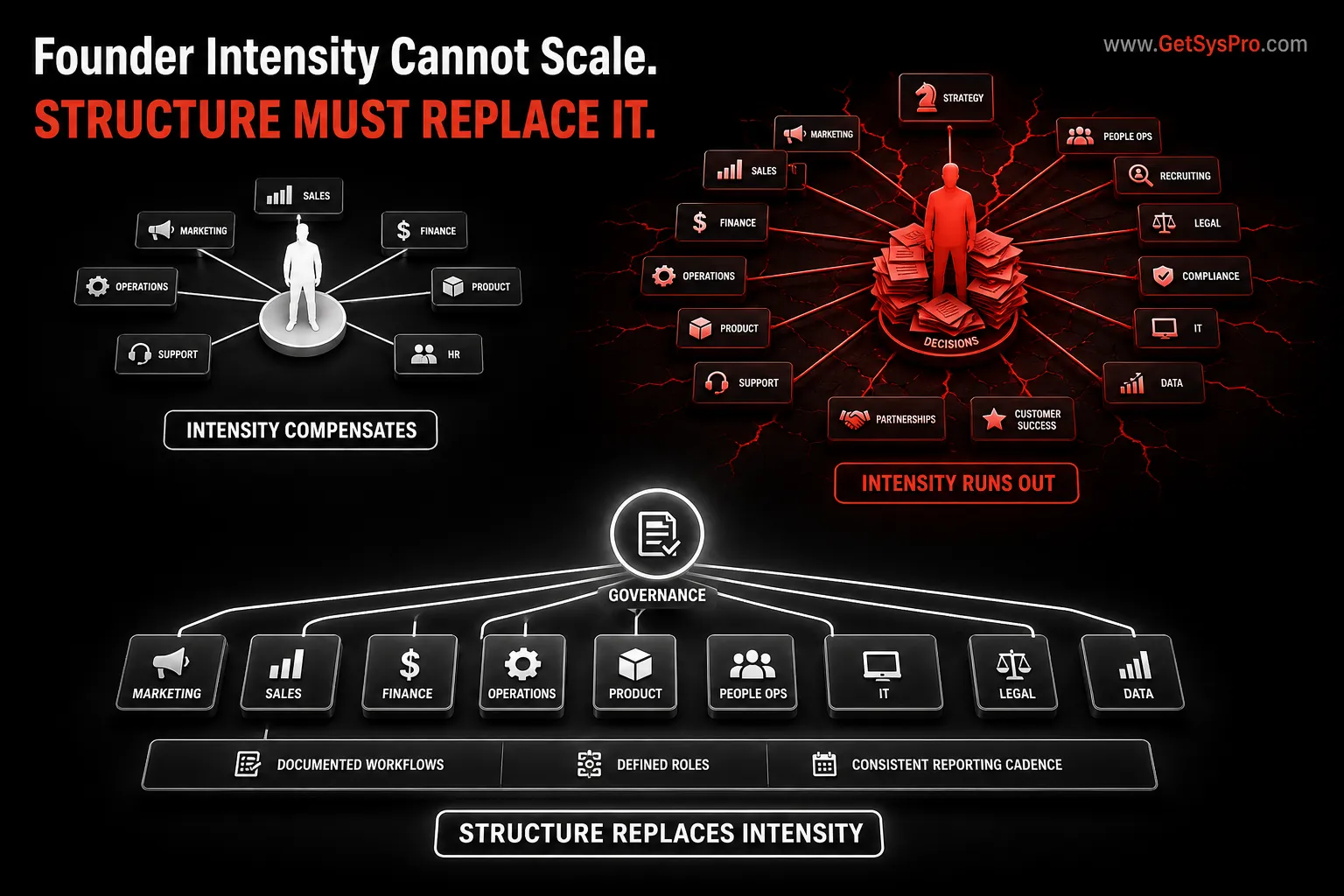
Founder intensity compensates for structural gaps at small scale. It cannot compensate at larger scale. Structure must replace intensity before intensity runs out. www.GetSysPro.com
Article Summary
Growth does not fix structural weakness. It exposes it and multiplies it. The inefficiencies, reporting gaps, and authority ambiguities that felt manageable at smaller scale become expensive at larger scale because scale increases both the frequency and the cost of every structural gap. Early-stage intensity compensates for structural absence, but intensity cannot scale. Scale multiplies variability unless governance evolves with it. Structural weakness shows up as reporting lags, blurred role definitions, undefined decision thresholds, and subjective accountability. Culture cannot compensate for unclear architecture. Sustainable expansion requires structural recalibration at each growth milestone rather than only at the point of failure. Growth is powerful. It creates opportunity and momentum. It is not corrective.
Growth Multiplies Everything. Make Sure It Multiplies Strength.
GetSysPro builds the operational systems, workflow standards, and accountability frameworks that ensure structural clarity keeps pace with your growth.
Frequently Asked Questions
Why does growth expose structural weakness rather than correcting it?
Growth increases the frequency of every operational process, so every structural gap repeats more often and at higher cost. An informal approval process that produced one problematic decision per month at low volume produces four per month at four times the volume. The structure does not improve because revenue improved. The gap becomes more visible and more expensive as volume flowing through it increases.
At what revenue stage does structural weakness become critical?
Structural weakness becomes critical when the volume of decisions, clients, and variables exceeds the leadership team’s capacity to personally manage every exception. That threshold varies by business model but commonly appears between doubling and tripling early revenue. The signal is not a specific dollar amount. It is the pattern: communication volume increasing while clarity decreases, decisions slowing while complexity accelerates, teams working harder while feeling progressively less aligned.
What is the difference between adding process and structural recalibration?
Adding process means layering additional steps onto existing workflows without examining whether those workflows are correctly designed for current complexity. Structural recalibration means examining what the organization requires at its current scale, defining the minimum governance structure that meets those requirements, and updating systems accordingly. Structural recalibration reduces friction where it is structural. Adding process often increases it.
How does structural weakness create cultural fatigue?
Structural weakness creates cultural fatigue because ambiguous systems generate continuous low-level stress for everyone within them. Inconsistent expectations, unclear ownership, and subjective performance standards make it difficult for high performers to know whether they are succeeding or failing. That ambiguity produces disengagement that looks like cultural failure but is actually structural failure. Cultural interventions without structural correction produce temporary improvement followed by return to the same disengagement pattern.
Should structural investment precede growth or accompany it?
Structural investment should accompany growth at each milestone rather than preceding it or following it reactively. Organizations that over-invest in structure before complexity justifies it create administrative overhead without operational benefit. Organizations that defer until growth has strained the system pay the correction cost under pressure. The right sequencing is structural recalibration timed to each significant increase in complexity, not structural perfection before growth begins.