 05/21/2024
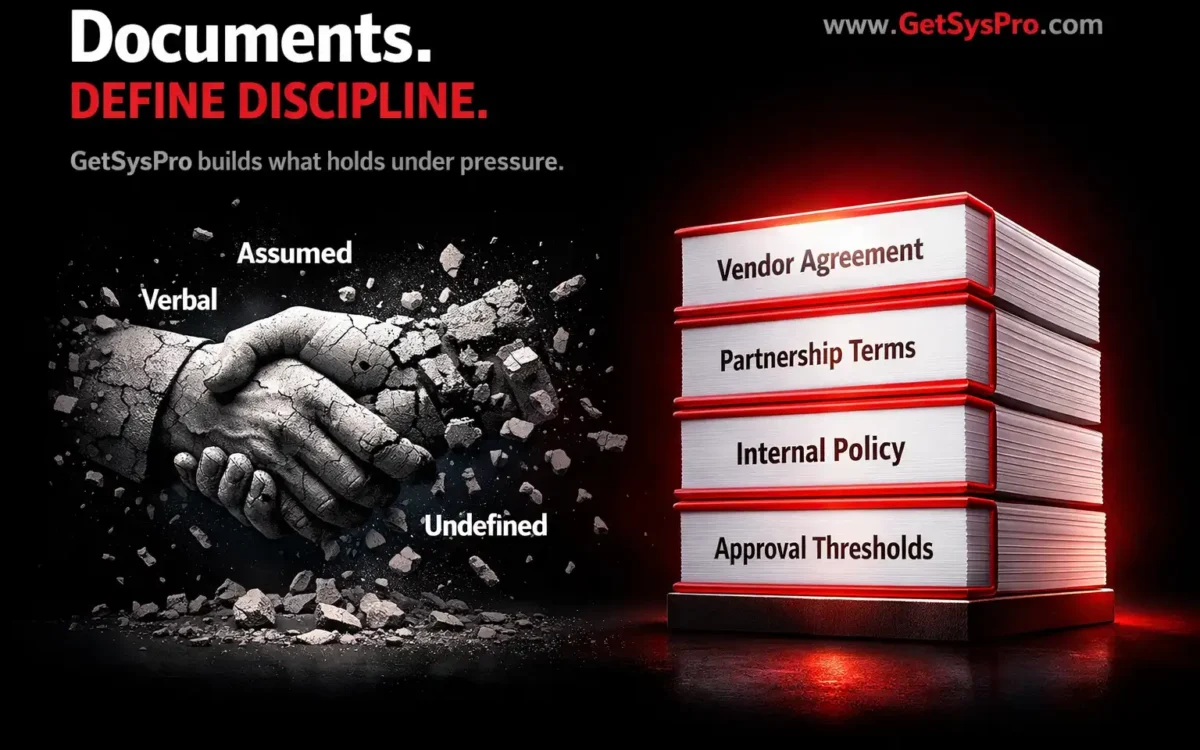
Documents define discipline because they convert assumptions into enforceable structure. When documentation is informal, performance becomes informal. When it is precise, operations become stable and scalable.
Documents define discipline in ways that most growing businesses do not appreciate until something forces the appreciation. A partnership dispute. A vendor disagreement. A scope misunderstanding that consumes weeks of management time. A compliance review that reveals no written policy ever existed for a process that has been running for three years. None of those situations announce themselves in advance. All of them trace back to the same root: documentation that was informal, assumed, or simply never created.
This article explains what documentation actually does for a growing organization beyond legal protection, where the absence of it creates the most operational damage, and how building a documentation standard early converts organizational discipline from a cultural aspiration into a structural reality.
In This Article
- Three Strategic Purposes Documentation Serves
- Informal Agreements Create Operational Friction First
- Governance Documents Reduce Dependency and Disputes
- Documentation Strengthens Financial Discipline
- How Scale Amplifies Both Ambiguity and Clarity
- Specialized Documents Creation With GetSysPro
- Frequently Asked Questions
Key Takeaways
- Documents define discipline because they convert assumptions into enforceable structure. Teams perform to what is written, measured, and enforced, not to what was said once in a meeting.
- Documentation serves three strategic purposes: defining expectations clearly, protecting against legal exposure, and reinforcing operational consistency across people and time.
- Informal agreements create operational friction long before they become legal disputes. Vendor strain, client disagreements, and internal conflict almost always trace back to expectations that were never written down.
- Governance documents reduce knowledge dependency. When procedures exist only in memory, continuity becomes fragile and performance depends on who is in the room rather than on what the organization has built.
- Documentation is not rigidity. It is the clarity that enables speed at scale. GetSysPro builds the specialized documents that formalize discipline across partnerships, vendors, governance, and internal policy.
Three Strategic Purposes Documentation Serves
Documentation carries a bureaucratic reputation in early-stage companies because it feels like the opposite of the speed that produced early growth. That framing is incorrect and costly. Documentation does not slow operations. Absence of documentation does. Every time a team member has to ask what the policy is, how a process works, or who has authority to approve something, the answer costs time that written documentation would have provided instantly. The cumulative cost of undocumented operations compounds invisibly across hundreds of daily interactions before it surfaces as a measurable organizational problem.
Understanding what documentation actually does for a growing organization requires separating it from its bureaucratic associations and recognizing it for what it is: operational discipline captured in writing. Three strategic purposes make that discipline valuable at every growth stage.
Clarity, Protection, and Consistency Across the Organization
The first purpose is defining expectations clearly so work and responsibilities operate on documented standards rather than individual interpretation. When expectations live only in someone’s head, they shift based on who is executing, who is managing, and what pressures are present in a given moment. Writing them down makes them stable and transferable.
The second purpose is protecting against legal and operational exposure by reducing ambiguity in agreements and policies. Ambiguity is not neutral. In any dispute, ambiguity favors the party with less to lose from an unresolved outcome. Clear documentation removes the ambiguity that creates that asymmetry.
The third purpose is reinforcing operational consistency so execution is repeatable across people and time. Organizations that rely on tribal knowledge to maintain consistency discover that knowledge leaves when people do. Documentation preserves institutional knowledge in a form the organization owns regardless of team composition.
“Documents define discipline because written standards are the only organizational standards that hold under growth pressure. Verbal agreements, assumed policies, and informal practices all degrade as complexity increases. Written documentation scales with the organization because it does not depend on any individual’s memory or presence to remain accurate.”
Editorial, GetSysPro Team
Informal Agreements Create Operational Friction First
Legal conflict is the visible outcome of documentation failure. Operational friction is the invisible outcome that precedes it, and it arrives much earlier. Vendor relationships strain when service levels and escalation paths were never defined precisely and both parties are operating from different interpretations of what was agreed. Client disputes emerge when deliverables lacked scope boundaries and the client expected something the team never committed to in writing. Internal conflict rises when responsibilities were implied rather than documented and two people both believe they own, or both believe they do not own, the same outcome.
None of those situations require bad faith to produce significant damage. They require only ambiguity, and ambiguity is the natural state of any agreement that was never written down precisely. The investment in clear documentation eliminates the ambiguity that allows misunderstanding to develop without any party intending it.
What Clear Contract Structure Actually Prevents
A well-structured agreement defines scope boundaries so both parties know what is and is not included. It specifies timelines so performance expectations are concrete rather than aspirational. Payment terms documented precisely prevent the billing disputes that strain vendor and client relationships more than almost any other issue. A defined dispute process establishes how disagreements get resolved before a disagreement exists, which produces dramatically better outcomes than attempting to establish that process while a dispute is actively underway. Each of those elements is easy to include before a relationship begins. Each becomes progressively harder to establish after friction has already developed.
Governance Documents Reduce Dependency and Disputes
Knowledge dependency is one of the most underestimated operational risks in growing organizations. When procedures exist only in the memory of experienced team members, continuity becomes fragile in proportion to how critical those team members are. A key employee departure does not just create a hiring gap. It creates a knowledge gap that exposes every process that person executed or oversaw, because the institutional knowledge required to execute those processes consistently left with them.
Written governance standards preserve institutional knowledge in a form the organization owns rather than renting from its current team composition. Approval thresholds written into policy documentation do not leave when the manager who memorized them does. Process standards written into operational documentation do not depend on a single employee’s presence to maintain consistency. The organization retains its operational knowledge regardless of personnel changes because the knowledge lives in the documentation rather than in individuals.
Governance Documentation as a Signal of Organizational Maturity
Clear governance documents also signal organizational maturity to investors, partners, and enterprise clients who evaluate operational reliability before committing significant resources. An organization that operates on written standards demonstrates it can function consistently without constant founder involvement. That demonstration matters at every stage of growth where external capital, strategic partnerships, or enterprise contracts are in play. Documenting governance is not administrative overhead in those contexts. It is a competitive differentiator that opens doors that informal operations cannot.
Is your business still operating on informal agreements and assumed policies?
GetSysPro builds the specialized documents that convert operational assumptions into enforceable discipline across your entire organization.
Documentation Strengthens Financial Discipline
The financial impact of documentation discipline is direct and measurable. Defined billing clauses reduce collection delays by establishing payment terms, late payment consequences, and escalation paths that both parties agreed to before a payment became overdue. Structured expense policies prevent unauthorized spending by establishing approval thresholds that make the authorization requirement explicit rather than assumed. Clear partnership terms prevent capital disputes by defining how distributions, decisions, and exits work before any of those events creates a conflict.
Each of those outcomes compounds financially over time. Reduced collection delays improve cash flow predictability. Prevented unauthorized spending protects margin. Avoided capital disputes preserve both the financial position and the relationships that informal documentation would have damaged. The investment in documentation precision pays back continuously across every transaction, relationship, and decision that the documentation governs.
Clarity Enables Speed Rather Than Slowing It
The counterintuitive reality of documentation discipline is that precision accelerates rather than constrains operations. Defined approval thresholds eliminate the decision latency that unclear authority generates. Documented billing terms eliminate the negotiation that occurs when terms were never specified. Clear scope boundaries eliminate the back-and-forth that undocumented expectations always produce. Every documented standard removes a recurring source of friction and replaces it with a defined answer that operates automatically. The organization moves faster because it stops relitigating questions that written standards would have answered once and preserved indefinitely.
How Scale Amplifies Both Ambiguity and Clarity
Scale does not change the nature of operational problems. It amplifies their consequences. A verbal agreement that works acceptably at two vendor relationships becomes a management burden at twenty because the informal understanding that made it work depends on personal familiarity that cannot transfer to twenty relationships simultaneously. An assumed policy that the founding team navigates intuitively creates inconsistent execution across a larger team because the intuition was never transferred into a written standard anyone else could apply reliably.
The amplification works in both directions. Ambiguity that is manageable at small scale becomes measurably damaging at large scale. Clarity that is valuable at small scale compounds in value at large scale because each documented standard applies across a larger base of transactions, relationships, and decisions as the organization grows. Writing discipline into the system early is an investment that pays back proportionally to organizational growth rather than simply maintaining its initial value.
Building the Documentation Standard Before Scale Forces It
Organizations that build documentation standards before scale demands them avoid the most expensive version of the work: remediation under pressure. Creating clear vendor agreements after a vendor dispute is underway requires negotiating from a weaker position. Writing partnership governance after a capital conflict has developed requires establishing rules for a game already in progress. Documenting internal policies after a compliance review has flagged their absence requires rebuilding under scrutiny. Every documentation investment made proactively is cheaper, cleaner, and more effective than the same investment made reactively after the absence of documentation has already created a problem.
Specialized Documents Creation With GetSysPro
The challenge for most growing businesses is not recognizing the value of documentation. It is building documentation that is actually precise enough to hold up, comprehensive enough to cover the situations that matter, and practical enough that the team can actually follow it. Generic templates pulled from the internet create the illusion of documentation without its substance. Agreements that use imprecise language, omit critical clauses, or fail to address the specific operational context of the business provide less protection than they appear to.
What Specialized Document Development Covers
Effective documentation for a growing business covers several distinct categories, each with different requirements. Vendor and client agreements need scope definitions, performance standards, payment terms, dispute processes, and termination provisions specific to the business’s actual service model. Partnership and operating agreements need distribution frameworks, decision rights, amendment procedures, and exit provisions that reflect the specific ownership structure and growth stage. Internal governance documents need approval thresholds, policy standards, and accountability frameworks that match the organization’s operational complexity. Standard operating procedures need process documentation precise enough to enable consistent execution without requiring the author’s presence to interpret.
GetSysPro Specialized Documents Creation builds the tailored documentation that formalizes discipline across partnerships, vendors, governance, and internal policy. Documents define discipline because they convert assumptions into enforceable structure. The question is whether your business writes that discipline into the system before a dispute forces it, or after.
Related GetSysPro Services

Scale amplifies what you built on. Documented foundations hold under growth pressure. Informal ones fracture. www.GetSysPro.com
Article Summary
Documents define discipline because they convert assumptions into enforceable structure. Documentation serves three strategic purposes: defining expectations clearly, protecting against legal and operational exposure, and reinforcing consistency across people and time. Informal agreements create friction before they create disputes. Governance documentation reduces knowledge dependency and signals organizational maturity. Documentation precision directly improves financial discipline through faster collections, controlled spending, and prevented capital disputes. Scale amplifies both ambiguity and clarity, making proactive documentation investment always cheaper than reactive remediation. GetSysPro builds the specialized documents that formalize discipline across the full organization.
Documents Define Discipline. Build Yours Before a Dispute Does.
GetSysPro builds the specialized documents that convert operational assumptions into enforceable structure across your entire organization.
Frequently Asked Questions
Why do documents define discipline rather than just reduce legal risk?
Legal risk is one dimension of what documentation protects against, but operational discipline is the primary value. Written expectations eliminate the interpretation variance that produces inconsistent execution across team members. Documented policies make accountability enforceable because there is a written standard to measure performance against. Governance procedures preserve institutional knowledge in a form the organization owns regardless of personnel changes. Each of those outcomes shapes how the organization operates every day, not just how it performs in a dispute. Teams perform to what is written, measured, and enforced. Documentation defines what that standard is.
Our verbal agreements have worked so far. When does informal documentation actually become a real problem?
Verbal agreements work when transaction volume is low, relationships are personal, and complexity is manageable without written structure. Each of those conditions degrades with scale. Higher transaction volume means more opportunities for misunderstanding to develop. Relationships that felt personal at five vendors become transactional at twenty. Complexity that was manageable informally becomes unmanageable when multiple people need to apply the same standard consistently without the opportunity for real-time clarification. The transition from functional to problematic typically happens gradually and invisibly until a specific dispute, compliance review, or personnel change reveals how much the organization depended on informal understanding that no longer exists.
What makes specialized document creation different from using templates found online?
Generic templates create the appearance of documentation without its substance. A vendor agreement that uses standard boilerplate language may cover common scenarios while omitting the specific operational context that makes a dispute likely in your business. A partnership agreement pulled from a template may lack the distribution framework, decision rights structure, or exit provisions that reflect how your specific ownership arrangement actually works. Specialized document development builds from the specific operational reality of the business rather than from generic assumptions about what businesses typically need. That specificity is what makes documentation enforceable rather than merely present.
Can documentation actually improve financial performance beyond just preventing disputes?
Directly and measurably. Defined billing clauses with payment terms and late payment consequences reduce collection delays, improving cash flow predictability. Structured expense policies with documented approval thresholds prevent unauthorized spending that compresses margin. Clear partnership terms prevent the capital disputes that damage both financial position and relationships. Beyond dispute prevention, documentation precision reduces decision latency by eliminating the recurring need to determine what the policy is on questions that written standards would answer automatically. Documented billing terms eliminate negotiation cycles. Clear scope boundaries eliminate the back-and-forth that undocumented expectations generate. Each reduction in friction produces a corresponding improvement in operational speed and cost efficiency.
How does GetSysPro approach specialized document creation for a growing business?
GetSysPro builds documentation from the specific operational reality of each business rather than from templates. The process starts with understanding the actual agreements, relationships, and processes that documentation needs to govern. Vendor and client agreements get built around the specific service model, scope definitions, and risk profile of the business. Partnership and governance documents reflect the actual ownership structure, decision-making approach, and growth stage rather than generic frameworks. Internal policies and SOPs get written at the precision level required for the team to execute consistently without needing interpretation support. The output is documentation that works in practice because it was built for the specific business rather than adapted from something built for a different one.