 04/29/2026
Most people searching for a business consultant are not looking for advice. They are looking for something to change.
The term business consultant covers a wide range of practitioners. What unifies most of them is a common delivery model: assess the situation, identify the problems, recommend the solutions, and deliver a document. The client is then responsible for implementing whatever the document says. That model has its place. It is not the model that produces operational transformation, and most business owners searching for a business consultant are not looking for a document. They are looking for something to change.
In This Article
- What a Business Consultant Actually Does
- When the Consulting Model Works
- The Deliverable Gap: Reports Versus Running Systems
- Why Implementation Is Where Most Engagements Break Down
- What Systems Installation Looks Like Instead
- How to Know Which Model Fits Your Situation
- How GetSysPro Is Different
- Frequently Asked Questions
Key Takeaways
- A business consultant assesses a situation, identifies problems, and delivers recommendations. The client is responsible for implementation. That is the standard model, and it has a structural limitation built into it.
- The consulting model works well for strategy, market analysis, and specialized expertise. It works poorly for operational transformation, because operational transformation requires implementation, not just insight.
- The deliverable gap is the core problem. A document that sits in a folder has not changed anything. What changes operations is execution: defined processes, trained people, enforced standards, and accountability structures that run after the engagement ends.
- Most business owners who need a business consultant actually need something closer to operational infrastructure: systems built inside the operation, not analysis delivered from outside it.
- GetSysPro is not a consulting firm. It is a systems installation operation. The difference is in the deliverable: not a report that describes what should change, but a running system that produces the change.
What a Business Consultant Actually Does
A business consultant provides expert analysis and recommendations to organizations facing specific challenges. The scope varies widely. A strategy consultant advises on market positioning and competitive direction. A financial consultant analyzes cost structures and capital allocation. An operations consultant maps workflows and identifies inefficiencies. An HR consultant addresses talent and organizational design.
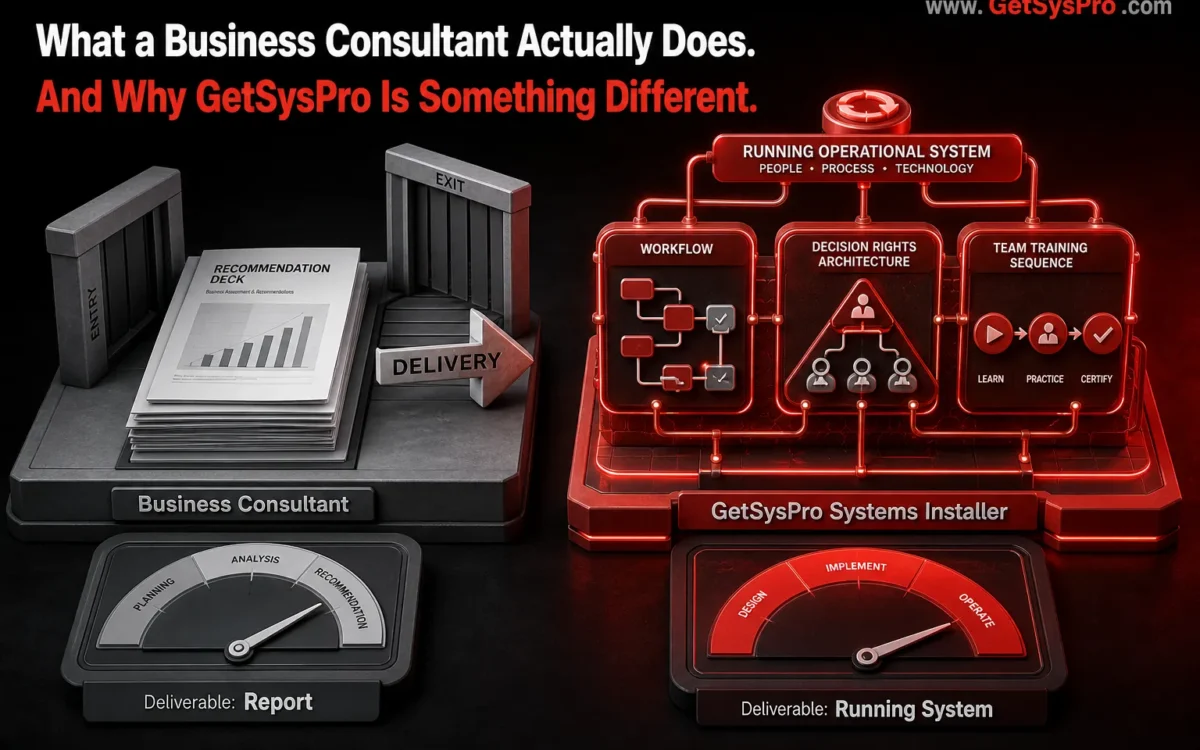
What most business consultants share is a process structure that follows a recognizable pattern. Discovery: the consultant gathers data, interviews stakeholders, and maps the current state. Analysis: the consultant identifies gaps, root causes, and improvement opportunities. Recommendation: the consultant presents findings and prescribes a course of action. Delivery: the engagement ends with a report, a deck, or a set of documented recommendations. What happens next is the client’s responsibility.
The Expertise Model and Its Structural Assumption
The consulting model is built on an expertise assumption: the consultant knows things the client does not, and transferring that knowledge produces value. That assumption is valid in many contexts. A business entering a new market genuinely needs someone who understands that market. Companies restructuring debt need financial expertise they may not have internally. Regulatory audit preparation requires compliance knowledge that is not worth building internally.
The model becomes a mismatch when the client’s problem is not a knowledge problem. Most operational problems in growing businesses are not knowledge problems. The owner knows the workflows are inconsistent. They know the approval processes are unclear. They know the reporting is fragmented and reactive. The gap is not insight. It is execution. Getting a report that confirms what they already sense, with recommendations they do not have the bandwidth or system to implement, does not close that gap.
When the Consulting Model Works
The conventional business consultant model produces genuine value in specific conditions. When the organization needs specialized knowledge it lacks and will not need permanently, a consultant is the right instrument. The knowledge transfer is the deliverable, and it is worth paying for without expecting the consultant to stay and execute.
Market entry analysis, M&A due diligence, regulatory compliance guidance, and technology selection are all contexts where the consulting model works well. The client needs an expert perspective. That perspective informs a decision, and the decision is then executed by the organization’s own team or a different set of practitioners. The consulting engagement does exactly what it is designed to do.
Where Consulting Has a Structural Ceiling
The consulting model has a structural ceiling in operational transformation engagements. When the problem is that the operation itself does not function well, delivering an analysis of that dysfunction does not fix it. The recommendations are accurate. The diagnosis is correct. The system that needs to change is still run by the same people with the same habits, the same informal processes, and the same structural gaps the report identified. Knowing about a problem and solving a problem are not the same activity, and the consulting model is designed for the former.
“A business consultant delivers a picture of what should change. A systems installer delivers the change. Both have their place. The mistake is hiring the first when you need the second.”
Editorial, GetSysPro Team
The Deliverable Gap: Reports Versus Running Systems
The most significant difference between a business consultant and a systems installer is what the client holds at the end of the engagement. A consulting engagement produces a deliverable in document form: a strategy memo, a process map, a recommendations deck, an improvement roadmap. That document has real value as a diagnostic artifact. It does not have operational value until someone executes it.
A systems installation engagement produces a different deliverable. Not a description of what the workflow should look like, but the workflow itself, documented, tested, and operating. Decision rights are not recommended but built: written into role descriptions and enforced through reporting structure. Training is not suggested but completed, against a documented standard, with performance measured against it.
Why the Distinction Matters in Practice
The deliverable gap produces a practical consequence that most business owners experience but rarely diagnose explicitly. They hire a business consultant, receive a thorough and accurate analysis, and find themselves with a document describing exactly what needs to change and no system to change it. Implementation requires bandwidth the owner does not have, team capacity that does not exist, and structural clarity that was the problem in the first place. The report sits in a folder. The operation continues as before.
This is not a failure of the consulting engagement. The consultant delivered what consulting delivers. The mismatch is between what the engagement model provides and what the operational problem requires. Recognizing that mismatch before hiring is what saves businesses from paying for analysis they needed and transformation they did not get.
Do you need analysis or do you need something to change?
GetSysPro does not deliver reports. It installs the systems, trains the team, and builds the oversight structure that produces measurable operational change.
Why Implementation Is Where Most Engagements Break Down
Implementation failure is the most common outcome of consulting engagements that addressed the right problems with the right analysis. The recommendations were correct. Prioritization was sound. The logic was defensible. Implementation requires a set of conditions the consulting model does not create: owner bandwidth to lead the change, team capacity to execute it, structural clarity to guide it, and accountability mechanisms to sustain it.
In the same organizations that needed a business consultant in the first place, those conditions typically do not exist at sufficient strength to drive implementation through to completion. The owner is already stretched. Teams are already at capacity on daily operations. The structural gaps the consultant identified are exactly the gaps that make implementation difficult. Reports add to the list of things that need attention rather than removing items from it.
The Bandwidth Problem Is Structural, Not Personal
Owner bandwidth constraints are not a personal failing. They are a structural consequence of running a business that has outgrown its original operating model. When the owner is the primary decision-maker, process enforcer, and accountability mechanism simultaneously, there is no bandwidth available for a parallel implementation initiative that requires all three of those things to be redesigned at once. Consulting models do not address the bandwidth problem. They assume sufficient bandwidth exists to act on the recommendations delivered.
Systems installation addresses the bandwidth problem directly. Rather than delivering recommendations that require the owner to implement them, it builds the system alongside the owner. The operational load transfers to the structure being installed. The owner holds more bandwidth after the engagement than they had before it. Operational gain is immediate rather than deferred to a future implementation phase that may never fully arrive.
What Systems Installation Looks Like Instead
Systems installation begins where most consulting engagements end. The problems have been identified. The gaps are understood. The difference is that installation does not stop at the identification stage. It proceeds into execution: building the workflows, documenting the standards, defining the decision rights, training the team, and establishing the reporting cadences that surface performance without requiring constant leadership involvement.
The sequence matters. Systems come before training, because training a team on an undocumented system transfers individual interpretation rather than organizational standard. Ownership definition comes before process documentation, because a process without a clear owner has no one responsible for its execution or maintenance. Reporting infrastructure comes before performance review, because review without reliable data produces opinion rather than accountability.
What the Business Holds When Installation Is Complete
When a systems installation engagement ends, the business holds a different kind of asset than a completed consulting engagement produces. Documented workflows that do not depend on any individual’s presence to function. Decision rights frameworks that reduce escalation without removing oversight. Reporting structures that surface performance problems early rather than after they have compounded. A team trained on defined standards rather than on individual interpretations. These assets operate continuously after the engagement ends rather than degrading as the document ages in a folder.
How to Know Which Model Fits Your Situation
The decision between a business consultant and a systems installer is a function of what the problem actually is. If the problem is a knowledge gap . you need expertise the organization does not have and will not need permanently . a business consultant is likely the right instrument. The knowledge transfer is the value, the engagement delivers it, and internal teams execute from there.
If the problem is operational . inconsistent execution, unclear ownership, informal processes, reactive financial management, escalation patterns that consume leadership bandwidth . a systems installer is the right instrument. Value is not in the diagnosis. The owner inside the operation every day usually has that already. Value is in the structural transformation, and structural transformation requires someone who builds rather than advises.
Signals That You Need Installation, Not Analysis
Several signals indicate that what you need is systems installation rather than a conventional business consultant. If you have already had a consultant or know what needs to change but the change has not happened, the problem is execution capacity, not insight. When your team executes inconsistently and the variation is traceable to absence of documented standards, the problem is process infrastructure, not personnel. Escalations routing to you by default and consuming your leadership bandwidth signal a decision architecture problem, not a strategy problem. Each of those problems requires structural installation, not additional analysis.
How GetSysPro Is Different
GetSysPro Services That Install Rather Than Advise
Fractional COO Leadership Services install the executive operational infrastructure that distributes authority, establishes accountability cadences, and removes the founder from the daily escalation loop, without removing them from strategic oversight.
Process and SOP Architecture
converts undocumented workflows and tribal knowledge into organizational standards that any team member can execute consistently, making delivery quality independent of who performs the work on any given day.
Business Operational Systems Audit provides the diagnostic baseline that identifies where the highest-leverage structural improvements are before installation begins, sequencing the work so the most impactful changes happen first.
Related GetSysPro Services
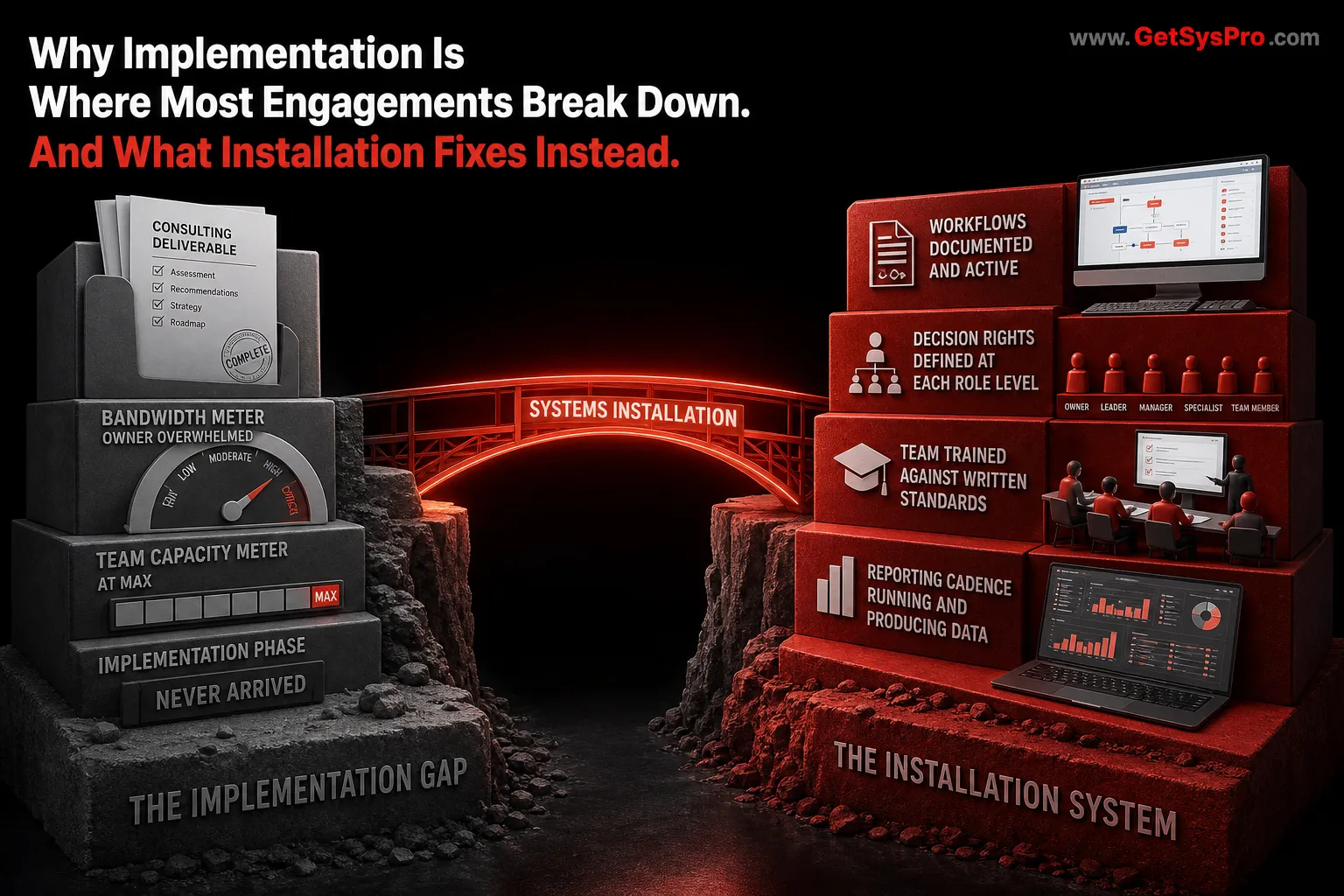
The consulting model does not address the bandwidth problem. It assumes sufficient bandwidth exists to act on the recommendations delivered. Systems installation addresses the bandwidth problem directly. www.GetSysPro.com
Article Summary
A business consultant assesses, analyzes, and recommends. The client implements. That model works when the problem is a knowledge gap. It breaks down when the problem is operational, because operational transformation requires execution, not just insight. The deliverable gap is the core issue: a report describes what should change, while a running system produces the change. Most growing businesses that search for a business consultant need systems installation, not additional analysis. GetSysPro is not a consulting firm. It is a systems installation operation that builds workflows, defines decision rights, trains teams, and installs the reporting infrastructure that makes operational improvement measurable and sustainable after the engagement ends.
You Do Not Need Another Report. You Need the System Built.
GetSysPro installs the operational infrastructure that produces measurable change inside your business, not a document that describes it.
Frequently Asked Questions
What does a business consultant actually do in a typical engagement?
A business consultant gathers information, analyzes it against their domain expertise, identifies gaps and opportunities, and delivers recommendations. The format varies: a strategy memo, a process map, a findings presentation, or a structured improvement roadmap. The engagement ends when the deliverable is delivered. Implementation is the client’s responsibility. The consultant’s value is the expertise and analytical framework they bring to the assessment, not execution of what the assessment produces.
Why do so many consulting engagements fail to produce lasting change?
Most consulting engagements that fail to produce lasting change were technically successful. The consultant diagnosed the problems accurately and recommended the right solutions. The failure happens at implementation. Those same conditions that created the operational problems in the first place . owner bandwidth constraints, team capacity limits, unclear decision rights, informal processes . make implementation of the recommendations extremely difficult. Reports add to the workload rather than reducing it. Without structural support for implementation, recommendations decay into intentions rather than converting into operational change.
How is a systems installer different from a business consultant?
A business consultant diagnoses and recommends. A systems installer diagnoses and builds. The engagement continues through installation: defining processes, documenting standards, establishing decision rights frameworks, training the team, and setting up reporting infrastructure. The client holds a running operational system at the end rather than a document that describes one. Both distinctions live in the deliverable and where the engagement ends.
How do I know if I need a business consultant or a systems installer?
The clearest indicator is whether your problem is a knowledge gap or an execution gap. If you need expertise you do not have and will not need permanently, a business consultant is likely right. If you already know what needs to change but the change has not happened, that is an execution gap. When your team executes inconsistently without documented standards, that is a process infrastructure gap. Escalations routing to you by default and consuming leadership bandwidth signal a decision architecture problem. They require structural installation, not additional analysis.
What does GetSysPro deliver that a business consultant does not?
GetSysPro delivers running operational infrastructure rather than recommendations about what that infrastructure should look like. Documented workflows the team can execute consistently. Decision rights frameworks that reduce escalation without removing oversight. Reporting structures that surface performance problems before they compound. A team trained against written standards rather than individual interpretations. Those assets operate after the engagement ends. GetSysPro is not a consulting firm. It is a systems installation operation, and the distinction is in what the business holds when the work is complete.