 01/09/2024
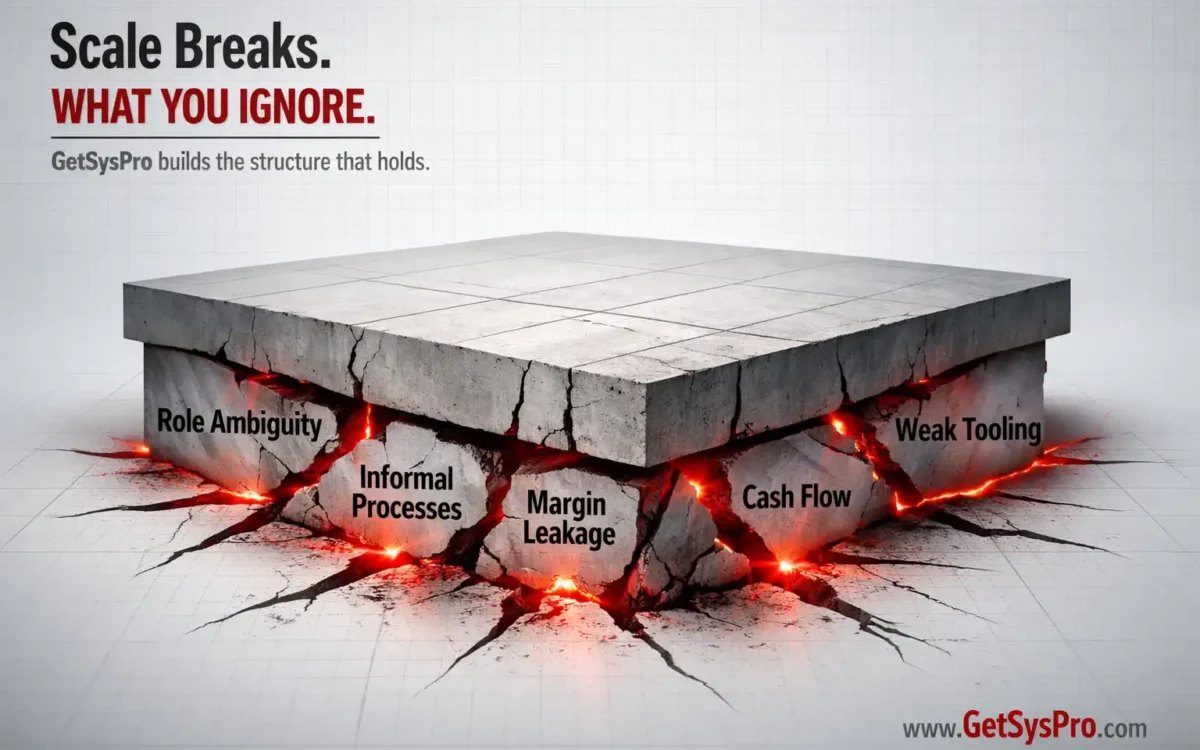
Scale breaks what you ignore because growth does not fix operational weaknesses. It finds them, amplifies them, and charges you for ignoring them.
Scale breaks what you ignore, and the pattern is consistent across every type of growing business. Revenue climbs, headcount expands, and momentum builds. Meanwhile, every area of operational weakness that felt manageable at smaller volume gets magnified. What worked informally at $500,000 starts breaking at $2 million. What held together with a small team starts unraveling at fifteen people. Growth is not the enemy. Ignoring what growth will expose is.
This article examines the five most common areas where scale breaks what you ignore, explains why each one compounds under growth pressure, and shows how to address them before the cost of correction becomes larger than the cost of prevention.
In This Article
- Growth Amplifies Everything, Including What You Ignored
- Role Ambiguity Becomes Escalation as Headcount Grows
- Informal Processes Generate Operational Drift at Volume
- Margin Leakage Builds Silently Before Revenue Reflects It
- Cash Flow Fragility Gets Exposed by Growth Commitments
- Weak Tooling Assumptions Collapse When Data Volume Rises
- Building Structure Before Scale Breaks It
- Frequently Asked Questions
Key Takeaways
- Scale breaks what you ignore because growth multiplies complexity and complexity punishes informal systems that were never designed to handle volume.
- Role ambiguity, informal processes, margin leakage, cash flow fragility, and weak tooling assumptions are the five most common areas that growth exposes.
- Each weakness compounds under pressure. Addressing them before scale hits is always faster, cheaper, and less disruptive than rebuilding while growing.
- Structure is not a constraint on growth. It is what determines whether growth creates advantage or operational crisis.
- GetSysPro helps growing businesses identify structural gaps and build the operational foundation that scale can run on.
Growth Amplifies Everything, Including What You Ignored
Scaling is neutral in one important sense: it does not discriminate between what is working and what is not. Every system, process, and assumption in the business gets tested under higher volume. Strong structures hold and often improve through repetition. Weak ones crack, and the cracks widen with every new client, hire, or service added on top.
The reason scale breaks what you ignore is not that growth creates new problems. Growth surfaces problems that already existed. A billing process that produced one error per month at ten clients produces twelve errors per month at one hundred and twenty clients. A communication gap that caused minor confusion in a five-person team causes significant coordination failures in a twenty-person one. The problem did not change. The volume multiplied its impact.
Why Founders Are Often Surprised by Growth Stress
Most founders assume revenue growth should make the business easier to run. More resources, more capacity, more stability. In practice, growth adds complexity faster than it adds resources, particularly in the early phases. Every new client brings expectations, communication requirements, and delivery variables. Each new hire adds coordination, training time, and decision load. Every new service creates additional touchpoints and dependencies.
When the operating model lacks clarity, that complexity compounds and leadership becomes the default problem solver for everything that falls through the cracks. The founder who expected growth to create freedom ends up more constrained than before. That pattern is not a growth problem. It is a structure problem that growth revealed.
“Scale breaks what you ignore. The question is never whether your weaknesses will be exposed. It is whether you find them on your terms or on the business’s terms after the damage is already accumulating.”
Editorial, GetSysPro Team
Role Ambiguity Becomes Escalation as Headcount Grows
Overlapping responsibilities feel efficient in a small team. Informal communication fills gaps, and everyone pitches in wherever needed. At low headcount, that flexibility is genuinely useful. As the organization grows, the same flexibility becomes a liability because what was informal coordination becomes structural confusion.
Tasks get duplicated because two people both assume they own a step. Accountability blurs because ownership was implied rather than defined. Critical items fall through gaps because each person believed the other was handling them. The cumulative result is escalation: teams surface questions and decisions upward to leadership because there is no clear boundary defining where their authority ends.
The Compounding Cost of Undefined Ownership
Escalation costs more than time. Every decision that routes to leadership unnecessarily consumes bandwidth that should be directed at higher-level priorities. Over time, founders trapped in escalation loops spend their time resolving coordination problems instead of building the business. That compression is directly proportional to headcount. Two people with unclear roles create some coordination friction. Ten people with unclear roles create a significant operational drag that slows everything down.
The solution is not better communication. Communication cannot substitute for defined ownership. Organizational structure that maps roles, boundaries, and decision rights is what removes the structural ambiguity that generates escalation in the first place. Building that structure before headcount grows is significantly easier than building it while managing a team that is already confused about who owns what.
Informal Processes Generate Operational Drift at Volume
Verbal workflows function at low volume because a small team can maintain consistency through direct interaction and shared memory. As transaction volume increases, that consistency degrades. Onboarding varies depending on who trains a new hire. Billing cycles drift based on who handles the account. Approval thresholds change informally without documentation. Small deviations compound into what researchers call operational drift, and the business stops delivering consistently without anyone making a deliberate choice to change.
The visible symptom is rework. Labor hours rise because work gets redone. Timelines slip because steps get missed. Client satisfaction becomes unpredictable because delivery quality depends on which team member handled the engagement rather than on a repeatable standard.
Margin Erosion Follows Inconsistent Execution
Rework is expensive. Every hour spent correcting work that should have been done correctly the first time is an hour that cannot be billed or applied to new work. When that pattern repeats across multiple clients and multiple team members, the aggregate cost becomes meaningful margin erosion. The business may be growing in revenue while shrinking in profitability, and the connection between informal processes and margin compression is not always visible until the damage is significant.
Documenting workflows does not slow the business down. Defined processes reduce the coordination overhead and rework that informal systems generate. The investment in documentation pays back quickly in reduced error rates and more predictable delivery margins.
Margin Leakage Builds Silently Before Revenue Reflects It
Revenue is a lagging indicator of business health. Margin is a more immediate one, and it often starts deteriorating before revenue shows any sign of pressure. Scale breaks what you ignore in this area because inefficiency hides inside growth. When revenue is climbing, the absolute dollar amount of profit can increase even while the percentage is declining. That distinction matters enormously because a business with shrinking margins is building fragility into its future regardless of how strong the top line looks today.
Margin leakage accumulates through several channels simultaneously. Projects take longer than estimated, consuming more labor without capturing more revenue. Vendor costs creep upward incrementally in ways that do not trigger immediate scrutiny. Scope exceptions become normalized as teams accommodate client requests without formal change orders. Each channel individually seems minor. Together they erode the economics of growth.
Tracking Delivery Effort as a Margin Defense
Protecting margin at scale requires tracking delivery effort systematically, not just revenue. That means measuring actual labor hours against estimated hours per engagement. It means reviewing vendor costs against budget on a defined cadence rather than only at year-end. Scope changes need formal documentation so the financial impact is captured rather than absorbed silently.
Businesses that build these tracking habits early find that margin visibility becomes a competitive advantage. Decisions about pricing, capacity, and client selection become more informed when actual delivery economics are understood. Waiting until margin decline is visible in the financial statements means the correction is already overdue.
Is your business structurally ready for the next stage of growth?
GetSysPro identifies the operational gaps that scale will expose and builds the structure to address them before growth forces the issue.
Cash Flow Fragility Gets Exposed by Growth Commitments
Growth requires upfront commitments. Payroll expands before productivity stabilizes. Marketing investment happens before returns materialize. Vendor payments fall due on schedule regardless of when receivables arrive. A business that is growing quickly and managing cash informally will encounter moments where commitments exceed available liquidity, and those moments create reactive decisions that can damage vendor relationships, team stability, and growth trajectory simultaneously.
Cash flow fragility is not a sign of a failing business. It is a sign of a growing business that has not yet built the financial visibility infrastructure that sustained growth requires. The goal is not to avoid growth. The goal is to pursue growth with enough forward visibility to manage the commitments it creates.
Rolling Forecasts as a Cash Management Tool
A rolling cash flow forecast that extends ninety days provides leadership with enough lead time to make deliberate decisions rather than reactive ones. Knowing three months in advance that a payroll expansion will create a liquidity gap allows for proactive planning: adjusting collections timing, renegotiating payment terms, or staging hiring decisions. Discovering that gap when it arrives means choices are limited and more expensive.
Building forecasting as an operational habit rather than a crisis response transforms cash management from reactive to proactive. The businesses that scale sustainably are almost always the ones that maintain this forward visibility as a standard practice rather than deploying it only when things get tight.
Weak Tooling Assumptions Collapse When Data Volume Rises
Technology does not solve structural weakness. This is one of the most common and costly misunderstandings in growing businesses. A CRM does not fix an unclear sales process. A project management platform does not fix undefined ownership. Financial software does not fix inconsistent data entry. Tools can only improve visibility when the underlying workflows and data definitions are already clear.
When structure is absent, software amplifies inconsistency. Reporting loses credibility because inputs are unreliable. Teams debate the numbers instead of acting on them. Leadership cannot trust dashboards because the data feeding them has not been maintained consistently. The business ends up with the cost of the technology, the complexity of managing it, and none of the visibility benefit it was supposed to provide.
Structure First, Then the Tool That Reinforces It
The correct sequence is always: define the workflow clearly, document the data standards, establish ownership of inputs, then select and implement the tool that reinforces that structure. Organizations that reverse this sequence and adopt software hoping it will impose structure end up with fragmented systems that require significant remediation to bring into alignment.
Tooling decisions made on top of clear operational foundations almost always deliver their intended value. The same tools adopted to compensate for missing structure almost always disappoint. The variable is not the software. The variable is the structure underneath it.
Building Structure Before Scale Breaks It
The healthiest approach to growth treats every increase in scale as a design trigger. Revenue milestones prompt review of workflow capacity. Headcount expansions prompt reassessment of ownership clarity and reporting lines. New service additions trigger documentation updates and delivery standard reviews. Structure is not something built once and left alone. It is something maintained and evolved in proportion to the complexity that growth introduces.
Where GetSysPro Starts When Structure Needs Building
Role ambiguity and accountability gaps that generate escalation and slow decision-making are addressed through GetSysPro Organizational Chart Development, which clarifies ownership, defines reporting lines, and gives every team member a clear understanding of their authority and boundaries.
Informal workflows and tribal knowledge driving inconsistency, rework, and margin compression are addressed through GetSysPro Process and SOP Architecture, which converts institutional knowledge into documented standards that deliver consistent results regardless of who executes the work.
For businesses that want to understand the full picture of where their operational foundation is strong and where it is exposed before growth forces the issue, the GetSysPro Business Operational Systems Audit maps every major operational area and sequences the improvements by impact priority.
Scale breaks what you ignore. Growth is an opportunity, and structure is what determines whether that opportunity becomes durable advantage or a compounding operational crisis.
Related GetSysPro Services

Growth adds pressure to every weak point. GetSysPro installs the systems that hold. www.GetSysPro.com
Article Summary
Scale breaks what you ignore because growth amplifies every operational weakness rather than resolving it. Role ambiguity becomes escalation. Informal processes generate drift and rework. Margin leakage builds silently while revenue grows. Cash flow fragility surfaces when growth commitments exceed liquidity. Weak tooling assumptions collapse when data volume rises. Addressing each of these areas before scale hits is always faster and less costly than rebuilding under pressure. GetSysPro builds the operational structure that growing businesses need to scale without breaking.
Scale Breaks What You Ignore. Build the Structure Before It Breaks.
GetSysPro identifies your operational gaps and installs the systems that let your business scale without compounding the problems underneath.
Frequently Asked Questions
In what specific ways does scale break what you ignore in a growing business?
Growth amplifies every existing weakness rather than resolving it. Role ambiguity that caused minor friction at five people creates significant escalation at twenty. Informal processes that produced occasional errors at low volume generate consistent operational drift at higher volume. Margin leakage that was barely visible at $500,000 becomes a meaningful profitability problem at $3 million. Scale does not create these problems but multiplies their impact in direct proportion to the volume it adds.
Role ambiguity seems minor early on. At what point does it become a real operational problem?
Ambiguity crosses from manageable to problematic when escalation becomes the default resolution mechanism. Teams stop owning decisions within their function and route them upward because boundaries are unclear. Leadership loses bandwidth to coordination problems instead of strategic priorities. The trigger is usually a headcount threshold between eight and fifteen people, though it varies by complexity. Building ownership clarity before reaching that threshold is significantly easier than restructuring during it.
Margin leakage feels like a finance problem. Can operational changes actually address it?
Operational changes are the primary lever for margin recovery because most leakage originates in delivery, not pricing. Projects consuming more labor than estimated, rework from inconsistent processes, and scope exceptions absorbed without formal change orders are all operational problems with operational solutions. Documenting delivery standards, tracking actual versus estimated hours, and establishing scope change protocols address the root causes directly. Financial reporting makes leakage visible, but operations is where it gets fixed.
Purchasing better software seems like a faster fix than rebuilding processes. Is that accurate?
Software adopted without underlying process clarity consistently underperforms expectations. Tools amplify the structure beneath them, whether that structure is strong or weak. A CRM built on top of an unclear sales process produces inconsistent data that reduces reporting reliability. A project management platform used by a team with undefined ownership creates noise rather than visibility. Defining the workflow first, then selecting the tool that reinforces it, is the sequence that delivers the intended value from technology investment.
Our business is growing fast right now. Is it too late to build structure without slowing momentum?
Building structure during growth is harder than building it before growth, but far less costly than rebuilding after growth has compounded the structural problems. Momentum does not have to stop for structure work to happen. GetSysPro prioritizes the highest-impact gaps first so businesses address what is most likely to break next rather than attempting a comprehensive overhaul simultaneously. Targeted structural improvements during growth protect momentum rather than interrupting it.
Last Updated: [the_modified_date format=”F j, Y”]