 05/18/2026
AI tools do not fix broken operations. They accelerate whatever system exists underneath them.
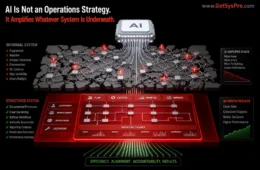
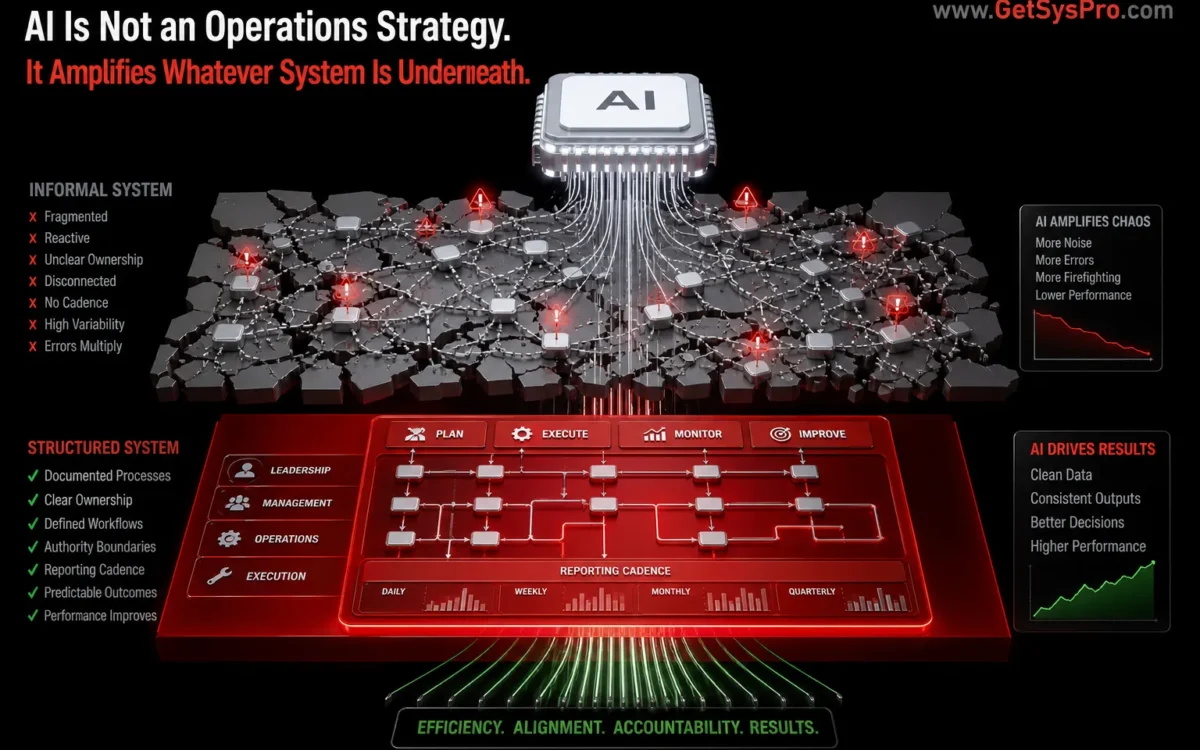
Nearly 60 percent of small businesses in the United States now use AI tools in their operations, more than double the adoption rate from just two years ago. The pitch is consistent: automate your workflows, reduce manual work, move faster. What the pitch leaves out is the prerequisite. AI tools amplify whatever operating system exists underneath them. When that system is documented, consistent, and governed by clear authority and cadence, AI produces real efficiency gains. When that system is informal, dependent on individual memory, and held together by heroics, AI accelerates the chaos rather than resolving it.
The question a business should ask before adopting an AI tool is not which tool to buy. It is whether the operations strategy underneath is ready to be amplified. AI is not an operations strategy. It is a tool that executes against one.
In This Article
Key Takeaways
- AI tools do not replace an operations strategy. They execute against whatever structure already exists.
- Deploying AI into informal, undocumented operations does not reduce chaos. It produces chaos faster and at higher volume.
- The operational prerequisites for effective AI adoption are documented workflows, defined authority, consistent reporting cadence, and measurable role ownership.
- AI is a multiplier, not a foundation. A business that cannot run consistently without AI will not run consistently with it.
- The right sequence is structure first, automation second. Building the operating system before selecting the tools is what determines whether the investment produces returns.
What AI Actually Does to an Operations Gap
An AI tool is a multiplier. It takes whatever inputs the operating system provides and processes them faster, at higher volume, and with less manual effort. When the inputs are clean, consistent, and governed by documented standards, the output improves. When the inputs are inconsistent, undocumented, and dependent on whoever happened to be available that day, the output reflects those inputs at accelerated scale.
This is not a limitation unique to AI. It is the same dynamic that applies to any system operating on top of informal process. Automation tools, CRM platforms, and workflow software all produce the same outcome when deployed into operational gaps: they make the existing dysfunction more efficient rather than replacing it.
What makes AI adoption different in 2026 is the speed and volume at which the amplification happens. A manual process that produces inconsistent outputs once a week produces them hundreds of times a week once AI is involved. The visibility of the problem increases, the surface area of the failure expands, and the correction becomes harder because the AI has now embedded the informal behavior into a repeating automated loop.
Speed Is Not the Same as Improvement
The most common mistake growing businesses make with AI adoption is treating speed as a proxy for operational improvement. Speed without an operations strategy is just a faster path to the same broken outputs. Moving faster is valuable only when the underlying process produces the right output. An HBR analysis on AI implementation consistently finds that the businesses extracting the most value from AI tools are those that redesigned their processes before deploying automation, not after. Structure precedes speed.
The Patterns AI Amplifies Instead of Fixing
Three operational failure patterns appear consistently in businesses that deploy AI before building the structural foundation it requires.
The first is inconsistent process output. When a workflow has never been documented and varies by person or circumstance, AI does not standardize it. The tool learns from the variation and reproduces it. Every output carries the same inconsistency the manual process carried, delivered at a volume the team cannot review or correct in real time.
The second is decision escalation without resolution. Businesses without documented authority boundaries already struggle with decisions routing upward rather than resolving at the appropriate level. AI tools that surface data, flag exceptions, or generate recommendations add volume to that escalation without adding the structural clarity that would allow it to resolve. More information without more defined authority produces more meetings, not faster decisions.
The Third Pattern: Invisible Accountability
The third is accountability diffusion. When role ownership is informal and tied to individuals rather than to documented functions, introducing AI tools creates a new question that informal organizations cannot easily answer: who owns the AI output? When a tool generates a report, a recommendation, or a customer communication, the accountability for reviewing, approving, and acting on it needs to sit with a defined role. Without that definition, AI outputs accumulate without action, which is operationally worse than the manual process it replaced.
What Has to Exist Before AI Can Help
Four structural elements determine whether an AI tool produces efficiency or accelerated dysfunction.
Documented workflows are the first. Every process the AI will touch needs a written standard that defines the inputs, the steps, the acceptable outputs, and the exception conditions. Without that standard, the tool has no consistent baseline to execute against and no way to distinguish acceptable variation from error.
Defined authority boundaries are the second. Every decision the AI will inform or generate needs a documented owner: who reviews it, who approves it, and what conditions trigger escalation. AI recommendations without decision ownership become unreviewed outputs sitting in dashboards nobody acts on.
Reporting Cadence and Role Ownership
Consistent reporting cadence is the third. AI tools that generate operational data, financial summaries, or performance dashboards produce value only when a review cadence exists to act on them. Data without cadence is decoration, and a business without an operations strategy cannot define what the data should drive. Role ownership tied to measurable outcomes is the fourth. When each function has a defined owner accountable for specific results rather than for effort or activity, the AI output has a receiver who is structurally responsible for acting on it. Those four elements together are what converts AI from a faster version of the existing informal system into a genuine operations improvement.
Structure first. Automation second. That is the sequence that works.
GetSysPro builds the operational foundation that makes AI worth deploying.
How AI Fits Into a Mature Operating System
In a structurally mature business with a real operations strategy, AI tools have a defined role that sits inside the operating system rather than on top of it. They execute documented processes at scale, surface variance from defined standards for human review, and reduce the manual effort required to maintain reporting cadence. The tools serve the system. The system does not depend on the tools to function.
This distinction is important because it changes how the adoption decision gets made. A mature organization evaluates an AI tool by asking whether it reduces friction inside an existing documented process. A structurally immature organization evaluates an AI tool by asking whether it will fix a problem the operating system has not yet been designed to solve. The first question produces genuine returns. Asking the second question produces vendor invoices and unresolved operational problems that now have an AI layer on top of them.
The Right Sequence for AI Adoption
Consistent returns follow a predictable sequence: document the process, define the authority, establish the cadence, then deploy the tool. Reversing that sequence, deploying first and hoping structure emerges from adoption, is the pattern behind most failed AI implementations in growing businesses. The McKinsey State of AI research consistently identifies process readiness as one of the strongest predictors of AI value capture. Organizations with defined processes before deployment report measurably higher returns than those that deploy first and redesign later.
Where GetSysPro Fits Before the AI Decision
The work that makes AI adoption valuable is the same work that makes the business scalable, resilient, and transferable independent of any technology decision. GetSysPro installs that foundation as a prerequisite to growth, not as a reaction to a failed tool deployment.
When process documentation is absent or inconsistent, Process and SOP Architecture builds the workflow standards that give AI tools a consistent baseline to execute against. When reporting structures are informal and role ownership is unclear, a Business Operational Systems Audit surfaces where architecture is behind growth so the gaps are closed before automation embeds them permanently.
For businesses that need operating leadership to install decision structure, cadence, and accountability frameworks before making technology investments, Fractional COO Leadership Services provides the structural installation without requiring a full-time executive hire.
Related GetSysPro Services
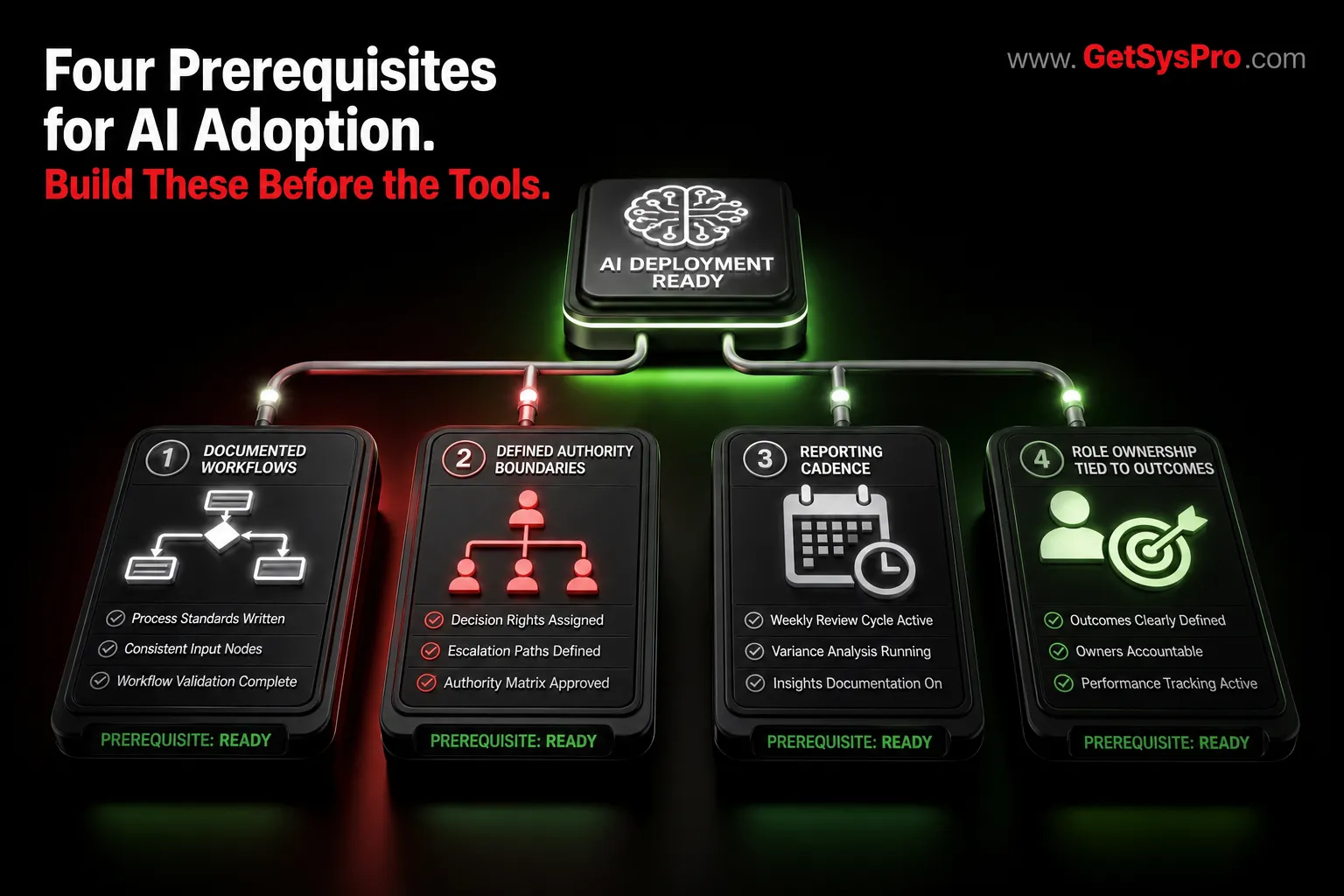
Four structural elements determine whether AI adoption produces efficiency or accelerated dysfunction: documented workflows, defined authority boundaries, consistent reporting cadence, and role ownership tied to outcomes. Build these before the tools. GetSysPro installs each one. www.GetSysPro.com
Article Summary
AI adoption is accelerating across small and mid-sized businesses, but the tool does not determine the outcome. The operating system does. AI amplifies whatever structure exists underneath it. When that structure is documented, governed, and cadenced, AI produces genuine efficiency gains. When it is informal and dependent on individual effort, AI accelerates the dysfunction. The four prerequisites for effective AI adoption are documented workflows, defined authority, consistent reporting cadence, and role ownership tied to outcomes. GetSysPro builds those prerequisites before the AI decision is made, not after a failed deployment makes the gap visible.
AI Is a Tool. Operations Strategy Is the Foundation. Build the Foundation First.
GetSysPro installs the operational architecture that makes every tool you deploy worth deploying.
Frequently Asked Questions
Why does AI adoption fail in small businesses with strong revenue?
Revenue does not indicate operational maturity, and AI requires operational maturity to deliver returns. A business with strong revenue but informal processes, undefined authority, and inconsistent reporting has gaps that AI tools will amplify rather than resolve. The tool executes against the system it finds. When that system is undocumented and variable, AI produces undocumented and variable outputs at higher speed and volume. The failure is not the tool. It is the absence of the structural foundation the tool requires.
What is the right sequence for adopting AI in a growing business?
Document the process, define the authority, establish the cadence, then deploy the tool. Each step is a prerequisite for the one that follows. A process cannot be automated consistently until it is documented consistently. Authority cannot be delegated to an AI-assisted workflow until it is defined for the human workflow. Reporting generated by AI tools cannot be acted on until a cadence exists for reviewing and responding to it. Businesses that reverse this sequence, deploying tools first and hoping structure emerges, consistently report lower returns and higher operational friction from AI adoption.
Can AI tools help build operational structure or only execute within it?
Some AI tools can assist in documenting processes, generating SOP drafts, or surfacing patterns in operational data. Those capabilities are useful inputs to the structural work. They are not substitutes for it. A process document generated by AI still requires human review, organizational alignment, and formal adoption before it governs behavior. Surfacing patterns in data still requires defined authority structures to translate those patterns into decisions. AI can accelerate the documentation and analysis work. It cannot perform the governance and adoption work that makes documentation operationally real.
How does a Business Operational Systems Audit help before an AI deployment?
The audit identifies which processes are documented and consistently followed, which authority boundaries are defined in writing, where reporting cadence exists and where it does not, and which roles carry measurable ownership of outcomes. Those findings define exactly where the structural gaps are before automation embeds them. A business that deploys AI before an audit risks locking informal processes into automated loops that are significantly harder to correct after the fact. The audit produces a prioritized sequence for closing gaps so that when AI tools are deployed, they run on a foundation that makes them worth deploying.
Is this relevant to real estate investment businesses or only general businesses?
It applies directly to real estate investment operations. REI businesses that manage acquisition pipelines, vendor relationships, property oversight, and investor reporting through informal systems face the same amplification risk when deploying AI tools. A property management workflow that is undocumented and person-dependent does not become consistent when AI is applied to it. An investor reporting process that varies by quarter does not become reliable when AI generates the template. GetSysPro’s operational work in real estate investment contexts, including Process and SOP Architecture and Manage Oversight of REI Properties, builds the structural foundation that makes AI adoption in REI businesses produce genuine operational improvement.
Last Updated: [the_modified_date format=”F j, Y”]