 05/08/2026
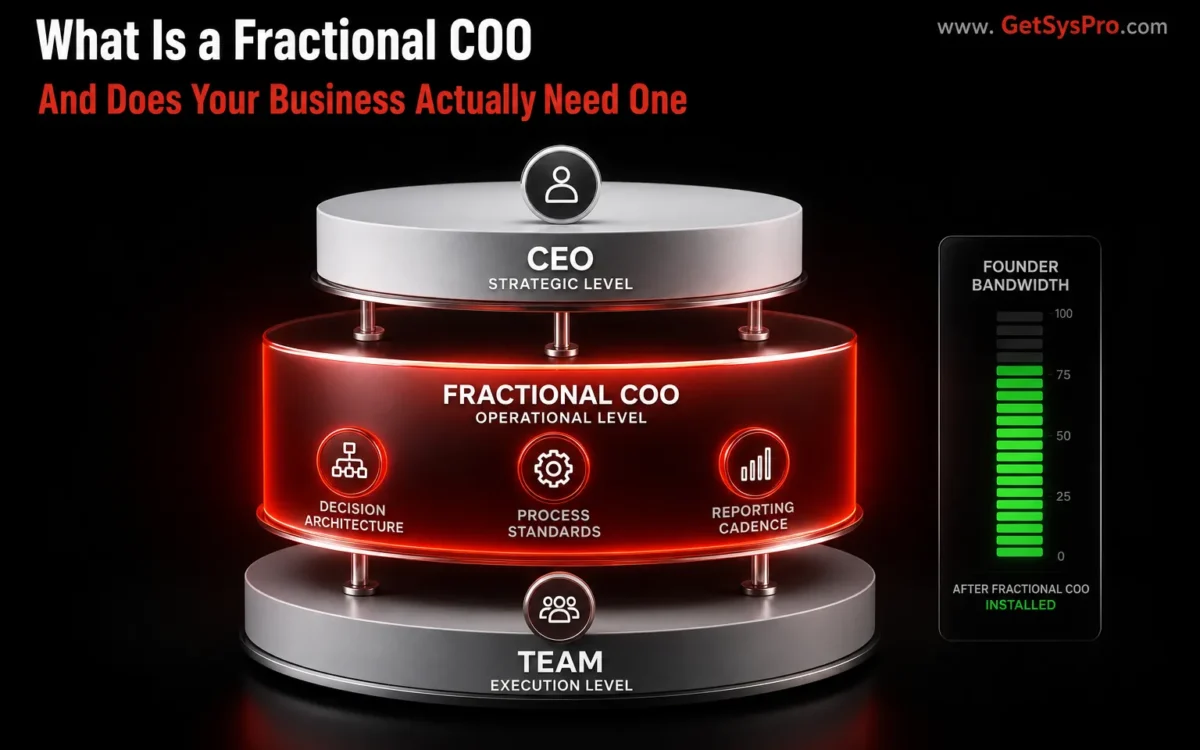
A fractional COO is the executive who owns your operational systems, not a coach and not a consultant.
The term fractional COO appears more frequently in conversations about business growth, but clarity around what it means and who actually needs one remains thin. Most of what has been written is a vague service page or a definition that stops at “part-time COO.”
In This Article
- What a Fractional COO Actually Is
- What a Fractional COO Is Not
- The Operational Signals That Indicate You Need One
- What a Fractional COO Engagement Looks Like in Practice
- Who the Model Serves and Who It Does Not
- How to Evaluate a Fractional COO Before You Hire One
- How GetSysPro Delivers Fractional COO Leadership
- Frequently Asked Questions
Key Takeaways
- A fractional COO is an executive-level operational leader engaged on a part-time or project basis to own the systems, structure, and accountability mechanisms that make a business run predictably at scale.
- Unlike a consultant who recommends and exits, the fractional COO engagement includes execution: building systems, training the team, and removing the founder from daily escalation.
- Operational signals that indicate the need for a fractional COO are specific: founder bandwidth consumed by routine decisions, inconsistent team execution, reactive reporting, and a portfolio that has outgrown its original model.
- Fractional COO leadership works best for businesses between roughly $500K and $5M in revenue that are scaling without the operational infrastructure to support that scale. It is not the right instrument for businesses that need strategic advice without execution, or for businesses that are not yet generating consistent revenue.
- What the business holds at the end of a fractional COO engagement is not a report. It is a running operational system with trained people, defined decision rights, and enforced standards that persist after the engagement ends.
What a Fractional COO Actually Is
A fractional COO is a Chief Operating Officer engaged part-time, project-based, or for a defined period rather than as a full-time employee. The role itself is the same as a traditional COO. The engagement structure is different.
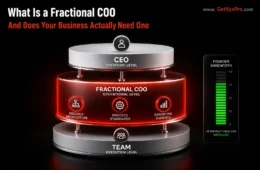
A COO owns the operational layer of the business. Where the CEO focuses on vision, strategy, and external relationships, the COO focuses on execution. That means keeping the internal systems, processes, people, and accountability structures aligned to deliver on the strategy the CEO sets. At the executive level, that means building and maintaining the operational infrastructure that lets the business scale without the founder personally managing every moving part.
Why Fractional Exists as a Model
Most businesses that need COO-level operational leadership cannot justify the cost of a full-time COO. A full-time COO at the executive level carries a compensation structure that makes sense for a business generating $10M or more annually. For businesses between $500K and $5M in revenue, the need for that operational leadership is real but the full-time hire budget is not yet available.
The fractional model solves that gap. The business gets executive-level operational leadership at a cost that fits its current stage. At executive capability level, the fractional model addresses the specific problems the business faces right now, without the full-time overhead. Engagement scales with the business rather than requiring a fixed commitment the revenue does not yet support.
What a Fractional COO Is Not
Clarity on what a fractional COO is requires equal clarity on what it is not. The market has produced a wide range of practitioners who use the title without delivering the substance.
A fractional COO is not a business coach. Coaching develops the individual: skills, mindset, decision-making capability, leadership presence. A fractional COO develops the operation: systems, processes, decision architecture, accountability structure. The output of coaching is a better-equipped founder. The output of a fractional COO engagement is a better-equipped organization. Those are different deliverables and require different practitioners.
Not a Consultant, Not a Project Manager, Not an Advisor
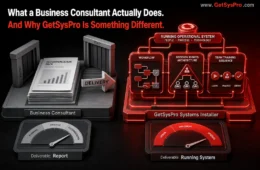
The fractional COO is not a consultant who assesses the situation, delivers recommendations, and exits. The fractional COO stays through implementation. The engagement does not end at the analysis stage. It continues through execution: building the workflows, defining the decision rights, training the team, and establishing the reporting cadences. What the business holds at the end is a running operational system, not a document that describes one.
A fractional COO is not a project manager. A project manager executes a defined scope within a defined timeline. The fractional COO redesigns the operational architecture that determines how all projects execute. The scope is not a single project. It is the system that governs all projects.
A fractional COO is not an advisor who sits on a monthly call and provides strategic input. Advisory relationships have value in specific contexts. A fractional COO engagement is not advisory. It is operational: inside the business, working on the systems, not outside providing perspective.
“A fractional COO is not someone who tells you what your operation should look like. It is someone who builds what your operation needs to look like, inside the business, with the team that runs it.”
Editorial, GetSysPro Team
The Operational Signals That Indicate You Need One
The decision to engage a fractional COO should be driven by operational signals, not by revenue milestones or headcount thresholds. The signals are specific and recognizable once you know what to look for.
Founder bandwidth consumed by decisions that should not require founder involvement is the clearest signal. When pricing approvals, vendor selections, and hiring sign-offs all route to the founder by default, the organization is operating without a decision architecture. Growth compounds the problem because each new hire and new client adds to the escalation volume without adding the structure that would contain it.
Inconsistent Execution, Reactive Reporting, and Outgrown Operating Models
Inconsistent team execution is the second signal. When the same process produces different results depending on who performs it, the variation traces back to undocumented standards. The team is executing from individual interpretation rather than organizational standard. New hires learn through shadowing and produce inconsistent output because the standard was never written down. Quality depends on who is available rather than on what the process requires.
Reactive reporting is the third signal. When financial visibility stops at a bank balance and a monthly statement, the business is managing backward. When operational data is assembled ad hoc rather than produced by a consistent reporting cadence, problems surface after they have already compounded.
The fourth signal is a portfolio or client base that has outgrown its original operating model. What worked at two properties, three clients, or five employees does not work at ten properties, fifteen clients, or twenty employees. The informal coordination, verbal agreements, and founder-dependent decision-making that produced early growth has become the ceiling on further growth. The operating model needs redesign before the next growth stage, not after it arrives and amplifies every existing gap.
What a Fractional COO Engagement Looks Like in Practice
A fractional COO engagement begins with a baseline assessment. The goal is to understand the operation as it actually runs, not as it is supposed to run. That means mapping existing workflows, reviewing how decisions get made and escalated, and identifying where the team spends its time and why.
From that baseline, the work sequences in a specific order. Systems and decision architecture come first. Ownership needs to be defined before processes are documented. The standard a team is trained against needs to exist in writing before training begins. The decisions those reports need to support must be identified before reporting cadences are established.
What Gets Built and What the Business Holds at the End
Process documentation covers the core workflows the team executes repeatedly: the tasks that recur across every client, every property, every project. Documented to a standard that transfers through structured onboarding rather than through informal observation. Decision rights frameworks specify who can decide what, within what limits, and what conditions require escalation. When those boundaries exist in writing, managers act within their authority without requiring founder confirmation on each decision.
Reporting cadences replace reactive financial management with forward visibility. Weekly operational reviews surface execution problems before they compound. Monthly financial reconciliation catches margin drift and billing gaps before they produce cash stress. The accountability structure that results from a well-executed fractional COO engagement means the business runs on defined standards rather than on the founder’s daily presence. That is what the business holds when the engagement ends: a running operational system with trained people and enforced standards, not a consulting report.
Recognizing these signals in your operation?
GetSysPro delivers fractional COO leadership that installs the systems, decision architecture, and reporting infrastructure that lets your business scale without the founder in every room.
Who the Model Serves and Who It Does Not
Fractional COO leadership produces the most significant results for businesses between $500K and $5M scaling without operational infrastructure to support that scale. Revenue is real. Growth is real. The operating model has not kept pace with either. The founder is stretched, the team is executing inconsistently, and the next growth stage will amplify every structural gap unless infrastructure is built before it arrives.
Real estate operators managing multiple markets and growing portfolios represent one strong fit. Service-based businesses with multiple clients, a growing team, and delivery processes that have not been documented represent another. Any business where the founder is the primary accountability mechanism, decision-maker, and process enforcer simultaneously is a candidate for fractional COO engagement.
When the Fractional COO Model Is Not the Right Instrument
The model is not the right instrument for every situation. If the primary need is strategic advice without execution, an advisory relationship or a strategy consultant is a better fit. When the business has not yet reached consistent revenue, the infrastructure investment fractional COO leadership requires does not yet have the transaction volume to justify it. When the founder is not willing to allow the decision rights redistribution that fractional COO requires, the engagement will produce friction rather than results. The model works when the business is ready to let the operational layer run on systems rather than on founder involvement.
How to Evaluate a Fractional COO Before You Hire One
The fractional COO market contains practitioners with a wide range of actual capability. Evaluating one requires looking past credentials and terminology into the specifics of what they deliver and how.
The first question is what the engagement produces. A fractional COO engagement should produce documented workflows, defined decision rights, trained teams, and reporting infrastructure. If the answer to what you receive is advice, direction, or strategic input, you are evaluating an advisor or a consultant, not a fractional COO. The deliverable should be operational infrastructure that runs after the engagement ends.
Questions That Separate Installers From Advisors
Ask how the engagement begins. An operator who installs systems will describe a baseline assessment that maps the operation as it actually runs. One who advises will describe a strategy session or a discovery call that produces a recommendations document. Ask what the team holds at the end of the engagement: a running system or a report. Ask whether the engagement includes training the team against written standards. Training is execution. Delivering a training recommendation is advice. Ask for specific examples of operational infrastructure built in prior engagements, not outcomes described in general terms.
The distinction between a systems installer and an advisor becomes clear when the conversation moves from what they do to what the business holds. A fractional COO who installs systems will answer that question in specific operational terms. An advisor will answer it in outcomes language that does not describe a deliverable you can point to.
How GetSysPro Delivers Fractional COO Leadership
GetSysPro Services That Install Fractional COO Infrastructure
Fractional COO Leadership Services install the executive operational infrastructure that distributes authority and establishes accountability cadences. The engagement produces decision rights frameworks and reporting structures that run on defined standards.
Process and SOP Architecture
converts undocumented workflows and tribal knowledge into organizational standards that any team member can execute consistently. Delivery quality becomes independent of which individual performs the work.
Business Operational Systems Audit provides the diagnostic baseline that identifies the highest-leverage structural improvements before fractional COO work begins, so the most impactful changes happen first.
Related GetSysPro Services
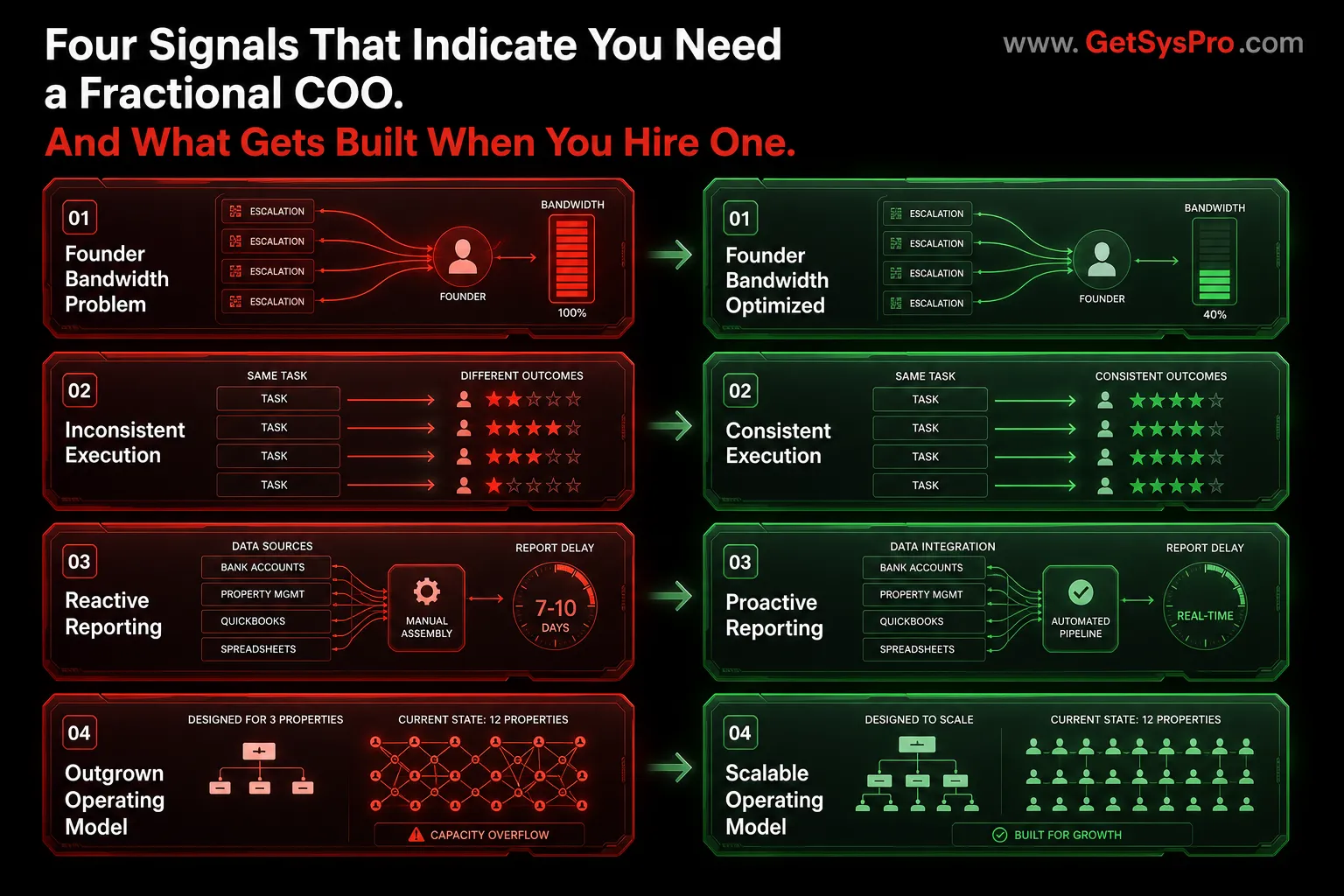
Founder bandwidth consumed. Inconsistent execution. Reactive reporting. Outgrown operating model. These are the four signals that indicate the need for a fractional COO, and what gets built when you hire one. www.GetSysPro.com
Article Summary
A fractional COO is an executive-level operational leader engaged on a fractional basis to own the systems and accountability mechanisms that make a business run predictably at scale. The role is not advisory. It is operational. The engagement includes execution: building the workflows, defining decision rights, training the team, and establishing reporting cadences. Signals that indicate the need for a fractional COO are specific: founder bandwidth consumed by routine decisions, inconsistent execution, reactive reporting, and a business that has outgrown its model. The model serves businesses between roughly $500K and $5M in revenue scaling without infrastructure. What the business holds at the end is a running operational system with trained people and enforced standards, not a report.
Your Operation Should Not Depend on Your Daily Presence to Run.
GetSysPro installs the fractional COO-level operational infrastructure that lets your business run on defined systems rather than on founder bandwidth.
Frequently Asked Questions
What does a fractional COO actually do day to day?
A fractional COO works inside the business on the operational infrastructure that makes it run. On a typical engagement, that means mapping existing workflows and identifying where execution breaks down. It means documenting processes to a consistent standard, defining decision rights so managers act without escalating routine decisions, and building reporting cadences that surface problems early. The work is execution, not advising.
How is a fractional COO different from a business coach or consultant?
A business coach develops the individual: skills, decision-making, leadership presence. A consultant assesses, recommends, and exits. The fractional COO develops the operation: systems, processes, decision architecture, accountability structure. The engagement stays through implementation. Deliverables are not advice or reports but a running system with trained people and enforced standards. The distinction is in what the business holds when the engagement ends.
What size business actually needs a fractional COO?
The fractional COO model produces the most significant results for businesses between roughly $500K and $5M in annual revenue that are scaling without the operational infrastructure to support that scale. Revenue is real, growth is real, but the operating model has not kept pace. Below that range, the transaction volume does not yet justify the infrastructure investment. Above it, a full-time COO hire typically becomes the right instrument. The model is defined more by operational condition than by revenue number. If the founder is the primary decision-maker, process enforcer, and accountability mechanism simultaneously, the business is a candidate regardless of exact revenue.
How long does a fractional COO engagement typically last?
Engagement length depends on the operational complexity of the business and the depth of structural work required. A focused engagement addressing decision architecture, process documentation, and reporting infrastructure for a business with a single location or market typically runs three to six months. A more complex engagement covering multiple markets, a larger team, or a portfolio with significant structural debt may run six to twelve months. The engagement ends when the infrastructure is running: workflows documented, team trained, decision rights enforced, and reporting cadences producing consistent data.
What should I look for when evaluating a fractional COO?
Ask what the business holds at the end. A fractional COO who answers in operational specifics, documented workflows, defined decision rights, trained teams, active reporting infrastructure, is describing a deliverable. One who answers in outcomes language, improved performance, better decision-making, more efficiency, is describing results without describing what produces them. Ask how the engagement begins and how the team is trained. Those answers separate an operator who installs from an advisor who describes.