 07/20/2023
Scaling Chaos vs. Scaling Structure
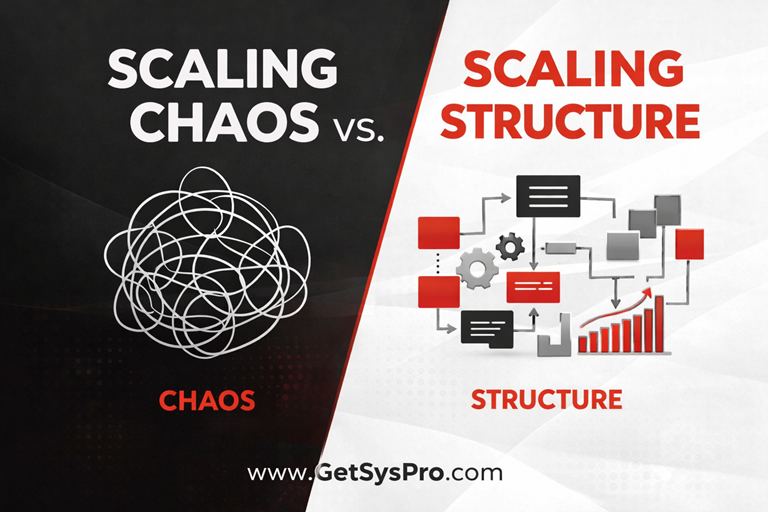
Scaling chaos happens when revenue grows faster than your operating model can support it. The business can look successful from the outside, but internally it feels unstable because processes stretch, teams react instead of plan, and small issues consume disproportionate attention. From the GetSysPro Team perspective, this is the stage where companies are not scaling systems, they are scaling chaos.
Chaos rarely looks dramatic. It often looks like urgency that never shuts off. Back-to-back meetings. Constant messages. Founders answering questions late at night because decisions cannot wait. Quick fixes that turn into permanent habits. It feels like momentum, but momentum without structure is volatility, not stability.
As growth accelerates, weaknesses that were hidden at lower volume become costly. At $300,000 a year, inefficiencies are inconvenient. At $2 million, they are expensive. At $5 million, they become dangerous. Revenue multiplies complexity, and if the operating model does not evolve, stress multiplies faster than the top line.
Many founders assume the strain is temporary and will settle once the surge passes. In reality, growth raises expectations. Clients expect faster responses. Employees expect clearer direction. Vendors expect tighter coordination. Without a deliberate redesign of how work moves through the organization, each layer of growth compounds the strain.
Scaling Chaos Warning Signs in Growing Teams
One of the clearest indicators that you are scaling chaos is increasing dependency on key individuals. Certain people become indispensable because critical information lives in their heads. Founders become escalation points for nearly every meaningful decision. Processes are explained verbally instead of documented. Work moves because specific people push it forward, not because the system carries it.
That dependency creates short-term reliability but long-term fragility. If a key employee leaves, the impact is disproportionate. If the founder is unavailable, performance dips. If demand spikes, the organization struggles to absorb it. The risk is not always visible in revenue, it lives in operational continuity and knowledge distribution.
If you want a practical way to frame role clarity and reduce dependency, RACI is a widely used tool for clarifying who is Responsible, Accountable, Consulted, and Informed:
https://www.atlassian.com/work-management/project-management/raci-chart
Another sign you are scaling chaos is inconsistent execution. Clients get different experiences depending on who owns the account. Internal projects start strong and drift. Metrics are discussed but not measured consistently. Meetings focus on solving yesterday’s problems instead of preventing tomorrow’s.
Scaling Structure With Clear Decision Rights
Scaling structure means leadership is no longer the default decision engine. Decision rights are explicit, and teams can move work forward without constant approval loops. When decision ownership is clear, escalation decreases and execution speed improves.
Clear decision rights also protect teams from constant priority shifts. When the organization knows who decides, and what standards decisions follow, execution becomes stable instead of reactive.
Scaling Structure With Roles and Accountability
Scaling structure requires clear ownership across functions. That means role definition, measurable outcomes, and reporting lines that reinforce accountability. When ownership is vague, accountability diffuses and leaders get pulled into mediation instead of strategy.
If you need to clarify ownership and accountability across functions, GetSysPro Organizational Chart Development supports role clarity that matches how the business actually runs:
https://www.getsyspro.com/service/organizational-chart-development/
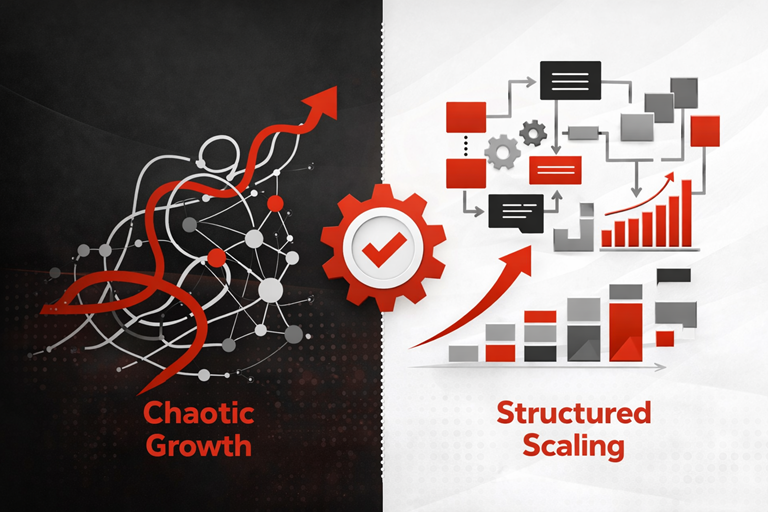
Businesses that scale successfully rely on structured systems, operational processes, and clear workflows to support growth.
Scaling Structure With SOPs and Documented Processes
Scaling systems means standardizing how work enters the organization, how it moves, and how it is measured. It means documented processes that reduce reliance on tribal knowledge. It means clear handoffs so execution stays consistent as volume increases.
If execution depends on people memory instead of process, GetSysPro Process and SOP Architecture helps document standards, handoffs, and repeatable workflows:
https://www.getsyspro.com/service/process-and-sop-architecture/
For an external reference on why SOPs improve consistency and reduce training time, Penn State Extension explains how well-written standard operating procedures provide direction and improve work consistency:
https://extension.psu.edu/standard-operating-procedures-a-writing-guide/
Scaling Chaos Shows Up in Financial Strain
Scaling chaos does not stay contained inside operations. It shows up financially. Rapid revenue increases can hide cash flow vulnerabilities, especially when billing is inconsistent, expenses overrun, or forecasting is reactive. A company can look profitable on paper while being strained operationally in real time.
The temptation during expansion is to focus exclusively on top-line metrics because revenue is visible and celebrated. Infrastructure is invisible and easy to postpone. Yet infrastructure determines whether growth compounds or collapses, because consistent delivery is what preserves trust at scale.
Businesses that scale chaos eventually hit a ceiling. Leadership burnout rises. Margins compress. Culture erodes under pressure. Client experience becomes inconsistent. Growth slows not because demand disappeared, but because the organization cannot sustain it.
By contrast, businesses that scale structure follow a different trajectory. New hires integrate faster because processes are clear. Clients receive consistent service because standards are documented. Financial visibility improves because reporting is structured. Leadership spends more time designing the future than managing the present.
From the GetSysPro Team perspective, the healthiest companies treat operational design as an ongoing discipline, not a one-time project. Growth should increase strength, not stress. If expansion feels increasingly chaotic, it is a signal to strengthen the architecture, because sustainable scale is built.