 07/11/2023
Accountability Begins With Clarity
Accountability begins with clarity, and most underperformance in growing companies is caused by vague ownership, not a lack of talent or effort. When roles are loosely defined and decision rights are unclear, execution slows, handoffs get messy, and leaders get pulled into constant correction. The business struggles because the structure does not tell people what owning the outcome actually means.
In early stage companies, blurred roles can feel efficient because everyone helps everywhere. As you scale, that flexibility turns into friction. Overlapping responsibilities create duplicated effort, priorities conflict, and work falls through gaps because each person assumes someone else is handling it. That is when the familiar line shows up: “I thought someone else owned that.”
From the GetSysPro Team perspective, this is where performance erosion begins. You may have smart people, good intent, and plenty of activity, but without clarity the organization becomes dependent on personalities, heroics, and constant leadership intervention. If you want scalable execution, clarity has to be a design decision, not a hope.
What Clarity Actually Means
Clarity is not hierarchy. It is ownership.
A clear organizational structure should answer:
-Who is responsible for the function
-Who has the authority to make decisions inside it
-Who is accountable for measurable results
-Who provides oversight, and what oversight includes
When these answers are implied instead of explicit, you create a hidden coordination cost. Teams may sound aligned in meetings, but execution reveals gaps. Marketing launches initiatives that operations cannot support. Sales commits to timelines without confirming capacity. Client issues escalate because nobody was assigned as the single owner.
Decision rights matter because they prevent bottlenecks and reduce second-guessing. Harvard Business Review highlights that decision-making improves when organizations combine data with manager expertise instead of relying on only one:
https://hbr.org/2017/06/the-best-approach-to-decision-making-combines-data-and-managers-expertise

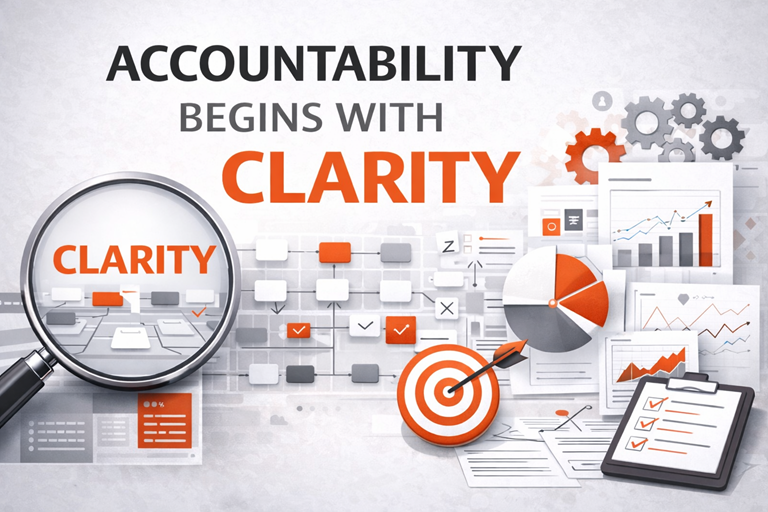
Clear systems and defined responsibilities create accountability and measurable outcomes within an organization.
Why Blurred Roles Break Execution
Unclear roles do not just create confusion. They create drag. Drag looks like rework, missed handoffs, duplicated effort, and constant escalation to leadership for decisions that should be handled inside the team. Over time, leadership becomes the glue holding everything together, which limits growth and increases burnout.
The biggest misconception is that job titles solve this. Titles describe status. They do not define outcomes, boundaries, or authority. High performing organizations document what each role owns, what it does not own, and what decisions it can make without asking.
What To Document Beyond Titles
If you want accountability to be real, clarity must be documented and reinforced consistently. That means defining roles in operational terms, not vague descriptions.
Clarity documents should include:
-Role outcomes, what success means in measurable terms
-Core responsibilities, what the role must do consistently
-Decision thresholds, what the role can approve, spend, change, or commit to
-Escalation paths, when and how to raise issues
-Key interfaces, who the role hands off to, and what the handoff standard is
This is where organizational design and SOP design must work together. When roles are clear but the process is undocumented, people still improvise. When the SOP exists but ownership is unclear, the SOP does not get followed.
How GetSysPro Builds Clarity
From the GetSysPro Team perspective, structure should be treated as a strategic asset, not a static document you update only when hiring. As services expand and headcount grows, the org chart must reflect reality, and the operating model must evolve with complexity.
If you need to clarify reporting lines, ownership, and accountability across functions, GetSysPro Organizational Chart Development is designed to create a structure that supports execution:
https://www.getsyspro.com/service/organizational-chart-development/
If your team is growing but execution is inconsistent because processes live in people’s heads, GetSysPro Process and SOP Architecture helps document workflows, standardize handoffs, and reduce dependency on tribal knowledge:
https://www.getsyspro.com/service/process-and-sop-architecture/
Structure Creates Performance
Without clarity, performance depends on personality, who happens to be proactive, who pushes hardest, and who remembers what. With clarity, performance depends on structure, defined ownership, documented expectations, and decision rights that keep work moving.
Strong teams need strong structure. Accountability does not begin with discipline. Accountability begins with clarity.