 03/26/2024
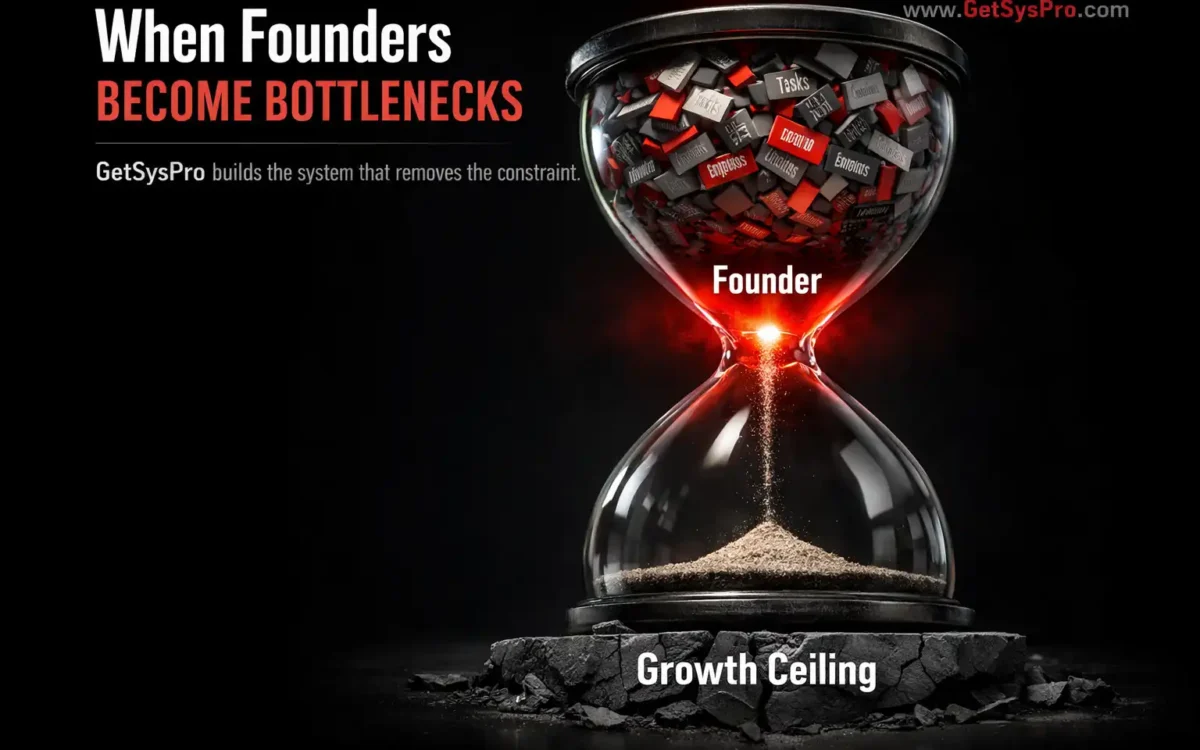
When founders become bottlenecks, growth slows not from lack of vision or effort, but because the organization has outgrown a model built around one person’s availability.
When founders become bottlenecks, it does not look like failure. It looks like success. Demand stays strong. The team stays busy. Revenue holds. But everything still moves through one calendar. Pricing approvals, hiring sign-offs, client exceptions, vendor negotiations, and strategic direction all require the same person. The founder stays involved because they care and because they have always been the system. Over time, involvement becomes dependency. Dependency becomes drag. And drag quietly kills the growth that created the bottleneck in the first place.
This article explains why founder bottlenecks form, what structural mechanisms perpetuate them, and how to design an operating model that distributes authority without removing the founder from meaningful oversight.
In This Article
- Why Founder Bottlenecks Start as Quality Control
- Delegation Without Structure Increases Anxiety, Not Freedom
- Centralized Decisions Create Learned Dependency
- Four Design Levers That Break the Bottleneck
- Operational Leadership Supports the Transition
- Moving From Bottleneck to Business Architect
- Frequently Asked Questions
Key Takeaways
- When founders become bottlenecks, the root cause is a decision architecture that has not scaled with the business, not a personal failure of leadership or effort.
- The bottleneck appears as compounding small delays long before it looks like a crisis. Each item seems manageable. Collectively, they create structural drag.
- Delegation without documented structure increases founder anxiety rather than relieving it. Structure converts delegation from a risk into a repeatable system.
- Centralized decision authority trains teams to escalate instead of act, making the pattern self-reinforcing over time.
- Structural redesign through decision thresholds, documented workflows, and reporting cycles removes the bottleneck without removing the founder from meaningful oversight.
Why Founder Bottlenecks Start as Quality Control
Founders become the default checkpoint because they want consistency. In early stages, that approach works. One person holds the standard, approves outputs, and ensures every deliverable reflects what the business stands for. At scale, that same approach becomes a queue with no bypass lane.
When the founder is the gate, the organization’s throughput caps at one person’s attention. Every task requiring sign-off competes with every other task requiring sign-off. The founder cannot expand their hours to match business volume. Growth becomes a function of founder availability rather than team capability. That is not a sustainable operating model. It is a ceiling dressed as a leadership style.
Constant Escalation Signals a Structural Gap, Not a Personnel Problem
Founders frequently misread escalation as a training problem or an attitude problem. The team does not understand, or the team does not take initiative. In most cases, the team behaves rationally within the system they operate in. When the system rewards escalation and provides no alternative framework, escalation is the logical response. Teams do not know what they can decide independently, what standards apply to their scope, or what genuinely requires founder attention. When no framework exists, everything escalates because escalation is the safest move.
Founders absorb that load and interpret it as proof they are needed rather than evidence of a missing structure. The distinction matters enormously. One diagnosis keeps the founder at the center. The other directs attention toward building a system that does not require them to be.
“When founders become bottlenecks, it is not because they are too involved. It is because the architecture that would make their involvement unnecessary does not exist yet. Building that architecture is not a leadership development exercise. It is an operational design problem.”
Editorial, GetSysPro Team
Delegation Without Structure Increases Anxiety, Not Freedom
Founders hesitate to let go because outcomes feel unpredictable. That hesitation is not controlling by nature. It is rational given the structural conditions. When no documented standard exists, delegation is a bet. The founder releases a task, trusts that the team interprets expectations correctly, and waits to see whether the output matches the standard in their head. More often than not, it does not. That outcome confirms the belief that the founder must stay involved, and the cycle tightens.
The solution is not a mindset shift. It is clearer architecture. Define ownership before assigning tasks. Document workflows so expectations stop living exclusively in the founder’s head. Make performance measurable so teams can evaluate outcomes against a standard rather than a feeling. When structure exists, delegation becomes confidence-based and repeatable. Without structure, delegation remains anxiety-driven and unpredictable regardless of how much the founder wants it to work.
Architecture Converts Delegation From a Risk Into a System
A founder who delegates without documentation bets on alignment that has not been established. A founder who delegates with documented workflows, defined quality checkpoints, and explicit escalation criteria operates a system. The difference between those two approaches is not personality. It is architecture. This is why founder bottlenecks persist even when founders genuinely want to step back. The desire to delegate exists. The system that makes delegation safe does not. Building that system requires written process documentation, clear ownership definitions, and measurable performance standards at every level of the organization.
Centralized Decisions Create Learned Dependency
Centralized decision structures do not just slow operations. They shape culture. Teams learn that the safest move is to escalate upward. Initiative declines over time because independent action without clear authority creates risk for the individual. Lateral problem solving weakens because cross-functional decisions have no established path. Capable people stop acting independently because the system does not reward independent action.
This is how a founder bottleneck becomes self-reinforcing. The more decisions the founder absorbs, the less the team practices decision making. The less the team practices decision making, the less capable it appears. The less capable it appears, the more the founder justifies staying involved. Every cycle deepens the dependency and widens the gap between the organization’s potential capacity and its actual output.
Reversing Learned Dependency Requires Deliberate Authority Transfer
Teams trained to escalate do not begin acting independently simply because a founder announces an intention to step back. The behavioral pattern embeds deeply by the time founders recognize it as a problem. Reversal requires deliberate, structured authority transfer. That means publishing decision thresholds by role, defining what each level can decide without escalation, and reinforcing independent decisions positively when they occur.
Tolerating some variance during the transition is unavoidable. Teams building decision confidence will make mistakes the founder would not have made. The alternative is permanent centralization and permanent growth limitation. Founders who accept short-term variance in exchange for long-term structural capacity make a rational trade. Those who cannot accept any variance remain bottlenecks indefinitely, and the business caps at whatever one person can personally oversee.
Still the last approval on everything?
GetSysPro installs decision systems, documented workflows, and reporting structures so your team executes without routing everything through you.
Four Design Levers That Break the Bottleneck
Relieving a founder bottleneck is a structural redesign challenge. The goal is to reduce unnecessary escalation while preserving real oversight where it matters. Founders do not need to exit all decisions. They need to exit the decisions that do not require their judgment so their attention stays available for the ones that genuinely do.
Thresholds, Documentation, Reporting Cycles, and Escalation Criteria
Decision thresholds by role eliminate the most common source of unnecessary escalation. Define clearly what each role can approve without escalation. Budget limits, vendor selections, client exceptions, and scope changes should each carry a published threshold that removes ambiguity and stops the default upward referral.
Documented workflows for recurring processes answer standard questions before teams think to ask them. When answers live in written process documentation rather than in the founder’s head, routine matters stop escalating and the founder stops serving as the organization’s institutional memory.
Reporting cycles that provide visibility without interruption give founders the oversight they need without requiring inclusion in every email and every meeting. Weekly or biweekly structured reporting replaces constant ad hoc check-ins with predictable, information-dense touchpoints that consume a fraction of the time.
Escalation criteria that filter non-critical issues teach teams what actually qualifies for founder-level attention. When that definition is explicit, teams self-filter rather than defaulting to upward referral. The founder receives fewer escalations, and each one that arrives genuinely warrants their judgment.
Operational Leadership Supports the Transition
Structural redesign works best when someone with operational authority and an outside perspective leads it. Founders who attempt to redesign their own role while simultaneously filling that role face an inherent conflict. They are simultaneously the problem, the designer of the solution, and the person responsible for implementation. That conflict rarely produces clean outcomes.
Operational leadership fills that gap. GetSysPro Fractional COO Leadership Services redistribute execution responsibility without sacrificing the oversight founders need. Accountability structures, performance reporting, and operational rhythms establish with enough clarity that the founder steps back from day-to-day decisions without losing visibility into performance.
Process Documentation and Role Clarity Complete the Structural Foundation
When recurring questions, inconsistent handoffs, and tribal knowledge drive escalation, GetSysPro Process and SOP Architecture builds the documentation layer that removes those sources of dependency. Standard answers to standard questions get written down, approved once, and embedded into daily operations. Teams stop escalating because the answer already exists in the system.
When role confusion drives constant founder involvement, GetSysPro Organizational Chart Development maps ownership and reporting lines clearly so accountability does not blur as the team grows. Founder involvement in decisions that clearly belong to another role becomes structurally unnecessary rather than culturally expected. That shift is the difference between a founder who is perpetually pulled into operations and one who chooses when to engage.
Moving From Bottleneck to Business Architect
The transition from bottleneck to architect is not a loss of control. Stepping back from tactical decisions frees attention for work that genuinely requires founder-level judgment. Capital allocation, strategic positioning, partnership development, and long-term growth design all benefit from focused attention. A founder spending hours on routine approvals has less capacity for those decisions, not more. The bottleneck does not just slow the organization. It diminishes the founder’s own contribution to the business.
When founders design intentional structure, growth accelerates with stability rather than slowing under the weight of a single point of failure. The business operates independently at the operational level while the founder stays engaged at the strategic level. That is not a diminished role. It is the role the business actually needs from its founder as it scales.
Structural Problems Have Structural Solutions
Founder bottlenecks are structural problems. Recognizing the pattern is step one. Building the architecture that distributes authority appropriately is step two. Both steps are available to every founder willing to treat operations as a design problem rather than a personal responsibility. The businesses that scale fastest are the ones whose operations do not depend on a single person’s daily presence. Building toward that independence is not abandonment of the business. It is the highest-leverage thing a founder can do for it.
Related GetSysPro Services

One calendar. An entire organization waiting. Growth cannot outpace one person’s availability. www.GetSysPro.com
Article Summary
When founders become bottlenecks, the root cause is a decision architecture that has not scaled with the business. The bottleneck appears as compounding small delays before it looks like a crisis. Delegation without documented structure increases founder anxiety rather than relieving it. Centralized decision authority trains teams to escalate instead of act, making the pattern self-reinforcing. Four structural levers break the cycle: decision thresholds by role, documented workflows for recurring processes, reporting cycles that provide visibility without interruption, and escalation criteria that filter non-critical issues. GetSysPro installs those systems and provides the operational leadership that guides the transition from bottleneck to business architect.
Your Business Should Not Stop When You Do.
GetSysPro installs the operational systems that let your team execute without you in every room.
Frequently Asked Questions
What actually causes founders to become bottlenecks in a growing business?
Founder bottlenecks develop when a business outgrows its original operating model without rebuilding how decisions get made. The founder was the system in the early stage, and that centralization made sense at low volume. As the team grows, that same structure becomes a single point of failure. Every approval, exception, and strategic call still routes through one person regardless of business volume or team size, because the decision architecture never changed to reflect the organization’s growth.
How does a founder recognize they have become the bottleneck?
The clearest signals are constant escalation, delayed decisions, and projects that stall when the founder is unavailable. If the team cannot move forward on routine matters without approval, the founder functions as a gate rather than a leader. Calendar overload driven by involvement in decisions that do not require founder-level judgment is another clear indicator. When the founder’s schedule determines the organization’s execution pace, the bottleneck is already well established.
Stepping back feels risky when quality matters. Does fixing this require sacrificing standards?
No. Structural redesign encodes quality standards into documented workflows, decision thresholds, and performance criteria so teams meet those standards without the founder present at every step. Quality becomes repeatable rather than dependent on individual oversight. The goal is not indifference to quality. The goal is building a system that delivers consistent quality independent of who executes the work on any given day.
Delegation has failed before. Why would a structural approach produce a different result?
Previous delegation attempts that failed almost always lacked documented structure. Delegating a task without a written workflow, defined output standard, and explicit escalation criteria is delegating hope rather than delegating work. The outcome depends on alignment that was never established. Documented workflows, defined outputs, and measurable performance standards convert delegation from a bet into a system. The structural approach produces different results because it changes the conditions under which delegation occurs, not just the intent behind it.
Can a fractional COO actually help a founder break out of this pattern?
A fractional COO brings operational authority and an external perspective to the redesign process. Founders trying to redesign their own role while filling that role face a conflict of interest. They cannot objectively evaluate a system they are simultaneously embedded in. Operational leadership handles the structural implementation while the founder focuses on strategic decisions, creating a clean separation that accelerates the transition without sacrificing the oversight the founder needs to maintain confidence in the process.