 03/12/2024
Your org chart predicts your problems because it shows where execution friction will surface before performance declines. Most businesses treat it as paperwork. It is actually a diagnostic tool.
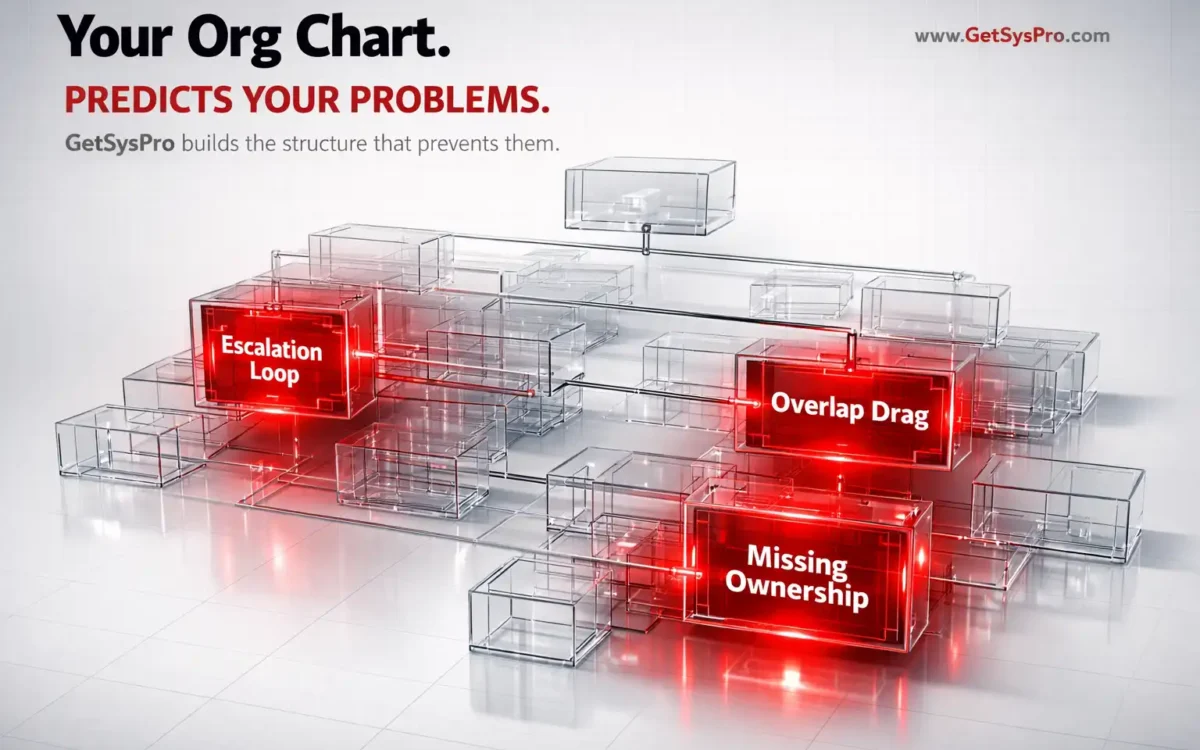
Your org chart predicts your problems long before performance metrics confirm them. Reporting lines that are undefined on paper produce escalation in practice. Overlapping responsibilities that look minor in a chart generate coordination friction and margin drag at scale. Missing ownership that nobody questions during early growth becomes a structural crisis when volume increases and informal coordination can no longer compensate. The org chart is not a record of titles. It is a map of how work, decisions, and accountability flow through the organization, and that map reveals exactly where execution will break down next.
This article explains what a functional org chart actually communicates, where structural ambiguity creates the most damage, and how to build an organizational structure that scales rather than one that constrains.
In This Article
- What an Org Chart Actually Reveals Beyond Titles
- Structural Ambiguity Shows Up as Slow Execution
- Decision Rights Turn a Chart Into an Accountability Map
- Overlapping Responsibility Creates Duplication and Margin Drag
- Structural Clarity Improves Culture and Retention
- Structure Must Evolve as the Organization Scales
- Building an Org Chart That Predicts Fewer Problems
- Frequently Asked Questions
Key Takeaways
- Your org chart predicts your problems because undefined reporting lines, overlapping responsibilities, and missing ownership on paper always produce escalation, duplication, and accountability gaps in practice.
- An org chart becomes useful when it explicitly maps decision rights, not just names and titles. Informal authority becomes inconsistent under growth pressure.
- Overlapping responsibilities create coordination cost, rework, and margin erosion that rarely trigger immediate alarm but compound significantly as volume increases.
- Structure must evolve intentionally as the business scales. What works at ten people frequently fails at thirty if role definitions and leadership layers do not keep pace with workflow complexity.
- GetSysPro builds organizational structures that answer three questions clearly: who reports to whom, who makes which decisions, and who owns measurable outcomes.
What an Org Chart Actually Reveals Beyond Titles
Most organizations treat the org chart as an administrative artifact. It gets updated when someone new joins, shown to investors during due diligence, and filed away until the next hiring cycle. That treatment misses the diagnostic value entirely. An org chart is not primarily about titles or reporting hierarchy. It is about decision rights and accountability, and those two elements determine how efficiently the organization executes at any level of complexity.
The questions an org chart should answer clearly are not complicated. Who owns revenue? Delivery owner? Who owns finance, compliance, and hiring? When those answers are vague on the chart, they will be vague in practice. Teams escalate decisions upward because nobody is certain who owns the outcome. Leadership bandwidth compresses because founders and senior managers become the default resolution point for problems that role clarity would have resolved at a lower level.
Why Execution Breakdown Traces Back to Structural Ambiguity
Execution breakdown almost always traces back to structural ambiguity rather than individual performance. Revenue stays steady, demand remains strong, and strategy is clear, yet deadlines slip and decisions stall. The organization feels busy but not productive. When that pattern appears, the correct diagnosis is structural rather than motivational. Clarity on paper produces clarity in practice. Ambiguity on paper produces ambiguity in practice, and that ambiguity compounds under growth pressure rather than resolving on its own.
“Your org chart predicts your problems because structure determines behavior. When ownership is unclear on paper, it will be unclear in practice. An org chart that answers who owns what is not administrative overhead. It is operational infrastructure.”
Editorial, GetSysPro Team
Structural Ambiguity Shows Up as Slow Execution
When reporting lines and responsibilities lack clarity, execution slows because people spend time clarifying who decides and who owns the outcome rather than acting. That clarification cost is not visible in any single instance. It accumulates across hundreds of situations per week throughout the organization, consuming hours of collective capacity on coordination that defined structure would eliminate.
A predictive org chart makes bottlenecks visible before they fully develop. It shows where responsibilities overlap, where authority is missing, and where leaders will become the default escalation path as volume increases. Reading the chart with that diagnostic lens reveals operational vulnerabilities that a standard performance review would never surface because structural problems do not show up as individual performance failures.
Early Stage Ambiguity Versus Growth Stage Ambiguity
Early stage companies survive structural ambiguity because coordination remains informal and the team is small enough to compensate. Founders fill gaps. Everyone pitches in wherever needed. The flexibility that makes small teams effective masks the structural gaps that informal coordination papers over. As complexity increases, that same ambiguity destabilizes execution. Growth routes more decisions upward. Teams hesitate before acting because ownership is unclear. Progress slows even when market opportunity remains strong. The structure that worked at eight people actively constrains performance at twenty-five.
Decision Rights Turn a Chart Into an Accountability Map
A chart populated with names and reporting lines but lacking explicit decision rights is a hierarchy diagram, not an accountability map. The distinction matters operationally. A hierarchy diagram tells you who reports to whom. An accountability map tells you who owns which outcomes and at what threshold a decision escalates. The second version is what enables distributed execution without loss of control.
When decision authority goes unspecified, the organization inherits it informally. Informal authority distributes unevenly and inconsistently. Some decisions escalate unnecessarily because team members lack confidence in their authority. Others go unmade because nobody claims ownership. Both patterns slow execution and consume leadership bandwidth on coordination that explicit decision rights would have eliminated entirely.
Three Levels Every Decision Rights Framework Requires
An effective decision rights framework defines three levels for every significant organizational function: decisions that the role owner makes independently, decisions that require consultation before action, and decisions that require escalation and approval. Defining these three levels explicitly for each function removes the ambiguity that generates unnecessary escalation. Team members act with confidence when they know their authority boundaries precisely. They default to escalation when those boundaries are vague, and that default imposes a coordination tax on the entire organization every time it triggers.
Overlapping Responsibility Creates Duplication and Margin Drag
Overlapping responsibility is one of the most overlooked structural signals in an org chart, and one of the most expensive. Marketing and sales track different metrics for the same pipeline. Operations and finance reconcile different data for the same projects. Managers supervise functions that intersect without clear boundaries defining who owns what at the handoff point. These inefficiencies rarely trigger immediate alarm because each instance seems minor and manageable on its own.
The aggregate cost is significant. Duplicated tracking creates reconciliation overhead that consumes skilled hours on data maintenance rather than analysis. Unclear handoffs between functions generate rework when the receiving party discovers that the work did not meet an unstated standard. Coordination meetings that exist only to clarify ownership produce no output beyond the clarification, which disappears the next time the same ambiguity surfaces. Individually minor, collectively these costs erode margin quietly and consistently.
Reading Overlap in a Chart Before It Becomes a Cost
Overlap reveals itself in org charts when two or more roles list similar responsibilities without explicit boundary definitions. Finance and operations both listed as owning reporting. Marketing and sales both listed as owning pipeline management. Two department heads both listed as responsible for vendor relationships. Each overlap on the chart represents a coordination cost waiting to materialize in execution. Identifying and resolving those overlaps structurally, before they generate rework and duplication at scale, is significantly cheaper than addressing the downstream costs after they accumulate.
Does your org chart predict problems or prevent them?
GetSysPro builds organizational structures that clarify decision rights, eliminate overlap, and give every role a precise accountability boundary.
Structural Clarity Improves Culture and Retention
The connection between organizational structure and culture is more direct than most leaders recognize. Structure shapes the daily experience of working in an organization. When employees do not know what they fully own, autonomy feels risky rather than empowering. Every decision carries the implicit question of whether it was theirs to make. That uncertainty slows action and creates the kind of chronic low-level anxiety that erodes engagement over time without ever appearing as a single identifiable incident.
High performers prefer clarity precisely because clarity lets them move decisively inside defined boundaries. The best team members want to own outcomes, not navigate ambiguity. When structure makes ownership clear, high performers accelerate. When structure leaves ownership vague, high performers either slow down to avoid overstepping or leave for environments where their contribution is better defined.
Clarity Reduces Internal Conflict Without Cultural Interventions
Internal conflict in growing organizations frequently traces back to structural ambiguity rather than interpersonal friction. Two people competing over the same decision, two departments claiming ownership of the same outcome, two managers giving conflicting direction on the same project. These conflicts feel cultural but are structural in origin. Defining escalation paths and authority boundaries explicitly resolves the structural cause rather than managing the cultural symptom. Organizations that invest in structural clarity routinely discover that cultural problems they attributed to personality dynamics were actually structural problems with a clear structural solution.
Structure Must Evolve as the Organization Scales
An org chart built for ten employees does not automatically scale to thirty. Leadership layers that made sense at smaller headcount create bottlenecks at larger ones. Role definitions that matched workflow realities in year one diverge from them by year three as responsibilities shift informally without structural updates to reflect the changes. Departments organized around founder preferences rather than workflow realities produce coordination friction that grows proportionally with volume.
Intentional structural evolution means reviewing the org chart against actual workflow, not theoretical workflow, at each significant scale milestone. The relevant questions are whether reporting lines reflect how work actually moves, whether role definitions match the decisions each role actually makes, and whether authority boundaries align with the organization’s current size and complexity rather than the size and complexity it had when the structure was last defined.
Structure Redesign as a Growth Trigger, Not a Crisis Response
Most organizations redesign their structure reactively, after execution has already deteriorated enough to force attention. Founders recognize the constraint when leadership discussions keep circling the same coordination problems, when team members consistently escalate decisions they should own, or when new hires take significantly longer to become productive than earlier hires did. Those are structural warning signs that a proactive structural review would have surfaced earlier at lower remediation cost. Treating structure redesign as a growth trigger rather than a crisis response is the discipline that separates organizations that scale smoothly from those that scale painfully.
Building an Org Chart That Predicts Fewer Problems
A functional org chart answers three questions clearly across every role and every function. Reporting establishes the reporting structure that routes information and accountability upward. Who makes which decisions places authority explicitly at the appropriate organizational level rather than leaving it to informal negotiation. Who owns measurable outcomes ties each role to a specific set of results that the person filling it is accountable for producing.
How GetSysPro Approaches Organizational Chart Development
GetSysPro builds organizational structures that answer all three questions explicitly rather than leaving any of them to informal interpretation. The process maps actual workflow to identify where reporting lines, decision rights, and accountability boundaries need definition. The output is not a formatted hierarchy diagram. It is a structural alignment that clarifies how work, decisions, and accountability flow through the organization at its current stage and at the next stage of growth it is preparing for.
GetSysPro Organizational Chart Development addresses the structural gaps that slow execution, generate escalation, and create the coordination overhead that compresses leadership bandwidth. When the org chart answers who owns what, execution moves faster, delegation becomes safer, and the organization stops routing problems upward that structure should resolve at a lower level.
Your org chart predicts your problems because structure determines execution. Build a chart that distributes authority clearly, eliminates overlap precisely, and evolves deliberately with scale, and the problems it predicts become fewer with every growth stage rather than more.
Related GetSysPro Services
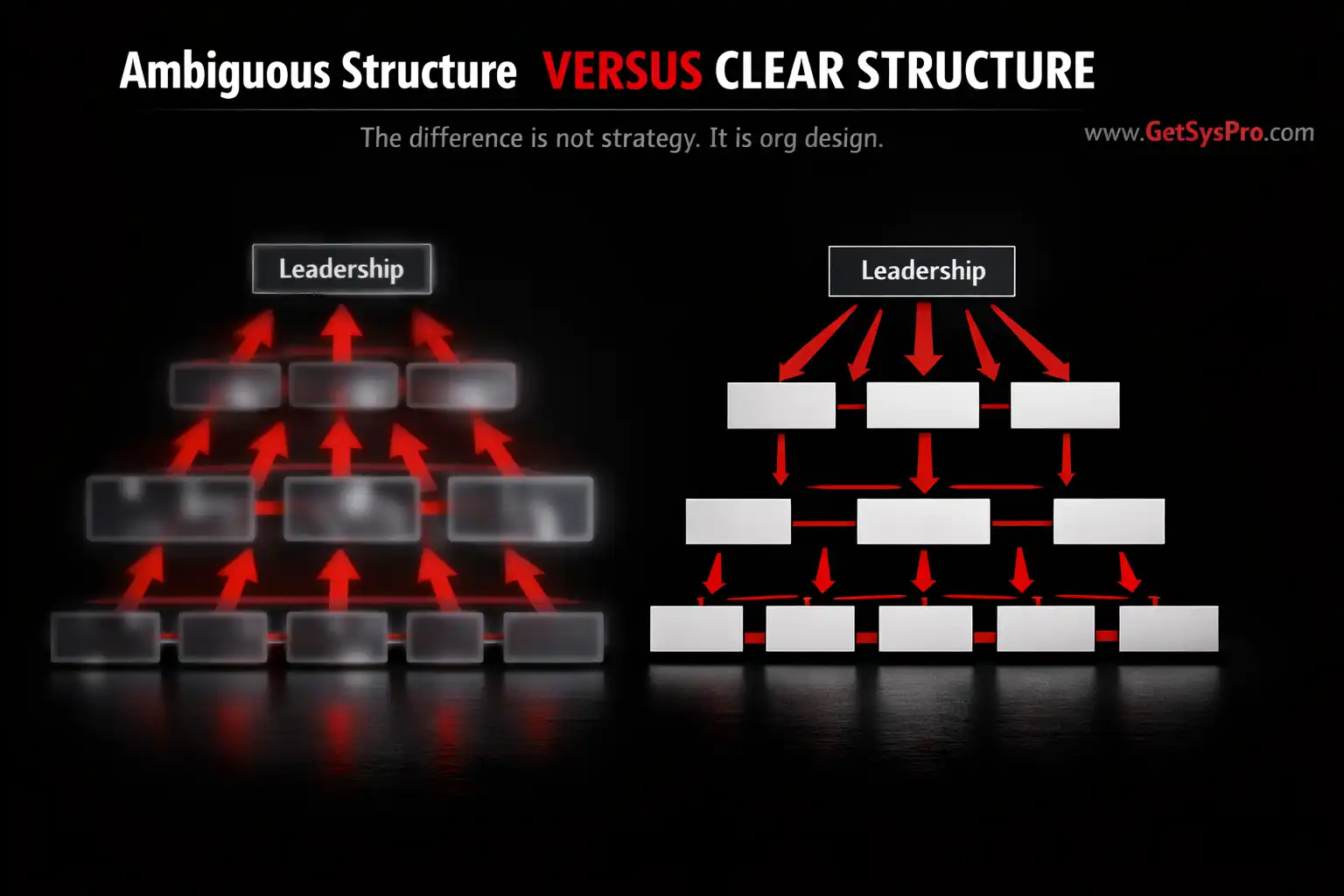
Ambiguous structure routes everything upward. Clear structure routes decisions where they belong. www.GetSysPro.com
Article Summary
Your org chart predicts your problems because structural ambiguity on paper produces escalation, duplication, and accountability gaps in practice. A functional org chart maps decision rights and accountability boundaries, not just names and titles. Overlapping responsibilities create coordination cost and margin drag that compound quietly. High performers need structural clarity to act decisively. Structure must evolve intentionally at each scale milestone rather than reactively after execution deteriorates. GetSysPro builds organizational structures that answer three questions clearly across every role: who reports to whom, who makes which decisions, and who owns measurable outcomes.
Your Org Chart Predicts Your Problems. Build One That Predicts Fewer.
GetSysPro builds organizational structures that distribute authority clearly, eliminate overlap, and scale with your business rather than constraining it.
Frequently Asked Questions
Beyond titles and reporting lines, what should an org chart actually define?
A functional org chart defines three things explicitly: reporting structure, decision rights, and accountability for measurable outcomes. Reporting structure establishes how information and accountability route upward. Decision rights specify who makes which decisions independently, who requires consultation before acting, and who needs approval before proceeding. Accountability for outcomes ties each role to specific results rather than just activities. Without all three elements, an org chart describes hierarchy but does not enable distributed execution.
Our team is small and everyone communicates informally. Is structural clarity premature?
Informal coordination works at small scale because the team size makes it manageable. The structural gaps it papers over do not disappear as the team grows. They become visible as execution problems: escalation loops, coordination friction, unclear ownership, and onboarding difficulty. Building structural clarity before growth reveals those gaps is always faster and less disruptive than building it after performance has deteriorated enough to force the issue. The right time for structural investment is one growth stage earlier than the point where the absence becomes painful.
Overlapping responsibilities seem minor day to day. At what point do they become a real problem?
Overlap becomes a real problem earlier than most organizations expect, typically around the point where volume requires the overlapping functions to interact frequently. Two roles with unclear boundaries at low interaction frequency produce occasional confusion. The same two roles at high interaction frequency produce consistent coordination overhead, duplicated work, and rework from misaligned standards. The threshold varies by function and volume, but the progression from minor to significant is predictable once interaction frequency crosses the point where informal clarification can no longer keep pace.
Internal conflict keeps surfacing between our teams. Could this be a structural issue rather than a cultural one?
Almost certainly. Internal conflict in growing organizations most commonly traces back to structural ambiguity rather than interpersonal friction. Two people competing over the same decision, two departments claiming ownership of the same outcome, or two managers giving conflicting direction on the same project all feel like personality conflicts but originate in undefined authority boundaries. Resolving the structural cause removes the conflict more reliably and more permanently than cultural interventions directed at the symptoms.
How often should an org chart be reviewed and updated as a business grows?
Structure review should connect to growth milestones rather than calendar intervals. Significant headcount additions, new service lines, new markets, and leadership transitions all create structural misalignment between the existing org chart and the actual workflow it governs. A review at each of those triggers addresses structural gaps while they are still early-stage and inexpensive to resolve. Organizations that review structure only in response to execution deterioration consistently pay more in remediation time and disruption than those that treat structural evolution as a proactive growth discipline.