 01/23/2024
Capacity determines growth limits more reliably than demand does. Until an organization addresses its structural ceiling, adding volume only increases strain.
Capacity determines growth limits, and the evidence is visible in nearly every organization that hits a growth plateau. Pipelines are healthy. Demand is real. The market opportunity is present. Yet performance stalls, deadlines slip, and leadership feels permanently stretched. The constraint is rarely external. It is structural capacity, and until that ceiling is raised, additional demand makes the problem worse rather than better.
This article defines what operational capacity actually encompasses, explains how capacity constraints manifest in growing organizations, and establishes the framework for increasing capacity through structure rather than effort.
In This Article
- Redefining Capacity Beyond Headcount
- Recognizing a Capacity Constraint Before It Becomes a Crisis
- Capacity Is a Design Problem, Not a Hustle Problem
- Hiring Without Structure Adds Cost Before It Adds Throughput
- Centralized Decision Making as a Growth Ceiling
- Auditing Capacity Before Committing to Expansion
- Financial Capacity Is Part of Growth Readiness
- Building Capacity With GetSysPro
- Frequently Asked Questions
Key Takeaways
- Capacity determines growth limits more reliably than demand does. A strong pipeline cannot overcome a structural ceiling that the organization is already pressing against.
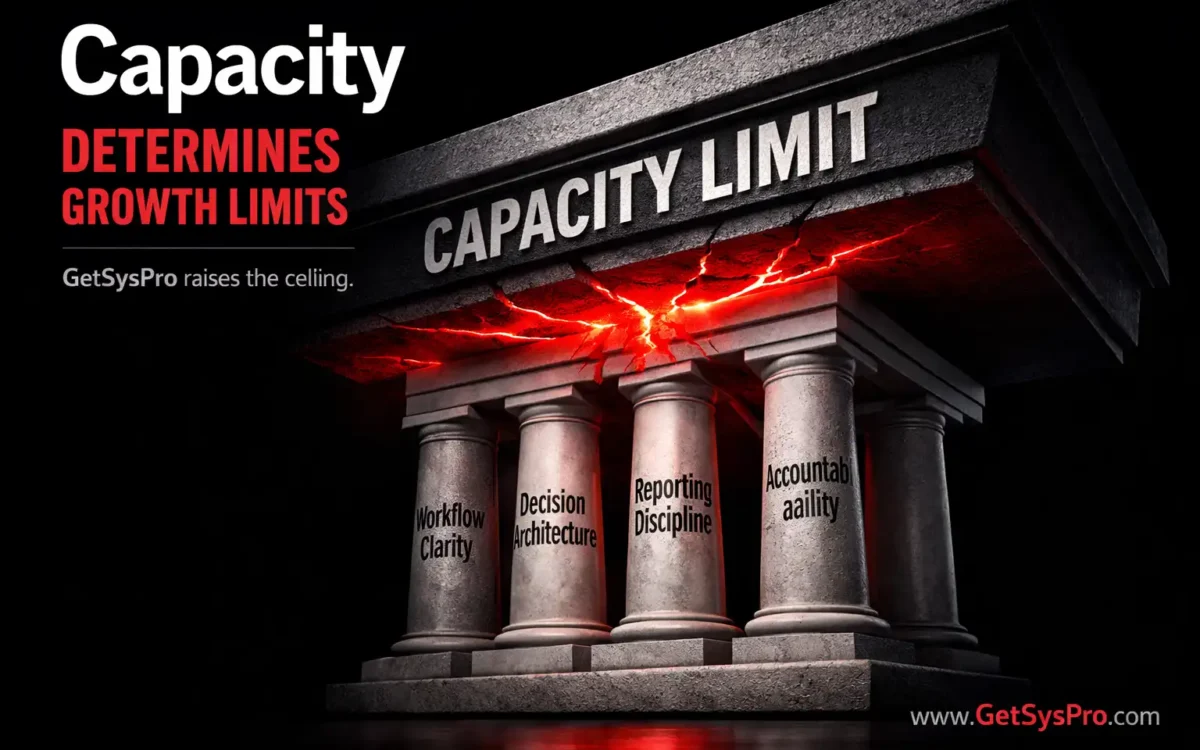
- Operational capacity encompasses workflow clarity, decision architecture, reporting discipline, and accountability structure, not headcount alone.
- Capacity constraints appear as execution strain: late deliverables, inconsistent handoffs, escalation loops, and leadership becoming the default problem solver for routine decisions.
- Hiring expands capability only when structure already exists to support it. New hires added to an unstructured system increase coordination overhead before they increase throughput.
- GetSysPro builds the organizational structure, process documentation, and reporting systems that raise operational capacity so growth compounds performance rather than amplifying fragility.
Redefining Capacity Beyond Headcount
The conventional understanding of capacity equates it with headcount. More people means more capacity. That equation is incomplete and often misleading. Headcount is one input into capacity, but it is not the primary determinant of how much work an organization can absorb without degrading quality, predictability, or margins.
Operational capacity is determined by how efficiently work moves through the business. Workflow clarity defines how tasks progress from initiation to completion without unnecessary friction. Decision architecture determines how quickly choices get made and by whom, without routing everything to senior leadership. Reporting discipline ensures that performance data is visible, accurate, and timely enough to inform decisions before problems escalate. Accountability structure defines who owns each outcome and is responsible for each process step.
Effort Versus Throughput: A Critical Distinction
Founders frequently confuse effort with throughput. When a team is working long hours and producing results, it appears that capacity is healthy. Burnout can look like momentum for an extended period. The distinction becomes apparent when demand increases. A team operating on effort rather than structure cannot absorb additional volume without quality degradation, because the system holding everything together is individual stamina rather than repeatable process.
Sustainable growth comes from increasing the amount of work the system can handle without increasing the chaos required to deliver it. That requires structural investment, not more hours. When structure is strong, teams absorb new volume predictably because workflows, ownership, and decision rights are already defined. When structure is weak, the same volume increase creates friction that expands in proportion to the growth.
“Capacity determines growth limits because structure determines capacity. Organizations that invest in operational infrastructure before demand peaks consistently outperform those that attempt to scale on effort alone.”
Editorial, GetSysPro Team
Recognizing a Capacity Constraint Before It Becomes a Crisis
Capacity limits rarely announce themselves as structural problems. Organizations experience them as operational symptoms: late deliverables, overloaded team members, inconsistent handoffs between functions, and leadership becoming the default escalation point for decisions that should be resolved within the team. The business remains active and often busy, but predictability erodes and the organization shifts into permanent reaction mode.
The diagnostic question is whether growth repeatedly creates operational strain. If every expansion initiative produces the same symptoms, including stretched teams, communication breakdowns, and leadership bandwidth consumption, that pattern is evidence that capacity design is lagging behind ambition. More demand applied to the same system will not resolve those symptoms. Additional volume applied to a constrained system exposes the constraint faster and at greater cost.
When Growth Slows, the Instinct Is Wrong
Organizations that assume a growth plateau requires stronger marketing or more aggressive sales are misdiagnosing the problem. In most cases, the internal system is already at its limit. Adding volume to an organization operating at maximum strain increases stress, reduces quality, and intensifies rework. The correct response to a growth plateau is a capacity assessment before an expansion push, not after the expansion push creates a crisis that forces the assessment anyway.
Capacity Is a Design Problem, Not a Hustle Problem
Structural improvements are the primary mechanism through which capacity grows. Streamlined workflows reduce rework and compress cycle time. Clear ownership reduces coordination overhead because team members act within defined authority rather than seeking approval for decisions they should own. Defined decision thresholds reduce escalation and eliminate the waiting that accumulates when every non-routine situation routes upward. Reporting discipline reduces operational surprises and improves planning accuracy.
Each of these improvements compounds. A reduction in rework frees hours that can be applied to new work. A reduction in escalation frees leadership bandwidth for strategic priorities. Better reporting accuracy improves decision quality, which reduces the corrective work that poor decisions generate. Structural capacity improvements do not add linear value. They create compounding returns as each improvement amplifies the effect of others.
Ownership Clarity as a Throughput Multiplier
One of the highest-leverage structural improvements any growing organization can make is defining ownership precisely. A practical framework for clarifying who owns, approves, consults on, and needs visibility into each major process is a responsibility assignment matrix. Defining those relationships explicitly removes the ambiguity that generates unnecessary coordination meetings, duplicated effort, and accountability gaps. When ownership is clear, work moves faster because team members act with confidence rather than seeking validation before each step.
Hiring Without Structure Adds Cost Before It Adds Throughput
Hiring is the most common organizational response to a capacity problem, and frequently the least effective one when structure does not precede it. New hires expand capability on paper immediately. Their contribution to actual throughput depends entirely on the structural environment they join.
Without defined roles, documented processes, and clear expectations, new hires increase coordination overhead before they increase output. Communication paths multiply as additional people join an undefined system. Decision points increase as new team members encounter situations that lack established protocols. Execution slows despite a larger payroll because the bottleneck is not personnel volume. The bottleneck is structural clarity.
Building the System Before Adding People to It
The goal is to build an organizational system where new hires increase throughput quickly because expectations, workflows, and standards already exist and can be transferred through structured onboarding rather than informal observation. When that foundation exists, each hire is an amplifier. When it does not, each hire is a coordination cost that requires significant time to recover before it generates net positive output.
Organizations that document their core processes before expanding headcount consistently achieve faster ramp times and more predictable delivery at scale. Those that hire first and document later spend significant management bandwidth on informal knowledge transfer that creates inconsistency rather than capability.
Is your organization’s capacity ready for the next growth stage?
GetSysPro conducts capacity audits that identify the structural constraints limiting throughput and build the systems that let growth compound performance rather than amplify fragility.
Centralized Decision Making as a Growth Ceiling
Centralized decision making is among the most common and most costly growth ceilings in scaling organizations. When decision rights remain concentrated at the top, teams wait for approvals that should be routine, projects stall at review stages that create no strategic value, and opportunities expire because the speed of organizational response cannot match the speed of the market.
The volume of decisions a leadership layer can process is finite. As an organization grows, the number of decisions that require processing grows faster than leadership bandwidth does. At a certain point, concentration of decision rights stops being a quality control mechanism and becomes a throughput constraint. Distributed decision frameworks increase organizational capacity without increasing chaos, provided that boundaries are explicitly defined and team members understand what they own.
Defining Decision Rights as a Capacity Investment
Distributing decision authority requires more than delegation intent. It requires structural definition: which decisions belong at which level, what information is required to make each class of decision, and what constitutes the boundary at which escalation becomes appropriate. Organizations that define these parameters explicitly create decision-making capacity throughout the structure. Those that delegate informally without structural definition often find that team members default to escalation anyway because the implied authority without explicit boundaries creates risk aversion rather than confident action.
Auditing Capacity Before Committing to Expansion
Sustainable growth requires a capacity assessment before major expansion initiatives, not after. The purpose of a capacity audit is to identify structural constraints that will surface under increased volume before that volume arrives and compounds the cost of discovery.
A rigorous capacity audit evaluates five dimensions. Workflow efficiency across departments reveals where cycle time is longer than necessary and where rework is consuming hours that should be applied to new work. Decision latency inside approval chains identifies where organizational speed is constrained by process design rather than by genuine complexity. Reporting visibility into operational metrics determines whether leadership has the information required to manage performance proactively. Margin stability under increased volume projects whether delivery economics hold as volume grows or whether cost structures contain hidden scalability problems. Team clarity around ownership identifies the ambiguity that will generate escalation and coordination overhead at scale.
Expansion Without Audit Is Guesswork
Organizations that expand without a prior capacity assessment are making growth bets on an untested structural foundation. Growth may produce positive results temporarily while quietly increasing operational fragility. The structural problems that were invisible at current volume become visible at higher volume, often at a cost and disruption level that significantly exceeds what proactive remediation would have required. A capacity audit before expansion is not a delay to growth. It is a prerequisite for growth that compounds rather than collapses.
Financial Capacity Is Part of Growth Readiness
Operational capacity discussions frequently omit the financial dimension, treating it as a separate domain. Financial capacity is an integral component of growth readiness, not an independent concern. Cash flow must support expansion without creating liquidity pressure that forces reactive decisions on timelines that do not align with strategic intent.
Revenue growth does not eliminate financial risk when forecasting is weak, billing is inconsistent, or expense management is loosely controlled. Organizations that grow revenue while maintaining poor financial operating discipline routinely find that cash position deteriorates even as top-line performance improves. Growth accelerates cash consumption before it stabilizes revenue, and that window of vulnerability widens when financial visibility is insufficient.
Rolling Forecasts as Operational Infrastructure
Rolling cash flow forecasts that extend ninety days provide leadership with the forward visibility needed to make deliberate decisions rather than reactive ones. Knowing in advance that a hiring expansion will create a liquidity gap allows proactive management of that gap through collections timing, payment term negotiation, or hiring sequencing. Discovering the gap when it arrives eliminates those options and forces more costly and disruptive responses. Financial forecasting is not a finance department activity. It is an operational infrastructure investment that belongs in the capacity framework of any organization preparing for sustained growth.
Building Capacity With GetSysPro
The organizations that scale sustainably share a common characteristic: they invest in structural capacity before demand requires it. Growth does not build structure. Structure enables growth. When the operational foundation is strong before volume increases, incremental growth compounds performance. When structure is fragile, the same incremental growth amplifies weakness until correction becomes unavoidable.
Which GetSysPro Services Address Capacity Constraints Directly
When growth is hitting a ceiling because ownership and reporting lines are unclear and escalation is consuming leadership bandwidth, GetSysPro Organizational Chart Development defines responsibilities, clarifies decision rights, and removes the structural ambiguity that generates coordination overhead at scale.
When capacity is constrained by inconsistency, rework, and tribal knowledge that cannot be transferred reliably to new team members, GetSysPro Process and SOP Architecture documents core workflows and standardizes execution so throughput increases with each hire rather than degrading under coordination load.
For organizations that want a comprehensive assessment of where capacity constraints exist before committing to an expansion initiative, the GetSysPro Business Operational Systems Audit maps the full operational picture and sequences improvements by impact priority so the highest-leverage structural investments happen first.
Capacity determines growth limits. The fastest path to sustainable scale is raising that ceiling through structural investment before demand forces the issue at greater cost and disruption.
Related GetSysPro Services
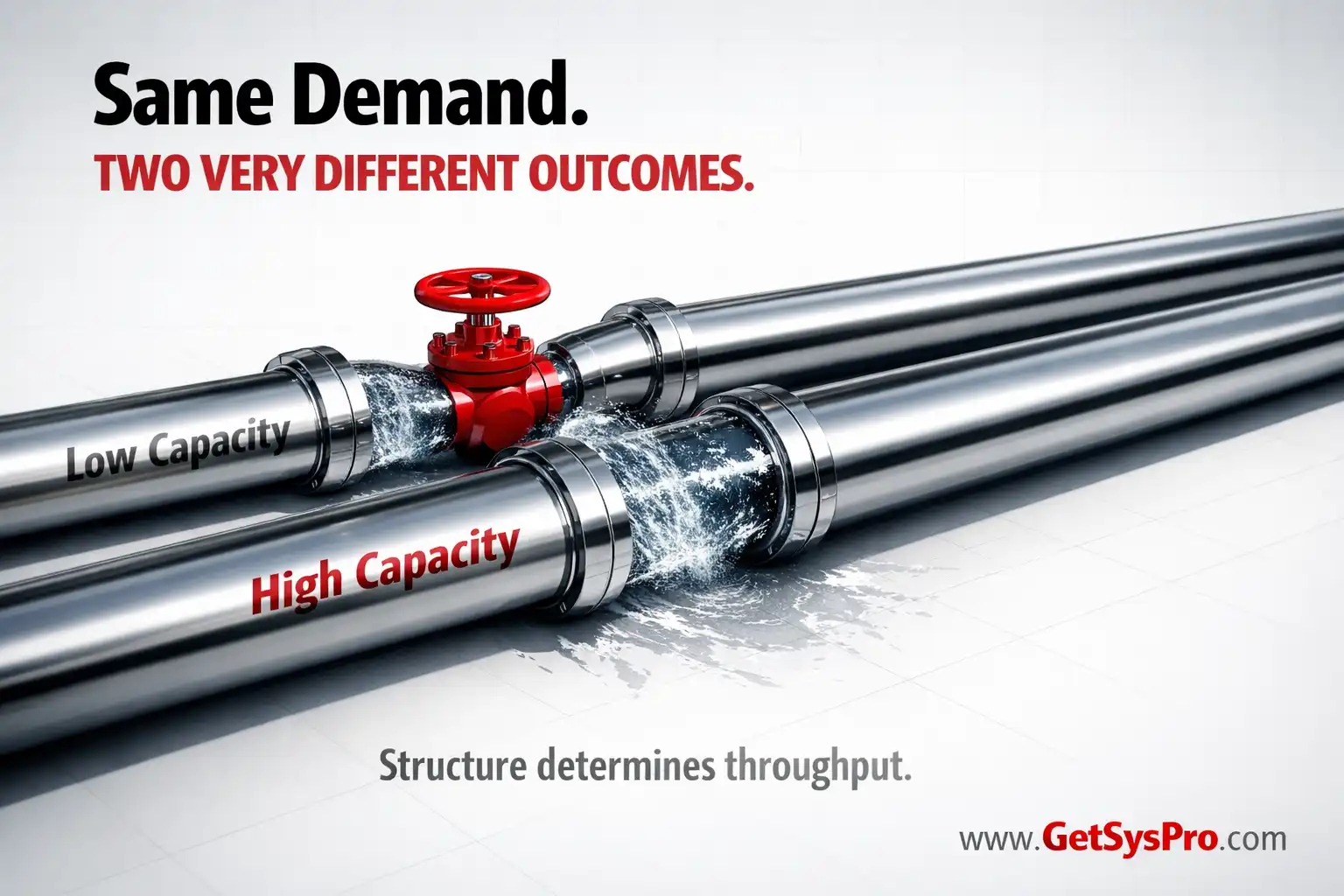
Same demand. Two different structures. One flows and one bottlenecks. GetSysPro builds the one that flows. www.GetSysPro.com
Article Summary
Capacity determines growth limits more reliably than demand does, and operational capacity encompasses far more than headcount. Workflow clarity, decision architecture, reporting discipline, and accountability structure are the structural elements that determine how much work an organization can absorb without degrading quality or margins. Capacity constraints appear as execution strain before they appear as revenue problems. Addressing them through structural investment before demand forces the issue is always faster, less costly, and less disruptive than rebuilding under growth pressure. GetSysPro builds the organizational foundation that raises capacity so growth compounds performance rather than amplifying fragility.
Capacity Determines Growth Limits. Raise the Ceiling Before Demand Tests It.
GetSysPro builds the structural capacity that lets your organization absorb growth without breaking under the volume.
Frequently Asked Questions
Beyond headcount, what does operational capacity actually include?
Operational capacity encompasses four structural elements: workflow clarity, decision architecture, reporting discipline, and accountability structure. Workflow clarity determines how efficiently work moves from initiation to completion. Decision architecture defines who makes which decisions and at what threshold escalation is appropriate. Reporting discipline ensures performance data is accurate and timely enough to inform decisions before problems escalate. Accountability structure defines who owns each outcome and process step. When all four are strong, the organization absorbs new volume predictably.
Our growth has plateaued but demand seems healthy. Could this be a capacity problem?
Almost certainly. When pipelines are healthy but performance plateaus, execution strain is the most common underlying cause. Late deliverables, inconsistent handoffs, teams operating in reaction mode, and leadership becoming the default escalation point are diagnostic indicators that the structural ceiling has been reached. Adding sales or marketing volume to a system already at its capacity limit accelerates the deterioration rather than resolving it. A capacity audit before the next expansion push is the correct response.
Hiring seems like the fastest fix when the team is overwhelmed. When does it actually help?
Hiring accelerates capacity only when structure precedes it. New team members added to an organization with defined roles, documented processes, and clear onboarding standards become net contributors quickly because the knowledge transfer is structured rather than informal. Without that foundation, each hire increases coordination overhead and extends the period before they contribute positively to throughput. The rule is simple: build the system first, then add people to it.
Distributed decision making sounds risky. How do you prevent it from creating chaos?
Distributing decision authority without structural definition does create chaos. The prerequisite is explicit definition of decision rights: which decisions belong at which organizational level, what information is required to make each class of decision, and what constitutes the appropriate escalation threshold. When those parameters are defined clearly, team members act with confidence within their authority. Without that explicit structure, delegation intent does not translate to distributed capacity because risk aversion drives default escalation regardless of intent.
At what point should a growing business conduct a capacity audit?
Before any major expansion initiative, not after. The value of a capacity audit is identifying structural constraints before increased volume compounds their cost. Conducting an audit after an expansion has already created operational strain means the assessment happens under pressure, with less time and more disruption than proactive remediation would have required. Organizations that audit capacity before expansion consistently experience more predictable growth trajectories than those that discover constraints reactively.