

Startup Turnkey Property Provider
Project Overview
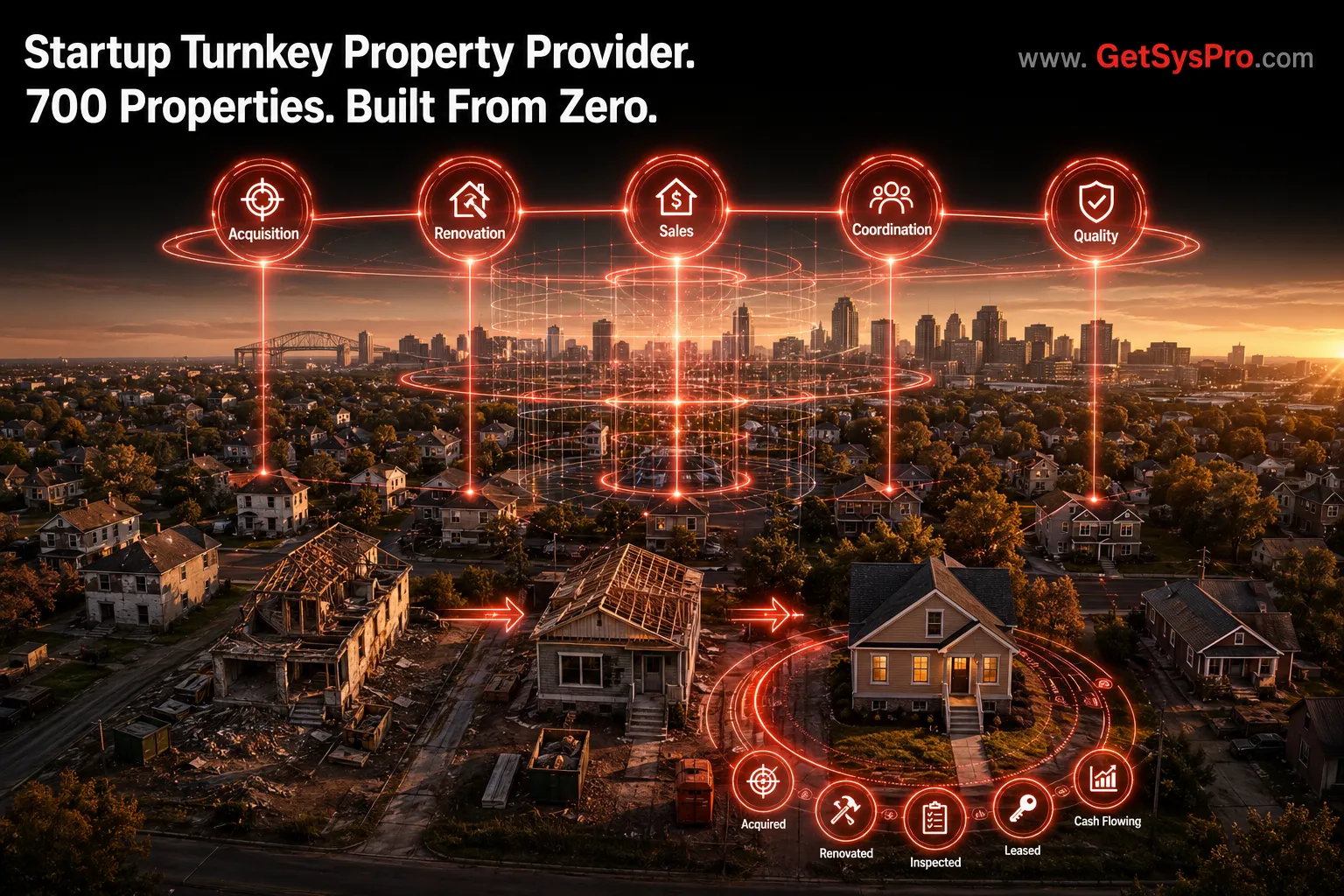
Zero employees. No systems. Zero operational infrastructure. That was the state of this Memphis turnkey real estate investment company when the engagement began.
The business model was clear: acquire residential properties, renovate them to investment standards, and deliver stabilized rental assets to investors purchasing remotely. The operational requirements behind that model were not simple. Multiple systems had to function simultaneously before a single property could be sold. None of them existed.
Tomo Oblak joined the organization as Chief Operating Officer and built the complete operational foundation from scratch. Acquisition pipelines. Renovation management systems. Investor sales processes. Vendor networks. Transaction coordination. Team structure. Internal documentation. Everything was designed, implemented, and operationalized inside the company.
Over approximately two years, the company scaled from a startup with nothing operational in place into one of the most active turnkey providers in the Memphis market. More than 700 renovated single-family homes delivered to investors. That result did not come from hustle. It came from infrastructure.
Project Snapshot
The following snapshot summarizes the key characteristics and operational scope of the organization during the project. It highlights the market environment, growth stage, and operational systems that supported the company’s development.
Industry
Market
Organization Stage
Systems/Infrastructure Implemented
Leadership/Management Services
Main Growth Differentiators
Organizational Background
The company was built to serve real estate investors seeking turnkey rental properties in the Memphis market. The model involves acquiring properties, renovating them to investment standards, and delivering them as stabilized rental assets. Simple to describe. Operationally demanding to execute.
Most buyers operated outside the local market. They could not inspect renovation quality, attend closings, or verify property condition before funds cleared. They relied entirely on the operator’s systems to deliver what they paid for. When those systems do not exist, investor confidence does not survive the first problem. Operational consistency was not a preference. It was the product.
At launch, none of that infrastructure existed. No teams. No systems. No documented procedures. No acquisition pipeline. No renovation management process. No investor sales workflow. No defined vendor relationships. The company needed every one of those things before it could function, and it needed them built in the right order.
A separate sister property management company was later established to manage properties post-sale, creating a vertically integrated platform that served investors from acquisition through ongoing operations.
Operational Challenges
Building a turnkey real estate investment company is not a linear problem. Acquisition, renovation management, investor sales, and transaction coordination do not run in sequence. They run at the same time. Every system has to be operational before the first deal closes, which means every system has to be built before the first deal is in the pipeline.
The specific challenges at launch included:
- Building a complete operational structure with no existing foundation to build from
- Creating acquisition pipelines capable of sourcing consistent deal flow at volume
- Managing renovation projects across a vendor network that did not yet exist
- Establishing investor acquisition and sales systems from scratch
- Designing inspection and due diligence workflows for remote buyers
- Managing transaction timelines across multiple simultaneous closings
- Setting and enforcing internal quality standards for renovated properties
- Building a reliable contractor and vendor network capable of handling volume
- Maintaining full operational transparency for investors who could never be on-site
Remote investors have one point of leverage: they can stop buying. Operational consistency and clear communication were the only things that kept them buying. Both required systems. Neither happened by accident.
Strategic Approach
Infrastructure first. Growth follows the systems. That was the operating principle from day one.
The strategy was not to generate transactions and build systems around the chaos. The strategy was to build the systems before the transactions demanded them. Every operational constraint that could slow the business down was identified at the design stage and addressed before it became a live problem.
Tomo Oblak designed the full operational architecture and drove the implementation personally. The work covered:
- A structured acquisition pipeline drawing from wholesalers, auctions, MLS, and internal sourcing operations
- Renovation management systems designed to handle dozens of active projects simultaneously
- An investor CRM that tracked leads, deal timelines, and pipeline status across a growing buyer base
- Standardized workflows for inspections, due diligence, and transaction coordination
- A vendor and contractor network built to support renovation volume at scale
- Standardized property evaluation and inspection procedures applied consistently before any listing
- Investor onboarding and sales processes that did not require Tomo to be the bottleneck
- SOP documentation and a defined team structure built before hiring began
The result was an organization that could scale transaction volume without losing operational control. That outcome requires the systems to be in place before the volume arrives. Not after.
Implementation Process
The build followed a sequenced implementation process: operational architecture first, technology and process systems second, team and vendor infrastructure third. Each layer was designed to support the one that followed.
Operational Architecture
Before any hiring or technology deployment, the operational framework of the company was designed and documented. Departmental responsibilities were defined. Leadership roles were established. Workflows for acquisition, renovation, and investor sales were mapped and sequenced. Structure came before headcount.
Technology Implementation
Four platforms were deployed to give the company operational visibility across all functions.
InvestorFuse:
Primary CRM for investor relationship management and deal pipeline tracking.
Asana:
Project management and internal operational coordination across all departments.
Slack:
Internal communication platform for team collaboration and real-time coordination.
QuickBooks:
Accounting, financial reporting, and expense tracking.
Together, these systems gave leadership full visibility across acquisition, renovation, and transaction activity without requiring manual status checks.
Process Documentation
Standard operating procedures were written for every core function: acquisition analysis, renovation management, investor sales, and transaction coordination. Documented workflows removed the dependency on individual knowledge and ensured that every property met consistent standards before it was listed. Processes were documented before team members were hired to follow them.
Team Development
The team grew from zero to approximately twenty employees. Every role was defined before it was posted. Hiring focused on acquisitions, construction coordination, transaction management, and investor relations. Training was built around the documented workflows, not around watching someone else do the job.
Vendor Network Development
A contractor and service provider network was built from the ground up to support renovation volume at scale. At peak operations, more than 120 vendors and contractors were active across renovation and repair activity. Network development was treated as an operational requirement, not a nice-to-have. Without it, renovation capacity would have capped the entire business.
Operational Systems Implemented
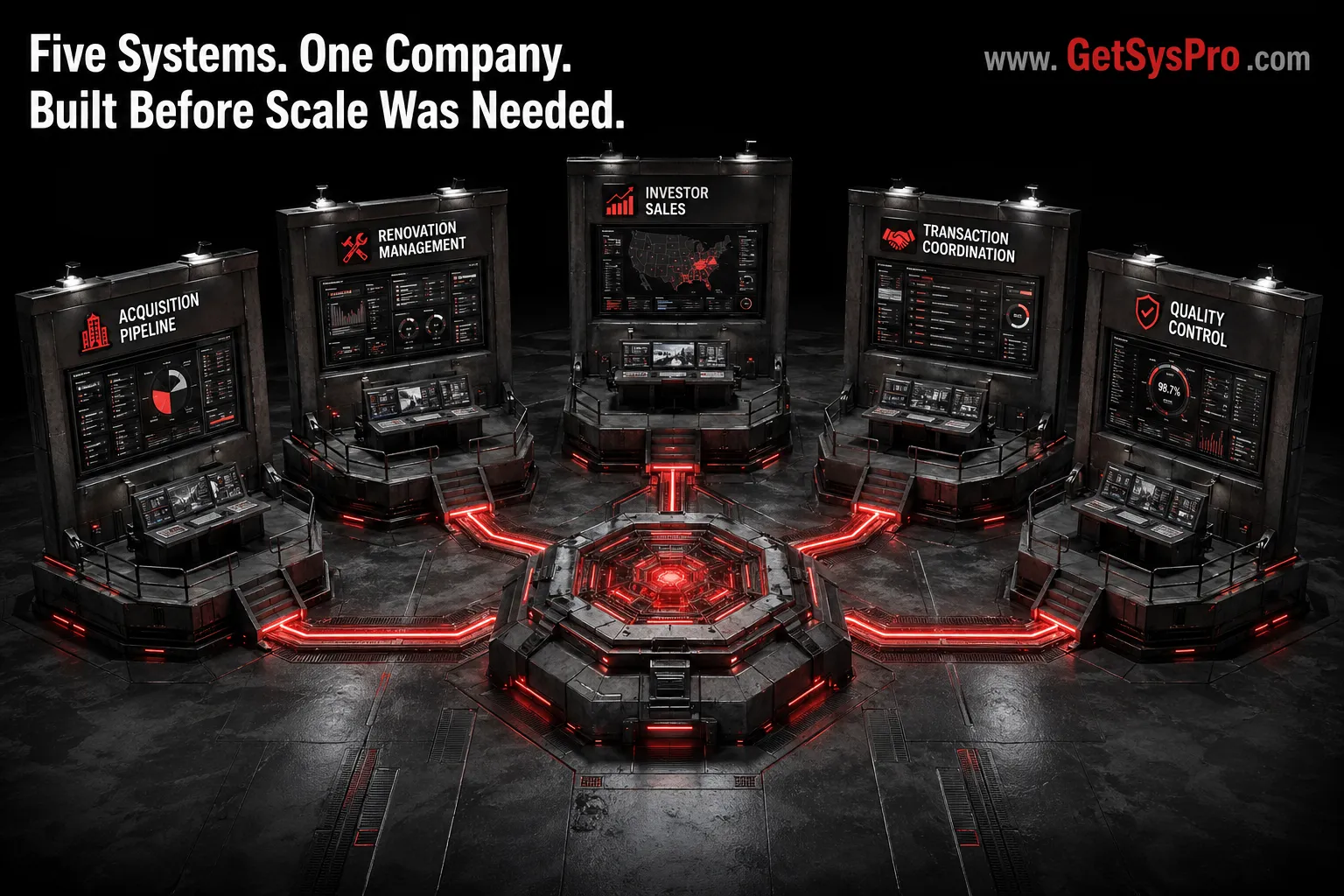
Five core operational systems were built and running before the company attempted to scale transaction volume. Each system handled a distinct function. Together, they made the business operable.
Property Acquisition Pipeline
Deal flow was sourced from multiple channels simultaneously: wholesalers, auctions, MLS opportunities, and a dedicated internal acquisitions operation. Multi-channel sourcing removed single-point dependency and kept the pipeline active even when one channel dried up.
Renovation Management
The company managed the complete renovation process for every acquired property. Renovation work was executed through a hybrid contractor model with internal oversight maintained throughout. No property was listed for sale until it had passed internal standards review. The contractor network handled volume. Internal oversight held the standard.
Inspection and Quality Control
A two-layer inspection process was designed specifically for a remote investor base. Every property underwent a third-party licensed home inspection as part of the investor due diligence package. Internal inspections verified renovation scope completion and property readiness before any listing was made. Remote investors could not be on-site. The system was built to replace that presence.
Investor Sales Systems
Investor acquisition and sales were managed through a structured CRM pipeline that tracked leads, property availability, and transaction status in real time. The buyer base included both domestic and international investors, with the majority being domestic operators purchasing remotely. The pipeline handled volume without requiring manual coordination at every step.
Transaction Coordination
Transaction coordination covered inspections, repair resolution, documentation, and closing facilitation. Every transaction followed a defined process from contract to close. After closing, a formal handoff to the affiliated property management company completed the investor experience. Nothing was left to be figured out at the last step.
Results and Operational Impact
More than 700 turnkey investment properties sold. Zero employees to twenty. A contractor network of 120+. Operations across two markets. All of it built in approximately two years from a starting point of nothing.
The full list of outcomes:
- More than 700 turnkey investment properties sold to domestic and international investors
- Organizational growth from zero to approximately twenty employees across all functions
- Structured acquisition and renovation pipeline running at consistent transaction volume
- Vendor and contractor network exceeding 120 active relationships at peak operations
- Full CRM, project management, and financial system implementation operational across the company
- Active operations expanded across Memphis and North Mississippi markets
- Vertically integrated investor ecosystem through the integration of a sister property management company
The operational infrastructure built during the startup phase was the reason the volume was possible. Companies that skip the infrastructure phase and try to close deals first consistently hit a ceiling that more deal flow cannot fix. This company did not hit that ceiling because the ceiling was removed before it could form.
Lessons from the Project
This project is a case study in why operational infrastructure must be built before growth, not in response to it. The specific lessons are not complicated. They are consistently ignored.
- Turnkey investment businesses require acquisition pipelines that are built and tested before deal volume is needed
- Renovation management systems must be designed from the start to handle multiple simultaneous projects without breaking
- Vendor network development is a prerequisite for scaling construction volume. It is not a byproduct of it.
- Investor communication and transaction coordination must be systematized before high-volume operations begin
- Operational systems implemented early determine how far the company can scale. Systems retrofitted under pressure limit it.
Every company that waits to build operational infrastructure until growth demands it will hit the same outcome: bottlenecks that slow the business, investor confidence that erodes, and founders who become the only system that works. That is a solvable problem. But it is much cheaper to solve it before it becomes the problem than after.
Representative Project Summary
This project demonstrates what full-scope operational development looks like inside a real estate investment business. The company started with nothing. The engagement covered everything: structure, systems, technology, processes, team, and vendor infrastructure.
The operational architecture installed during the early stage of the company made consistent transaction volume possible at scale. Disciplined execution against a clear operational design produced a company that became one of the most active turnkey providers in the Memphis market.
That outcome was not an accident and it was not the result of market conditions. It was the result of building the infrastructure before the business needed to depend on it.
Conclusion
Real estate investment businesses that try to scale without operational infrastructure do not fail because the market fails them. They fail because they run out of systems before they run out of opportunity. Acquisition dries up because the pipeline was never built. Renovations stall because management was never systematized. Investors stop buying because communication and quality consistency were never enforced.
GetSysPro does not coach businesses through these problems. The work is operational. Systems are designed, implemented, and enforced inside the company. Processes are documented and made executable. Teams are structured and accountable. The result is a business that runs on infrastructure, not on the founder’s availability.
If your real estate operation is experiencing the same friction this company had at launch, the starting point is a Business Systems Audit. It identifies exactly where the gaps are before they compound.
Business Systems Audit:
Business Operational Systems Audit 🆔
Book a Discovery Call:
Book a Call with Tomo