05/22/2025
Capital follows structure, not just vision. Investors look for operational maturity as evidence that growth is repeatable under scrutiny.
A strong pitch deck opens the door. Operational maturity is what keeps it open through diligence. Sophisticated investors know that projections are a founder’s best case, not a validated forecast. What they are actually evaluating during diligence is whether the operating system behind the numbers is capable of delivering on those projections under real conditions, with real stress, and with real accountability. A weak operating system under a strong narrative is one of the most common reasons diligence friction rises fast and term sheets slow down.
In This Article
- What Operational Maturity Actually Means to an Investor
- What Investors Ask During Diligence
- Decision Architecture: The Fastest Scalability Signal
- Reporting Cadence: Evidence That Leaders Use Numbers to Run the Business
- Documentation: The Quiet Differentiator in Diligence
- How to Build Operational Maturity Before a Raise
- How GetSysPro Builds the Operating System Behind the Deck
- Frequently Asked Questions
Key Takeaways
- Investors look for operational maturity because it signals repeatable execution under stress. A strong narrative without a strong operating system produces diligence friction, not a term sheet.
- During diligence, sophisticated investors ask system questions, not just deck questions. They want to know whether performance is governed by cadence, decision rights, and documentation, or by founder memory and personal attention.
- Decision architecture is the fastest scalability signal. If the founder is central to every approval, growth is constrained by bandwidth. Investors want authority boundaries that are defined, documented, and consistently followed.
- Reporting cadence is evidence that leaders use numbers to run the business rather than report them. Weekly KPI review that drives decisions and monthly variance analysis that explains what changed are both signals of operational maturity.
- Documentation is a quiet diligence differentiator. Partnership terms, vendor standards, and internal approval policies that match current operating reality reduce investor risk perception and accelerate the close.
What Operational Maturity Actually Means to an Investor
Operational maturity, from an investor’s perspective, is the evidence that an organization can execute its plan without depending on any single individual’s continuous involvement to hold it together. It is not about size or headcount or the sophistication of the technology stack. It concerns whether the systems, decision structures, and accountability mechanisms that govern execution run on documented, repeatable, and measurable standards.
The COSO internal control framework offers a useful external lens: mature organizations manage risk through defined control activities, information and communication systems, and structured monitoring. Translated to early-stage and growth-stage business diligence, that means the investor is looking for evidence that the business has moved beyond founder-dependent execution into organizational execution, where the system produces the output rather than the individual.
Why Operational Maturity Matters More Than Projections
Projections represent a founder’s best case with the most favorable assumptions. Every investor knows this. What they cannot assess from a deck alone is whether the operating system underneath those projections is capable of producing them. Operational maturity serves as the proxy for that capability. A business with strong operational maturity and modest projections often earns more favorable diligence outcomes than a business with aggressive projections and weak operational infrastructure. The former signals execution confidence. The latter signals execution risk, regardless of how compelling the market opportunity looks.
What Investors Ask During Diligence
Sophisticated investors rarely limit diligence to deck questions. They ask system questions designed to reveal whether performance is repeatable or founder-dependent. The pattern of those questions is consistent across investor types and deal stages.
How often are KPI results and financial variance reviewed, and who owns the corrective actions when performance departs from plan? Who approves spending above a defined threshold, and is that threshold documented somewhere the team can reference without asking leadership? How are responsibilities distributed across departments, and where do routine decisions escalate? What documentation governs partnerships, vendor standards, and operational exceptions?
What the Answers Reveal
When answers to those questions depend on founder memory or founder attention, risk perception rises. The investor hears: this business runs because of this person, not because of this system. When answers point to cadence, dashboards, decision rights frameworks, and documentation, operational maturity becomes visible and verifiable. The investor hears: this business runs because it is built to run, and that is what capital needs to hear before it commits.
“Investors do not simply fund growth. They fund execution confidence, and operational maturity is the evidence that execution confidence is warranted.”
Editorial, GetSysPro Team
Decision Architecture: The Fastest Scalability Signal
Decision architecture is one of the fastest ways investors assess scalability during diligence. If the founder is central to every approval, the business is not scalable in its current form. The founder’s bandwidth constrains growth, and bandwidth does not scale with revenue. Every additional hire, client, and market adds to the volume of decisions without adding the structural capacity to process them, which means the constraint compounds rather than resolves as the business grows.
Investors look for operational maturity in whether authority boundaries exist in writing and get consistently followed. Can managers approve routine vendor decisions without checking with leadership? Do team members know what they can decide, within what limits, and what requires escalation? Are those boundaries written down in a form the team can reference, or do they exist only in the founder’s head?
Dependent Versus Scalable
Investors draw one core distinction: dependent versus scalable. A dependent organization requires “checking with leadership” for decisions that an established authority framework would resolve at a lower level. A scalable organization distributes decision-making authority to the level where the most relevant context exists, with escalation reserved for decisions that genuinely require senior judgment. That distinction determines whether the investor sees a business that will scale with capital or a business that will bottleneck under it.
Reporting Cadence: Evidence That Leaders Use Numbers to Run the Business
Investors do not want numbers. They want evidence that leaders use numbers consistently to run the business. The difference is significant. A business that produces financial statements monthly has numbers. A business that reviews KPI performance weekly, identifies variance from plan, assigns corrective ownership, and tracks resolution has evidence of operational maturity in its reporting cadence.
Weekly KPI review drives decisions rather than providing updates. When the review surfaces a performance gap, the question is not what happened. It is who owns the correction and by when. Monthly variance review explains what changed and what action follows rather than simply reporting what the numbers were. Forecasting discipline projects forward rather than managing by bank balance, giving leadership visibility into where cash and performance are heading before they arrive.
Metrics as Decoration Versus Metrics as Control
Without cadence, metrics are decorative. They exist but do not govern execution. With cadence, metrics become a control mechanism: the organizational commitment to know what is happening, act on what the data requires, and hold the team accountable to the plan. Any experienced investor identifies that distinction within the first hour of operational diligence, and it often determines whether the conversation moves toward a term sheet or toward a revised valuation with protective provisions that compensate for the identified execution risk.
Heading into a raise? The operating system behind the deck matters more than you think.
GetSysPro installs the decision architecture, reporting cadence, and documentation infrastructure that signals operational maturity to investors before diligence begins.
Documentation: The Quiet Differentiator in Diligence
Documentation is a quiet diligence differentiator because its presence is rarely celebrated but its absence is immediately noticed. When investors ask about partnership terms and the answer is a verbal description rather than a current signed document, risk perception rises. When vendor standards are described as “generally consistent” rather than defined in writing, enforceability questions follow. Internal approval policies that exist in practice but not in documentation leave the investor unable to verify consistency or resilience through key personnel changes.
The documentation investors assess during diligence covers three primary categories. Partnership terms need to match current operational reality, not the terms from two years ago that no one has revisited. Vendor standards need to be consistent, enforceable, and reviewable rather than maintained through individual relationships that do not survive turnover. Internal policies need to define thresholds, approval chains, and exception handling in writing so that governance is explicit rather than assumed.
What Strong Documentation Communicates
Current, comprehensive, and internally consistent documentation communicates operational maturity without requiring the founder to explain it. The investor can verify that authority has been defined, that agreements remain enforceable, and that the organization operates on written rather than tribal standards. That verification reduces the due diligence risk premium investors build into their terms, which directly affects valuation and deal structure. Strong documentation does not just satisfy investor checklists. It changes the economics of the deal.
How to Build Operational Maturity Before a Raise
The most common mistake founders make in fundraising preparation is spending the available time refining the deck rather than strengthening the operating system the deck describes. A well-constructed deck accelerates the first meeting. Operational maturity determines what happens in the second and third. Investors who like the narrative will spend diligence looking for reasons the narrative is credible, and operational maturity is where that credibility either holds or cracks.
Building operational maturity before a raise requires no full business rebuild. It requires identifying the specific gaps that investor diligence will expose and closing them before scrutiny arrives. Decision rights that exist only informally require documentation. Inconsistent reporting cadences require structure and assigned ownership. Agreements and vendor standards that no longer reflect current reality require updating. Those are structural corrections with defined scope and predictable timelines, not multi-month transformation programs.
The Biggest Upgrade Before a Raise May Not Be the Deck
The operating system that makes the deck believable is often the more valuable investment. A deck without operational maturity behind it generates interest and then diligence friction. A deck with operational maturity behind it generates interest and then diligence confirmation. The difference between those two outcomes is not the quality of the narrative. It is the quality of the execution evidence that narrative rests on.
How GetSysPro Builds the Operating System Behind the Deck
Fractional COO Leadership Services install the cadence, KPI ownership, and operational discipline that signal institutional readiness to investors. The engagement builds the decision architecture, reporting infrastructure, and accountability structures that convert founder-dependent execution into organizational execution.
Business Operational Systems Audit identifies where reporting integrity, decision rights, and workflows will face the most scrutiny during diligence. The audit surfaces structural gaps before investors find them, giving the business time to correct architecture rather than explain deficiencies under capital pressure.
Specialized Documents Creation
formalizes the partnership terms, vendor standards, and internal policies that investors evaluate for enforceability and clarity during diligence. When documentation is current, comprehensive, and internally consistent, it reduces investor risk perception and changes the economics of the deal.
Related GetSysPro Services
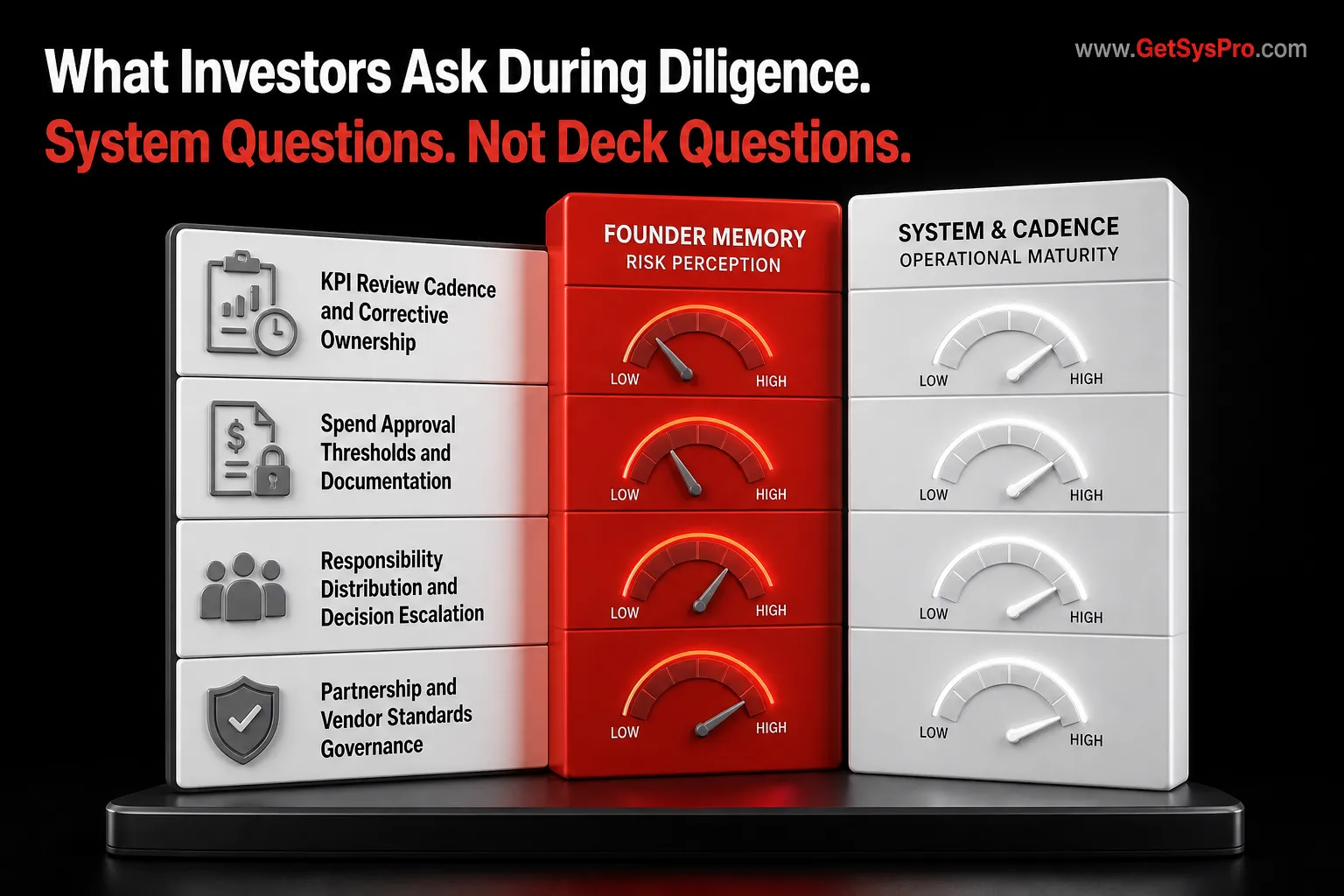
When answers to diligence questions depend on founder memory, risk perception rises. When answers point to cadence, decision rights, and documentation, operational maturity becomes visible. www.GetSysPro.com
Article Summary
Investors look for operational maturity because it signals repeatable execution under stress. Capital follows structure, not just vision. During diligence, sophisticated investors ask system questions: who owns corrective actions, who approves spending, how decisions escalate, what documentation governs exceptions. Decision architecture is the fastest scalability signal. Reporting cadence is the evidence that leaders use numbers to run the business. Documentation is the quiet differentiator that reduces investor risk perception and changes deal economics. The biggest upgrade before a raise may not be the deck. It may be the operating system that makes the deck believable. Investors do not simply fund growth. They fund execution confidence.
Investors Fund Execution Confidence. Build It Before Diligence Begins.
GetSysPro builds the decision architecture, reporting cadence, and documentation infrastructure that signals operational maturity before capital scrutiny arrives.
Frequently Asked Questions
What do investors mean by operational maturity?
Operational maturity is the evidence that an organization executes its plan without depending on any single individual’s continuous involvement. It means the systems, decision structures, and accountability mechanisms governing execution run on documented, repeatable, and measurable standards. From an investor’s perspective, operational maturity is the proxy for execution confidence: the signal that the business will deliver on its projections because it is built to, not because one person holds it together through personal attention and tribal knowledge.
What questions do investors ask to assess operational maturity during diligence?
Sophisticated investors ask system questions rather than deck questions. Who reviews KPI results and financial variance, and who owns corrective actions? Who approves spending above a defined threshold, and is that threshold documented? How are responsibilities distributed, and where do routine decisions escalate? What documentation governs partnerships, vendor standards, and exceptions? When answers point to cadence, decision rights frameworks, and documentation, operational maturity becomes visible. When answers depend on founder memory, risk perception rises.
Why is decision architecture important to investors evaluating scalability?
Decision architecture determines whether a business scales or bottlenecks under capital. When the founder stands at the center of every approval, founder bandwidth constrains growth. Investors look for authority boundaries that exist in writing and get consistently applied. A scalable organization distributes decision-making to where the most relevant context exists. That distribution gives capital what it needs before committing to a growth plan.
How does reporting cadence signal operational maturity to investors?
Reporting cadence signals operational maturity by demonstrating that leaders use numbers to run the business rather than report them. A business that reviews KPI performance weekly, identifies variance from plan, assigns corrective ownership, and tracks resolution has evidence of operational maturity in its cadence. A business that produces financial statements monthly has numbers but not necessarily control. Investors identify the difference within the first hour of operational diligence, and that distinction often determines whether the deal moves toward a term sheet or toward a revised valuation with protective provisions.
What documentation do investors review during diligence and why does it matter?
Investors review partnership terms, vendor standards, and internal approval policies during diligence. Partnership terms must match current operational reality rather than agreements from two years ago that no longer reflect how the business runs. Vendor standards must be consistent, enforceable, and reviewable. Internal policies must define thresholds, approval chains, and exception handling in writing so governance is explicit rather than assumed. Current, comprehensive, and internally consistent documentation reduces investor risk perception and directly affects valuation and deal structure. Strong documentation changes the economics of the deal.