 04/24/2025
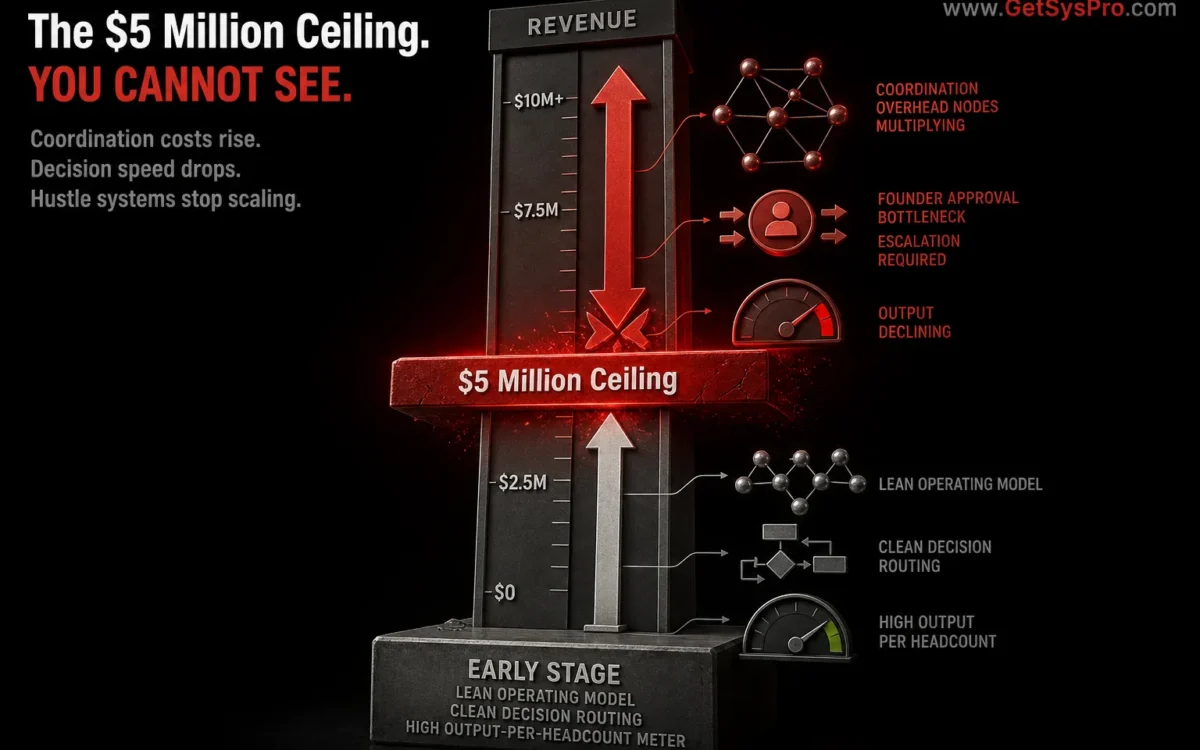
Around $3M to $7M, companies hit an invisible constraint: coordination costs rise, decision speed drops, and hustle stops scaling.
This is not market failure. It is an operating model ceiling. The $5 million ceiling is the point where the responsiveness model that produced early growth starts working against the business. Nothing catastrophic happens at first. Revenue may still rise. Internally, everything feels heavier. The friction accumulates across every function simultaneously rather than concentrating in any single visible failure that would prompt immediate structural investigation.
In This Article
- The Ceiling Shows Up as Heaviness, Not Collapse
- Why $5M Breaks Improvisation
- The Number One Bottleneck: Centralized Decision Control
- The Hidden Leak: Undocumented Workflow
- The Financial Drift Problem
- How Complexity Compounds at Mid-Seven Figures
- How GetSysPro Breaks the $5 Million Ceiling
- Frequently Asked Questions
Key Takeaways
- The $5 million ceiling is not a market problem. It is an operating model ceiling that appears when the responsiveness model that produced early growth becomes a structural constraint at mid-seven-figure scale.
- The ceiling shows up as heaviness rather than collapse. Leaders feel busier but less strategic. Meetings multiply without proportional outcomes. Hiring increases but productivity per employee declines. Reporting fragments and departments interpret priorities differently.
- Scale multiplies the cost of ambiguity. Centralized decisions create bottlenecks. Informal approvals create inconsistency. Tribal knowledge creates repeat mistakes. Coordination overhead rises faster than output.
- The primary bottleneck at this stage is that founders remain approval hubs. Even strong managers escalate decisions because authority boundaries are unclear. Breaking the ceiling requires calibrated decision rights.
- You cannot break a mid-stage ceiling with more marketing. The operating system must be able to translate demand into repeatable delivery and predictable profitability. Breaking through requires architectural redesign, not motivational reinvention.
The Ceiling Shows Up as Heaviness, Not Collapse
The $5 million ceiling does not announce itself as a structural failure. Revenue may still be rising. The team is working. Clients are being served. What changes is the texture of execution: everything feels harder than the output justifies. Leaders feel busier but less strategic. Meetings multiply yet outcomes do not improve proportionally. Hiring increases but productivity per employee declines as each new hire absorbs coordination overhead rather than producing it.
Reporting fragments so teams debate which version of the numbers is accurate rather than making decisions from shared data. Departments interpret strategic priorities differently, so execution drifts in multiple directions simultaneously. This is structural tension rather than motivational decline. The people involved are not less capable or less committed than they were when the business was smaller. The system has accumulated overhead without removing the informal structures that worked at lower volume. Those same structures now generate friction at higher volume.
Why the Ceiling Is Invisible at First
The $5 million ceiling stays invisible for as long as the financial metrics remain positive. Revenue growth masks coordination cost increases. Headcount growth masks productivity per employee decline. Activity level masks output quality degradation. Leaders who diagnose from financial statements miss the ceiling entirely because the ceiling lives in operational metrics, not in revenue or gross margin. By the time the ceiling shows up on the P&L, the structural accumulation that produced it has been compounding for months.
“The $5 million ceiling is not visible on the P&L at first. You feel it in friction, delay, and rework. Ceilings are rarely external. They are architectural.”
Editorial, GetSysPro Team
Why $5M Breaks Improvisation
Early growth runs on responsiveness and centralized control. The founder reviews everything, key decisions get made quickly at the top, and informal communication compensates for process gaps that formal documentation would fill. That model produces traction at early scale. The volume of decisions, exceptions, and delivery events is small enough that centralized attention can reach all of them without creating meaningful bottlenecks.
At $5M-scale, the same model becomes a structural constraint. Centralized decisions create bottlenecks because the volume of decisions that require founder involvement exceeds the time available for founder involvement. Informal approvals create inconsistency. The same type of decision gets resolved differently depending on who asks, when they ask, and what context the approver brings to the conversation. Tribal knowledge creates repeat mistakes. Standards that exist only in individuals’ heads do not transfer to new hires through observation and experience as reliably as they transfer through documentation.
Scale Multiplies the Cost of Ambiguity
The operational pattern is consistent: scale multiplies the cost of ambiguity. At early stage, an unclear decision boundary produces one problematic escalation per week. At $5M scale, the same unclear boundary produces five escalations per week. Each consumes the same leadership bandwidth as the single weekly escalation did at early stage. The structural cost has not changed. The frequency has. Coordination overhead rises faster than output. The number of coordination events scales with headcount and transaction volume while the structural clarity that would contain that overhead has not kept pace.
The Number One Bottleneck: Centralized Decision Control
The most common constraint at the $5 million ceiling is that founders remain the approval hub for decisions that managers should own. Even strong managers escalate decisions upward because authority boundaries are unclear. Acting without explicit approval carries accountability risk when authority has never been documented. Speed drops as the escalation volume rises. Opportunity cost accumulates as decisions wait in the founder’s queue rather than resolving at the level where the most relevant context exists.
The organization becomes dependent on one person’s bandwidth. Not because that person has failed to delegate, but because delegation without documented authority is not functional delegation. The manager told they own a function but never given documented decision rights for that function cannot actually own it in the operational sense. They can own the work. They cannot own the decisions that determine how the work gets done. The founder’s involvement in those decisions has not actually been removed from the system.
Calibrated Decision Rights as the Structural Fix
Breaking the $5 million ceiling on this dimension requires calibrated decision rights: documented specification of who can decide what, within what dollar amount or risk threshold, and what conditions trigger escalation to the next authority level. When those boundaries exist in writing and everyone operating within the system knows what they are, the escalation volume decreases substantially. Managers act within their documented authority. Issues that genuinely require leadership judgment escalate appropriately. Leadership bandwidth shifts from firefighting to strategic and governance work.
The Hidden Leak: Undocumented Workflow
At the $5 million ceiling, the phrase “we know how to do it” becomes a structural liability. When workflows live in conversation and institutional memory rather than in documented standards, new hires learn through shadowing rather than through documentation. Standards vary by individual because each person who performs the work applies their own internal standard rather than an organizational one. Rework becomes normal because the handoff standard was never defined clearly enough to prevent it. Fatigue increases because the absence of clarity requires constant navigation of ambiguity rather than execution of defined process.
Process documentation at this stage is not bureaucracy. It is margin protection and delivery stability. Every undocumented handoff that produces rework carries a direct cost. The labor time to redo the work plus the coordination overhead of identifying what went wrong. At early scale, that cost is manageable because the volume of undocumented handoffs is low. At $5M scale, the same undocumented handoff may occur dozens of times per week, and each instance carries the same cost as the occasional instance did at lower volume.
Documentation as Execution Infrastructure
Documented workflows do more than reduce rework. They make execution quality independent of which individual performs the work. The organization can grow headcount without the quality degradation that informal systems produce as new hires arrive without adequate standards to operate within. Documentation converts institutional memory from a fragile individual asset into a durable organizational asset. It persists through personnel change and scales with volume rather than degrading under it.
Is your business approaching or already at the $5 million ceiling?
GetSysPro identifies the structural constraints limiting your operating leverage and builds the architectural redesign that breaks through them.
The Financial Drift Problem
Revenue growth at the $5 million ceiling can mask margin drift that is accumulating in the background. Forecasting becomes reactive when there is no structured process for projecting forward rather than reporting backward. Expense approvals become inconsistent when thresholds are undefined and approvals happen through relationship and availability rather than through documented authority. Variance compounds quietly when reporting cadence is not disciplined enough to surface it before accumulation becomes material.
The instinct at the ceiling is often to generate more revenue. More marketing, more sales capacity, more lead volume. More revenue applied to an operating system that cannot translate demand into repeatable delivery does not break the ceiling. It amplifies the operational drag that the ceiling is producing. Each additional unit of revenue runs through the same undocumented workflows, informal approval processes, and fragmented reporting that already generate friction on current revenue.
Financial Discipline as a Ceiling-Breaking Tool
Financial discipline at the $5 million ceiling means installing structured processes that make financial performance visible and actionable rather than reactive. Monthly variance review against forecast replaces the reactive financial management that only surfaces issues when they have already compounded. Documented expense approval thresholds replace the mood-dependent approval processes that produce inconsistency at scale. Rolling cash flow forecasting replaces the bank-balance management that leaves the business unprepared for the liquidity variability that the $5M revenue level introduces.
How Complexity Compounds at Mid-Seven Figures
Bain’s research on organizational growth identifies the pattern precisely: complexity creeps in as companies grow and extra layers combined with unclear decision rights bog down execution. At mid-seven figures, each of the structural gaps that produced manageable friction at lower volume has compounded into a meaningful operational constraint. Communication channels have multiplied. Approval pathways have lengthened. Reporting has fragmented. Departments have begun optimizing locally rather than toward shared organizational outcomes.
None of those developments required anyone to make a bad decision. Each hire was rational. Every additional approval step managed a real risk. Each reporting variation served a local need. Individually, each decision was defensible. Collectively, they produced a system whose coordination overhead now works against the business rather than for it. The $5 million ceiling is what accumulated complexity looks like from the inside. Everything is harder than the output justifies, and no single decision explains why.
Why the Fix Is Architectural, Not Motivational
The consistent mistake at the $5 million ceiling is attempting to solve an architectural problem through motivational intervention. Accountability pressure does not eliminate undocumented workflows. Leadership intensity does not resolve unclear authority boundaries. Additional meetings do not produce the shared data visibility that fragmented reporting prevents. The ceiling requires architectural redesign. The examination covers what each layer of coordination, approval, and reporting contributes versus what overhead it generates. Overhead that exceeds the contribution gets eliminated.
How GetSysPro Breaks the $5 Million Ceiling
GetSysPro Services for Architectural Redesign at Mid-Seven Figures
Organizational Chart Development clarifies reporting relationships and authority boundaries so decisions move without escalation, directly addressing the founder bottleneck that limits organizational speed at the $5 million ceiling.
Fractional COO Leadership Services install the cadence, accountability frameworks, and distributed control that restore organizational leverage when leadership bandwidth is saturated and redesign is required.
Process and SOP Architecture
converts institutional memory into documented organizational standards. Delivery consistency becomes independent of which individuals perform the work, protecting margin as volume increases past the ceiling.
Related GetSysPro Services
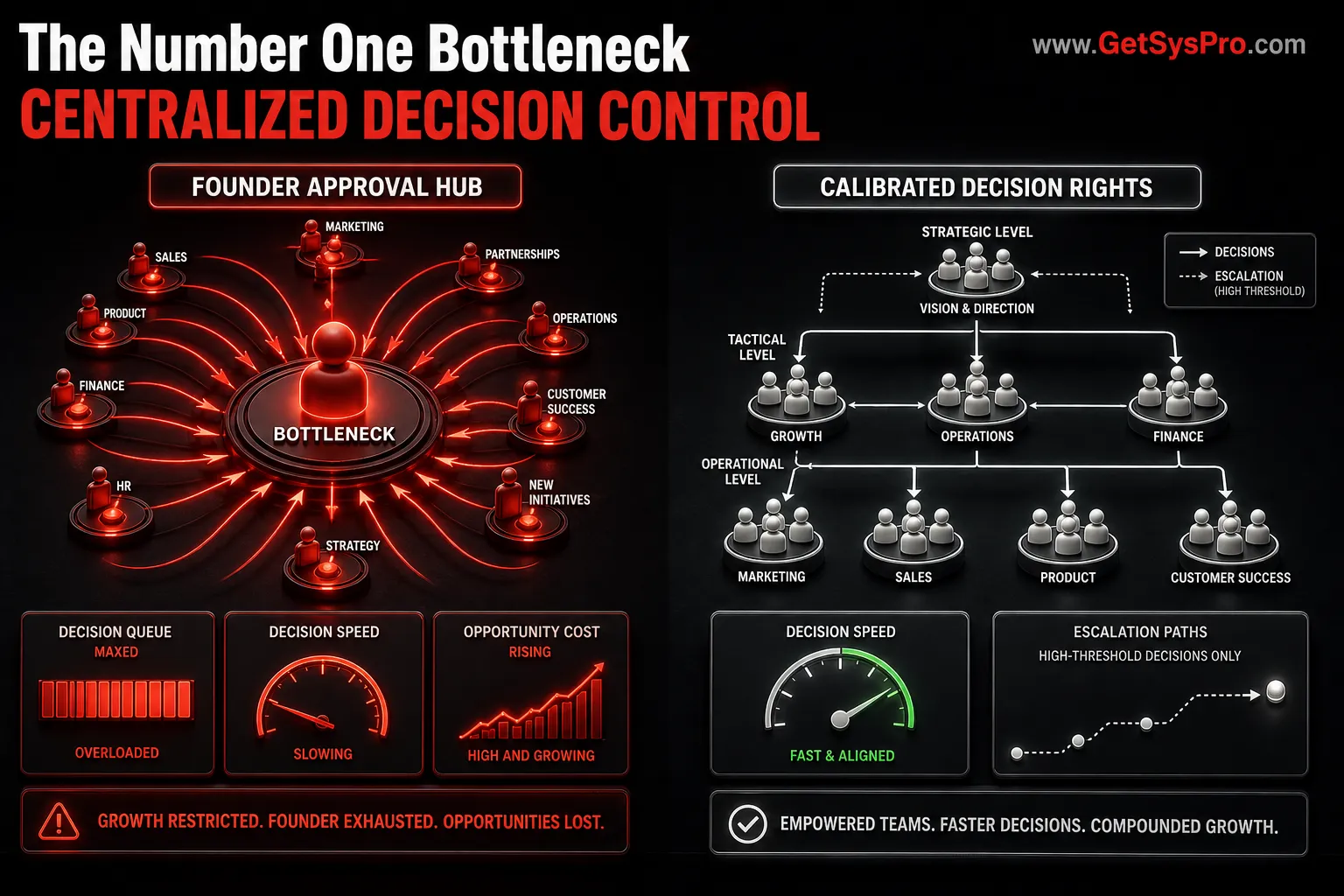
The most common constraint at the $5 million ceiling is that founders remain the approval hub for decisions managers should own. Calibrated decision rights restore the decision speed that centralized control has consumed. www.GetSysPro.com
Article Summary
The $5 million ceiling is an operating model ceiling that appears between $3M and $7M in revenue when the responsiveness model that produced early growth becomes a structural constraint. It shows up as heaviness rather than collapse. Leaders feel busier but less strategic. Meetings multiply without proportional outcomes. Hiring increases while productivity per employee declines. Scale multiplies the cost of ambiguity. Centralized decisions create bottlenecks. Informal approvals create inconsistency. Tribal knowledge creates repeat mistakes. The primary bottleneck is the founder approval hub. The hidden leak is undocumented workflow. Financial drift compounds in the background. Breaking through requires architectural redesign: calibrated decision rights, documented workflows, disciplined financial cadence, and clear reporting structures. Ceilings are rarely external. They are architectural.
Ceilings Are Rarely External. They Are Architectural.
GetSysPro identifies the structural constraints at the $5 million ceiling and builds the architectural redesign that restores organizational leverage.
Frequently Asked Questions
What is the $5 million ceiling and why does it appear at that revenue level?
The $5 million ceiling is an operating model constraint that typically appears between $3M and $7M in revenue. At that scale, the responsiveness model that produced early growth: centralized decisions, informal approvals, tribal knowledge, and leader-dependent coordination, becomes a structural constraint. The volume of decisions, exceptions, and delivery events exceeds the capacity of the informal system to process them without accumulating overhead. Scale multiplies the cost of ambiguity. The business hits a ceiling not because the market has changed but because the operating model has not.
Why do more hires not solve the $5 million ceiling?
Each hire without a clearly defined role, documented decision authority, and workflow standards adds coordination overhead rather than structural capacity. The new hire operates within the same informal system as everyone else, which means they absorb the same ambiguity costs rather than eliminating them. Adding headcount to a structurally ambiguous system increases the number of people experiencing the ambiguity rather than reducing the ambiguity itself. The ceiling requires structural redesign, not additional staffing, to break.
What does calibrated decision rights mean in practice?
Calibrated decision rights means documenting who can decide what, within what dollar amount or risk threshold, and what conditions trigger escalation to the next level. In practice, each role has a documented authority profile. It specifies the decision categories they own, the spending limits within which they can act without escalation, and the conditions that require senior approval. When those boundaries exist in writing, managers act within their authority without requiring confirmation, and escalation volume decreases substantially.
How does undocumented workflow create margin leakage at $5M scale?
Every undocumented handoff that produces rework carries a direct cost. The labor time to redo the work plus the coordination overhead of identifying what went wrong. At early scale that cost is manageable because undocumented handoffs are infrequent. At $5M scale, the same undocumented handoff occurs dozens of times per week. Each instance carries the full cost. Rework becomes a normal operating condition rather than an exception. The cumulative cost of that normalized rework compounds into meaningful margin leakage that revenue growth obscures but does not eliminate.
Why does more marketing fail to break the $5 million ceiling?
More revenue applied to an operating system that cannot translate demand into repeatable delivery does not break the ceiling. It amplifies the operational drag already present. Each additional unit of revenue runs through the same undocumented workflows, informal approval processes, and fragmented reporting that is already generating friction on current revenue. The drag compounds with volume rather than diminishing. Breaking the ceiling requires fixing the operating system that processes revenue, not increasing the volume of revenue the broken system must process.