 04/09/2024
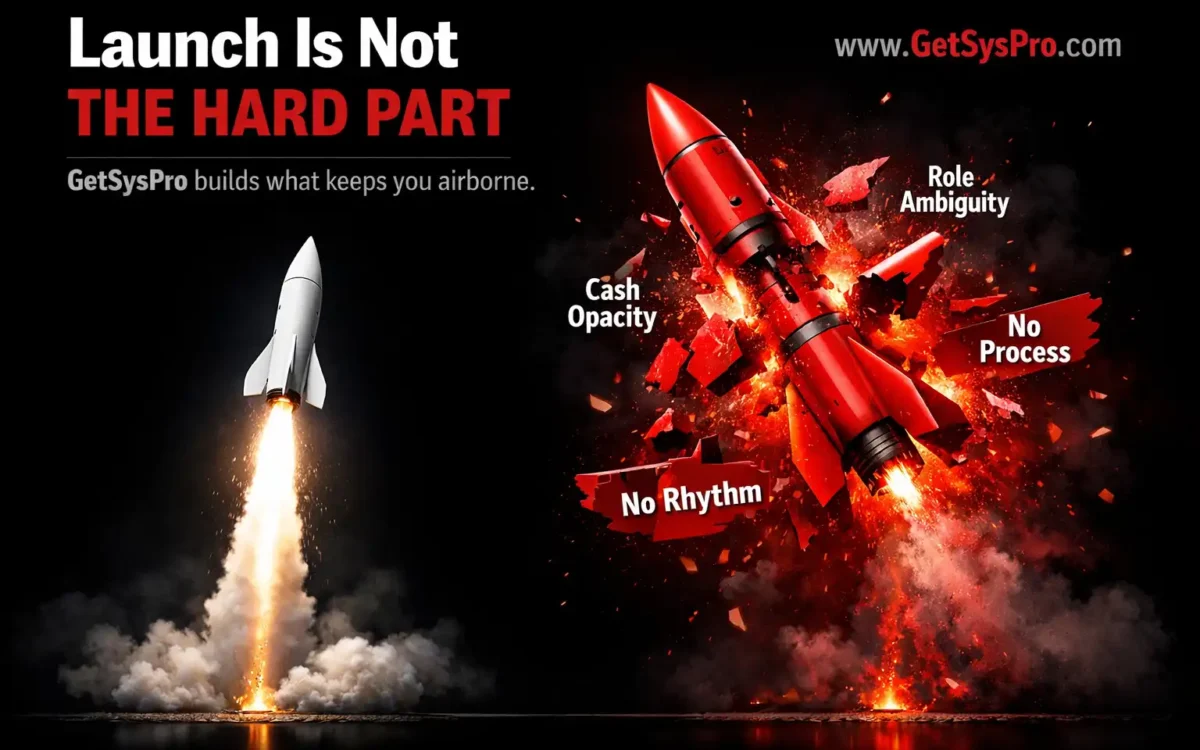
Why startups collapse after launch has less to do with the idea and more to do with the operating model that follows early momentum. Launch is not the hard part. Survival after launch is.
Why startups collapse after launch is one of the most studied questions in business, and the answer consistently points away from bad ideas and toward bad operating architecture. Early traction masks the problem. Revenue comes in. Clients sign. The team stays busy. Then somewhere between month twelve and month eighteen, the cracks appear. Deadlines start slipping. Quality turns inconsistent. Cash planning goes reactive. The founder becomes the bottleneck because the company runs on informal habits rather than defined systems. The idea was never the issue. The operating model was.
This article examines the specific structural failures that cause startups to collapse after launch, what those patterns look like in practice, and what founders can build early to prevent the execution strain that kills promising companies well before they reach scale.
In This Article
- When Systems Never Replace Heroics
- Role Ambiguity Is Where Post-Launch Failure Begins
- Financial Discipline Must Come Before Growth
- Documentation Protects Momentum as the Team Expands
- Operational Rhythm Prevents Drift Before It Becomes Damage
- Build Architecture Before Acceleration
- Frequently Asked Questions
Key Takeaways
- Why startups collapse after launch traces back to operating architecture that was never built. Early traction hides the gap until execution strain surfaces between month twelve and eighteen.
- Energy and heroics compensate for missing systems in the early stage. As volume increases, founder capacity becomes the limiting factor and the reactive model destabilizes.
- Role ambiguity that feels efficient at launch becomes accountability diffusion as the team grows. Critical work falls between functions when ownership is implied rather than defined.
- Financial visibility, documented workflows, and operational review cadences are not administrative overhead. They are the structural foundation that separates startups that survive from those that stall.
- GetSysPro builds the operational architecture that lets startups move from launch momentum to predictable, scalable execution before structural debt forces a more expensive correction.
When Systems Never Replace Heroics
In the early stage, energy compensates for missing systems. Founders fill gaps manually. They solve problems in real time, manage cash intuitively, and negotiate agreements informally. The team moves fast because everyone does whatever is needed. That responsiveness is a genuine competitive advantage at small scale. It is also a structural liability the moment volume increases.
The pattern appears consistently across startups that collapse after launch. The founding team executes brilliantly through the first wave of customers. Then a second wave arrives, and the same informal mechanisms that handled the first wave break under the load of the second. Founders who expected their systems to scale discover they never built systems. They built habits, and habits do not scale.
What Startup Heroics Actually Cost at Scale
Every problem solved through individual heroics rather than documented process represents a cost that compounds. The founder who personally resolves a vendor dispute is not building the vendor management process that prevents the next dispute. The team member who manually tracks cash in a spreadsheet is not building the financial reporting structure that supports growth decisions. The time spent firefighting is time not spent building the architecture that would make firefighting unnecessary. Startups that never replace heroics with operating standards become dependent on constant founder involvement, and that dependency is structurally fragile. One founder out sick, one unexpected demand spike, or one team departure can reveal how hollow the operating model actually is.
“Why startups collapse after launch is rarely about the market or the idea. It is almost always about the gap between early momentum and operational structure. The companies that survive are the ones that build the architecture before they need it, not after they feel the absence of it.”
Editorial, GetSysPro Team
Role Ambiguity Is Where Post-Launch Failure Begins
Fluid roles feel efficient at launch. Everyone helps everywhere. The team covers gaps without being asked. That flexibility creates genuine speed in the early stage, and founders often try to preserve it because it feels like culture. What they are actually preserving is structural ambiguity, and ambiguity becomes more expensive with every person added to the team.
As headcount grows, the overlap that felt like teamwork becomes accountability diffusion. Tasks get duplicated because two people assumed the other owned them. Critical work falls between functions because ownership was implied rather than assigned. Decisions stall because nobody is certain who has the authority to make them. Each failure mode traces back to the same root: roles were never defined, so accountability was never real.
What Role Clarity Actually Produces in Practice
Role clarity is not corporate overhead. It is execution speed. A defined owner for each measurable outcome is the difference between progress and constant partial completion. Startups that define roles explicitly before headcount expands discover that onboarding accelerates, handoffs improve, and the coordination overhead that consumed founder bandwidth at four people does not compound at ten. The investment in role definition is front-loaded and the return compounds continuously. The cost of skipping it also compounds, just in the opposite direction.
Financial Discipline Must Come Before Growth
Capital constraints get blamed when startups collapse after launch, but operational fragility often creates the cash stress rather than the other way around. Burn rate becomes unclear when approvals are informal and expenses accumulate without structured oversight. Forecasting becomes unreliable when billing is inconsistent and collections lack a defined process. Revenue tracking disconnects from delivery milestones when financial reporting is not integrated into the operating model.
The result is a startup that reaches growth inflection points without the financial visibility to navigate them confidently. Founders make capital allocation decisions based on bank balance rather than forward-looking forecasts. Hiring decisions happen without clear unit economics. Vendor commitments accumulate without tracked exposure. Each decision seems reasonable at the moment it is made. Collectively, they produce the cash stress that gets attributed to the market rather than to the operating model that created it.
Financial Visibility as Operating Infrastructure, Not Accounting
Startups that survive treat financial visibility as part of the operating model from the beginning. That means clear reporting cycles that produce consistent financial pictures rather than ad hoc balance checks. It means defined approval thresholds so spending decisions follow a documented process rather than informal judgment. A forecasting discipline that extends ninety days forward rather than backward gives leadership the visibility to make deliberate decisions rather than reactive ones. Building that infrastructure early costs a fraction of rebuilding it under growth pressure after the absence of it has already created the cash constraints it was designed to prevent.
Documentation Protects Momentum as the Team Expands
Documentation carries a bureaucratic reputation that it does not deserve in a startup context. Founders who resist documentation in the name of speed are protecting agility in the short term at the cost of continuity in the medium term. Every undocumented process is knowledge that lives in one person’s head. When that person leaves, gets sick, or simply gets pulled in a different direction, the knowledge leaves with them and the process breaks.
Informal agreements create legal and operational exposure that compounds as transaction volume increases. Verbal commitments that feel efficient at two clients become unenforceable disputes at twenty. Inconsistent contracts that nobody notices at early stage become a compliance liability at growth stage. Undocumented workflows that the founding team executes from memory cannot transfer to new hires without a breakdown period that consumes training time the business does not have.
Documentation as Continuity Infrastructure
Standardized contracts, internal governance documents, and documented workflows reduce ambiguity, accelerate onboarding, and keep execution consistent as the team expands. The startup that documents its processes early builds a compounding asset. Every new hire reaches productivity faster because the knowledge is written down. Each client interaction follows a consistent standard because the process exists independently of who executes it. Each vendor relationship carries enforceable terms because the agreement was documented rather than assumed. Documentation is not the enemy of startup speed. It is the mechanism that makes startup speed sustainable beyond the founding team.
Is your startup running on systems or on heroics?
GetSysPro builds the operational architecture that moves growing businesses from launch momentum to predictable, scalable execution.
Operational Rhythm Prevents Drift Before It Becomes Damage
Startups collapse gradually, not suddenly. Problems build over months because no cadence surfaces them early. A billing inconsistency that goes unnoticed for two months becomes a cash flow gap. A process breakdown that nobody flags for six weeks becomes a client relationship problem. A team misalignment that never surfaces in a structured review becomes a retention issue. The pattern is consistent: absence of rhythm allows drift, and drift compounds until it becomes a crisis that consumes far more resources to resolve than a timely review would have required.
Weekly review cycles create visibility into execution before problems escalate. Monthly financial reconciliation catches margin drift and billing gaps before they produce cash stress. Quarterly alignment ensures priorities stay coordinated across functions rather than diverging as each team optimizes independently. These cadences do not slow a startup down. They create the predictability that makes growth sustainable rather than chaotic.
Rhythm as the Mechanism That Converts Activity Into Progress
Startups without operational rhythm confuse activity with progress. Teams work hard and stay busy but directional alignment degrades over time without structured review. The founder who attends every meeting to maintain alignment is the founder who becomes the bottleneck described in the previous section. Operational rhythm replaces constant founder involvement with a structured cadence that surfaces problems, confirms priorities, and maintains alignment without requiring the founder to be present in every room at every moment. Rhythm is the mechanism that allows the organization to grow without the founder growing proportionally more overwhelmed.
Build Architecture Before Acceleration
The most expensive version of operational architecture is the one built reactively, under growth pressure, after the absence of it has already produced visible execution failures. Financial reporting structured after the cash crisis is more disruptive than financial reporting structured before growth begins. Decision rights defined after escalation has already made the founder the bottleneck require a behavioral change as well as a structural one. Documentation built after a key employee departure captures imperfect reconstructions of processes that would have been clean if documented at origin.
Building architecture before acceleration means investing in structure at the moment it feels premature rather than waiting until it feels urgent. That timing is uncomfortable because the startup still feels agile and unconstrained. It is also the timing that produces the most leverage because structural investment at early stage compounds across every subsequent growth phase rather than simply catching up to the damage already done.
How GetSysPro Supports Startup Architecture From Launch
For real estate focused ventures building the operational foundation before portfolio growth begins, GetSysPro Complete REI Startup Coaching structures the operating model from the foundation up rather than retrofitting structure onto an organization already under growth strain.
For startups already operating and sensing the friction that structural gaps create, GetSysPro Business Operational Systems Audit provides the diagnostic clarity that identifies where workflow integrity, reporting accuracy, role clarity, and financial oversight need structural investment before those gaps compound further.
Launch is momentum. Structure is sustainability. The question is not whether your startup can launch. It is whether it can operate predictably once it does, and whether the operating model was built to support the growth the launch momentum created.
Related GetSysPro Services
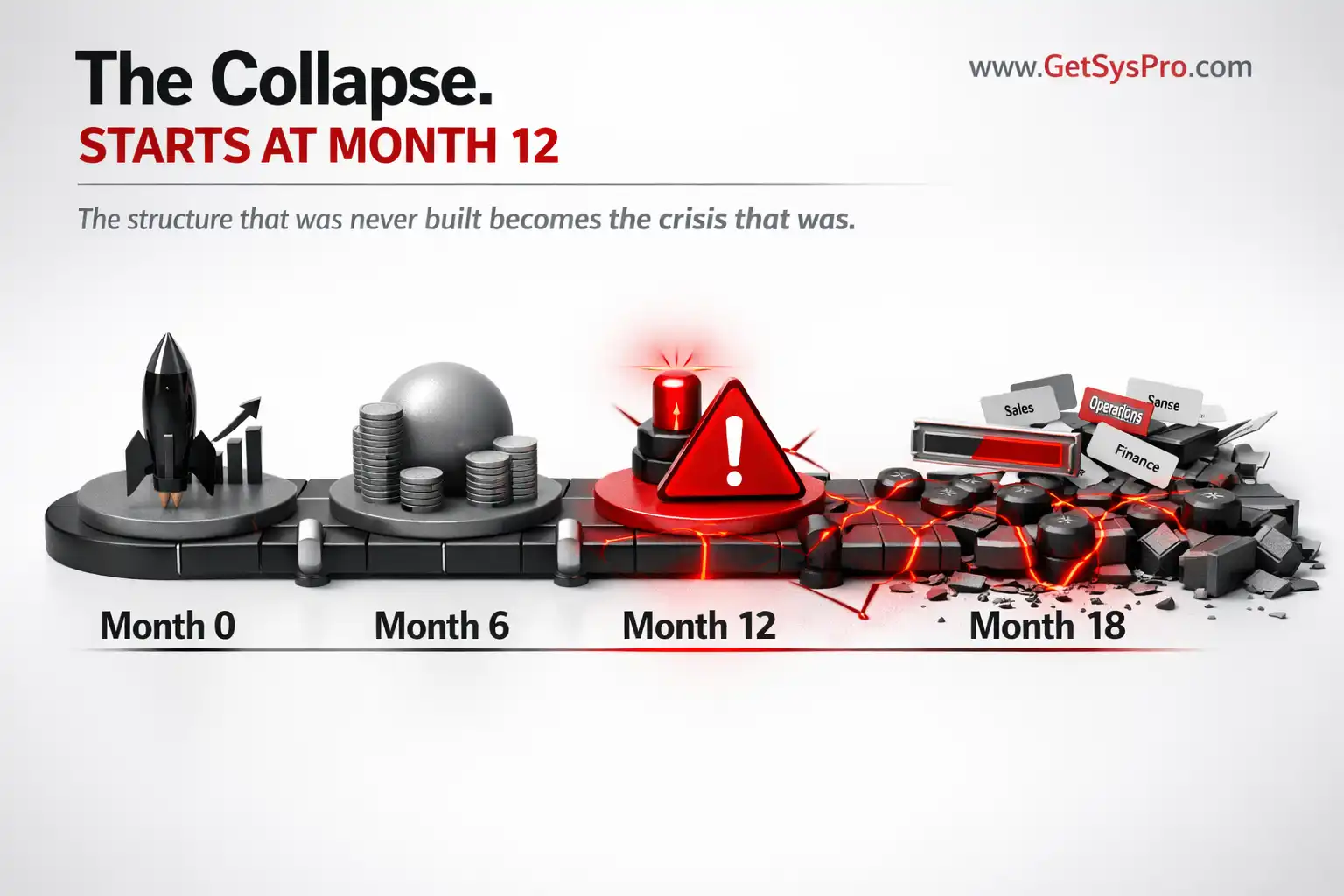
Early traction hides the structural gaps. By month twelve they start showing. GetSysPro builds the architecture before the timeline reaches that point. www.GetSysPro.com
Article Summary
Why startups collapse after launch traces back to operating architecture that was never built. Energy and heroics compensate for missing systems in the early stage, but as volume increases, founder capacity becomes the limiting factor and the reactive model breaks. Role ambiguity, financial opacity, undocumented processes, and absent operational rhythm each contribute to the execution strain that surfaces between month twelve and eighteen. Startups that survive build architecture before acceleration. GetSysPro builds that operational foundation before structural debt forces a more expensive and more disruptive correction.
Launch Is Momentum. Structure Is What Sustains It.
GetSysPro builds the operating architecture that moves startups from early momentum to predictable, scalable execution.
Frequently Asked Questions
What specifically causes startups to collapse after launch rather than before it?
Post-launch collapse almost always traces back to operating architecture that was never built during the launch phase. Early momentum masks the gap. Revenue arrives, clients sign, and execution appears functional because founder energy compensates for missing systems. Between month twelve and eighteen, volume increases beyond what informal habits can absorb. Execution strain surfaces across multiple areas simultaneously: role ambiguity, financial opacity, inconsistent delivery, and escalating founder involvement. The idea was sound. The operating model was not built to support what the idea created.
At what point should a startup stop prioritizing speed and start building structure?
Structure and speed are not opposites in a startup context. The correct framing is: build structure at the moment it feels premature rather than waiting until it feels urgent. That timing produces the most leverage because structural investment at early stage compounds across every subsequent growth phase. Waiting until structure feels necessary means waiting until the absence of it has already produced visible execution failures, and building under that pressure is more disruptive and more expensive than building proactively.
Fluid roles and informal communication worked during launch. Why do they stop working after it?
Fluid roles work at launch because the team is small enough that informal coordination fills the gaps. Every gap can be covered by whoever is available because the volume of gaps is manageable. As headcount grows, the same informality produces accountability diffusion rather than flexibility. Two people assume the other owns the same task. Critical work falls between functions. Decisions stall without a clear owner. Each failure traces back to ownership that was implied rather than defined. The informality that created speed at four people creates friction at twelve.
Is poor capital management the real reason most startups fail, or is it something else?
Capital constraints are frequently the visible cause but rarely the root cause. Operational fragility creates the cash stress in most cases. Informal approvals allow spending to accumulate without structured oversight. Inconsistent billing delays revenue without reducing expenses. Missing financial visibility prevents founders from making deliberate capital decisions and forces reactive responses to situations that better reporting would have surfaced weeks earlier. Addressing the operating model typically resolves the cash stress without requiring additional capital.
How does GetSysPro help a startup build operational architecture before it becomes a crisis?
GetSysPro approaches startup architecture through two primary entry points depending on stage. Startups in the launch or early growth phase benefit from Complete REI Startup Coaching, which structures the operating model from the foundation including financial reporting, decision rights, vendor agreements, and workflow documentation before portfolio or client volume creates growth pressure. Startups already experiencing execution friction benefit from a Business Operational Systems Audit, which identifies the specific structural gaps generating the most friction and sequences improvements by impact priority so the highest-leverage fixes happen first.