 02/13/2024
Real estate investors fail operationally because acquisition skill does not translate into execution discipline. Deals create opportunity. Operations determine whether you keep it.
Real estate investors fail operationally more often than they fail on deal sourcing, and the gap between the two is wider than most investors want to acknowledge. The underwriting model is solid. The financing strategy is sound. The acquisition closes. Then the operational reality sets in, and the returns start compressing in ways the spreadsheet never predicted. Vendor coordination becomes chaotic. Renovation oversight loses structure. Reporting turns inconsistent. Capital planning stays informal. What looked like a profitable position on paper becomes an administratively unstable operation that grinds away at margin with every passing month.
This article defines where operational failure actually occurs in real estate portfolios, why it compounds as volume grows, and what structural discipline looks like for investors who intend to scale rather than survive.
In This Article
- Where Real Estate Investors Fail Operationally
- Underwriting Sets the Target. Operations Determine the Outcome.
- Portfolio Growth Creates Decision Bottlenecks
- Process Clarity Stops Renovation and Maintenance Drift
- Oversight Must Scale With the Asset Base
- Build Structure Before You Add Volume
- Execution Rhythm Protects Investor Bandwidth
- Documentation Reduces Risk and Prevents Disputes
- Frequently Asked Questions
Key Takeaways
- Real estate investors fail operationally because execution after closing is reactive rather than structured, and reactive execution compounds in cost as portfolio volume increases.
- Operational failure does not appear on the acquisition spreadsheet. It surfaces through delays, rework, inconsistent communication, and preventable disputes that compress returns over time.
- Portfolio growth without operational structure creates decision bottlenecks where every vendor dispute, renovation change, and tenant exception escalates to the investor.
- Documented workflows, defined oversight cadences, and clear decision thresholds are the structural foundations that separate investors who scale from investors who stall.
- GetSysPro builds operational systems for real estate investors across every stage: startup, growth, and optimization of existing portfolios.
Where Real Estate Investors Fail Operationally
Real estate has never been more competitive at the acquisition stage. Access to underwriting models, financing strategies, and market analytics is widespread. Serious investors all have access to fundamentally similar tools. The differentiation that determines long-term performance is not analytical. It is operational. The investors who build durable, scalable portfolios are the ones who treat execution after closing with the same rigor they apply to deal underwriting before it.
Operational mismanagement does not announce itself during due diligence. The strain begins after closing, when complexity compounds across properties, vendors, and tenants simultaneously. A single property with informal processes is manageable. Five properties with informal processes is a coordination problem. Twenty properties with informal processes is a business that is actively consuming the returns it was designed to generate.
Why Operational Failure Is Invisible Until It Is Expensive
The insidious quality of operational failure in real estate is how long it can remain invisible. Delays add to carrying costs without appearing as line items in the original budget. Rework from poor vendor coordination consumes labor hours that never get captured in reporting. Communication inconsistencies generate disputes that settle for less than the original position but drain management time disproportionate to the dollar amount. By the time operational failure is clearly visible in the numbers, months of margin compression have already occurred.
“Real estate investors fail operationally because they treat operations as an afterthought to acquisitions. Structure does not slow the portfolio down. Lack of structure does.”
Editorial, GetSysPro Team
Underwriting Sets the Target. Operations Determine the Outcome.
Underwriting is a model. Operations are reality. The projected return assumes lease administration runs on time, maintenance coordination is efficient, compliance oversight is consistent, vendor relationships are managed, and financial tracking is accurate. When any one of those functions is informal, the model diverges from reality and the divergence compounds with time.
Performance-driven portfolios run on operational discipline across every function: lease administration, maintenance coordination, compliance oversight, vendor management, and financial reporting. When those functions are informal, performance becomes personality-driven. Results depend on which property manager happened to be assigned, which vendor had availability, and whether the investor personally intervened at the right moment. That model cannot scale because it depends on circumstances rather than systems.
The Real Cost of Informal Operational Functions
Informal operations have a direct cost that most investors underestimate because it accumulates incrementally rather than appearing as a single line item. Extended holding costs from delayed renovations add carrying expense every month. Lease-up timelines that slip due to vendor coordination failures delay revenue without reducing expenses. Vendor disputes that lack documented standards take longer to resolve and often settle unfavorably. Collectively, these costs can compress actual returns significantly below projected ones on deals that were underwritten conservatively. The acquisition was not the problem. The operation was.
Portfolio Growth Creates Decision Bottlenecks
A single-property investor can operate informally because the decision volume is manageable. At five properties, the operational complexity is still containable with strong personal involvement. At ten, fifteen, or twenty properties, the volume of operational decisions rises faster than any individual investor can absorb without structural support. Change orders require approval. Vendor disputes require resolution. Tenant exceptions require policy responses. Capital allocation decisions require timely review.
When decision rights are unclear, everything escalates to the investor. That is the decision bottleneck pattern: the portfolio grows in asset count while the investor becomes increasingly consumed by operational coordination rather than strategic growth. The portfolio feels busy. Control feels absent. Returns become harder to predict because execution depends on the investor’s personal bandwidth rather than on a repeatable system.
Breaking the Escalation Cycle With Defined Decision Rights
Distributed decision authority is the structural solution to escalation bottlenecks. That requires explicitly defining which decisions belong at which level of the operation, what information is required to make each class of decision without escalation, and what the threshold is for routing a decision upward. When those parameters are clear and documented, property managers and operational staff act with confidence within their authority. The investor recovers bandwidth for acquisition, capital allocation, and strategic direction instead of spending it on operational coordination that the system should handle independently.
Process Clarity Stops Renovation and Maintenance Drift
Renovation and maintenance are where operational failure in real estate is most expensive and most visible. Projects run over budget not because cost estimates were wrong but because change order management was informal. Timelines slip not because contractors underperformed but because approval workflows were undefined, creating delays at every decision point. Maintenance quality varies across properties not because vendors differ but because intake, triage, and communication standards were never documented.
Sustainable portfolios run on documented workflows, not verbal habits. Maintenance intake needs a consistent process for receiving, categorizing, and prioritizing requests across every property in the portfolio. Capital expenditure approvals should follow defined thresholds so routine maintenance does not require investor review while significant expenditures receive appropriate scrutiny. Vendor onboarding and performance standards need documentation so the quality bar is explicit rather than assumed.
What Documented Renovation Workflows Actually Prevent
Documented renovation workflows prevent the most common and costly sources of schedule and budget overrun: undefined scope, informal change order approval, and fragmented communication between investors, contractors, and property managers. When the workflow is defined, every party knows what information is required before work begins, what the approval process looks like for scope changes, and what the communication standard is for progress reporting. That clarity does not add bureaucracy. It removes the ambiguity that generates the back-and-forth that extends project timelines and increases carrying costs.
Is your portfolio running on systems or on your personal bandwidth?
GetSysPro builds the operational infrastructure that separates investors who scale from investors who stall.
Oversight Must Scale With the Asset Base
Oversight is not micromanagement. Conflating the two is one of the most common mistakes investors make as portfolios grow. Micromanagement means involvement in every operational decision regardless of significance. Oversight means defined review cycles, clear performance standards, and reporting infrastructure that surfaces problems before they escalate into expensive corrections.
At two or three properties, oversight through personal observation is feasible. At ten or fifteen, personal observation becomes selectively blind. The investor sees the properties they visit and receives the reports they remember to request. Problems at properties not recently visited accumulate until they become unavoidable. Oversight that does not scale with the asset base creates asymmetric visibility: some properties are well-managed because they receive attention, while others drift operationally because they do not.
Structured Review Cycles as Oversight Infrastructure
Systematic oversight requires defined review cycles with consistent reporting formats, measurable performance standards against which each property and each vendor is evaluated, and escalation criteria that route problems to attention before they compound. Building that structure is a one-time investment that pays back continuously as portfolio size increases. The alternative, personal intervention at each property as problems become visible, becomes increasingly expensive and increasingly incomplete as the portfolio grows beyond what personal attention can cover.
Build Structure Before You Add Volume
The cheapest time to build operational structure is before the portfolio grows past the point where informal management breaks down. Early discipline around entity setup, reporting cadence, capital tracking, and role definition prevents the expensive remediation that reactive investors pay for later. Rebuilding operational infrastructure on a portfolio already under growth pressure is significantly more disruptive and costly than installing it before growth begins.
Investors launching a new venture have an opportunity to design the operating foundation before portfolio growth creates the pressure that makes structural work difficult. Defining reporting standards, vendor management protocols, and decision rights frameworks before the first acquisition is the discipline that separates operators from accidental landlords.
What a Structural Audit Reveals in Existing Portfolios
For investors already operating and feeling the friction of informal systems, a structured operational audit identifies the specific bottlenecks limiting performance: inconsistency in reporting, gaps in approval chains, workflow breakdowns in maintenance coordination, and financial oversight that lacks the rigor required for confident capital allocation decisions. The audit does not rebuild the portfolio from scratch. It identifies the highest-leverage structural improvements and sequences them in order of impact so the remediation is targeted rather than comprehensive.
Execution Rhythm Protects Investor Bandwidth
As portfolios grow, investors consistently become the operational bottleneck without intending to. Every vendor decision, renovation change order, and tenant exception routes upward because the system has no defined mechanism for handling it at a lower level. The investor who intended to be a strategic capital allocator ends up spending the majority of their time on operational coordination that a well-structured system could handle without their involvement.
Execution rhythm is the operational discipline that prevents that pattern. Defined decision thresholds establish which decisions require investor approval and which can be resolved at the property management level. Clear ownership assigns accountability for each operational function so questions have a first point of resolution that is not the investor. Regular review cadences replace ad hoc communication with structured reporting that provides visibility without consuming bandwidth.
Fractional Executive Support as a Structural Option
Investors who need executive-level operational discipline without the overhead of a full-time operations hire have access to a structural option that is increasingly common in sophisticated real estate operations. Fractional COO engagement provides the operational architecture, oversight infrastructure, and execution rhythm that stabilizes portfolio management at a cost structure appropriate for portfolios that cannot yet justify full-time executive operational support. The result is the strategic clarity and bandwidth protection of professional operational leadership applied to the specific structural needs of the portfolio.
Documentation Reduces Risk and Prevents Disputes
Real estate carries legal and operational exposure at every level of the portfolio. Lease ambiguity generates tenant disputes that are expensive to resolve and difficult to enforce. Operating agreement gaps create partnership conflicts that damage relationships and portfolios simultaneously. Vendor contracts without defined scope and performance standards produce disputes that take time and money to settle regardless of outcome. Ambiguity in real estate documentation is not a technical oversight. It is a financial liability that sits in the portfolio until something triggers it.
Consistent, clear documentation across leases, operating agreements, vendor contracts, and partnership documents is not legal overhead. It is operational infrastructure that makes the portfolio enforceable. Standards that exist only in verbal agreements or informal understandings are standards that disappear when tested.
Documentation Standards Across a Scaling Portfolio
As the portfolio scales, documentation inconsistency compounds. Leases with different terms across properties create management complexity and unequal enforcement exposure. Vendor contracts without standard performance clauses produce inconsistent quality and difficult remediation. Partnership documents that lack clear distribution, decision, and exit provisions generate conflicts that become disproportionately expensive as asset values increase. Standardizing documentation across the portfolio is a structural investment that reduces legal and operational exposure at every stage of growth.
Related GetSysPro Services
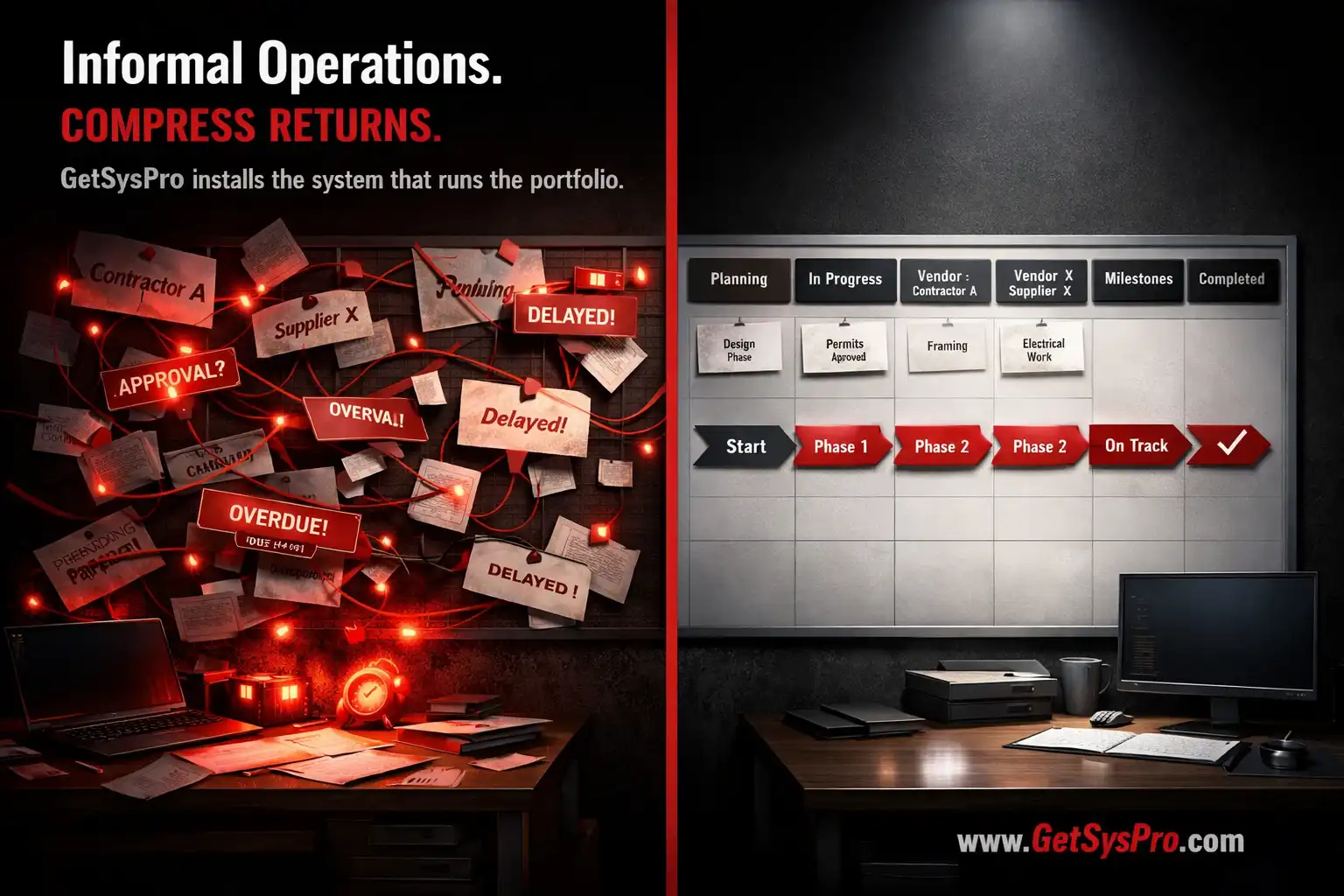
Informal operations compress returns. Structured operations protect them. GetSysPro installs the system that runs the portfolio. www.GetSysPro.com
Article Summary
Real estate investors fail operationally because execution after closing is reactive rather than structured, and reactive execution compounds in cost as portfolio volume grows. Operational failure is invisible during due diligence and surfaces through delays, rework, inconsistent communication, and preventable disputes that compress returns. Documented workflows, defined oversight cadences, clear decision thresholds, and standardized documentation are the structural foundations that separate investors who scale sustainably from those who stall. GetSysPro builds that operational infrastructure across every stage of portfolio development.
Stop Running Your Portfolio on Personal Bandwidth. Build the System.
GetSysPro builds operational infrastructure for real estate investors at every stage of portfolio growth.
Frequently Asked Questions
In what specific ways do real estate investors fail operationally after a successful acquisition?
Operational failure after closing typically appears across four areas: renovation and maintenance management without documented workflows, financial reporting that is too informal to support confident capital decisions, vendor and contractor coordination without defined performance standards, and portfolio oversight that relies on personal observation rather than systematic review cycles. Each failure mode is individually manageable at low portfolio volume. At scale, all four compound simultaneously and erode returns in ways that the original underwriting model never captured.
At what portfolio size does informal management become genuinely risky?
Informal management creates real risk earlier than most investors expect. At five properties, coordination complexity is already exceeding what verbal habits can handle reliably. By ten properties, informal management actively degrades returns through accumulated delays, inconsistent vendor performance, and escalation bottlenecks that consume investor bandwidth. The threshold varies by asset type and complexity, but five to seven properties is generally where investors who have not invested in operational structure begin experiencing the symptoms that informal management generates at scale.
Oversight feels like micromanagement. How do structured review cycles actually differ?
Micromanagement means involvement in every operational decision regardless of whether the decision requires investor expertise. Structured oversight means defined review cycles, consistent reporting formats, and measurable performance standards that surface problems before they require emergency intervention. The distinction is in what triggers involvement. Micromanagement responds to everything. Structured oversight responds to exceptions identified by a system designed to catch them early. The result is more reliable performance visibility with significantly less bandwidth consumption.
Documentation sounds like legal overhead. Can it actually protect investment returns?
Documentation protects returns directly because ambiguity in real estate carries a financial cost. Lease clauses that are inconsistent across properties create unequal enforcement exposure. Vendor contracts without defined scope produce disputes that settle unfavorably. Operating agreement gaps generate partnership conflicts that damage relationships and assets simultaneously. The legal cost of ambiguity typically exceeds the operational cost of documentation by a significant margin. Standardizing documentation across the portfolio is a structural investment with a measurable return.
Our portfolio is already operating. Is it too late to build operational structure without disrupting performance?
Building structure on an existing portfolio is harder than building it before growth begins but far less costly than allowing informal systems to continue compressing returns. GetSysPro approaches existing portfolio remediation through a structured audit that identifies the highest-leverage gaps first and sequences improvements by impact priority. The goal is targeted structural improvement rather than comprehensive overhaul, so performance is protected throughout the process and investors see operational improvement without the disruption of a full rebuild.